Madrid · Self-guided audio walk

The Habsburg Heart: Madrid's Imperial Squares

Walk the tight weave of squares and passageways where an empire was ruled, and where madrileños still gather for chocolate, grapes, and gossip.

  • 6Stops
  • 1.1 kmDistance
  • 20+ minTime
The Habsburg Heart: Madrid's Imperial Squares

Photo by FEDERICO JORDÁ from MADRID, ESPAÑA on Wikimedia Commons

This walk traces the kernel of Habsburg Madrid, the tangle of streets and plazas that served as the imperial capital when Spain ruled half the world. You start at Puerta del Sol, kilometer zero of the nation's roads, where the clock tower counts down every New Year's Eve. From there you slip into the Pasadizo de San Ginés for chocolate con churros at a café that has barely changed since 1894. Plaza Mayor opens next, the 1619 arcaded rectangle where bullfights, autos-da-fé, and royal pageants played out under 237 balconies. A few steps away, the Mercado de San Miguel fills a 1916 iron-and-glass hall with oysters and jamón. Plaza de la Villa gathers the old city hall and noble houses around Madrid's oldest civic square, and the walk ends at the Iglesia de San Nicolás, whose 12th-century brick tower may have begun as a mosque minaret.

Hear it on the street

Get the turn-by-turn audio guide in the app. The narration plays itself as you reach each stop, hands-free and offline.

Stop by stop

The route

Interactive map of the route. The full stop list below works without it.

Puerta del SolMust see

Photo by Wilson Tovar on Unsplash

Puerta del Sol

0:00

The heart of Madrid, home to Kilometer Zero, the clock that rings in the Spanish New Year, and the Bear and the Strawberry Tree.

You are standing at kilometer zero, the navel of Spain. Every radial road in the country begins its count right here, where a small stone plaque sits on the pavement in front of the old post office. That building, the Real Casa de Correos, went up in 1768 to a design by the French architect Jaime Marquet. Its clock tower was added in 1866, and on New Year's Eve it is the clock every Spaniard watches.

At each stroke of midnight, you eat one grape. Twelve strokes, twelve grapes, and if you manage all twelve in time, luck for the year ahead. The tradition has been broadcast on national television since 1962. The square itself began as the eastern gate of the medieval city wall, the gate that faced the rising sun.

Little of that wall remains. What you see now is a broad, half-moon plaza where Calle Mayor, Calle del Arenal, and a half-dozen other streets collide. Behind you, near the metro entrance, is the bronze Bear and the Strawberry Tree, the symbol of Madrid. It is the city's default meeting point: people do not say "meet me at Sol." They say "meet me at the bear." Walk to the left side of the Casa de Correos and find Calle del Arenal.

A few doors down, on your right, a narrow passage called the Pasadizo de San Ginés cuts through the block. Duck into it.
≈5 min walk to the next stop
Chocolatería San GinésMust see

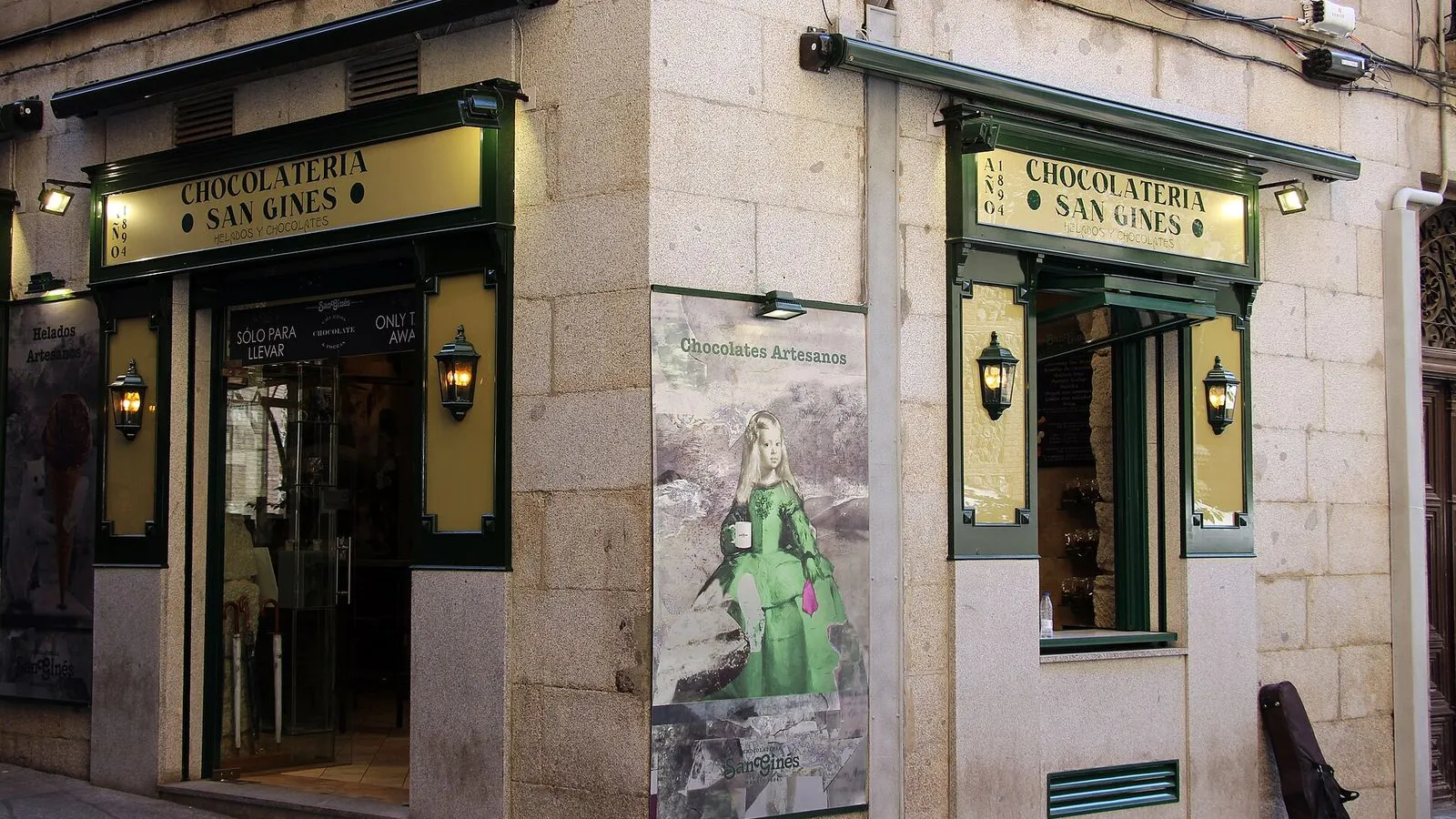
Photo by Fred Romero from Paris, France on Wikimedia Commons

Chocolatería San Ginés

0:00

Madrid's most famous chocolatería, pouring thick hot chocolate and frying churros in a hidden pasadizo since 1894.

You are inside a Madrid ritual that began in 1894. This space opened as an inn in 1890, but four years later it became a churrería, and it has been frying churros ever since. The green walls, the white marble tables, the low light: it looks much as it did when theatre crowds spilled in from the Eslava next door, or when Valle-Inclán wrote it into his play Luces de Bohemia as the "buñolería modernista." During the Second Republic, regulars called it La Escondida, the hidden one, because the passage outside is easy to miss. That seclusion is long gone.

The place now turns out around four thousand churros a day. But the chocolate is still made from the house recipe, thick and dark, served in a white cup. Dip, bite, repeat. The place never closes: 24 hours, 365 days a year.

The first chocolate of the new year is drunk here, just after the grapes.

≈2 min walk to the next stop
Plaza MayorMust see

Photo by KreatePix - Yuni Martin on Unsplash

Plaza Mayor

0:00

The great arcaded square of Habsburg Madrid, completed in 1619, where bullfights, markets, and royal pageants once filled the cobblestones.

This is the rectangle that held imperial Spain. Completed in 1619 under Philip III, the Plaza Mayor was designed by Juan Gómez de Mora as a uniform stage for the monarchy. Bullfights, canonisations, and autos-da-fé all happened on this pavement. The king and queen watched from the royal balcony of the Casa de la Panadería, the twin-towered building on the north side.

Its facade now carries frescoes painted by Carlos Franco in 1992, a modern layer on a building that began as the city bakery in 1590. The square has burned three times, most severely in 1790. Juan de Villanueva rebuilt it afterward, lowering the rooflines and closing the corners. The equestrian statue of Philip III in the centre was cast in Florence by Giambologna and finished by Pietro Tacca in 1616.

It stood at the Casa de Campo for more than two centuries before Queen Isabella II moved it here in 1848. Walk to the southwest corner and find the Arco de Cuchilleros. Its steep steps drop to the Calle de los Cuchilleros, the street of the knife-makers who once supplied the butchers of the plaza. The buildings here slope outward because they double as buttresses.

When you are ready, head through the arch on the west side that leads toward the Mercado de San Miguel.

≈2 min walk to the next stop
Free preview ends here · stops 4 to 6 continue in the app

Mercado de San Miguel

A 1916 cast-iron-and-glass market hall, now a gourmet tapas temple where the city eats standing up.

in app

Plaza de la Villa

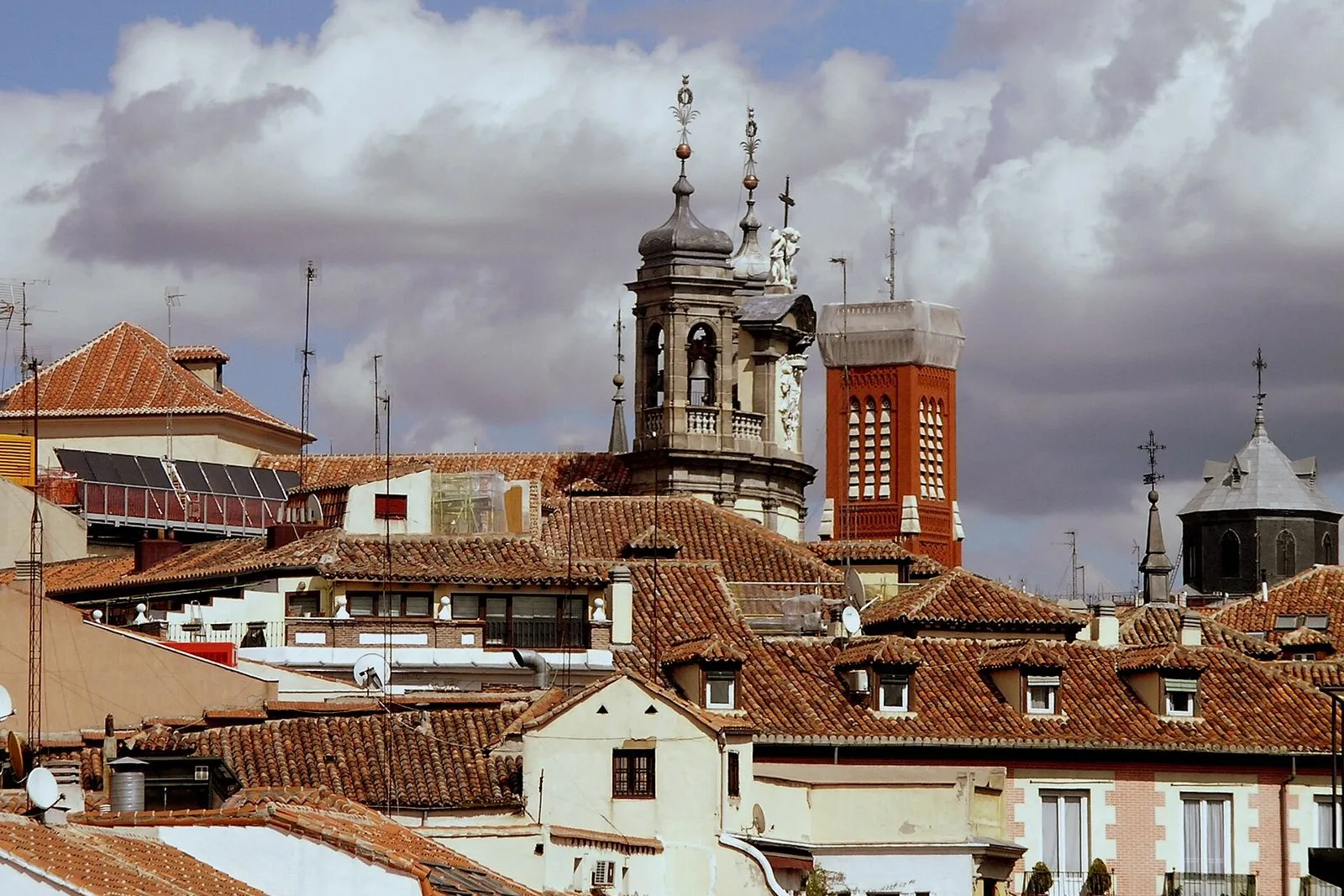
Madrid's oldest civic square, framed by the former city hall, a 16th-century palace, and a 15th-century tower that may have held a captive French king.

in app

Iglesia de San Nicolás de los Servitas

Madrid's oldest surviving church, with a 12th-century Mudejar brick tower that may have begun as a mosque minaret.

in app
Good to know

Before you go

How long does the Habsburg Heart walk take?

The full loop takes about two hours at a gentle pace without stops. With a chocolate con churros break at San Ginés, a browse through the Mercado de San Miguel, and time to photograph Plaza Mayor, plan on two and a half to three hours.

Is the Mercado de San Miguel worth it or is it just a tourist trap?

The Mercado de San Miguel is genuinely beautiful, a 1916 iron and glass hall, and the food quality is high. It is also expensive by Madrid standards and packed at peak times. Go for one or two things: an oyster and a glass of cava, a cone of croquetas. For a full meal at local prices, walk five minutes to the Mercado de la Cebada or the Mercado de Antón Martín instead.

Can I go inside the Iglesia de San Nicolás?

The church is open for Mass and occasionally for visits, but hours are irregular. The 12th century Mudejar brick tower, possibly a former mosque minaret, is visible from the street at all hours and is the real draw.

Provenance · last verified August 18, 2026

Built from the Wayside route itself: the stops, their order, and the walk between them.

Photo by FEDERICO JORDÁ from MADRID, ESPAÑA on Wikimedia Commons · CC BY 2.0

Photo by Wilson Tovar on Unsplash

Photo by Fred Romero from Paris, France on Wikimedia Commons · CC BY 2.0

Photo by KreatePix - Yuni Martin on Unsplash

Photo by Nicolas Vigier on Wikimedia Commons · CC0

Photo by Jose Luis Cernadas Iglesias from Coruña, España on Wikimedia Commons · CC BY 2.0

Photo by Tim Tregenza on Wikimedia Commons · CC BY-SA 3.0

Photo by Felipe Gabaldón on Wikimedia Commons · CC BY 2.0

Photo by Tinou Bao on Wikimedia Commons · CC BY 2.0

Photo by Jorge Láscar on Wikimedia Commons · CC BY-SA 2.0

Photo by Nicolas Vigier from Madrid, Spain on Wikimedia Commons · CC0

Coming soon

Wayside isn't in the app stores yet, but it's in the works. Check back soon.