One day in Madrid: a self-guided walking itinerary
Churros at dawn, a palace by noon, the Prado at golden hour, and tapas on the streets where Cervantes walked.
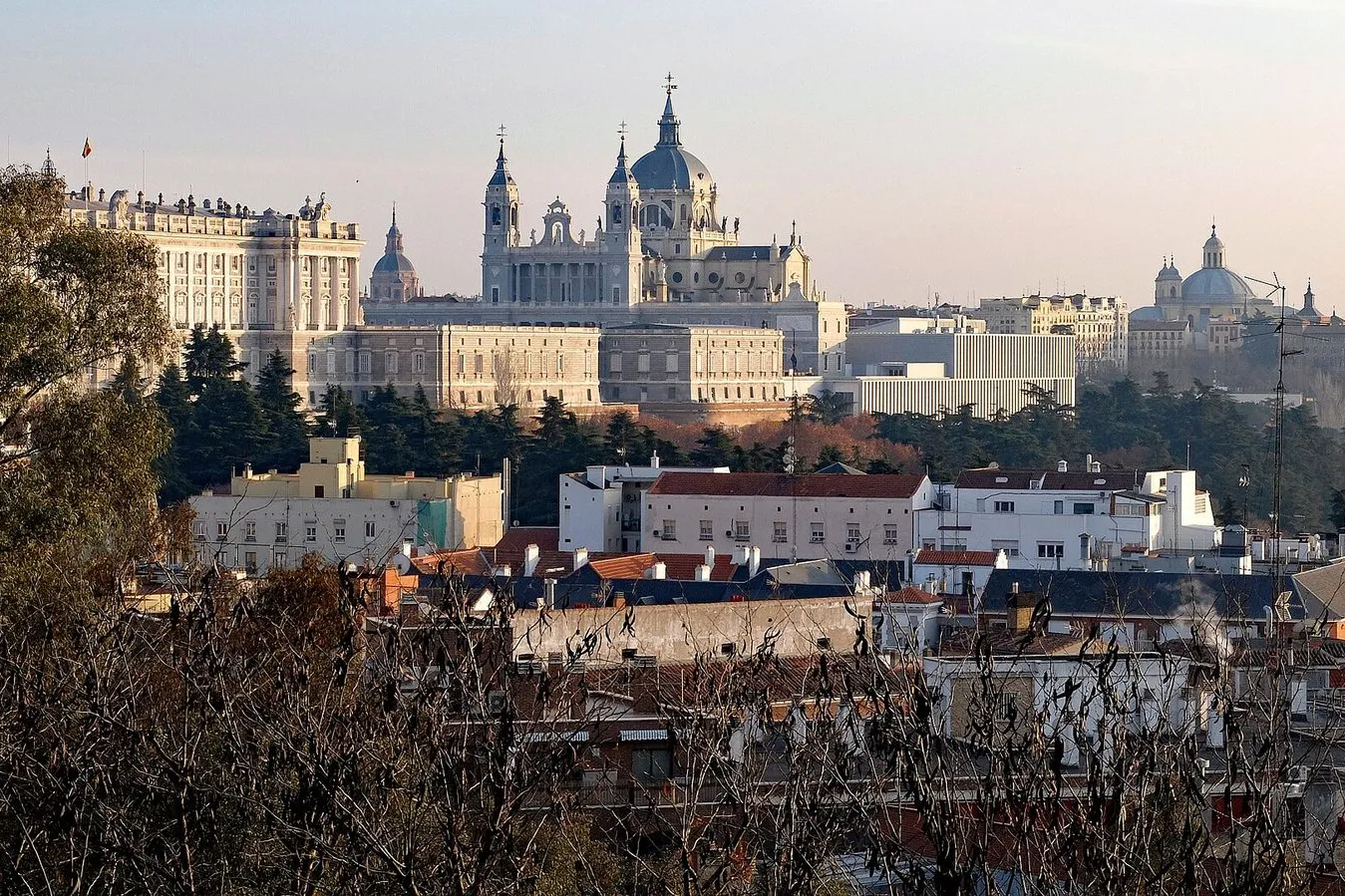
Photo by Unknown authorUnknown author on Wikimedia Commons
Interactive map of the route. The full stop list below works without it.
How do you spend one day in Madrid on foot?
This one day route walks Madrid the way the city itself unfolds: from the Habsburg tangle of squares where an empire was run, west to the largest palace in Western Europe, then east along the tree lined Paseo del Prado to the tropical garden inside Atocha station. You end the day in the Barrio de las Letras, on the streets where Cervantes, Lope de Vega, Quevedo and Góngora wrote, quarreled, and sometimes lived across the alley from each other. Every stop is reachable on foot, with a short metro hop in the middle if your feet need a rest. The timings steer you toward the palace when the morning light hits its white stone and toward the Prado when the free entry window opens.
- Morning9:00 to 12:00
Churros and the Imperial Squares
Start at Puerta del Sol while the square is still quiet. Stand on Kilometer Zero, the brass slab in the pavement from which every Spanish radial road is measured. Find the Bear and the Strawberry Tree statue on the eastern side; madrileños meet here for everything from first dates to championship celebrations. Then slip into the Pasadizo de San Ginés, a narrow alley just off Calle del Arenal, for chocolate con churros at a café that opened in 1894 and has barely changed the recipe since. From there, walk into Plaza Mayor through the Arco de Cuchilleros. The 1619 arcaded rectangle was built as a stage for royal pageants, bullfights, and autos da fé under 237 balconies. A few steps away, the Mercado de San Miguel fills a 1916 iron and glass hall with oysters, jamón, and vermouth. Grab a cone of croquetas and a caña of beer at the bar; this is your mid morning snack and your intro to how Madrid eats standing up.
- HoursChocolatería San Ginés has been pouring thick hot chocolate and frying churros in the same pasadizo since 1894. It opens at 9:00 and runs until late, but the morning crowd is thinner.SourceChocolatería San Ginés official site
- HoursMercado de San Miguel is open Sunday to Thursday from 10:00 to midnight, Friday and Saturday until 1:00 am. Mornings before noon are the calmest window.SourceMercado de San Miguel
EatChocolate con churros at Chocolatería San Ginés (Pasadizo de San Ginés, 5). A cup of thick hot chocolate and six churros costs about €4.50.
- Midday12:00 to 15:00
The Palace and the Egyptian Temple
Walk west from the Mercado de San Miguel, crossing Calle Mayor. The street opens onto Plaza de Oriente, a monumental square designed in 1844 with twenty limestone statues of Visigothic kings that were carved for the palace roof but proved too heavy to lift. The Royal Palace rises on your left: 3,418 rooms, the largest palace in Western Europe, built on the ashes of the old Alcázar that burned on Christmas Eve 1734. Buy a self guided entry ticket (€18) and walk the grand staircase, the throne room, and the royal armory. When you exit, the Almudena Cathedral faces you across the plaza, consecrated by Pope John Paul II in 1993 after more than a century of starts and stops. From the cathedral, walk uphill through the Sabatini Gardens and on to the Templo de Debod, a 2nd century BC Egyptian temple dismantled stone by stone and rebuilt above the Parque del Oeste. The reflecting pool at its feet catches the afternoon light.
- CostThe Royal Palace self guided visit costs €18 standard, €9 reduced (ages 5 to 16, over 65, students up to 25). Free for EU and Latin American citizens Monday to Thursday from 17:00 to 19:00 (16:00 to 18:00 in winter).SourcePatrimonio Nacional tickets
- HoursThe Royal Palace is open Monday to Saturday 10:00 to 19:00 (April to September) and 10:00 to 18:00 (October to March). Sundays and holidays 10:00 to 16:00. Closed January 1, January 6, May 1, December 25.SourcePatrimonio Nacional
- HoursThe Templo de Debod is free and open Tuesday to Sunday. Hours vary by season: winter 10:00 to 20:00, summer (June 15 to September 15) 10:00 to 19:00. Closed Mondays and major holidays.SourceTurismo Madrid
EatLunch at Casa Ciriaco (Calle Mayor, 84), a wood paneled tavern open since 1887. Their pepitoria de gallina (chicken in almond and saffron sauce) is the house classic. A menú del día runs about €16 to €20.
- Afternoon15:00 to 18:30
The Paseo del Prado and a Train Station Jungle
From Templo de Debod, take a short Metro ride (Plaza de España to Banco de España, Line 2) or a 20 minute walk east to Plaza de Cibeles. The goddess Cybele rides her lion chariot at the head of the Paseo del Prado, facing the white wedding cake façade of the Palacio de Cibeles. Walk south down the boulevard, past the fountains and the Thyssen museum on your right. At the roundabout with Neptune, trident raised in white marble, the Prado Museum stretches along your left. Juan de Villanueva designed this neoclassical temple for the natural sciences in 1785; it opened as the Royal Museum of Paintings in 1819. If the free entry window fits your timing (the last two hours before closing), step inside for Goya, Velázquez, and Bosch. Otherwise, continue past the Royal Botanical Garden's iron fence and the living wall at CaixaForum to Atocha station. Inside the 1892 wrought iron train shed, a tropical garden with over seven thousand plants and a pond of turtles is free and open to the public.
- TicketsThe Prado Museum costs €15 standard, €7.50 reduced (seniors 65+, students under 25). Free for under 18s and students 18 to 25 in arts or humanities. Free entry for everyone Monday to Saturday 18:00 to 20:00 and Sunday 17:00 to 19:00.SourceMuseo del Prado
- HoursThe Prado is open Monday to Saturday 10:00 to 20:00, Sundays and holidays 10:00 to 19:00. Closed January 1, May 1, December 25. Reduced hours (10:00 to 14:00) on January 6, December 24 and 31.SourceMuseo del Prado
- AccessAtocha station's tropical garden is free, open daily, and has no ticket or entry gate. The pond turtles are real; do not feed them.SourceTurismo Madrid
EatCoffee at the Café del Jardín inside the Atocha tropical garden, a small bar tucked among the palms. An espresso is about €2.
- Evening18:30 to late
The Literary Quarter After Dark
From Atocha, walk north into the Barrio de las Letras. Plaza de Santa Ana opens up as the neighborhood's living room, built over a demolished convent and anchored by the Teatro Español, Madrid's oldest working theatre. The plaza fills with tables as the evening begins. Walk east down Calle Huertas, the main artery of the Literary Quarter; look down at the pavement for brass verses set into the cobblestones, lines from Cervantes, Lope de Vega, Quevedo, and Góngora. Turn onto Calle de Cervantes and walk to the corner of Calle del León, where Cervantes died in a rented room on April 22, 1616, the day after finishing the dedication of his last novel. A few blocks away, the Convento de las Trinitarias still holds what may be his bones. Find a tapas bar on Calle Huertas or Calle de las Huertas for dinner. This neighborhood eats late; the good bars fill after 9:00.
- TicketsCasa Museo Lope de Vega, the house the playwright bought in 1610 and lived in for twenty five years, is free but requires advance online booking. It is open Tuesday to Sunday 10:00 to 18:00.SourceCasa Museo Lope de Vega
- The Convento de las Trinitarias, where Cervantes was buried in 1616, is a functioning convent. The church is occasionally open for Mass; the crypt where bone fragments possibly his were found in 2015 is not open to the public.SourcePatrimonio Nacional
EatDinner at Casa Alberto (Calle de las Huertas, 18), a tavern open since 1827. Their rabo de toro (stewed oxtail) is the signature dish. A full dinner with wine runs about €25 to €35 per person.
Planning your day
Can I really walk this whole itinerary in one day?
Yes. The four segments are designed so each slot leaves you in the right place for the next, and the whole route moves west to east across the historic center without backtracking. Most segments are 15 to 25 minutes on foot; the longest single leg, from the Templo de Debod to Plaza de Cibeles, is a 20 minute walk or a 5 minute metro ride (Line 2, two stops). If you start at 9:00 and keep a relaxed pace, you will finish the last stop by early evening with time for a long dinner.
What should I book in advance?
Book Royal Palace tickets online at least a day ahead; the ticket desk queue can run 30 to 45 minutes in high season. Prado tickets are also best bought online to skip the queue, especially if you are aiming for the free evening slot when the line forms early. Casa Museo Lope de Vega is free but requires advance online reservation and often fills days ahead. For most tapas bars and restaurants on this route, walk ins are fine.
SourcePatrimonio NacionalMuseo del PradoIs this itinerary doable on a Monday, when some museums close?
The Royal Palace, Prado, and Atocha garden are all open on Mondays. The Reina Sofía is closed on Tuesdays, not Mondays. El Rastro flea market runs only on Sundays, so if your one day is a Sunday, swap the afternoon literary quarter for the Rastro and Lavapiés instead.
More of Madrid
- Walking toursWalking tours in Madrid
- Know before you goMadrid practicalitiesEverything a first-time visitor to Madrid needs to know: getting in from Barajas, riding the metro, when to come, what to book ahead, and the small things that make the city work.
- TourDos de Mayo to MovidaThe imperial squares where Spain ruled half the world, in two hours on foot.

Do it yourself
Follow it in the app
Every walk comes with offline maps, audio narration, and zero ads. No data needed once you download.
Provenance · last verified August 10, 2026
Routed from our own Madrid walking tours, with the operational detail checked against the source.
SourcesTripStou Madrid budget guide 2026Turismo MadridMuseo del PradoMuseo Reina SofíaChocolatería San Ginés official siteMercado de San MiguelPatrimonio NacionalTurismo MadridTurismo MadridCasa Museo Lope de VegaPatrimonio Nacional
Photo by Unknown authorUnknown author on Wikimedia Commons · CC0