Madrid · Self-guided audio walk

The Cut and the Quarter: Gran Vía to Chueca

Walk the great avenue that sliced through old Madrid, then step into the neighborhood that built a new identity in the space it left behind.

  • 7Stops
  • 2.7 kmDistance
  • 45+ minTime
The Cut and the Quarter: Gran Vía to Chueca

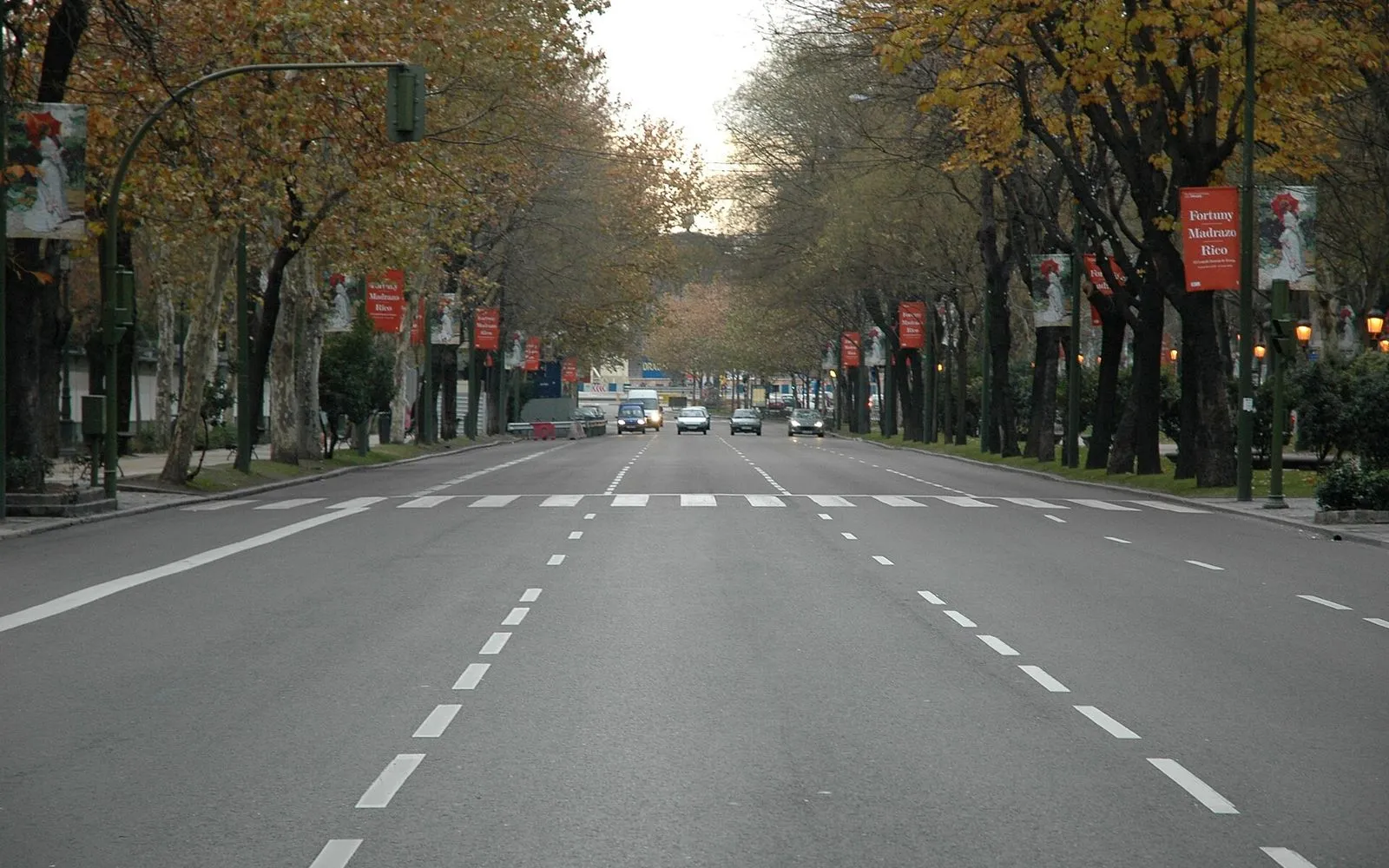
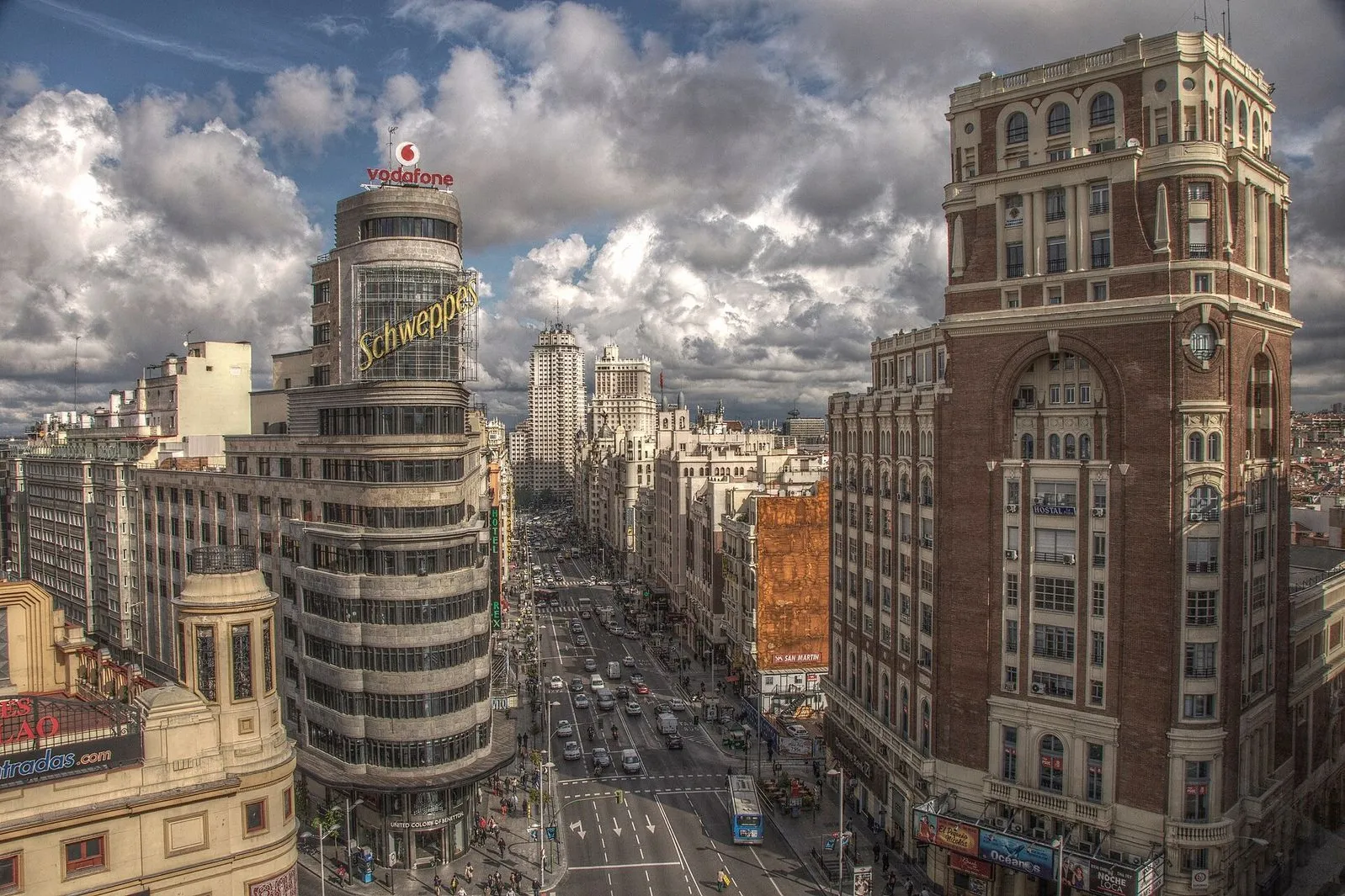
Photo by Felipe Gabaldón on Wikimedia Commons

Gran Vía was an act of urban surgery. Starting in 1910, the boulevard carved through more than three hundred buildings to connect the east and west of Madrid, creating a showcase of early twentieth-century architecture. This walk follows that cut from the Beaux-Arts Edificio Metrópolis to the art-deco Capitol building, with its famous Schweppes neon sign. Then it turns north into Chueca, the old working-class quarter that, a century later, remade itself as Madrid's LGBTQ+ heart. You will walk the narrow streets the boulevard severed, visit a market reborn as a food destination with a rooftop terrace, and end at the city's finest art nouveau palace.

Hear it on the street

Get the turn-by-turn audio guide in the app. The narration plays itself as you reach each stop, hands-free and offline.

Stop by stop

The route

Interactive map of the route. The full stop list below works without it.

Edificio MetrópolisMust see

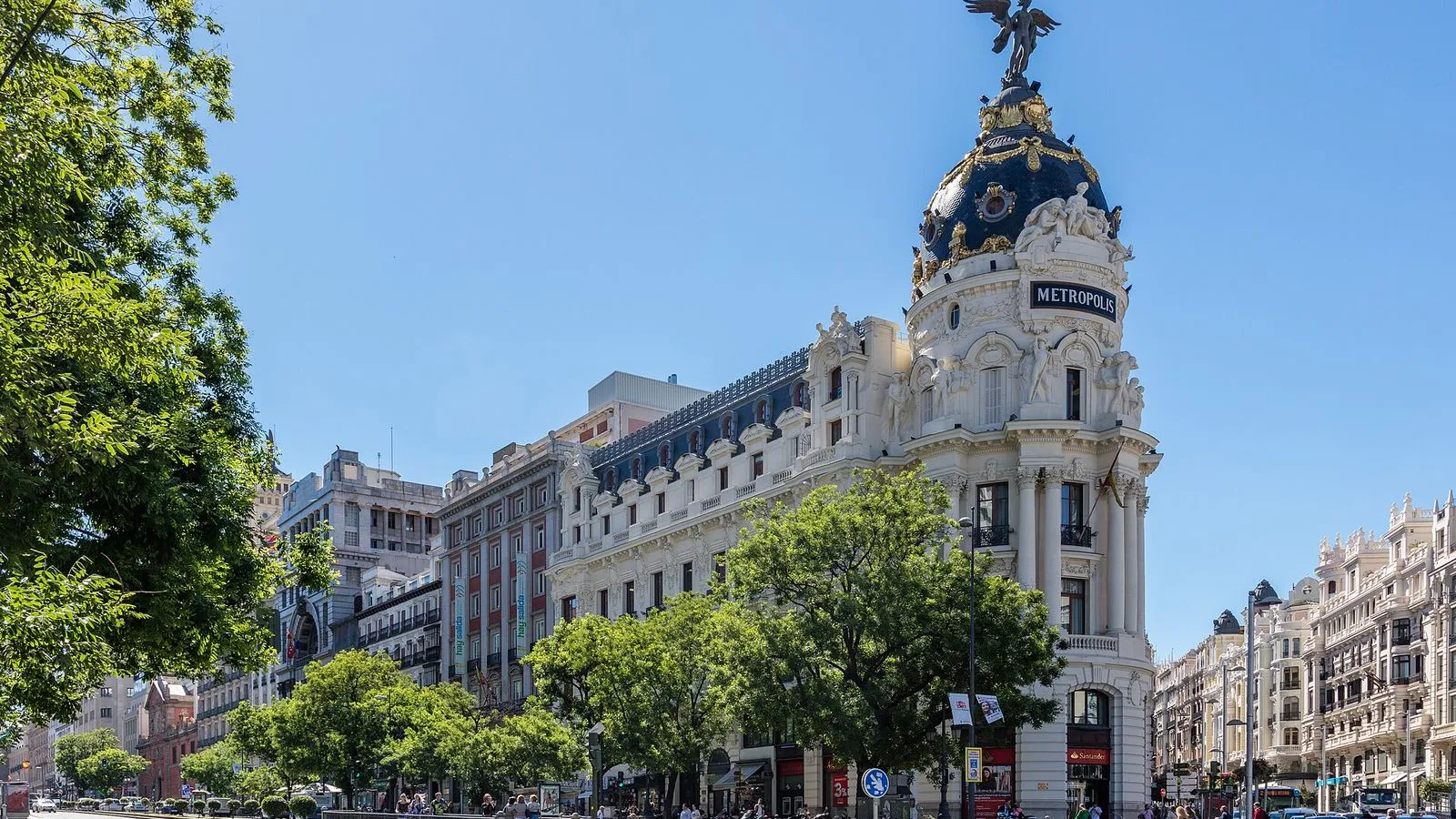
Photo by Diego Delso on Wikimedia Commons

Edificio Metrópolis

0:00

The Beaux-Arts landmark where Gran Vía begins, crowned by a winged Victory and a dome of thirty thousand gold leaves.

You are standing at the corner of Calle Alcalá and Gran Vía, looking at the building everyone photographs but few really see. The Edificio Metrópolis went up between 1907 and 1910, before Gran Vía itself was finished. Five houses were knocked down to clear this corner. The French architects Jules and Raymond Février won the commission with a Beaux-Arts design, and the Spanish architect Luis Esteve actually built it.

For sixty years a statue of the phoenix sat on top, the symbol of the insurance company La Unión y el Fénix that first occupied the building. When Metrópolis Seguros bought the place in 1972, the old owners took their phoenix with them to Paseo de la Castellana. The winged Victory you see now, by Federico Coullaut, went up in 1977. Look at the dome.

Those are thirty thousand leaves of twenty-four carat gold. The four figures on the columns below represent Mining, Agriculture, Industry, and Commerce. This was also one of the first concrete buildings in Madrid, though the stone cladding hides it completely. When you are ready, walk up Gran Vía.

The tall clock tower ahead belongs to the Telefónica Building.
≈7 min walk to the next stop
Edificio TelefónicaMust see

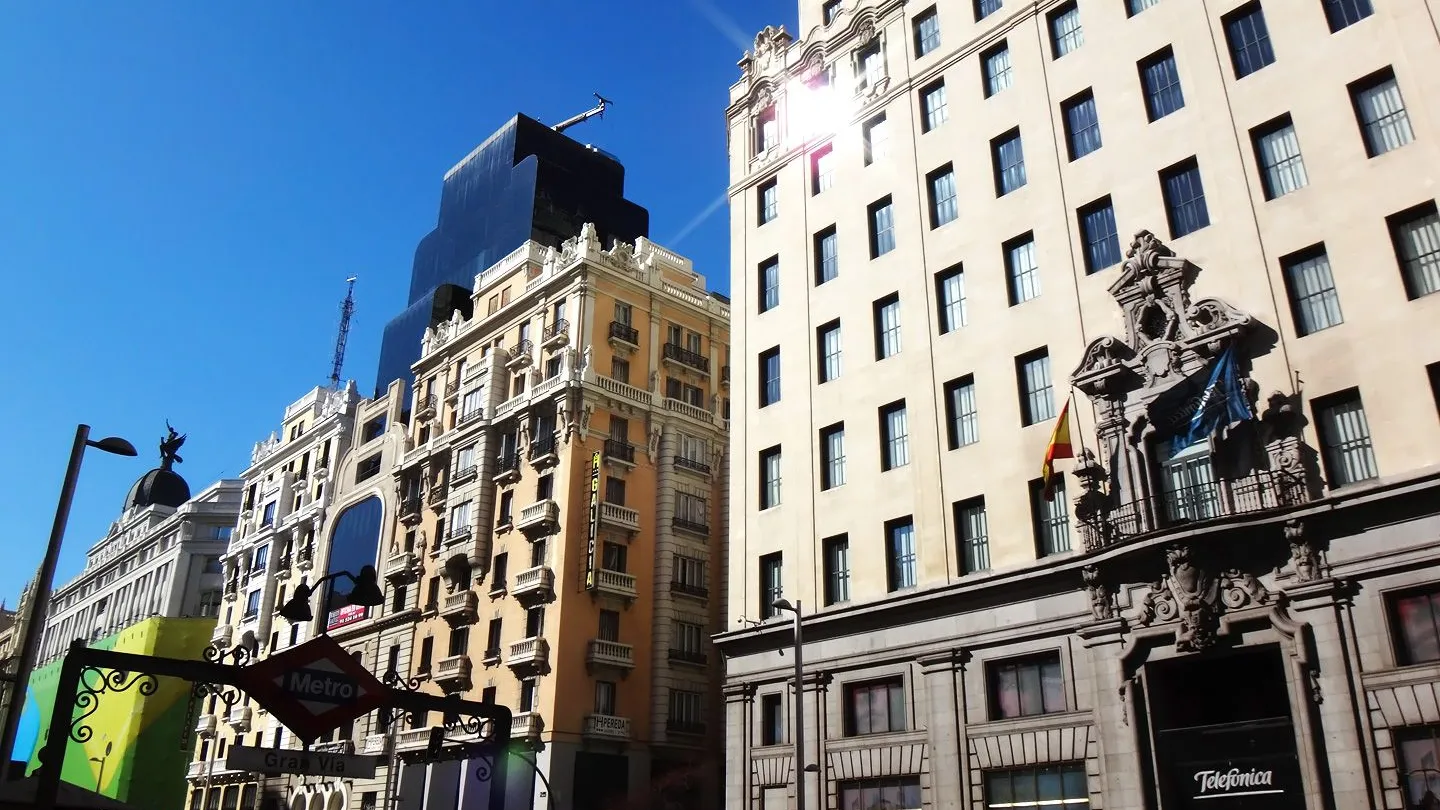
Photo by FouPic on Wikimedia Commons

Edificio Telefónica

0:00

Madrid's first skyscraper, built for the telephone company in 1929, where the first call between Spain and America was placed.

This was Europe's first real skyscraper. When the Edificio Telefónica was finished in March 1929, its eighty-nine meters made it the tallest building on the continent. Ignacio de Cárdenas, the architect, had studied the new towers going up in New York and brought that language home: a steel frame, fourteen high-ceilinged floors, and a stone façade dressed with baroque ornament that nods to Madrid's own architectural traditions. More than a thousand workers built it, at a cost of thirty-two million pesetas.

Before it even opened, on the thirteenth of October 1928, King Alfonso XIII placed the first transatlantic telephone call from inside this building, to President Calvin Coolidge in Washington. Look up at the clock. From 1967 until 2013 it glowed red. Telefónica changed it to blue to match the corporate brand.

It held the Madrid height record until 1953, when the Edificio España overtook it. When you are ready, keep walking west on Gran Vía. The square ahead is Plaza del Callao.

≈7 min walk to the next stop
Plaza del CallaoMust see

Photo by Zaqarbal on Wikimedia Commons

Plaza del Callao

0:00

The great plaza where Gran Vía's energy peaks, defined by the Capitol building's art-deco curve and its 1972 Schweppes neon sign.

You are standing in Plaza del Callao, the pulsing center of Gran Vía. The square opened with the third section of the boulevard in the 1920s, and from the start it was designed for crowds. The building that commands your attention is the Edificio Carrión, better known today as the Capitol. It went up between 1931 and 1933, designed by two young architects, Luis Martínez-Feduchi and Vicente Eced, who had absorbed everything happening in German expressionism.

See how the curved corner catches the light like the prow of a ship. That was deliberate. At fifty-four meters and fourteen floors, it was never the tallest building on the street, but it became the most recognizable. The Schweppes neon sign went up in 1972 and has stayed ever since.

When the building was restored in 2007, almost every other advertisement was stripped from the façade. The Schweppes sign and a small Vodafone sign on the roof were the only ones spared. Inside, the building originally held sixty-four apartments, a hotel, a cinema with nearly two thousand seats, and the first centralized air conditioning system in Madrid. The Vierendeel beams that span the cinema ceiling, thirty-one meters long and three meters deep, were the largest in the world when they were poured.

When you are ready, leave Gran Vía behind. Walk north up Calle de Hortaleza, which starts just off the square.

≈12 min walk to the next stop
Free preview ends here · stops 4 to 7 continue in the app

Calle de Hortaleza

The old street that Gran Vía cut in two, now the main artery of a neighborhood that rebuilt itself on its own terms.

in app

Mercado de San Antón

A three-story market reborn in 2011, with a traditional food hall, a tapas floor, and a rooftop terrace looking over the Chueca rooftops.

in app

Plaza de Chueca

The neighborhood's sunny living room, named for a zarzuela composer and now the heart of Madrid's LGBTQ+ quarter.

in app

Palacio Longoria

Madrid's most important art nouveau building, a 1904 palace of curving stone and iron that now houses Spain's society of authors and editors.

in app
Good to know

Before you go

Why is Gran Vía called 'the cut'?

Starting in 1910, the Gran Vía was carved through the dense medieval street grid of central Madrid, demolishing more than three hundred buildings. It took four decades to complete and permanently severed neighborhoods that had grown together for centuries. The boulevard connected east and west Madrid and became the city's early 20th century architectural showcase.

Is Chueca only an LGBTQ+ neighborhood?

Chueca is Madrid's LGBTQ+ heart and also a mixed, welcoming neighborhood where anyone can have a good dinner, a drink, or a morning coffee. The Mercado de San Antón has a rooftop terrace that is one of the best lunch spots in the area. Plaza de Chueca fills with families during the day and a younger crowd at night. Pride in late June transforms the entire district.

Provenance · last verified August 18, 2026

Built from the Wayside route itself: the stops, their order, and the walk between them.

Photo by Felipe Gabaldón on Wikimedia Commons · CC BY 2.0

Photo by Diego Delso on Wikimedia Commons · CC BY-SA 4.0

Photo by FouPic on Wikimedia Commons · CC BY 2.0

Photo by Zaqarbal on Wikimedia Commons · CC BY-SA 3.0

Photo by Nicolas Vigier on Wikimedia Commons · CC0

Photo by Jose Luis Cernadas Iglesias from Coruña, España on Wikimedia Commons · CC BY 2.0

Photo by Tim Tregenza on Wikimedia Commons · CC BY-SA 3.0

Photo by Tinou Bao on Wikimedia Commons · CC BY 2.0

Photo by Jorge Láscar on Wikimedia Commons · CC BY-SA 2.0

Photo by FEDERICO JORDÁ from MADRID, ESPAÑA on Wikimedia Commons · CC BY 2.0

Photo by Nicolas Vigier from Madrid, Spain on Wikimedia Commons · CC0

Coming soon

Wayside isn't in the app stores yet, but it's in the works. Check back soon.