Chicago · Self-guided audio walk

Forever Open, Clear, and Free

Walk the lakefront one stubborn mail-order magnate sued into existence, from the Bean to Buckingham Fountain.

  • 7Stops
  • 3 kmDistance
  • 45+ minTime
Forever Open, Clear, and Free

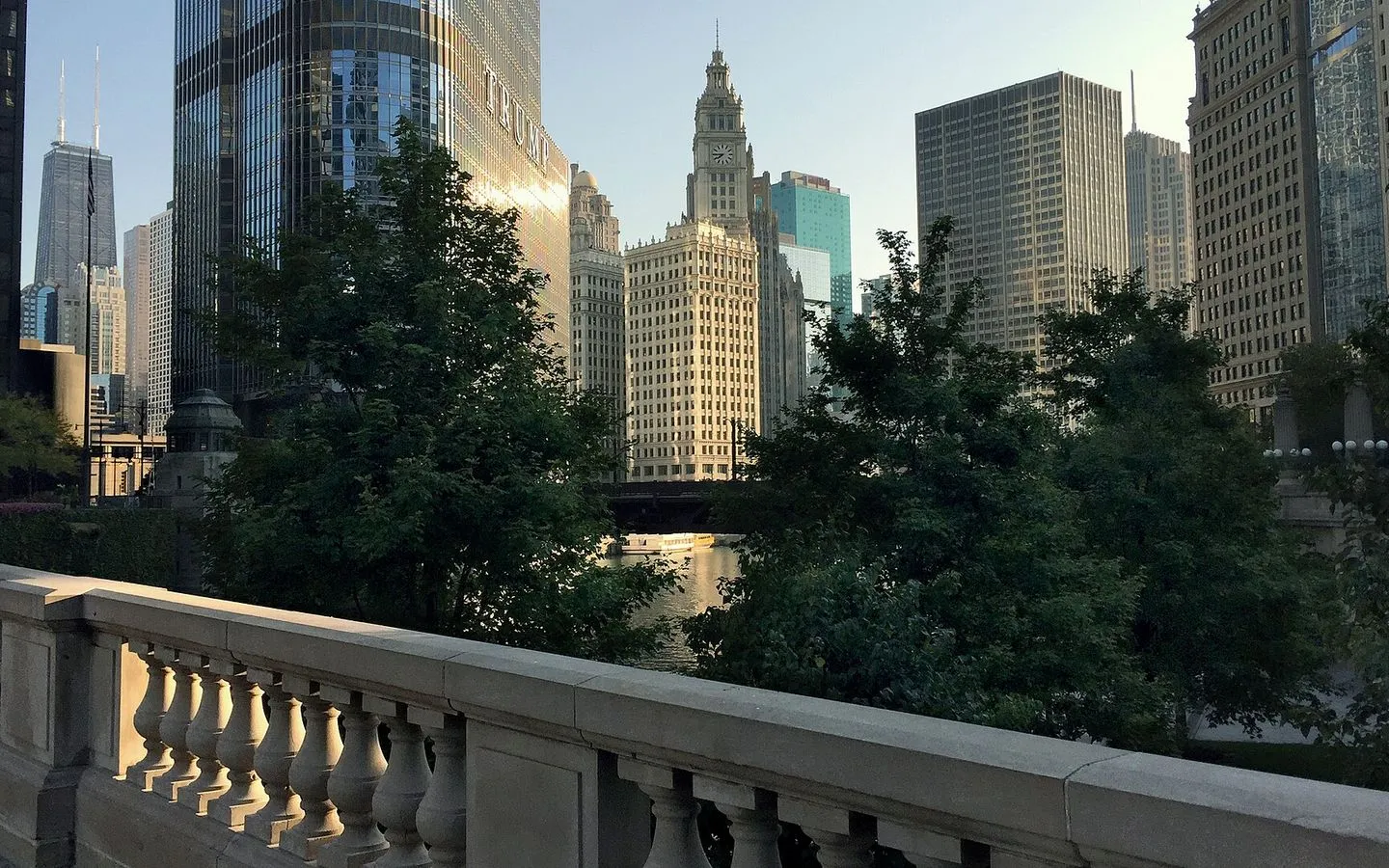
Photo by David Paul Ohmer on Openverse

Chicago's lakefront was marked on an 1836 plat map as "Public Ground: A Common to remain forever Open, Clear & free of any buildings." Aaron Montgomery Ward spent 22 years and four Illinois Supreme Court cases enforcing those words. This walk traces what his lawsuits preserved: the 24.5-acre rooftop garden of Millennium Park, Anish Kapoor's Cloud Gate, Frank Gehry's silver bandshell, the bronze lions of the Art Institute (the one building that slipped through), the Tiffany glass dome inside the old public library, and the grand green sweep of Grant Park down to Buckingham Fountain's choreographed water. It is Chicago's front yard, and it belongs to everyone.

Hear it on the street

Get the turn-by-turn audio guide in the app. The narration plays itself as you reach each stop, hands-free and offline.

Stop by stop

The route

Interactive map of the route. The full stop list below works without it.

Millennium ParkMust see

Photo by Daniel Romero on Unsplash

Millennium Park

0:00

Where a grimy rail yard and parking lot sat for decades, a 24.5-acre rooftop garden now anchors Chicago's lakefront.

You're standing at the northwest corner of Millennium Park, on what was, until 1997, a scar of gravel and railroad tracks. The Illinois Central Railroad held an easement here for nearly 150 years, running a single boxcar back and forth to maintain the legal fiction that the land was still in rail use. When the city discovered it actually owned the land underneath, Mayor Richard M. Daley seized the moment.

Construction began in 1998, and the park opened in July 2004, four years late and nearly half a billion dollars over the original estimate. But the result silenced every critic. The park sits on top of a parking garage and an active commuter rail station, making it one of the world's largest green roofs. The name Millennium was meant to mark the year 2000; the park arrived fashionably late.

Look east. The silver curve you see in the distance is where you're heading next.

≈1 min walk to the next stop
Cloud GateMust see

Photo by Sebastian Latorre on Unsplash

Cloud Gate

0:00

Anish Kapoor's 110-ton mirror-polished steel sculpture reflects Chicago's skyline and everyone who stands before it.

You're standing before Cloud Gate, though almost nobody in Chicago calls it that. It's the Bean. Anish Kapoor's sculpture weighs 110 tons and is made of 168 stainless steel plates welded together so seamlessly that you cannot find a single joint. The surface was inspired by liquid mercury.

It took longer to polish than to build, and when the park opened in July 2004, it was still under a tent with workers buffing out the last imperfections. The final price tag was 23 million dollars, all private money. Walk underneath the 12-foot arch and look up. The mirrored ceiling multiplies you into a kaleidoscope, a concave chamber Kapoor called the omphalos, Greek for navel.

The sculpture reflects the Michigan Avenue street wall behind you, the sky above, and every person who walks past. Touch the surface. It is cleaned daily, sometimes twice, to keep that mirror finish. When you're ready, head north toward the silver ribbons rising above the tree line.

≈2 min walk to the next stop
Jay Pritzker PavilionMust see

Photo by Diego Delso on Wikimedia Commons

Jay Pritzker Pavilion

0:00

Frank Gehry's stainless steel bandshell, with 4,000 seats and room for 7,000 more on the Great Lawn.

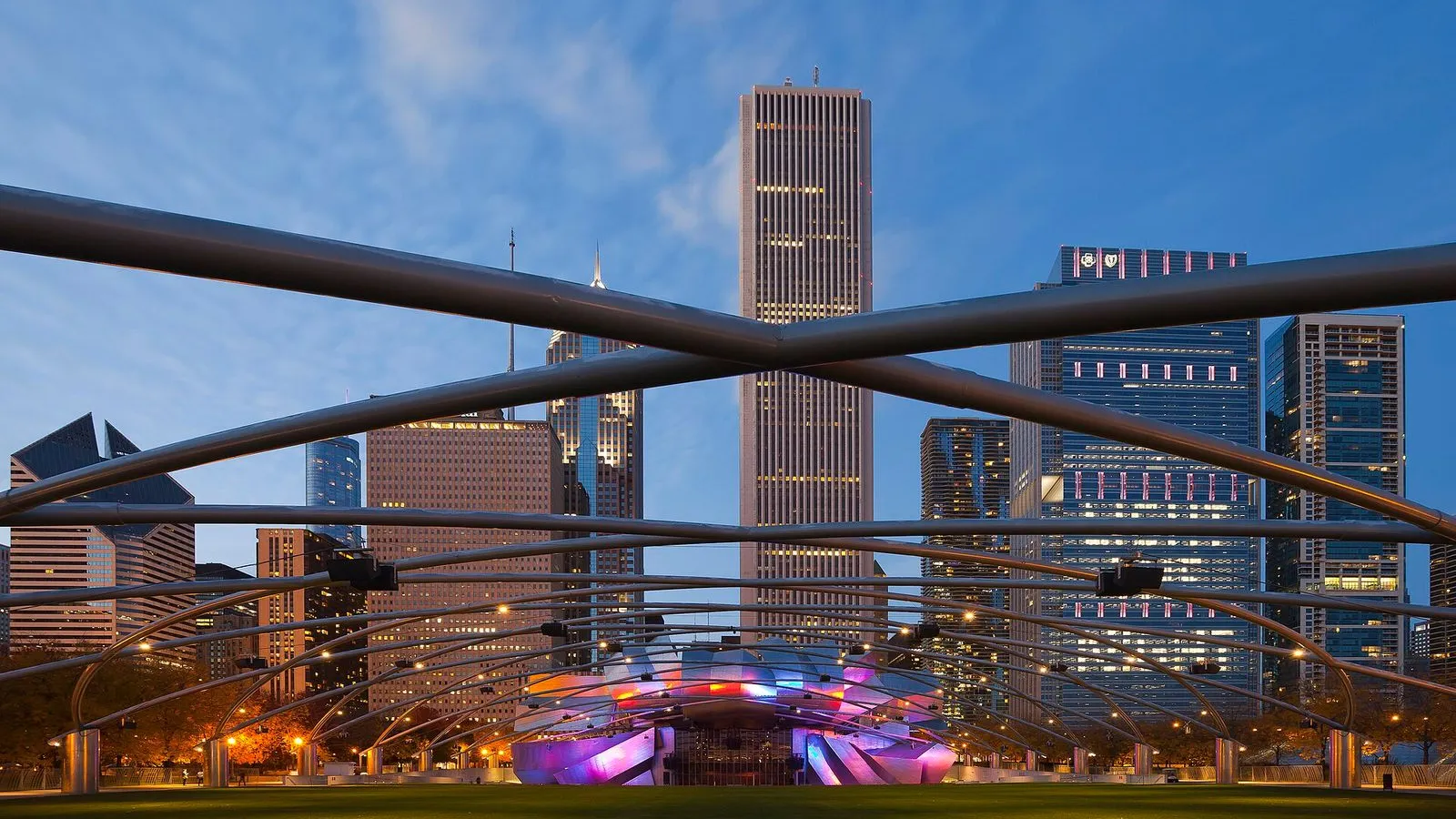
Frank Gehry designed this bandshell, and it nearly broke the project. The curving stainless steel plates that frame the stage are Gehry's signature: brushed metal ribbons that look like they were caught mid-flight and frozen there. The pavilion cost 60 million dollars, funded by the Pritzker family of Hyatt Hotels fame. It seats 4,000 in fixed chairs and can hold another 7,000 on the Great Lawn.

Gehry insisted on a trellis of steel pipes that crisscrosses the lawn, suspending the sound system above the audience so everyone hears the same mix, whether you're in the front row or sprawled on the grass at the back. The pavilion sits on top of the Harris Theater, an indoor venue, and the two share a loading dock and backstage. In a park that exists only because the law said this land must stay open and clear of buildings, Gehry's creation is the grandest thing that ever slipped through. When you're ready, walk south out of the park toward the Beaux-Arts building with the green bronze roof on Michigan Avenue.

≈7 min walk to the next stop
Free preview ends here · stops 4 to 7 continue in the app

Art Institute of Chicago

Two bronze lions have guarded the Art Institute's Michigan Avenue steps since 1894, the sole building allowed in Grant Park.

in app

Chicago Cultural Center

The former public library houses the world's largest Tiffany glass dome, 30,000 pieces of Favrile glass under a cast-iron frame.

in app

Grant Park

Chicago's 319-acre front yard exists because one stubborn mail-order magnate sued the city four times and won every case.

in app

Buckingham Fountain

Kate Buckingham gave this fountain to Chicago in 1927 in memory of her brother, and it still performs hourly water displays.

in app
Good to know

Before you go

Is Millennium Park free?

Yes. Millennium Park is free and open daily from 6 a.m. to 11 p.m., and Cloud Gate and the Pritzker Pavilion need no ticket. The Welcome Center at 201 E. Randolph St. is open 9 a.m. to 7 p.m. from Memorial Day through October 1.

SourceCity of Chicago
When does Buckingham Fountain put on its show?

From early May through mid-October the fountain runs 8 a.m. to 11 p.m., with a major display for 20 minutes at the top of each hour. The light and music shows begin at dusk, and the last display starts at 10:35 p.m.

SourceChicago Park District
Do I need a ticket for the Art Institute?

Yes, and timed entry is recommended. General admission is $32 for adults, $26 for seniors, students, and teens, and free for children under 14. Chicago residents pay $20.

SourceArt Institute of Chicago

Provenance · last verified August 17, 2026

Built from the Wayside route itself: the stops, their order, and the walk between them.

Photo by David Paul Ohmer on Openverse · CC BY 2.0

Photo by Daniel Romero on Unsplash

Photo by Sebastian Latorre on Unsplash

Photo by Diego Delso on Wikimedia Commons · CC BY-SA 3.0

Photo by Acediscovery on Wikimedia Commons · CC BY 4.0

Photo by Chicago Running Tours & more on Openverse · CC BY 2.0

Photo by artistmac on Openverse · CC BY-SA 2.0

Photo by Ryan Dickey from Evanston, IL / Chicago, United States on Wikimedia Commons · CC BY 2.0

Photo by Ranjit Souri on Unsplash

Photo by artistmac on Openverse · CC BY-SA 2.0

Photo by Ben Collins-Sussman on Wikimedia Commons · CC BY 2.0

Coming soon

Wayside isn't in the app stores yet, but it's in the works. Check back soon.