Rome · Self-guided audio walk

From the Aventine to Testaccio: Rome's Quiet Hill and the Mountain of Shards

A downhill walk from a secret keyhole view of St. Peter's to an ancient trash heap made of 53 million olive oil jars, ending at Rome's best street-food market.

  • 7Stops
  • 2.2 kmDistance
  • 40+ minTime
From the Aventine to Testaccio: Rome's Quiet Hill and the Mountain of Shards

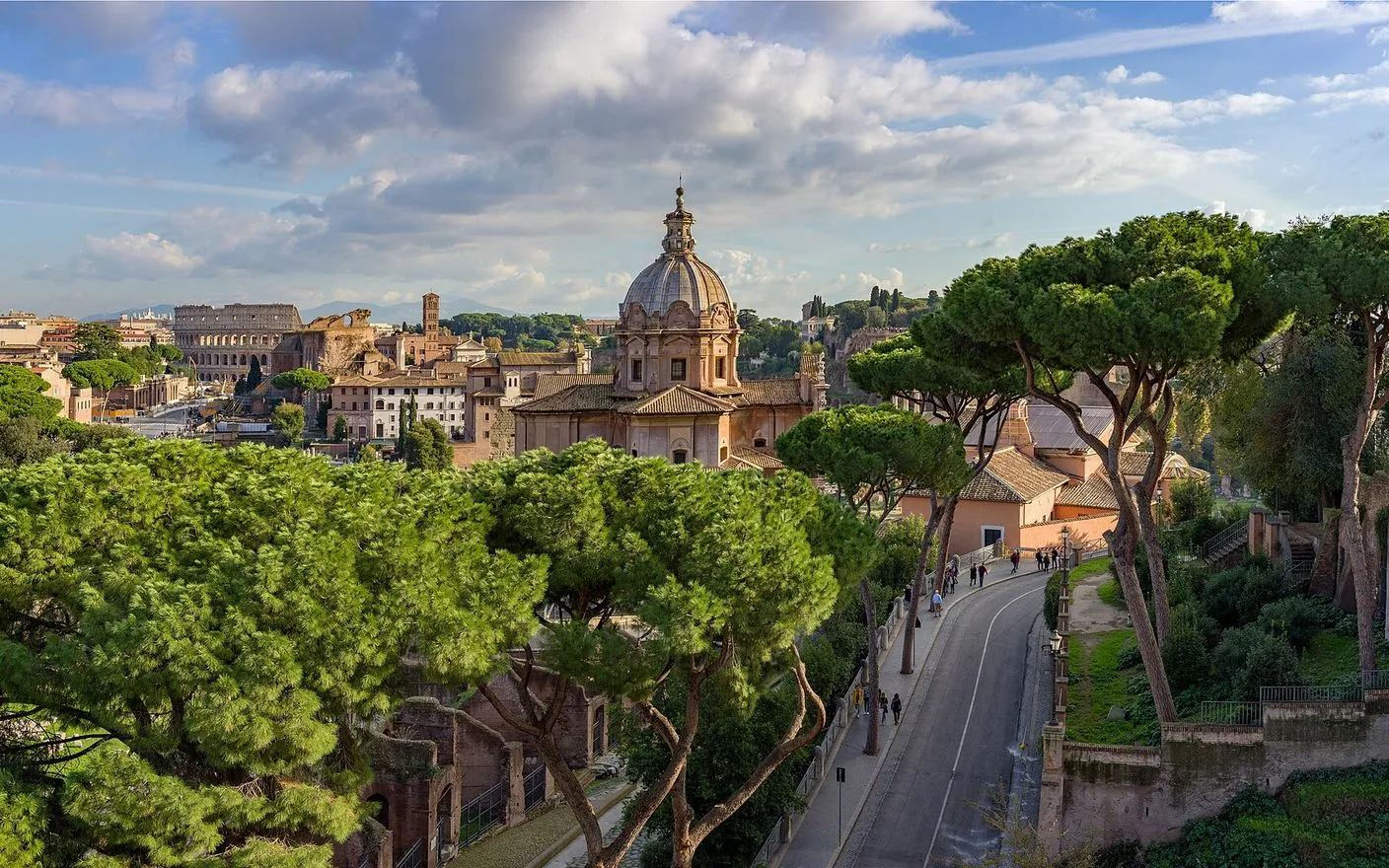
Photo by My Past from Norway on Wikimedia Commons

The Aventine is Rome's quietest central hill, green and residential, with almost no tourists. This walk starts at the Giardino degli Aranci, whose terrace looks across the Tiber straight to St. Peter's dome. A few paces away, Santa Sabina, a 5th-century basilica, preserves its original wooden doors with the oldest known depiction of the Crucifixion. Around the corner, peer through the famous keyhole at the Priory of the Knights of Malta and see the dome perfectly centered at the end of a corridor of hedges. Then descend into Testaccio, a former working-class district built around Monte Testaccio, an artificial hill of 53 million broken ancient amphorae. The walk ends at the Mercato Testaccio, where Romans eat some of the city's best street food. Along the way, the Pyramid of Cestius, a marble tomb from 12 BC, and the Non-Catholic Cemetery, where Keats and Shelley are buried, mark the boundary between the two neighborhoods.

Hear it on the street

Get the turn-by-turn audio guide in the app. The narration plays itself as you reach each stop, hands-free and offline.

Stop by stop

The route

Interactive map of the route. The full stop list below works without it.

Giardino degli AranciMust see

Photo by Gabriella Clare Marino on Unsplash

Giardino degli Aranci

0:00

A terrace of bitter orange trees on the Aventine Hill with one of Rome's finest views across the Tiber to St. Peter's dome.

You are standing on the Aventine, the quietest of Rome's seven hills. The terrace in front of you was laid out in 1932, but the view is far older. Straight ahead, across the Tiber, is the dome of St. Peter's, designed by Michelangelo.

To its right, the white monument of the Vittoriano. Below you, the river bends around the Tiber Island. The garden takes its name from the bitter orange trees that line the central path. According to legend, Saint Dominic planted the very first orange tree in Italy right here in the 13th century, bringing a sapling from Spain.

That tree still grows in the cloister of Santa Sabina, the church visible behind you through the wall. This spot was once a fortress of the Savelli family, built in the 1280s. The wall around the garden is all that remains. The Dominicans later turned the grounds into a vegetable patch.

Only in 1932 did the city open it to the public, giving Rome a belvedere to rival the Janiculum and the Pincio. Take a moment at the railing. The dome looks close enough to touch, but it sits nearly three kilometers away. When you are ready, walk back toward the entrance gate and turn right onto Via di Santa Sabina.
≈2 min walk to the next stop
Santa SabinaMust see

Photo by Fiat 500e on Wikimedia Commons

Santa Sabina

0:00

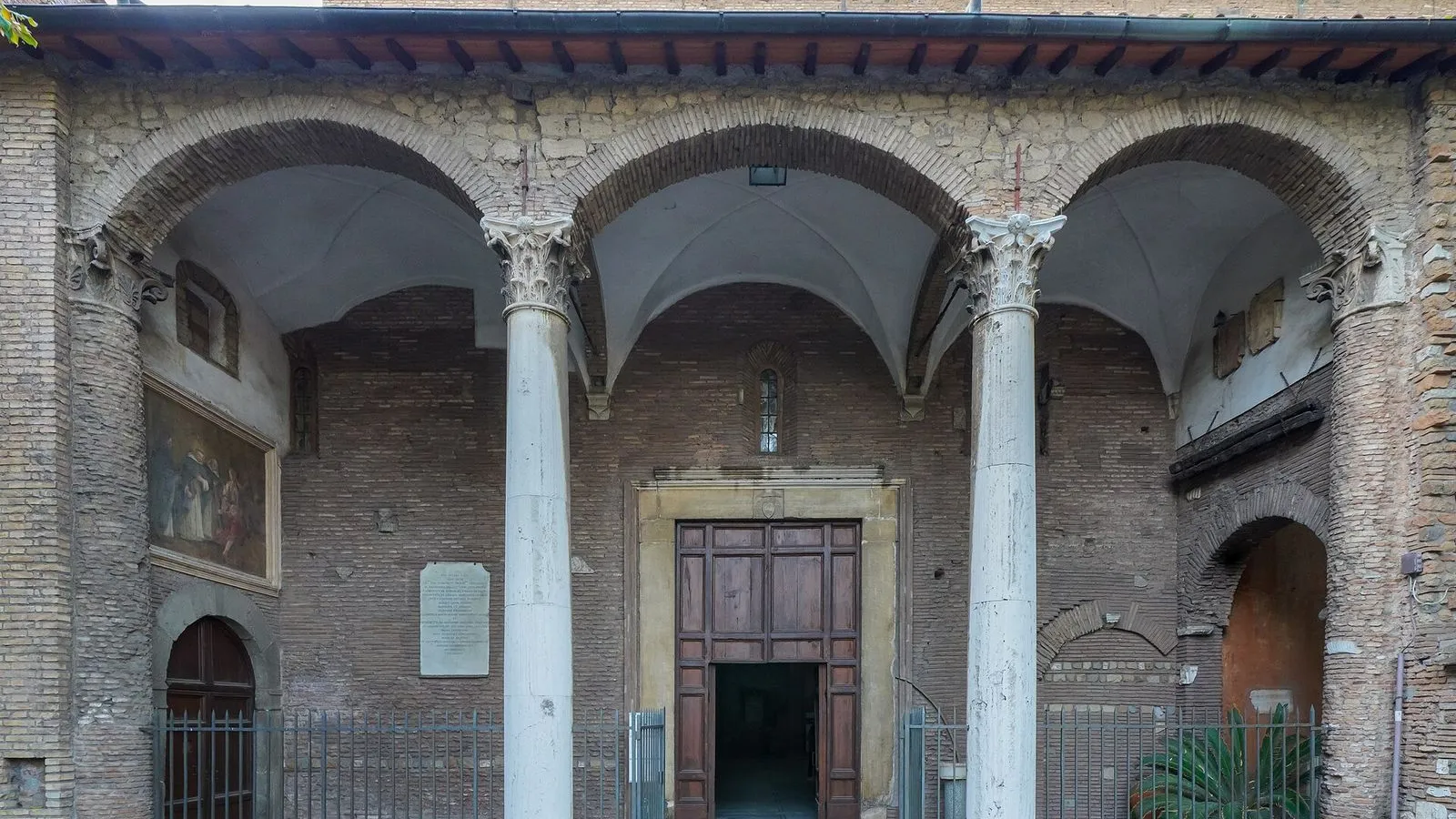
Rome's oldest surviving basilica from the 5th century, with original cypress-wood doors carved with the earliest known depiction of the Crucifixion.

You are standing before the oldest basilica in Rome that still keeps its original shape. Santa Sabina was built between 422 and 432 by a priest named Peter of Illyria, on the site of a Roman matron's house. Sabina had been executed for converting to Christianity, and this church carries her name. Step inside.

What you notice first is the light. The windows are not glass but thin sheets of selenite, a translucent stone. That is exactly how the church was lit fifteen centuries ago. The twenty-four marble columns dividing the nave from the aisles were taken from a temple of Juno that once stood on this hill.

Their Corinthian capitals match perfectly, all spolia, all second-hand. Before you leave, look at the wooden door you came through. It is cypress wood, carved around 430, the oldest surviving wooden door in Rome. Eighteen of its original twenty-eight panels remain.

One of them shows the Crucifixion, the earliest known depiction of it in the world. The figures are simple, almost schematic. At the time, showing Christ on the cross was still a daring act. When you are done, exit and turn left.

Walk past the garden wall to the small piazza at the end of the lane.

≈3 min walk to the next stop
Piazza dei Cavalieri di MaltaMust see

Photo by user:Lalupa on Wikimedia Commons

Piazza dei Cavalieri di Malta

0:00

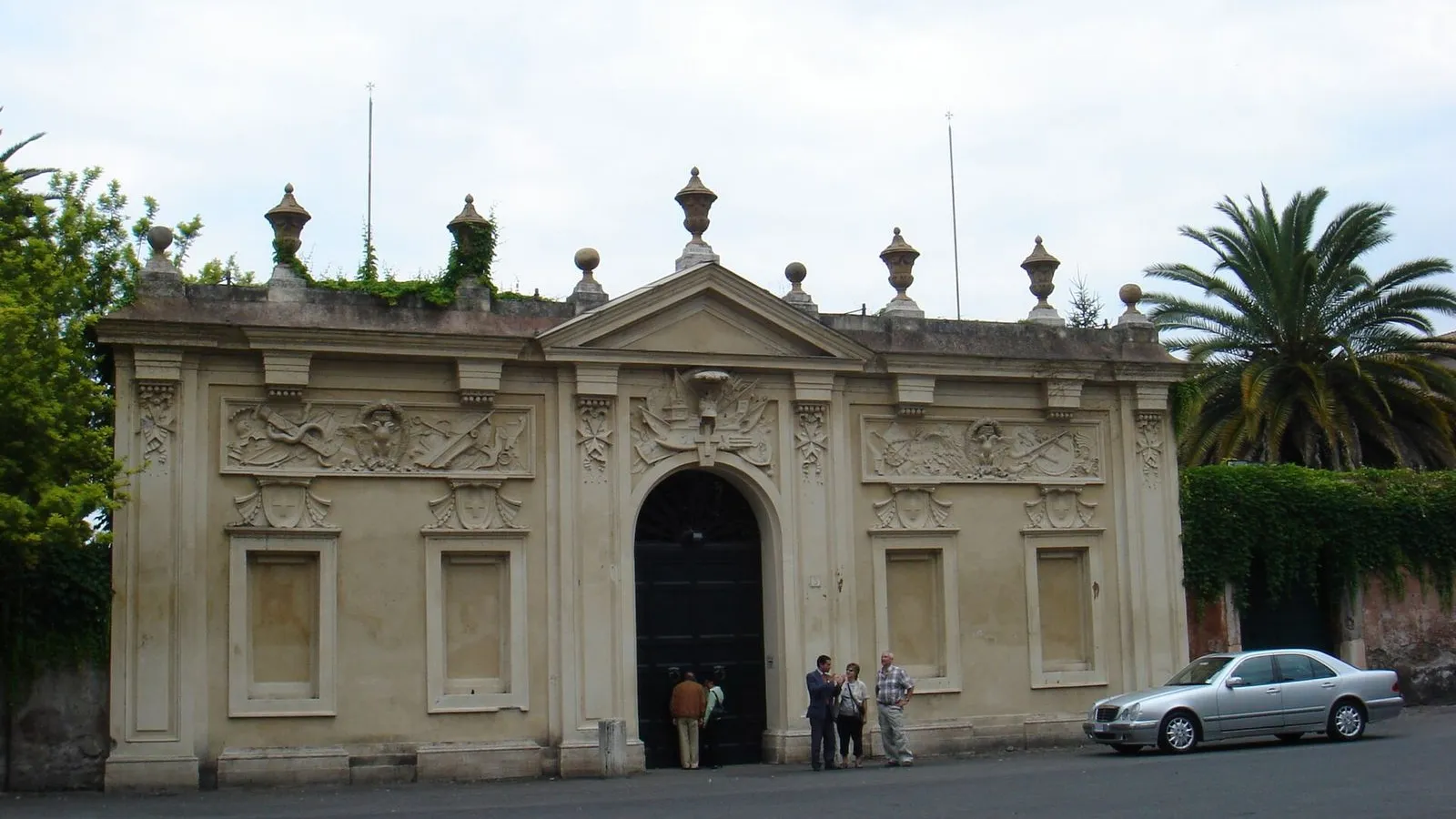
A Piranesi-designed square whose green door hides the Aventine Keyhole, framing St. Peter's dome at the end of a hedge-lined avenue.

You are in Piazza dei Cavalieri di Malta, a tiny rococo square designed in 1765 by Giovanni Battista Piranesi. The wall in front of you belongs to the Villa del Priorato di Malta, the institutional seat of the Sovereign Military Order of Malta, the oldest surviving chivalric order in the world. Step up to the green door. Put your eye to the keyhole.

What you see is hard to describe to anyone who has not seen it: a tunnel of perfectly clipped laurel hedges, and at the far end, floating in the exact center of the frame, Michelangelo's dome of St. Peter's. It is an optical trick Piranesi engineered deliberately, an alignment that bonds the Order to the Holy See. Through that single keyhole you are looking across three sovereign states: Italy beneath your feet, the Order of Malta's extraterritorial garden, and Vatican City in the distance.

The obelisks on the walls resemble ships' masts. The Aventine has always been imagined as a ship ready to sail. Piranesi leaned into the metaphor, filling the square with nautical motifs. Romans call this spot the Buco di Roma, the Hole of Rome.

When you have had your look, head back out the way you came and begin the descent downhill.

≈12 min walk to the next stop
Free preview ends here · stops 4 to 7 continue in the app

Pyramid of Cestius

A marble-faced Roman pyramid from 12 BC, the tomb of Gaius Cestius, preserved because it was built into the city walls.

in app

Non-Catholic Cemetery

A quiet, green burial ground beside the Pyramid of Cestius, the final resting place of poets John Keats and Percy Bysshe Shelley.

in app

Monte Testaccio

An artificial hill 35 meters high, composed entirely of fragments from an estimated 53 million ancient Roman amphorae.

in app

Nuovo Mercato Testaccio

A covered food market where Romans come for some of the city's best street food, from pizza al taglio to supplì and panini with fresh porchetta.

in app
Good to know

Before you go

Do I need to book the Aventine Keyhole?

No. The keyhole at the Piazza dei Cavalieri di Malta is free and open to the street. Peer through the green door at any hour. The line, when there is one, moves quickly. The view of St. Peter's dome perfectly centered at the end of a hedge-lined avenue is a Rome classic.

Is the Non-Catholic Cemetery worth a visit?

Yes. The Non-Catholic Cemetery is a quiet, green pocket beside the Pyramid of Cestius. Keats and Shelley are buried here, and the inscriptions alone are worth the visit. Entry is free but a small donation is appreciated. It closes at 17:00 in winter and 18:00 in summer, and is closed on Sundays and public holidays.

SourceNon-Catholic Cemetery: official site
Keep exploring

More walks in Rome

Provenance · last verified August 9, 2026

Built from the Wayside route itself: the stops, their order, and the walk between them.

Photo by My Past from Norway on Wikimedia Commons · CC BY 2.0

Photo by Gabriella Clare Marino on Unsplash

Photo by Fiat 500e on Wikimedia Commons · CC BY-SA 4.0

Photo by user:Lalupa on Wikimedia Commons · Public domain

Photo by Wolfgang Moroder on Wikimedia Commons · CC BY-SA 3.0

Photo by Nicola since 1972 on Openverse · CC BY 2.0

Photo by Dguendel on Wikimedia Commons · CC BY 3.0

Photo by Nhartmannphotos on Wikimedia Commons · CC BY-SA 4.0

Photo by Palickap on Wikimedia Commons · CC BY-SA 4.0

Photo by Diliff on Wikimedia Commons · CC BY-SA 3.0

Photo by Vadim Zhivotovsky on Wikimedia Commons · CC BY 3.0

Coming soon

Wayside isn't in the app stores yet, but it's in the works. Check back soon.