Rome · Self-guided audio walk

Baroque Heart of the Campus Martius

From a morning market to the Spanish Steps, a walk through Rome's most beautiful piazzas, fountains, and domes.

  • 6Stops
  • 2.4 kmDistance
  • 40+ minTime
Baroque Heart of the Campus Martius

Photo by Nicola since 1972 on Openverse

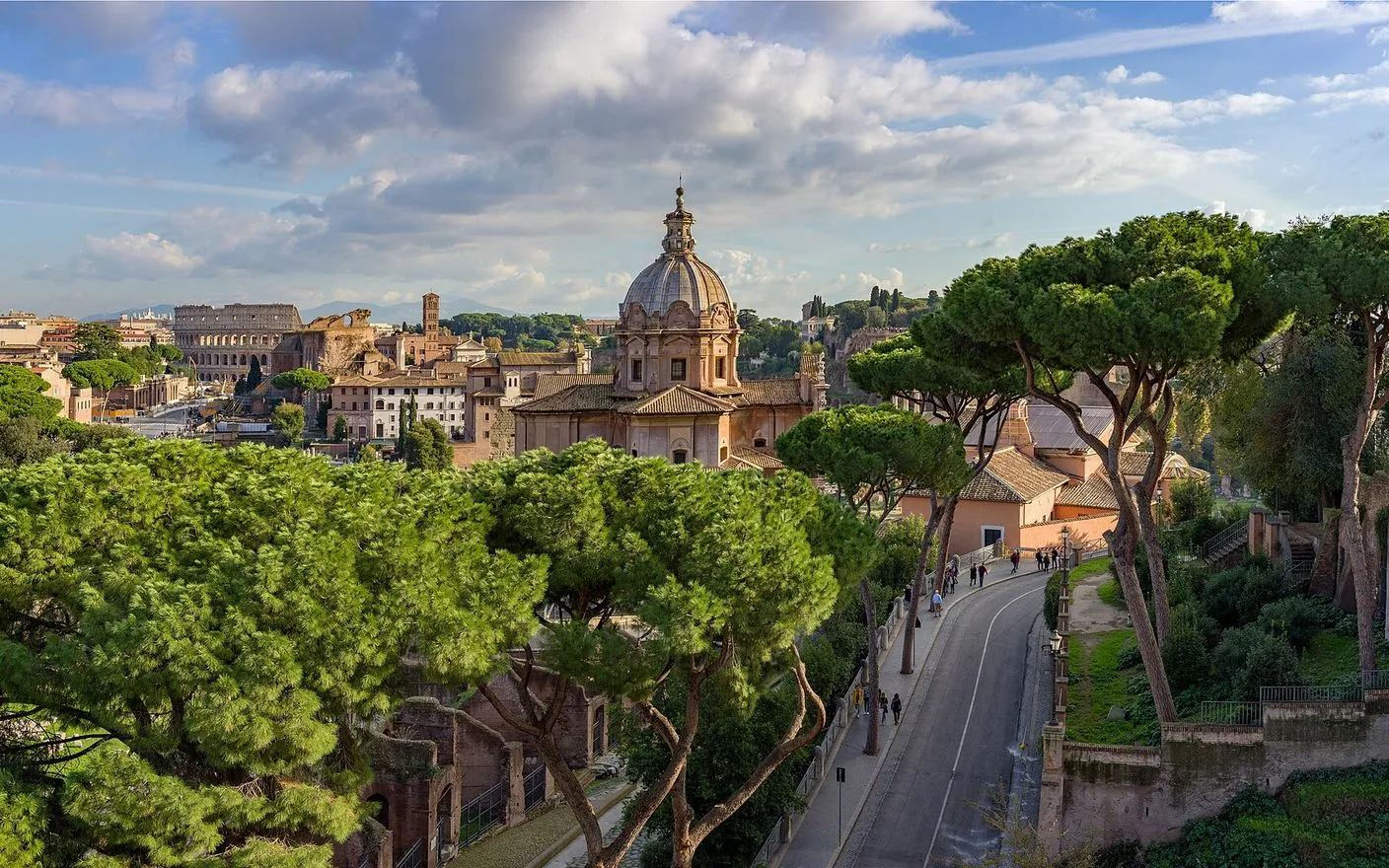
The Campus Martius was ancient Rome's Field of Mars, a floodplain outside the city walls. Today it is the Baroque heart of the centro storico, where Bernini, Borromini, and Pozzo built their masterpieces. This walk threads together six stops: the morning market at Campo de' Fiori, the theater of Piazza Navona, the Pantheon's impossible dome, the painted ceiling of Sant'Ignazio, the Trevi Fountain, and the Spanish Steps. Along the way you cross nineteen centuries of stone and water, with gelato within reach at every turn.

Hear it on the street

Get the turn-by-turn audio guide in the app. The narration plays itself as you reach each stop, hands-free and offline.

Stop by stop

The route

Interactive map of the route. The full stop list below works without it.

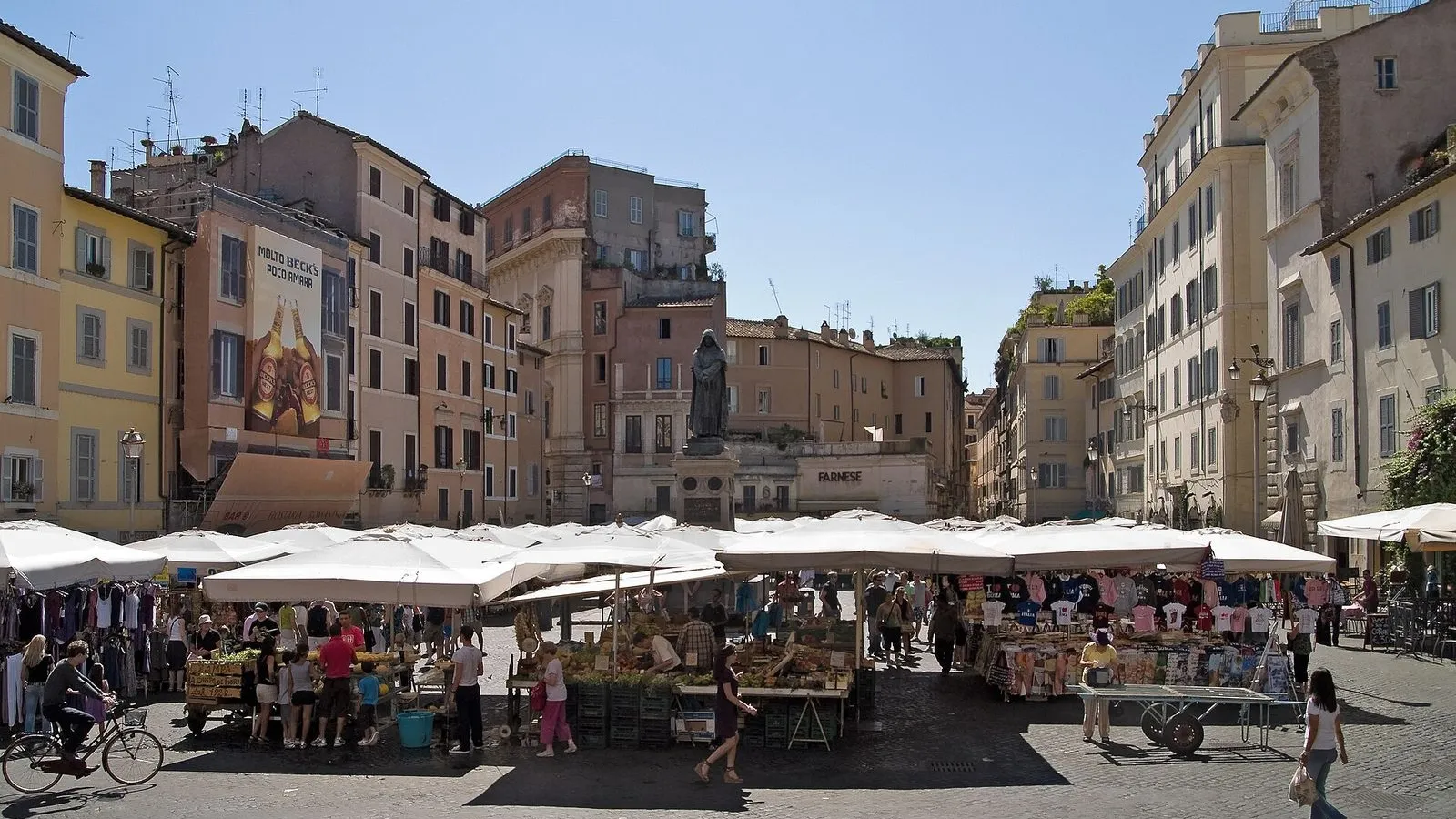
Campo de' FioriMust see

Photo by Myrabella on Wikimedia Commons

Campo de' Fiori

0:00

A working market square since the 15th century, with fresh produce, flowers, and the brooding statue of Giordano Bruno at its center.

You're standing in a square whose name means field of flowers, a memory of the meadow that was here before the city paved it over in 1456. For most of its life this has been a market, not a monument. The streets leading into it are named for the trades that once lined them: crossbow makers, coffer makers, hat makers. The market stalls around you sell seasonal produce, cut flowers, spices.

If you're here before nine in the morning, you're seeing it at its best: locals doing their weekly shop, vendors calling out prices, the espresso machine at the corner bar running nonstop. Later in the day the tourist stalls multiply and the square shifts character, but right now this is still a neighborhood. Now look at the hooded bronze figure in the center. That's Giordano Bruno, the philosopher and former Dominican friar who was burned alive on this exact spot on February 17, 1600.

His crime was insisting that the universe was infinite and contained countless other worlds, and he refused to recant. The statue was put up in 1889 over furious protest from the Vatican, and it faces deliberately toward it. The inscription reads: 'To Bruno, from the century he foresaw, here where the pyre burned.' For a market square, this place carries an unusual weight.
≈6 min walk to the next stop
Piazza NavonaMust see

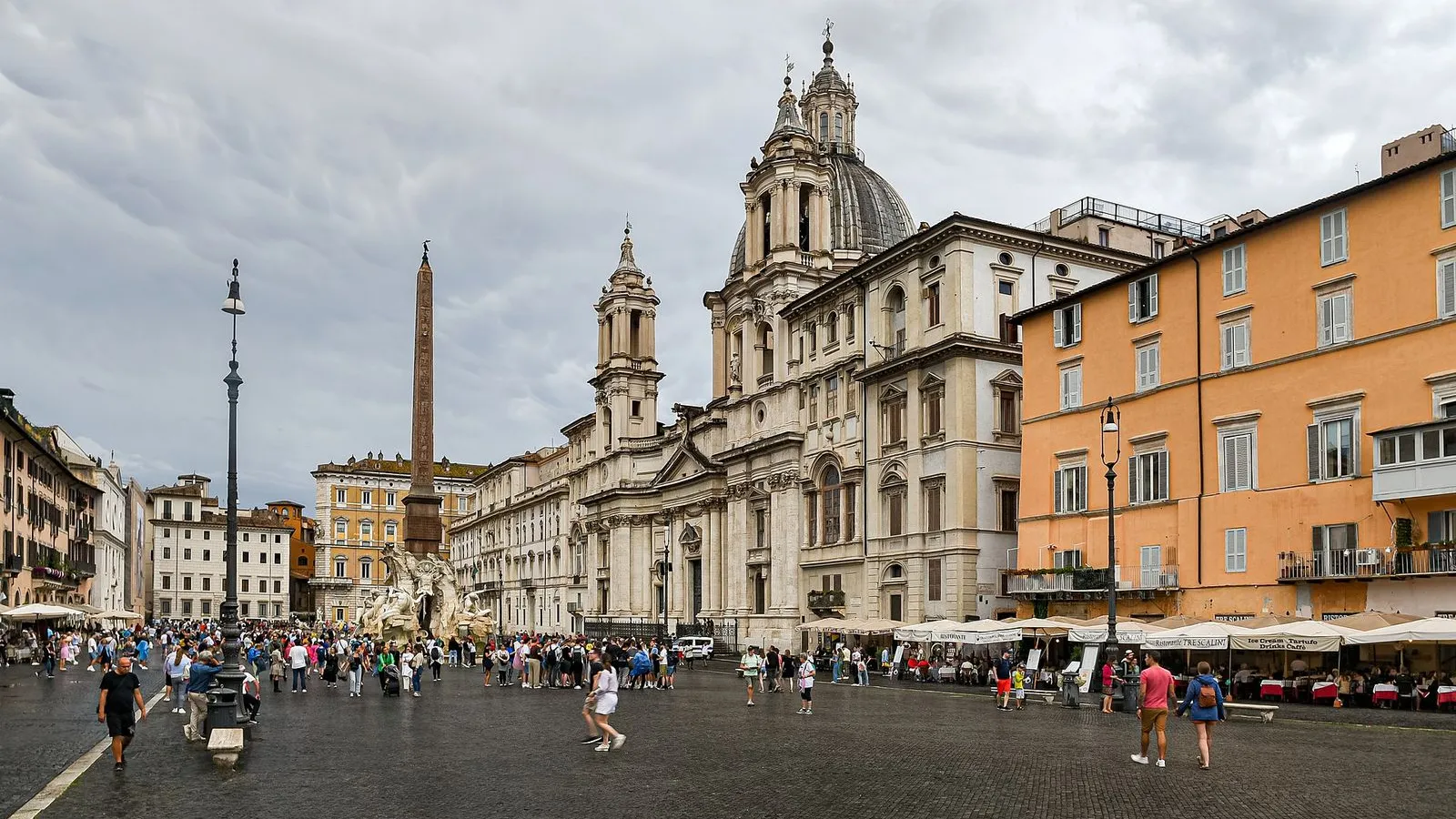
Photo by Jorge Franganillo on Wikimedia Commons

Piazza Navona

0:00

Rome's most theatrical square, built over Domitian's stadium, with Bernini's Fountain of the Four Rivers at its heart.

You're standing inside a stadium. That long oval shape isn't a Baroque invention; it's the footprint of the Stadium of Domitian, built around 80 AD to host foot races and wrestling matches for thirty thousand spectators. For centuries after the empire fell, Romans built houses into the old stone seating, and the arena became a muddy piazza. The shape survived.

In the seventeenth century, Pope Innocent X Pamphili turned it into the square you see now. His family palace faces you on the left, and the church of Sant'Agnese in Agone, designed by Borromini, curves on your right. But the star is dead center: Bernini's Fountain of the Four Rivers, unveiled in 1651. Four river gods sprawl around a jagged travertine rock that supports an Egyptian obelisk.

The Ganges carries an oar, the Nile's head is veiled because its source was then unknown, the Danube touches the papal coat of arms, and the Río de la Plata throws up a hand in alarm at the sight of a serpent. The dove on top is the Pamphili family emblem. The whole thing is a theater of water and stone, and Bernini meant for you to walk all the way around it. At the southern end, the Fountain of the Moor was carved by Giacomo della Porta in 1575, with Bernini adding the central figure of a Moor wrestling a dolphin a century later.

At the northern end, the Fountain of Neptune balances it out. Take a lap.

≈5 min walk to the next stop
PantheonMust see

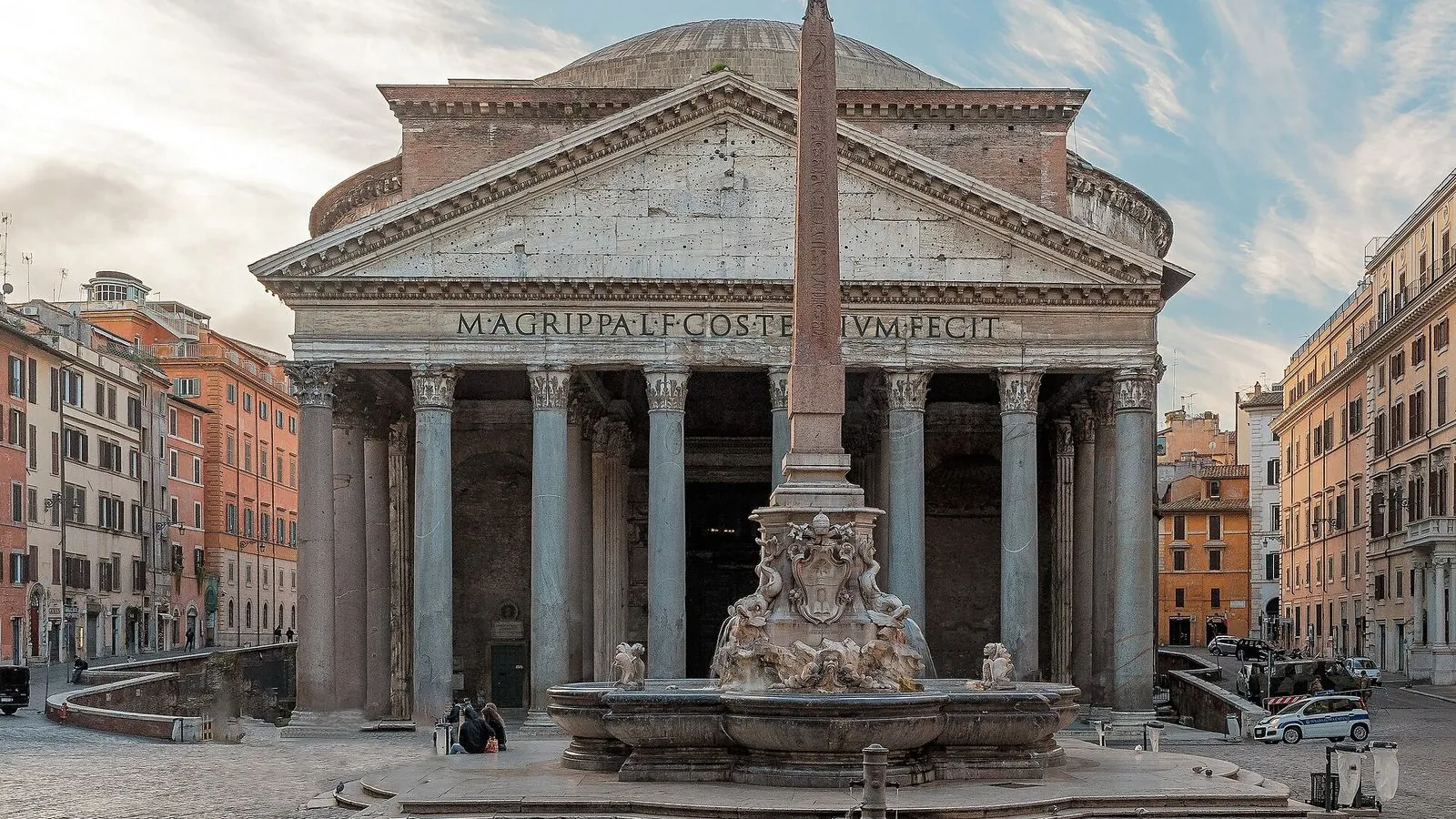
Photo by Rabax63 on Wikimedia Commons

Pantheon

0:00

The largest unreinforced concrete dome on earth, standing for nineteen centuries with an open oculus to the sky.

The building in front of you has been standing for more than nineteen hundred years, and its dome is still the largest unreinforced concrete dome on the planet. Not the largest in antiquity, not one of the largest: the largest, period. Forty-three point three meters across, and forty-three point three meters high. A perfect sphere would fit inside.

The secret is in the concrete. The aggregate changes as the dome rises. Heavy travertine chips at the base, then tufa and broken brick in the middle, and at the crown, around the oculus, lightweight volcanic pumice. Each layer is thinner and lighter than the one below it.

The oculus itself, almost nine meters wide, does more than let in rain and light; it relieves the stress at the dome's weakest point and acts as a compression ring, holding the whole structure together. The inscription across the portico, M AGRIPPA L F COS TERTIVM FECIT, credits Marcus Agrippa, who built the first temple here in 27 BC. That one burned. The emperor Hadrian rebuilt it around 126 AD and modestly kept Agrippa's name.

Since 609 it has been a church, Santa Maria ad Martyres, which is why it survived when so many ancient Roman buildings were stripped for stone. The artist Raphael is buried here, in a tomb near the altar. Entry requires a ticket. Join the queue that snakes across the portico.

Once inside, stand under the oculus and look up. On a rainy day, the floor is wet in a perfect circle. On a clear day, a column of light moves across the coffered ceiling like a slow sundial. The Romans built this, and almost two thousand years later, no one has built a bigger unreinforced concrete dome.

Michelangelo, designing St. Peter's, came ninety centimeters short.

≈4 min walk to the next stop
Free preview ends here · stops 4 to 6 continue in the app

Sant'Ignazio di Loyola

A Jesuit church where Andrea Pozzo painted a fake dome so convincing that the eye refuses to see the flat ceiling.

in app

Trevi Fountain

Rome's largest Baroque fountain, where Oceanus commands a chariot of seahorses against a palazzo backdrop.

in app

Spanish Steps

The monumental staircase linking Piazza di Spagna to Trinità dei Monti, with the Barcaccia fountain at its foot.

in app
Good to know

Before you go

Is the Pantheon free to enter?

No. Since 2023 the Pantheon charges a €7 entry fee for adults. EU citizens aged 18 to 25 pay €2. Entry is free for under-18s, Rome residents, and on the first Sunday of each month. Tickets are time-slotted and must be bought online via the Musei Italiani platform or on site.

SourceDirezione Musei Nazionali Roma: Pantheon
What is the best time of day to visit the Trevi Fountain?

Early morning, before 8:00, is the only time the Trevi Fountain feels quiet. By 9:00 the crowds build and stay thick until after midnight. Late afternoon, when the low sun hits the travertine, is the most beautiful light, but also the busiest. If you want a photograph without a hundred people in it, go at dawn.

Keep exploring

More walks in Rome

From Foundation to Empire: Rome's Ancient WalkThe essentials

From Foundation to Empire: Rome's Ancient Walk

Walk Rome's history in order: from the Palatine's mythical hut to the Colosseum's arena.

9 stops2.4 km40+ min
The Trastevere ClimbThe hidden side

The Trastevere Climb

Cross a Renaissance bridge, stand before Raphael's Galatea, then climb to the fountain that inspired the Trevi and the finest free panorama in Rome.

6 stops2.4 km40+ min
From Michelangelo to the River: The Capitoline and the GhettoThe essentials

From Michelangelo to the River: The Capitoline and the Ghetto

Descend from Michelangelo's perfect piazza through the ancient Jewish quarter to the oldest bridge and the island of healing.

7 stops1.3 km25+ min
From the Aventine to Testaccio: Rome's Quiet Hill and the Mountain of ShardsThe essentials

From the Aventine to Testaccio: Rome's Quiet Hill and the Mountain of Shards

A downhill walk from a secret keyhole view of St. Peter's to an ancient trash heap made of 53 million olive oil jars, ending at Rome's best street-food market.

7 stops2.2 km40+ min
The Caelian Hill: Rome's Quiet SummitThe hidden side

The Caelian Hill: Rome's Quiet Summit

A climb through Rome's most layered hill, from an underground Mithraeum to the mother church of Catholicism.

5 stops2 km35+ min
The Pope's Backyard: From St. Peter's to the Bridge of AngelsThe local mix

The Pope's Backyard: From St. Peter's to the Bridge of Angels

The papal city from the street: Bernini's colonnade, Mussolini's boulevard, a secret escape route, and the angels on Hadrian's bridge.

6 stops1.9 km25+ min
Monti: Rome's First RioneThe local mix

Monti: Rome's First Rione

A 100-minute walk from the square where locals gather at sunset, through the streets where Julius Caesar grew up, to Michelangelo's Moses and a basilica ceiling that Romans say was gilded with the first gold from the Americas.

6 stops2 km30+ min

Provenance · last verified August 18, 2026

Built from the Wayside route itself: the stops, their order, and the walk between them.

Photo by Nicola since 1972 on Openverse · CC BY 2.0

Photo by Myrabella on Wikimedia Commons · CC BY-SA 3.0

Photo by Jorge Franganillo on Wikimedia Commons · CC BY 2.0

Photo by Rabax63 on Wikimedia Commons · CC BY-SA 4.0

Photo by Wolfgang Moroder on Wikimedia Commons · CC BY-SA 3.0

Photo by Dguendel on Wikimedia Commons · CC BY 3.0

Photo by Nhartmannphotos on Wikimedia Commons · CC BY-SA 4.0

Photo by My Past from Norway on Wikimedia Commons · CC BY 2.0

Photo by Palickap on Wikimedia Commons · CC BY-SA 4.0

Photo by Diliff on Wikimedia Commons · CC BY-SA 3.0

Photo by Vadim Zhivotovsky on Wikimedia Commons · CC BY 3.0

Coming soon

Wayside isn't in the app stores yet, but it's in the works. Check back soon.