Rome · Self-guided audio walk

From Michelangelo to the River: The Capitoline and the Ghetto

Descend from Michelangelo's perfect piazza through the ancient Jewish quarter to the oldest bridge and the island of healing.

  • 7Stops
  • 1.3 kmDistance
  • 25+ minTime
From Michelangelo to the River: The Capitoline and the Ghetto

Photo by Nhartmannphotos on Wikimedia Commons

This walk starts on the Capitoline Hill, where Michelangelo designed a piazza that turned Rome toward a new age. From there you descend past the Theatre of Marcellus, Augustus's prototype for the Colosseum, and into the narrow streets of the former Jewish Ghetto. The Portico d'Ottavia, Rome's medieval fish market, is still the quarter's ancient gateway. Around the corner, the Turtle Fountain sits in a pocket-square like a Renaissance secret. The Great Synagogue, with its aluminum dome, anchors the neighborhood and its museum tells the story of the oldest continuous Jewish community in Europe. You cross Ponte Fabricio, a bridge from 62 BC that has never stopped carrying feet, and end on Tiber Island, a ship-shaped sanctuary where a hospital has operated since 1584. The walk takes about an hour and fifty minutes, all downhill or flat, through three thousand years of layered Roman history.

Hear it on the street

Get the turn-by-turn audio guide in the app. The narration plays itself as you reach each stop, hands-free and offline.

Stop by stop

The route

Interactive map of the route. The full stop list below works without it.

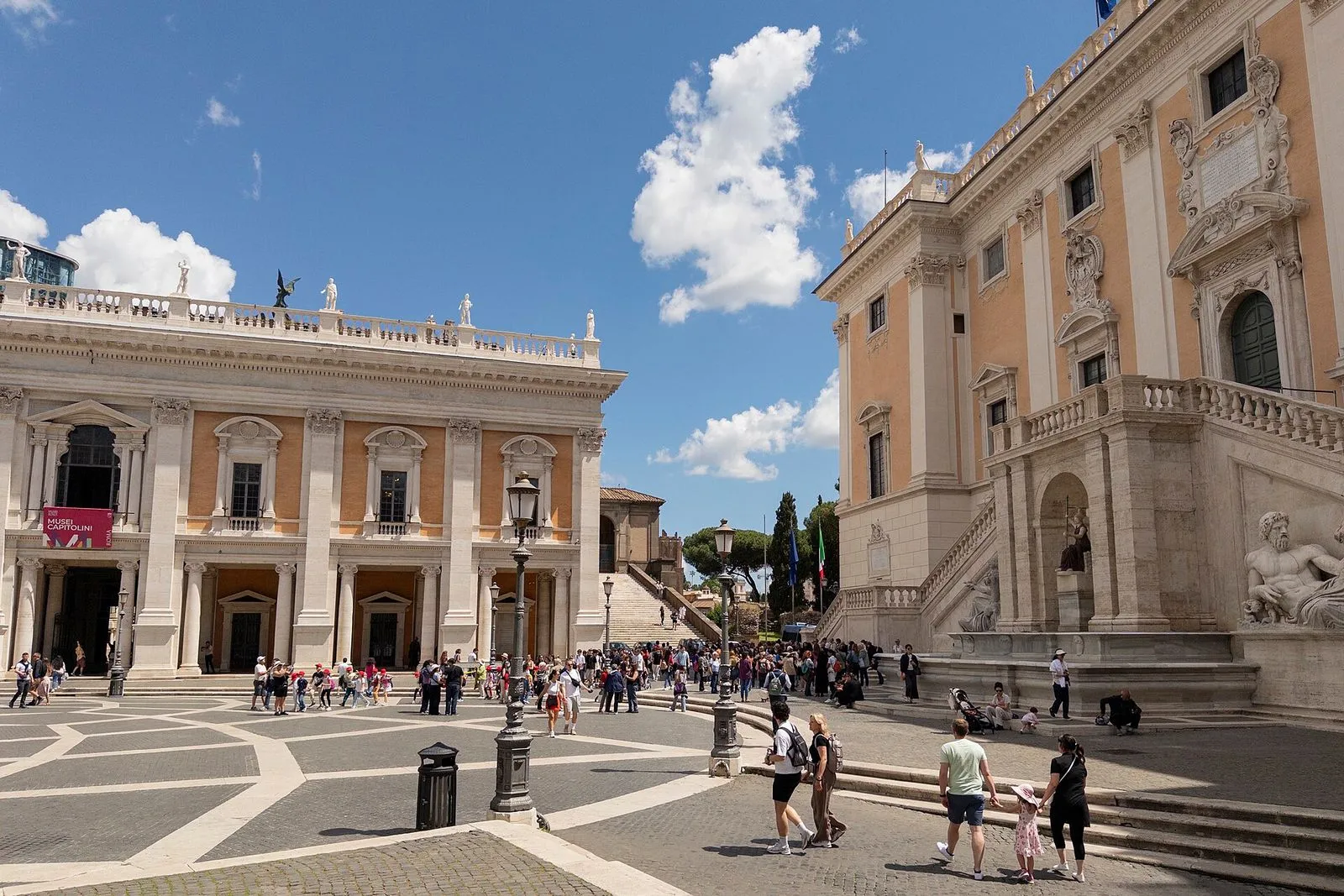
Piazza del CampidoglioMust see

Photo by joanne clifford on Wikimedia Commons

Piazza del Campidoglio

0:00

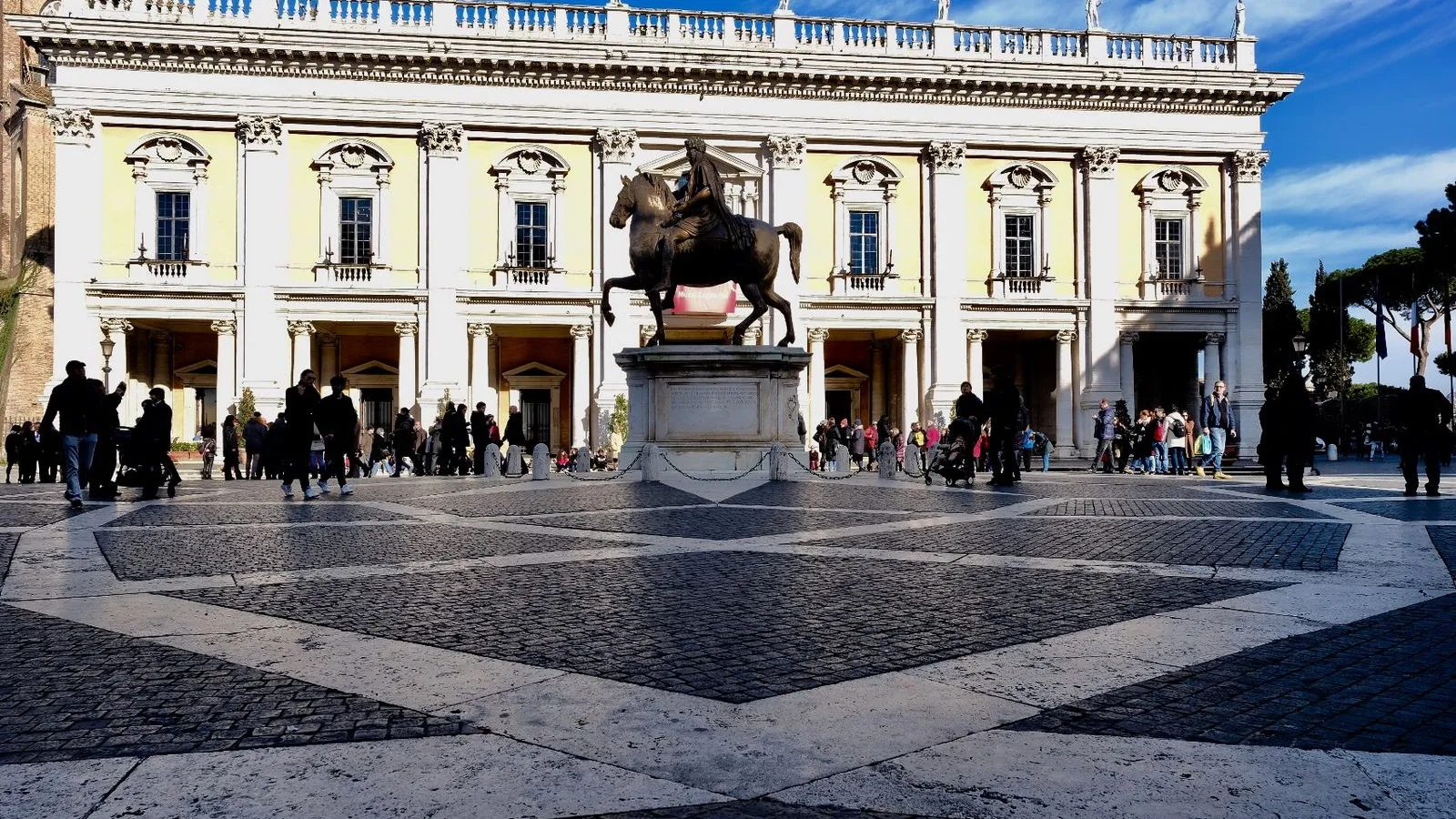
Michelangelo's masterpiece square atop the Capitoline Hill, with the equestrian Marcus Aurelius and palaces housing the oldest public museum in the world.

You're standing on the Capitoline Hill, the ceremonial heart of Rome since before the Republic. The piazza under your feet is Michelangelo's last great architectural work, laid out for Pope Paul III in the 1530s and not fully paved until 1940. Take in the geometry. The square is a trapezoid, wider at the back than at the front, which tricks your eye into thinking it is larger than it really is.

The oval star pattern in the pavement radiates from the equestrian statue of Marcus Aurelius at the center. That is a copy; the original, gilded bronze, is inside the Capitoline Museums to your left and right. Michelangelo turned the hill's axis 180 degrees. For a thousand years the Capitoline faced the Roman Forum behind you.

He spun it around to face the new city, toward Saint Peter's, and added the grand ramp, the cordonata, that you climbed to get here. The Palazzo Senatorio straight ahead has been Rome's city hall since the twelfth century. Underneath it sits the Tabularium, the ancient Roman state archive. When you are ready, find the cordonata and descend.

From the bottom, turn right on Via del Teatro di Marcello.
≈5 min walk to the next stop
Theatre of MarcellusMust see

Photo by Gaiadh on Wikimedia Commons

Theatre of Marcellus

0:00

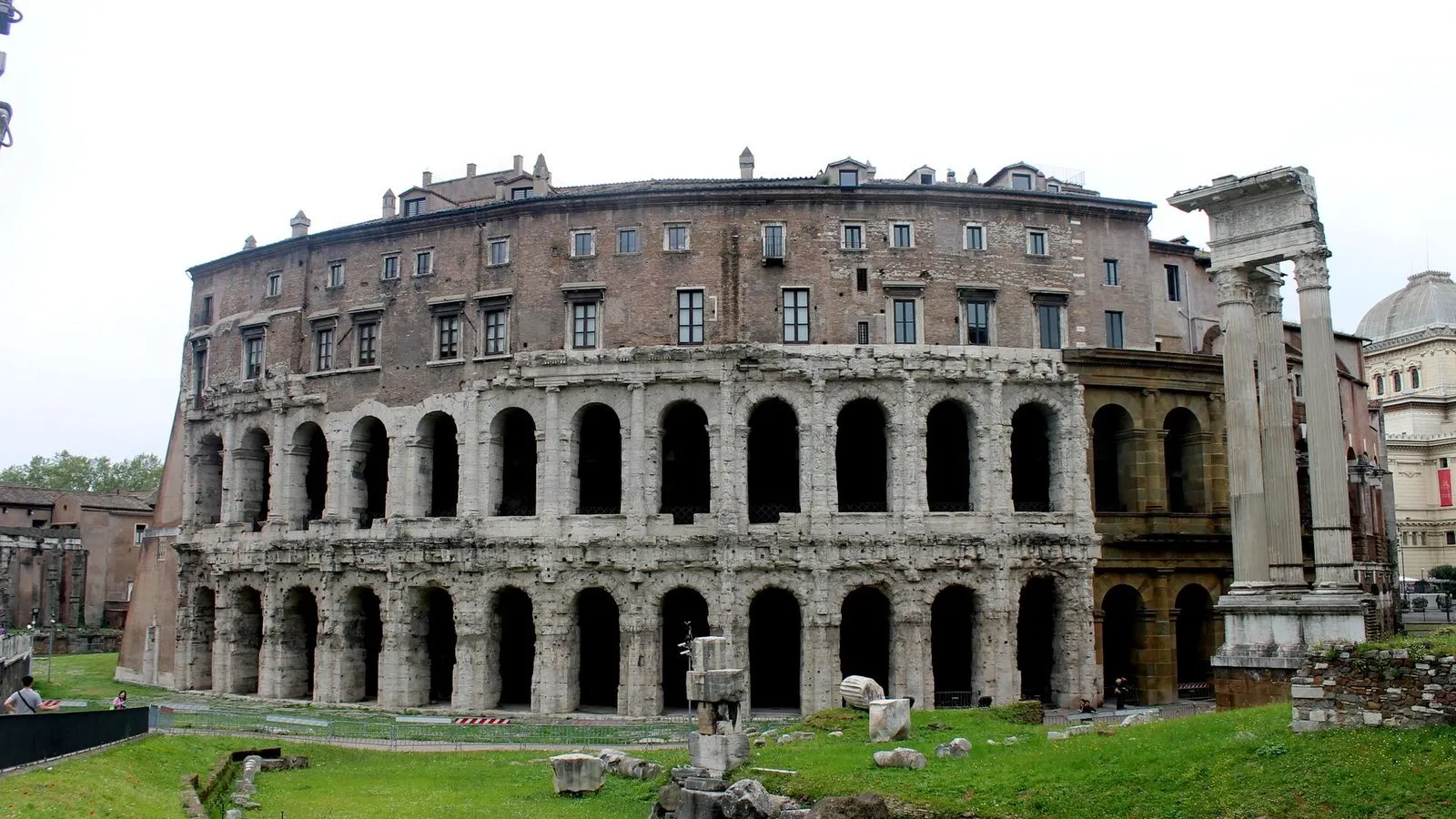
Augustus's great theatre from 13 BC, later a fortress and a palace, still standing three tiers high.

This is the theatre that taught the Colosseum how to stand. Julius Caesar cleared the ground. Augustus finished it in 13 BC and named it for his nephew and heir, Marcellus, who had died at nineteen. The curved travertine wall in front of you is the theatre's outer shell: two tiers of arched arcades, Doric below and Ionic above.

A third tier of Corinthian pilasters once topped them, long gone now. It held somewhere around 15,000 people, making it the largest and most important theatre in ancient Rome. Look up. The apartments above the arches are not ancient.

In the Middle Ages the theatre became a fortress, first for the Pierleoni family, then the Savelli. In the 1520s Baldassare Peruzzi built a Renaissance palace right on top of the Roman shell. It is still a private residence today, the Palazzo Orsini. The theatre is also the earliest datable building in Rome to use fired brick, a technique the Romans had just learned from the Greek world.

When you are done, walk past the theatre on Via del Portico d'Ottavia. The Portico is two minutes ahead on your left.

≈2 min walk to the next stop
Portico d'OttaviaMust see

Photo by Jorge Franganillo on Wikimedia Commons

Portico d'Ottavia

0:00

The monumental gateway that served as Rome's fish market and marked the northern entrance to the Jewish Ghetto.

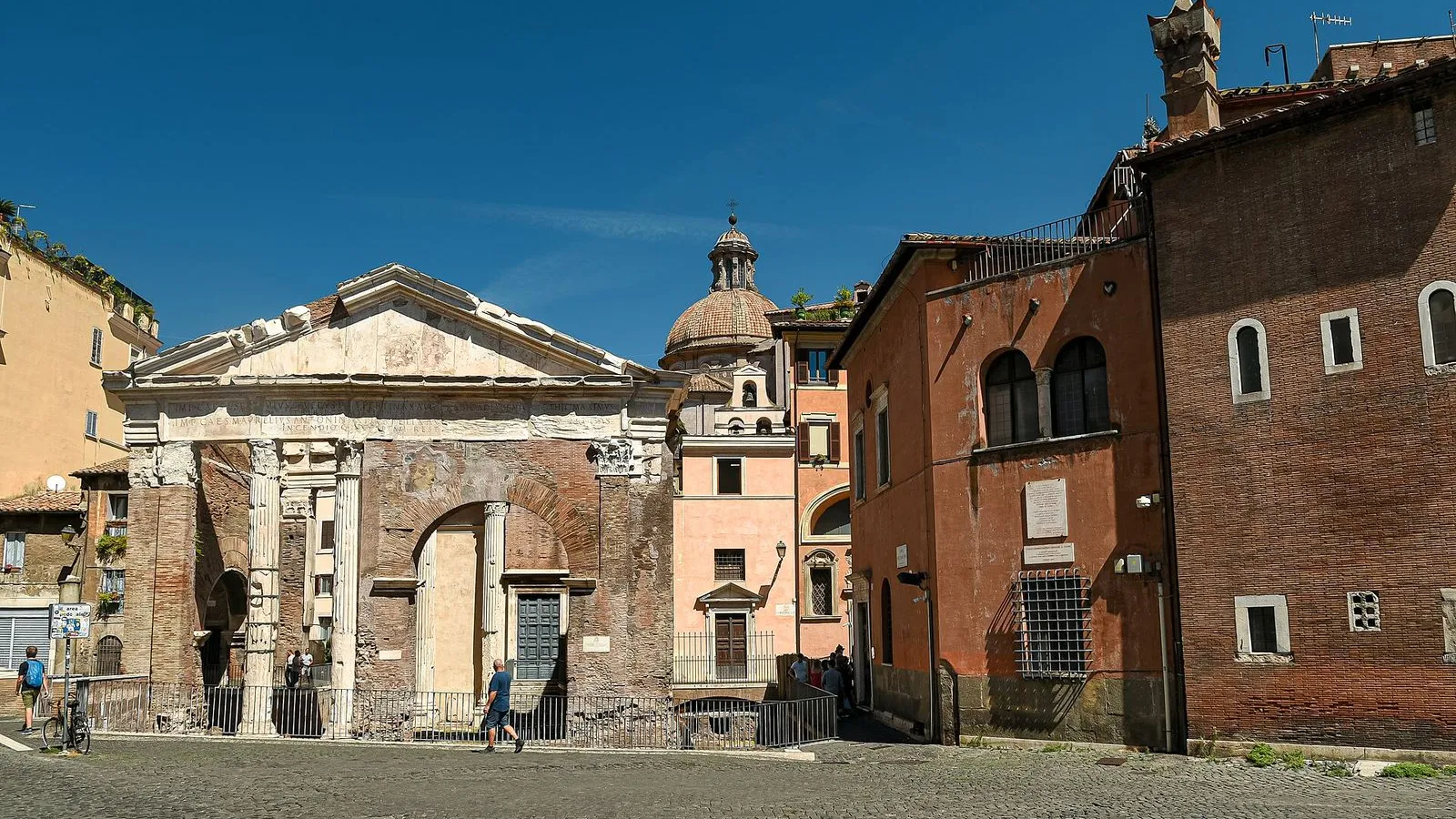
These columns are what remains of the Portico d'Ottavia, a vast colonnaded square built in the second century BC and rebuilt by Augustus, who renamed it for his sister Octavia. It once enclosed two temples, a library, and an assembly hall where the Roman Senate sometimes met. In 442 an earthquake toppled the two center columns, and they were replaced with the brick arch you see now. That arch, and the church of Sant'Angelo in Pescheria built into the ruins behind it, tell the next chapter.

From the Middle Ages through the late 1800s this was the city fish market. The name of the church, Saint Angel in the Fish Market, says it plainly. Find the marble slab embedded in the right side of the arch. The Latin inscription decrees that any fish longer than the slab, from head to first fin, belonged to the city magistrates.

That slab is the only visible trace of the market. This portico was also the northern gate of the Jewish Ghetto, established by Pope Paul IV in 1555. The wall ran from here to the river, and for over three hundred years Rome's Jews were locked inside every night. The ghetto was abolished in 1870 when Rome joined the Kingdom of Italy; the walls came down in 1888.

Turn away from the arch and walk one block to Piazza Mattei, a small square just to your right.

≈3 min walk to the next stop
Free preview ends here · stops 4 to 7 continue in the app

Fontana delle Tartarughe

A late Renaissance jewel with bronze turtles, quietly tucked into a small square once fought over by noble families.

in app

Great Synagogue of Rome

The Tempio Maggiore, opened in 1904 on the site of the demolished ghetto, with its distinctive aluminum dome and two millennia of history inside.

in app

Ponte Fabricio

Rome's oldest bridge, built in 62 BC and still carrying pedestrians to Tiber Island.

in app

Tiber Island

A ship-shaped sanctuary in the Tiber, home to a temple of healing and a hospital that has operated since 1584.

in app
Good to know

Before you go

Can I visit the Great Synagogue of Rome?

Yes, the Tempio Maggiore and its museum are open Sunday through Thursday from 10:00 to 18:00 and Friday from 10:00 to 16:00. The museum ticket costs €11 full price and includes a guided tour of the synagogue. The museum tells the story of the oldest continuous Jewish community in Europe. The synagogue is closed on Saturdays and Jewish holidays.

SourceMuseo Ebraico di Roma: official site
Is Tiber Island worth crossing the bridge for?

Yes. Ponte Fabricio, the bridge from 62 BC, is the oldest bridge in Rome that still carries foot traffic. Tiber Island itself is a ship-shaped sanctuary where a hospital has operated since 1584. In summer, the island hosts an open-air cinema and pop-up bars along the riverbank. It is a brief, rewarding detour.

Keep exploring

More walks in Rome

From Foundation to Empire: Rome's Ancient WalkThe essentials

From Foundation to Empire: Rome's Ancient Walk

Walk Rome's history in order: from the Palatine's mythical hut to the Colosseum's arena.

9 stops2.4 km40+ min
Baroque Heart of the Campus MartiusThe essentials

Baroque Heart of the Campus Martius

From a morning market to the Spanish Steps, a walk through Rome's most beautiful piazzas, fountains, and domes.

6 stops2.4 km40+ min
The Trastevere ClimbThe hidden side

The Trastevere Climb

Cross a Renaissance bridge, stand before Raphael's Galatea, then climb to the fountain that inspired the Trevi and the finest free panorama in Rome.

6 stops2.4 km40+ min
From the Aventine to Testaccio: Rome's Quiet Hill and the Mountain of ShardsThe essentials

From the Aventine to Testaccio: Rome's Quiet Hill and the Mountain of Shards

A downhill walk from a secret keyhole view of St. Peter's to an ancient trash heap made of 53 million olive oil jars, ending at Rome's best street-food market.

7 stops2.2 km40+ min
The Caelian Hill: Rome's Quiet SummitThe hidden side

The Caelian Hill: Rome's Quiet Summit

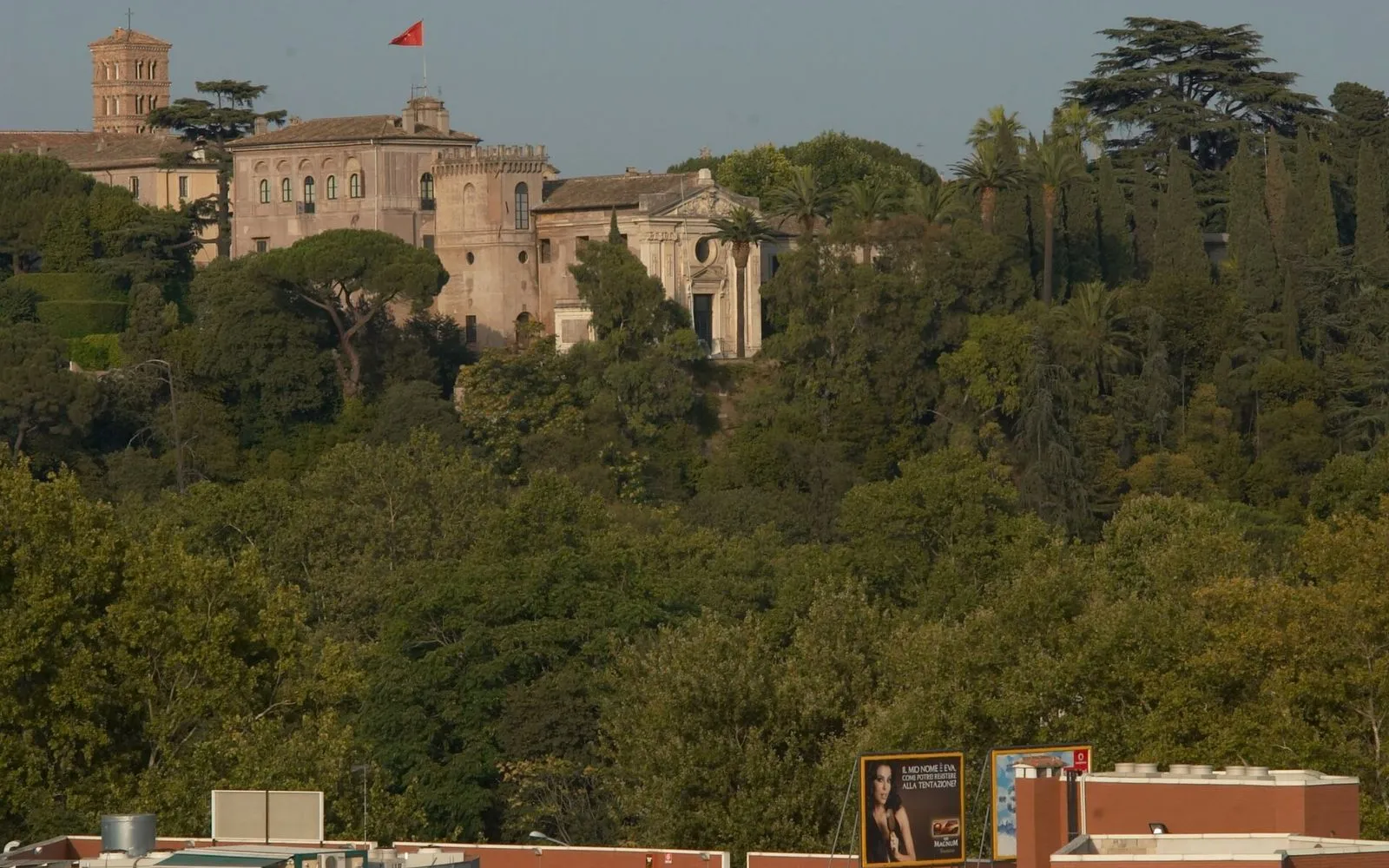
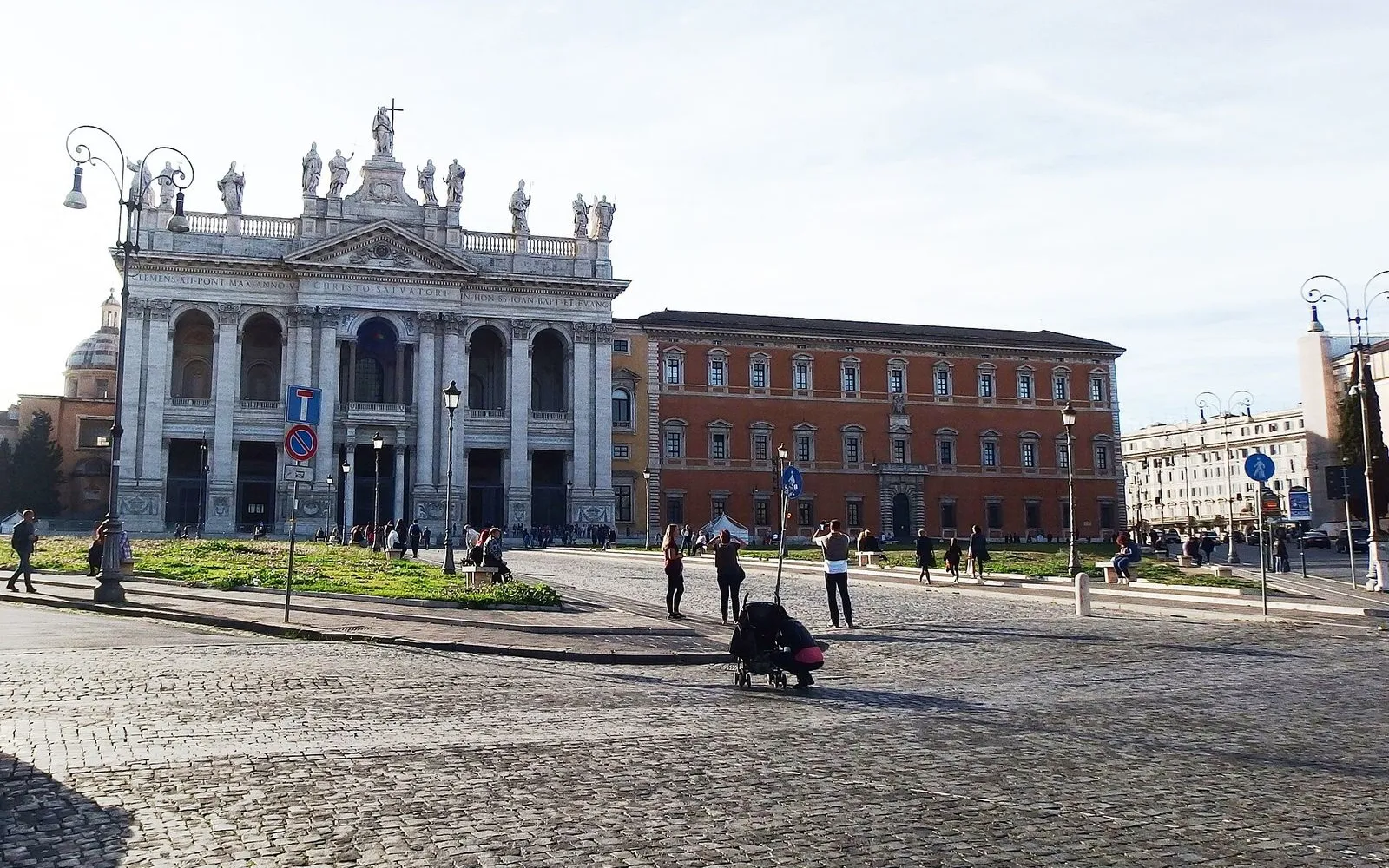
A climb through Rome's most layered hill, from an underground Mithraeum to the mother church of Catholicism.

5 stops2 km35+ min
The Pope's Backyard: From St. Peter's to the Bridge of AngelsThe local mix

The Pope's Backyard: From St. Peter's to the Bridge of Angels

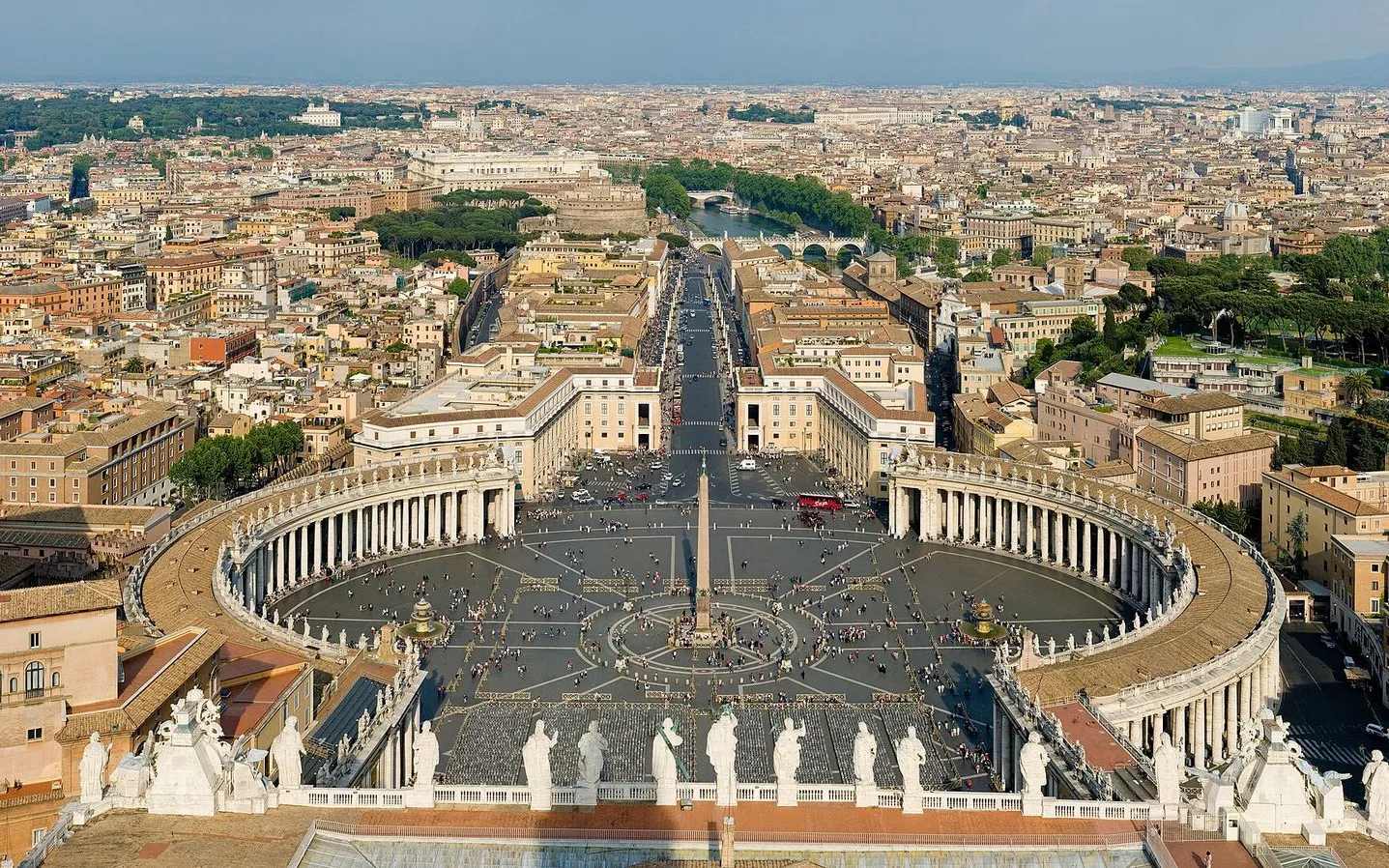
The papal city from the street: Bernini's colonnade, Mussolini's boulevard, a secret escape route, and the angels on Hadrian's bridge.

6 stops1.9 km25+ min
Monti: Rome's First RioneThe local mix

Monti: Rome's First Rione

A 100-minute walk from the square where locals gather at sunset, through the streets where Julius Caesar grew up, to Michelangelo's Moses and a basilica ceiling that Romans say was gilded with the first gold from the Americas.

6 stops2 km30+ min

Provenance · last verified August 9, 2026

Built from the Wayside route itself: the stops, their order, and the walk between them.

Photo by Nhartmannphotos on Wikimedia Commons · CC BY-SA 4.0

Photo by joanne clifford on Wikimedia Commons · CC BY 2.0

Photo by Gaiadh on Wikimedia Commons · CC BY-SA 4.0

Photo by Jorge Franganillo on Wikimedia Commons · CC BY 2.0

Photo by Wolfgang Moroder on Wikimedia Commons · CC BY-SA 3.0

Photo by Nicola since 1972 on Openverse · CC BY 2.0

Photo by Dguendel on Wikimedia Commons · CC BY 3.0

Photo by My Past from Norway on Wikimedia Commons · CC BY 2.0

Photo by Palickap on Wikimedia Commons · CC BY-SA 4.0

Photo by Diliff on Wikimedia Commons · CC BY-SA 3.0

Photo by Vadim Zhivotovsky on Wikimedia Commons · CC BY 3.0

Coming soon

Wayside isn't in the app stores yet, but it's in the works. Check back soon.