Milan · Self-guided audio walk

From Rail Yards to the Vertical Forest

Walk the seam where Milan's working-class Isola meets the glass towers and hanging gardens of Porta Nuova.

  • 6Stops
  • 3 kmDistance
  • 45+ minTime
From Rail Yards to the Vertical Forest

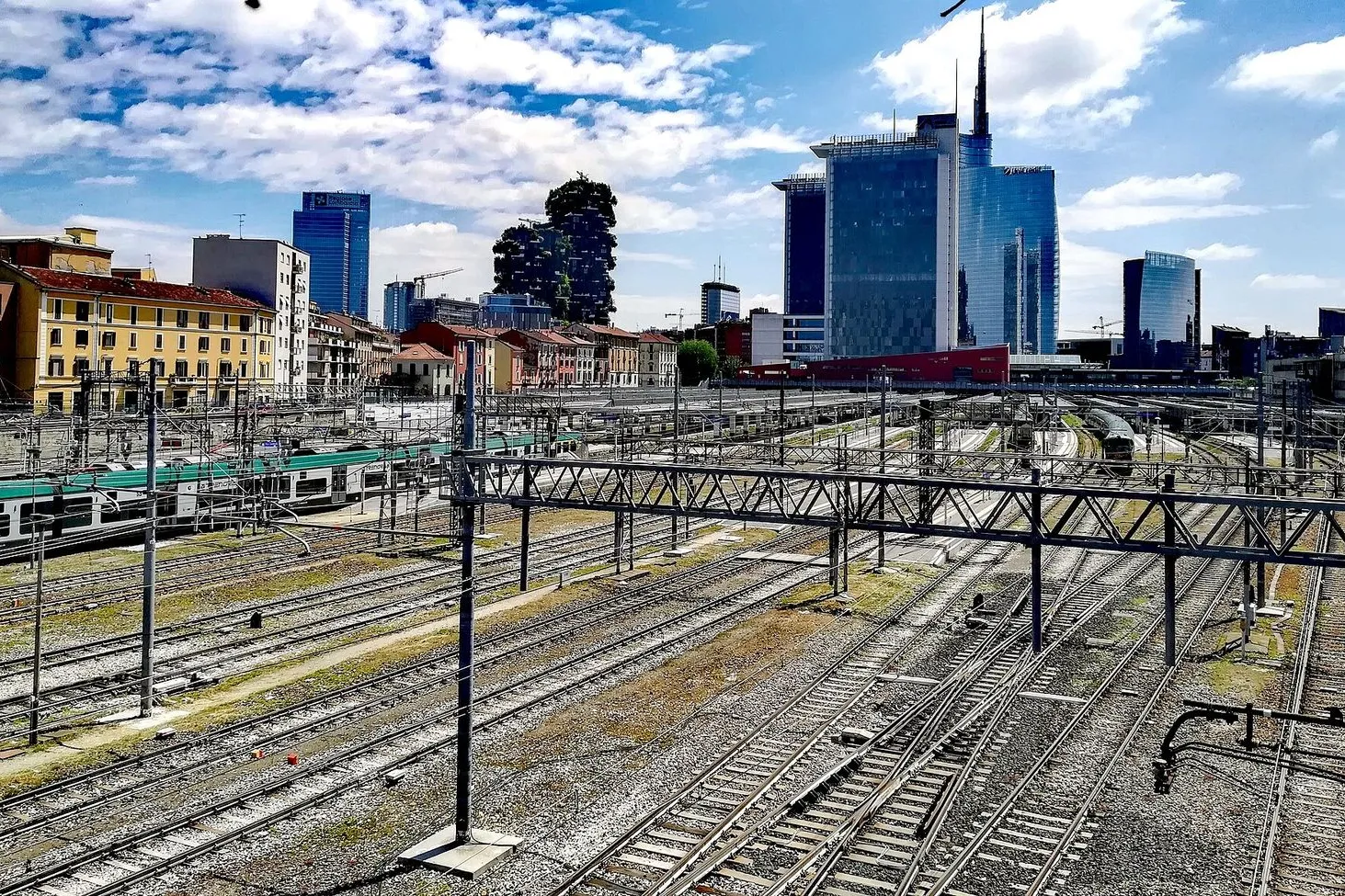
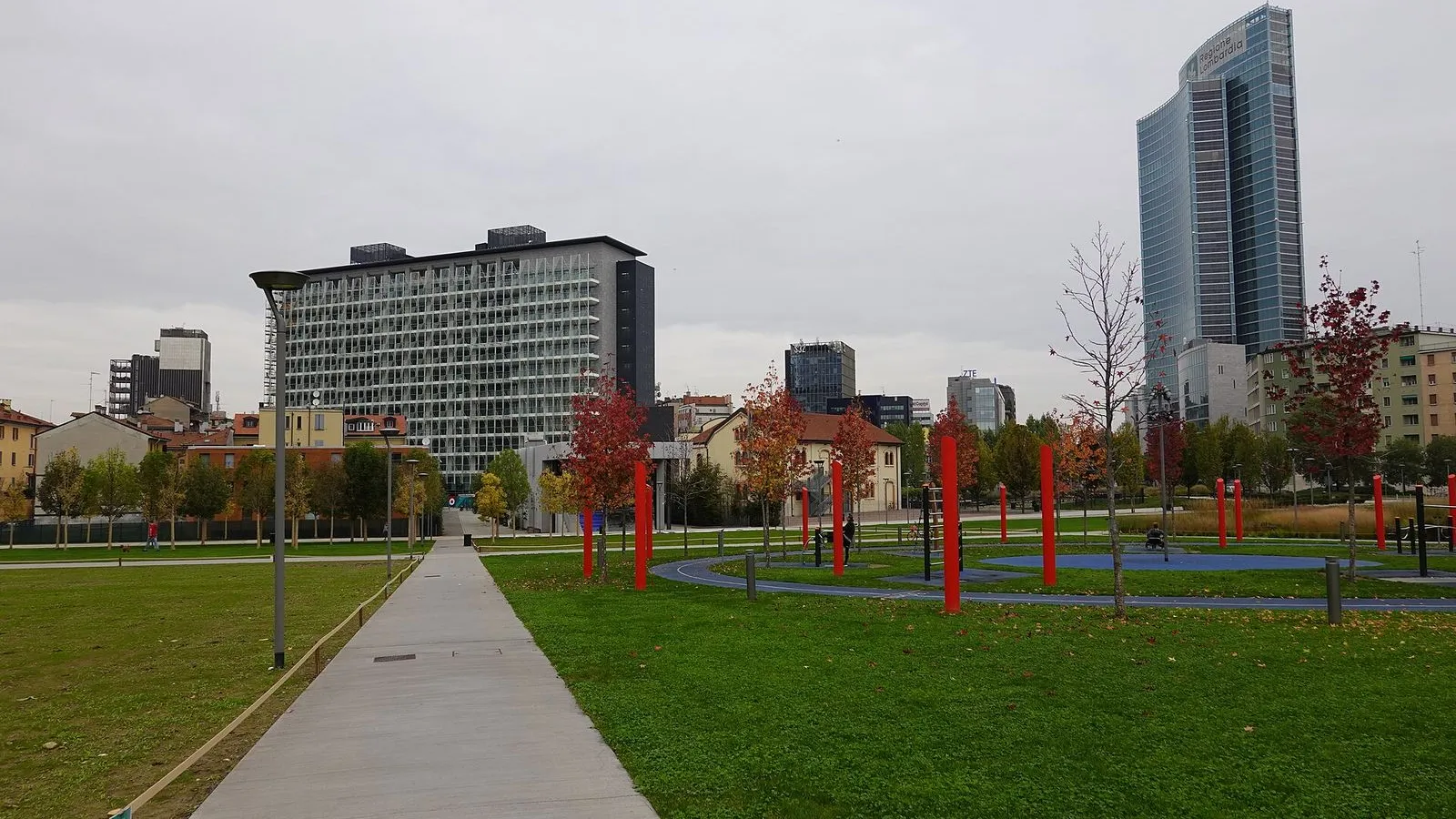
Photo by FlavMi on Wikimedia Commons

Milan did something improbable after the 2008 financial crisis. It took 29 hectares of abandoned rail yards just north of the city center and, over a single decade, turned them into one of Europe's largest urban regeneration projects. This walk traces the seam between what was built and what was already there. You start on the raised disc of Piazza Gae Aulenti, where César Pelli's glass towers circle a shallow reflecting pool, then climb toward the Bosco Verticale, two apartment blocks carrying a small forest of 800 trees on their staggered balconies. The route crosses the Biblioteca degli Alberi, a botanical park planted over former tracks, before ducking into the narrow streets of Isola, the working-class neighborhood whose case di ringhiera and artisan workshops refused to vanish when the skyscrapers arrived. From there you follow the old road to Como, now a pedestrian strip of boutiques and cocktail bars, and end at the Monumental Cemetery, an open-air sculpture gallery whose marble angels have watched the entire skyline rise over the last 160 years.

Hear it on the street

Get the turn-by-turn audio guide in the app. The narration plays itself as you reach each stop, hands-free and offline.

Stop by stop

The route

Interactive map of the route. The full stop list below works without it.

Piazza Gae AulentiMust see

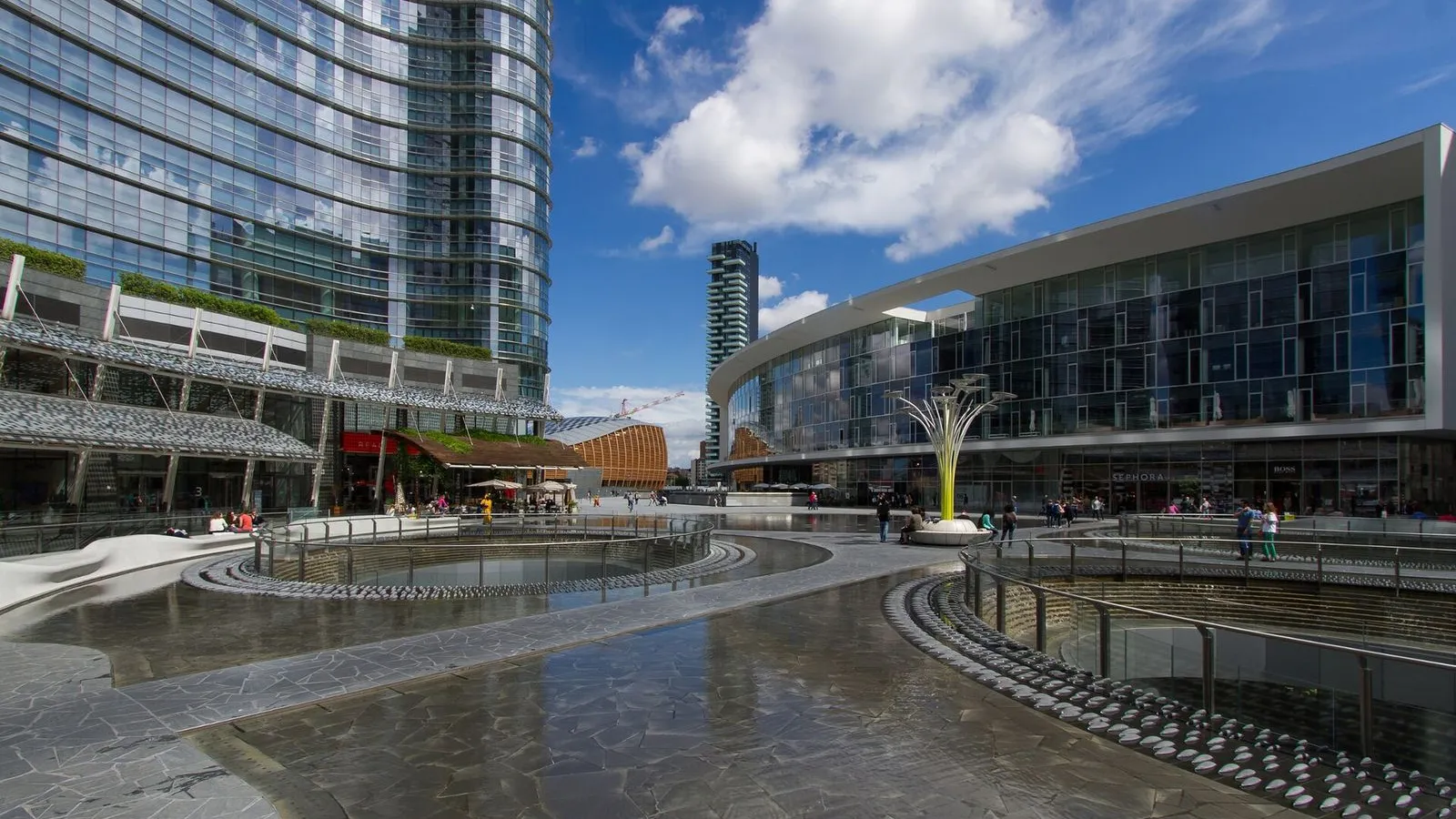
Photo by Pierre Selim Huard on Wikimedia Commons

Piazza Gae Aulenti

0:00

A raised circular piazza at the heart of Porta Nuova, ringed by César Pelli's glass towers and centered on a shallow reflecting pool that cascades two stories down.

You are standing on a disc of pale stone, raised a full story above the street. Below you, the old Varesine rail yards sat empty for forty years, a hole in the city where traveling circuses pitched their tents and, for a long time, an amusement park drew Milanese families. None of that is visible now. Around you rise the three UniCredit towers, the tallest in Italy when they topped out in 2012.

Their architect, César Pelli, arranged them so the highest, 231 meters with its spiral spire, catches the morning light first. Look at the pool. It is only a few centimeters deep, but it is not merely decorative. It cascades over the edge of the podium and falls two floors down, feeding a ring of light wells that brighten the shopping concourse below.

On a still day the water becomes a mirror, and the towers double. The piazza is named for Gae Aulenti, the Italian architect who turned a Paris train station into the Musée d'Orsay. Fitting, because this whole district is a station turned into something else. When you are ready, walk northeast along the right-hand edge of the square toward the two green towers you can already see.

≈5 min walk to the next stop
Bosco VerticaleMust see

Photo by Uri Pernalete on Unsplash

Bosco Verticale

0:00

Two residential towers by Stefano Boeri carry 800 trees and over 20,000 plants across their staggered balconies, a vertical forest completed in 2014.

You are looking at the most photographed apartment building of the last decade. Two towers, 111 and 78 meters tall, wrapped in foliage. Not vines or creepers, proper trees. Holm oaks, flowering pears, wild apples, pomegranates.

Over 800 of them, plus 5,000 shrubs and 15,000 perennials, all rooted in concrete planters cantilevered from each balcony. Stefano Boeri and his team spent three years growing these trees in a nursery before the towers were finished. They needed to train the roots to tolerate wind at height and to accept a very specific soil mix, volcanic lapilli, peat, and bark. Each balcony is a microclimate.

The leaves filter particulate matter from the air, absorb CO₂, and cut the building's cooling load by about 30 percent in summer. Birds nest here. Butterflies breed. The towers opened in 2014, the last piece of the Porta Nuova puzzle.

They sit exactly where the rail tracks once curved around the Isola district, sealing it off from the rest of Milan. For a century, this was a wall of steel and gravel. Now it is a wall of leaves. Cross the road and walk around to the park side of the towers for the best view, then continue east into the Biblioteca degli Alberi.

≈5 min walk to the next stop
Biblioteca degli AlberiMust see

Photo by Guilhem Vellut on Wikimedia Commons

Biblioteca degli Alberi

0:00

A 90,000-square-meter botanical park by Petra Blaisse, planted on former rail land with labeled tree species arranged as a living library.

This park is called the Library of Trees, and the name is literal. Over 500 trees grow here, arranged in 22 circular groves, each one a different species. Every tree is labeled with its Latin and common name, its country of origin, and the year it was planted. You can walk from the Caucasian wingnut to the Japanese pagoda tree in twenty paces.

The Dutch firm Inside Outside, led by Petra Blaisse, won the competition to design this space in 2003, but construction did not begin until 2015. The park opened in 2018. Under your feet, about a meter down, the soil is an engineered mix sitting on a waterproof membrane that seals off the contaminated ground of the old rail yards. Before planting, the earth had to be capped, drained, and rebuilt.

Look west. The UniCredit spire rises above the treeline. Look east and north and you see the old Isola, brick apartment blocks, red rooftops, the campanile of the church of Santa Maria alla Fontana. The park was designed to stitch these two worlds together.

Paths radiate from circular clearings, some paved for cyclists, some gravel for walkers, some left as grass. In summer, families spread blankets here. Office workers from the towers eat lunch on the benches. When you are ready, walk north toward the red brick buildings and find Via Borsieri.

≈7 min walk to the next stop
Free preview ends here · stops 4 to 6 continue in the app

Via Borsieri

The spine of Milan's old working-class Isola district, lined with case di ringhiera, artisan workshops, and neighborhood trattorias.

in app

Corso Como

A pedestrianized former trade route turned fashion-and-nightlife strip, home to Carla Sozzani's pioneering 10 Corso Como concept store.

in app

Cimitero Monumentale

Milan's open-air sculpture museum, opened in 1866, with Carlo Maciachini's striped marble Famedio housing the tomb of Alessandro Manzoni.

in app
Good to know

Before you go

Can you go inside the Bosco Verticale?

The Bosco Verticale is a private residential building. The apartments are occupied and there is no public interior access. You can admire the towers and their 800 trees from the street, from the Biblioteca degli Alberi park, and from the raised pedestrian walkways of Porta Nuova. The best view is from the park just east of the towers, where you can see all the way up the staggered balconies.

Is the Cimitero Monumentale free to visit?

Yes, the Cimitero Monumentale is free and open to the public. It is not a macabre stop but an open-air sculpture gallery. Carlo Maciachini's striped-marble Famedio contains the tomb of Alessandro Manzoni, and the arcades and lawns beyond hold funerary monuments by some of the most important Italian sculptors of the late 19th and early 20th centuries. Allow 45 minutes to an hour. Dress respectfully; it remains an active cemetery.

How do I get to Porta Nuova from the Duomo?

Take the M3 yellow line from Duomo to Repubblica, one stop, or the M2 green line to Gioia or Garibaldi, two to three stops. Garibaldi station puts you directly under Piazza Gae Aulenti. You can also walk from Brera in about 20 minutes, crossing the Giardini Pubblici and heading up Corso Como.

Provenance · last verified August 18, 2026

Built from the Wayside route itself: the stops, their order, and the walk between them.

Photo by FlavMi on Wikimedia Commons · CC BY-SA 3.0

Photo by Pierre Selim Huard on Wikimedia Commons · CC BY 3.0

Photo by Uri Pernalete on Unsplash

Photo by Guilhem Vellut on Wikimedia Commons · CC BY 2.0

Photo by JasonParis from Toronto, Canada on Wikimedia Commons · CC BY 2.0

Photo by Terragio67 on Wikimedia Commons · CC BY-SA 4.0

Photo by LucaChp on Wikimedia Commons · CC BY-SA 3.0

Photo by LucaChp on Wikimedia Commons · CC BY-SA 3.0

Photo by https://www.flickr.com/photos/belboo/ on Wikimedia Commons · CC BY-SA 2.0

Photo by Steffen Schmitz on Wikimedia Commons · CC BY-SA 4.0

Coming soon

Wayside isn't in the app stores yet, but it's in the works. Check back soon.