Milan · Self-guided audio walk

From Fortress to Park: Milan's Grand Axis

Walk the sightline that runs from the castle to the Arch of Peace, through courtyards, parkland, and design.

  • 6Stops
  • 1.7 kmDistance
  • 30+ minTime
From Fortress to Park: Milan's Grand Axis

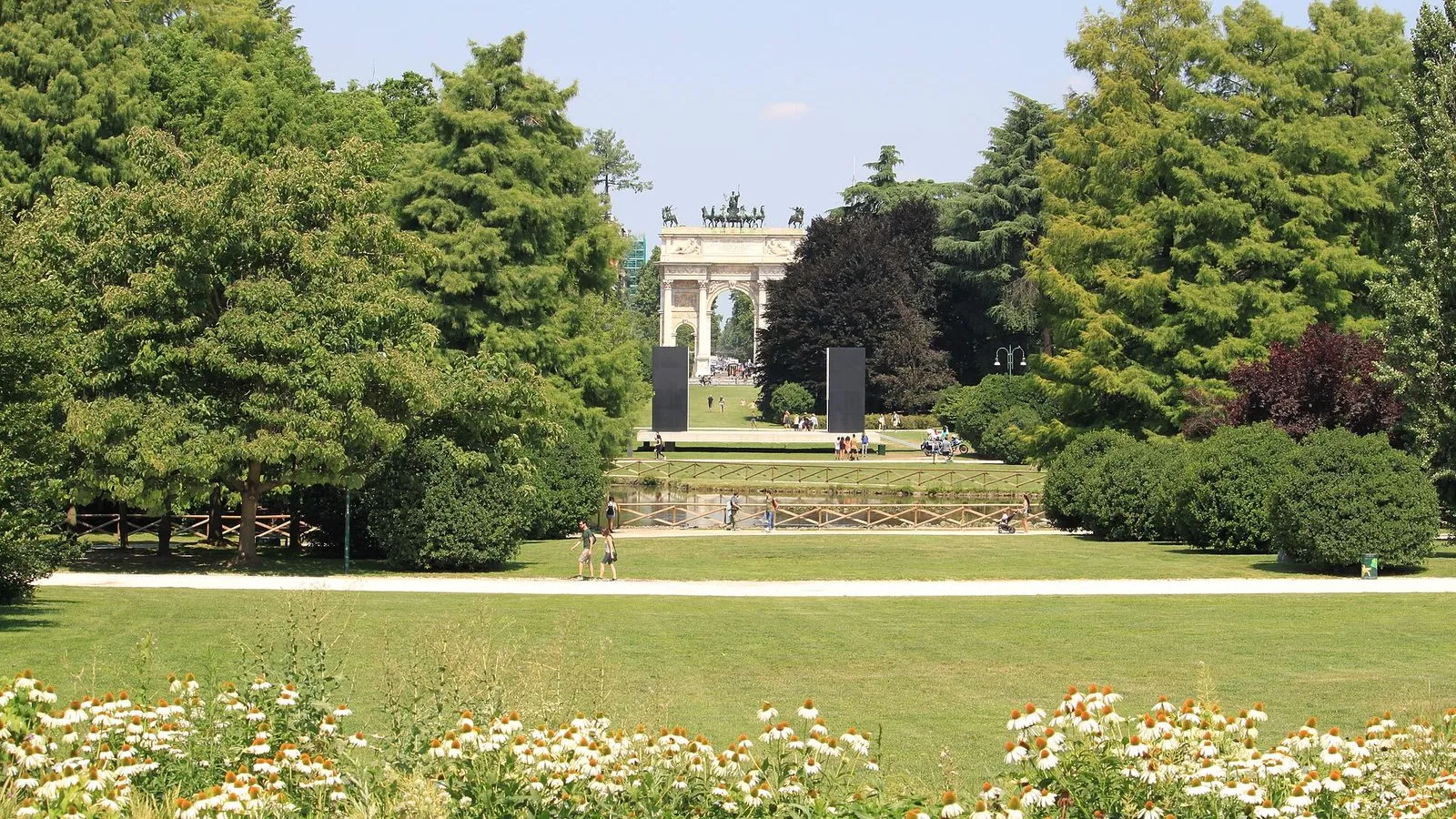
Photo by Terragio67 on Wikimedia Commons

This walk follows Milan's most dramatic straight line: from the Sforza Castle's Filarete tower to the neoclassical Arco della Pace. Along the way you cross a park that was once a duke's hunting ground and later a military parade ground, past a 1930s panoramic tower and a design museum. It is the story of how Milan took a fortress, stripped it of its cannons, and turned its parade ground into one of Europe's finest city parks.

Hear it on the street

Get the turn-by-turn audio guide in the app. The narration plays itself as you reach each stop, hands-free and offline.

Stop by stop

The route

Interactive map of the route. The full stop list below works without it.

Castello SforzescoMust see

Photo by Marivaldo Vivan on Unsplash

Castello Sforzesco

0:00

The 15th-century fortress of the dukes of Milan, entered through the soaring Filarete tower rebuilt in 1905.

You are standing in Piazza Castello, facing the Filarete tower, the central gate of the Sforza Castle. The tower you see is a 1905 reconstruction by Luca Beltrami, but the design goes back to 1452, when the Florentine architect Filarete drew it for Duke Francesco Sforza. The original tower stood less than 70 years before it exploded in 1521. It was being used as a gunpowder magazine.

Beltrami rebuilt it using 16th-century drawings, and he added the clock, the statue of Saint Ambrose in the niche above the arch, and the Sforza coats of arms painted across the facade. The round towers flanking the gate were Francesco Sforza's innovation, replacing the earlier square ones. Cannonballs glanced off curved walls, so round towers meant survival. The castle began as a Visconti stronghold in the 1300s.

Francesco Sforza seized it in 1450 and turned it into a princely residence. Walk through the gate into the Courtyard of Arms when you are ready.
≈3 min walk to the next stop
Pietà RondaniniMust see

Photo by ☰☵ Michele M. F. from Milano, Italy on Wikimedia Commons

Pietà Rondanini

0:00

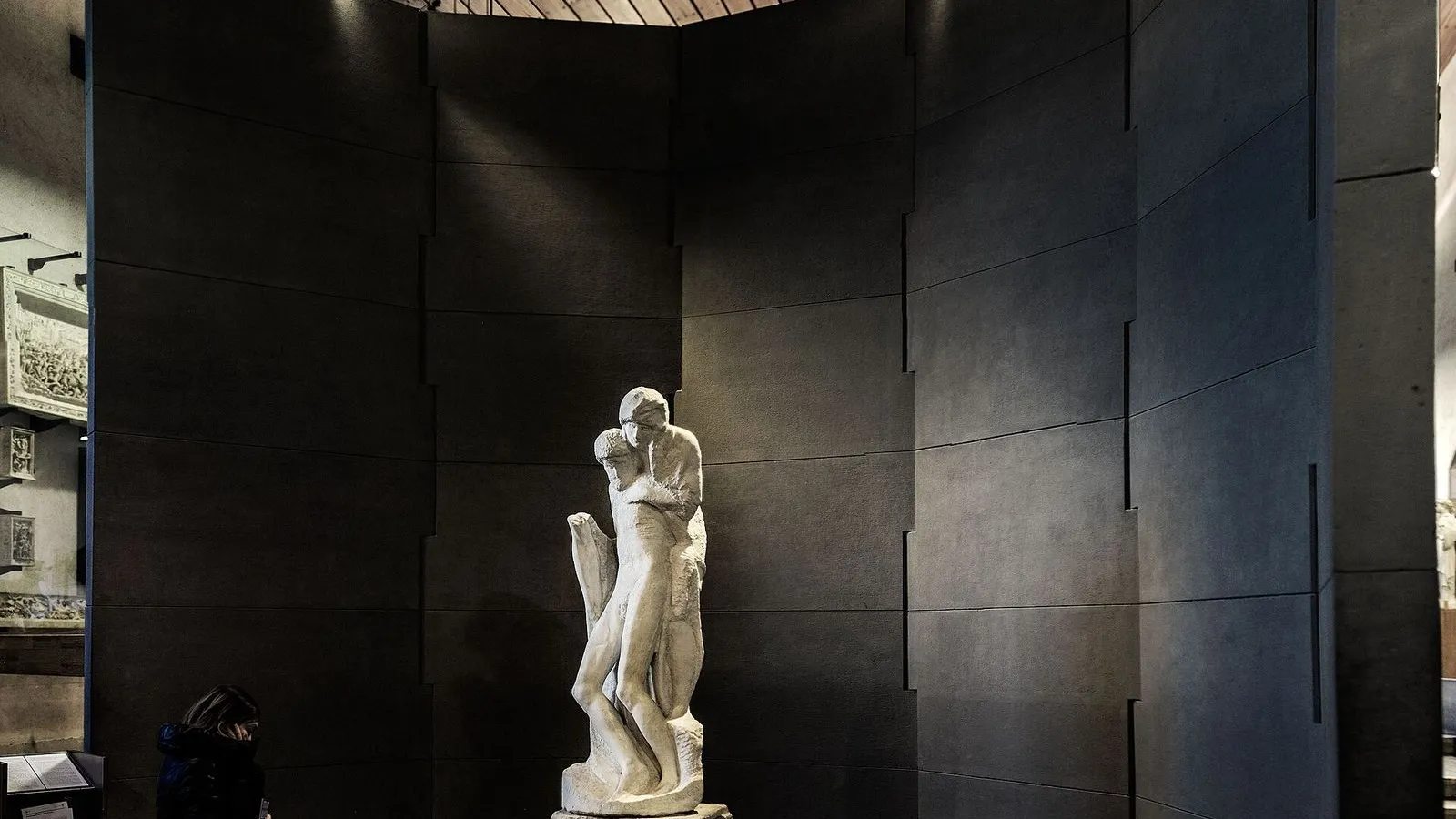
Michelangelo's final sculpture, unfinished at his death in 1564, now housed in the castle's former Spanish hospital.

You are in the Cortile delle Armi, the Courtyard of Arms. This was the castle's military heart, where troops drilled and weapons were stored. On your left is the former Spanish hospital, a long low building where sick soldiers lay during the Habsburg occupation. Since 2015 it has held a single work of art: Michelangelo's Pietà Rondanini.

Michelangelo worked on this marble group for the last twelve years of his life, and he was still chiseling it six days before he died at age 88. The sculpture shows Mary holding the body of Christ, but the figures are elongated, almost abstract. At some point Michelangelo radically changed the composition: you can see a detached right arm still clinging to Christ's side, a ghost of the earlier version. The sculpture was found in his Rome studio, passed through the Rondanini family collection, and was bought by the city of Milan in 1952.

The room's lighting was designed by Michele De Lucchi to make the marble seem to float in near darkness. Take your time inside; the entrance is through the museum door to your left.

≈8 min walk to the next stop
Parco SempioneMust see

Photo by Gipi2706 on Wikimedia Commons

Parco Sempione

0:00

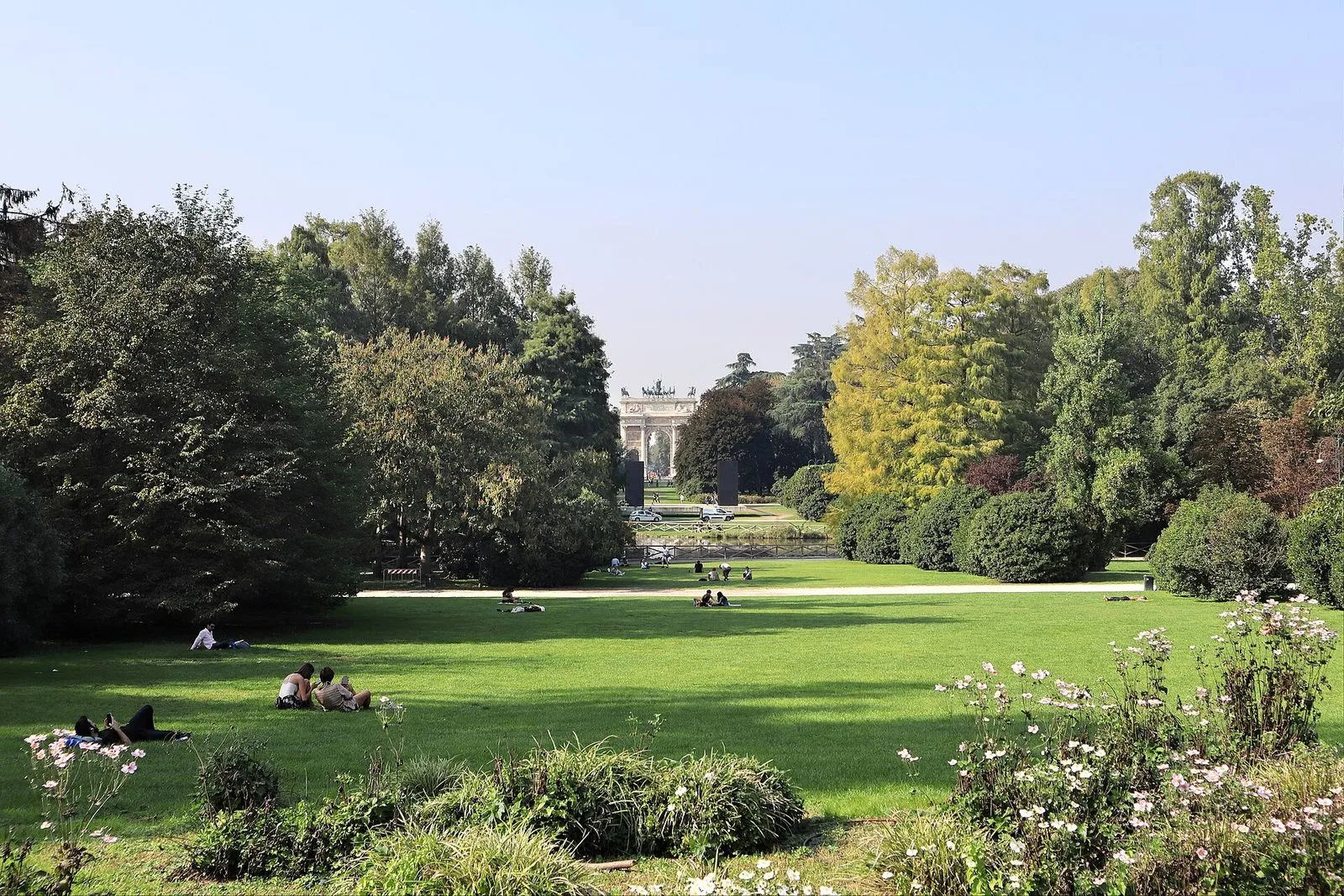
Milan's central green lung, laid out in the 1890s on the former parade ground of the Sforza Castle.

You have stepped out of the castle's rear gate into Parco Sempione. What you are walking across was, for centuries, a very different place. Under the Visconti and Sforza dukes, this was the Barcho, a walled hunting reserve three million square meters wide, stocked with deer, boar, and even exotic animals. After the Sforza fell and the Spanish took over, the hunting ground was abandoned.

By the 1800s it had become a military parade ground, the Piazza d'Armi, where Austrian and then Italian troops drilled under the shadow of the castle. In 1888 the city decided to turn it into a public park. The architect Emilio Alemagna designed an English-style landscape: winding paths, a pond, gentle hills, and long sightlines that frame the castle on one end and the Arch of Peace on the other. The name Sempione comes from the Simplon Pass route toward Switzerland and France, the road Napoleon built.

Walk deeper into the park along the main axis, toward the tower you see rising ahead.

≈3 min walk to the next stop
Free preview ends here · stops 4 to 6 continue in the app

Torre Branca

A 108-meter steel tower designed by Giò Ponti in 1933, offering a panorama from the Alps to the Duomo.

in app

Triennale Milano

Italy's leading design and architecture museum, housed in the 1933 Palazzo dell'Arte at the park's edge.

in app

Arco della Pace

A neoclassical marble arch finished in 1838, where the grand axis from the Duomo meets the road to France.

in app
Good to know

Before you go

Is the Castello Sforzesco courtyard free?

Yes. The castle courtyards are free and open daily from 7:00 to 19:30. You can walk under the Filarete tower, cross the parade ground, and exit into Parco Sempione without paying. You only need a ticket to enter the museums inside the castle, including Michelangelo's Pietà Rondanini.

SourceCastello Sforzesco Official Site
What is the Pietà Rondanini?

The Pietà Rondanini is Michelangelo's final sculpture, left unfinished at his death in Rome in 1564 at the age of 88. He worked on it during the last ten years of his life, re-carving the marble block multiple times. The two figures of Mary and Christ are elongated, almost weightless, and the surface still bears the marks of his chisel. It sits alone in the former Spanish hospital of the Castello Sforzesco, in a dim room that makes the white marble float.

SourceCastello Sforzesco Official Site
Can I climb the Torre Branca?

Torre Branca, the 108-meter steel tower designed by Giò Ponti in 1933, is open seasonally and the schedule varies. When open, the lift takes you to the top in under a minute for a panorama that stretches from the Duomo to the Alps. Check the Triennale Milano website for current hours before you go; it closes in bad weather.

Provenance · last verified August 21, 2026

Built from the Wayside route itself: the stops, their order, and the walk between them.

Photo by Terragio67 on Wikimedia Commons · CC BY-SA 4.0

Photo by Marivaldo Vivan on Unsplash

Photo by ☰☵ Michele M. F. from Milano, Italy on Wikimedia Commons · CC BY-SA 2.0

Photo by Gipi2706 on Wikimedia Commons · CC BY-SA 4.0

Photo by JasonParis from Toronto, Canada on Wikimedia Commons · CC BY 2.0

Photo by FlavMi on Wikimedia Commons · CC BY-SA 3.0

Photo by LucaChp on Wikimedia Commons · CC BY-SA 3.0

Photo by LucaChp on Wikimedia Commons · CC BY-SA 3.0

Photo by https://www.flickr.com/photos/belboo/ on Wikimedia Commons · CC BY-SA 2.0

Photo by Steffen Schmitz on Wikimedia Commons · CC BY-SA 4.0

Coming soon

Wayside isn't in the app stores yet, but it's in the works. Check back soon.