Paris · Self-guided audio walk

Canal to Belleville: The Paris Parisians Keep

From the locks of Canal Saint-Martin to the hilltop views of Belleville, five kilometers of real Paris. No selfie sticks, no postcards.

  • 7Stops
  • 5.8 kmDistance
  • 85+ minTime
Canal to Belleville: The Paris Parisians Keep

Photo by DimiTalen on Wikimedia Commons

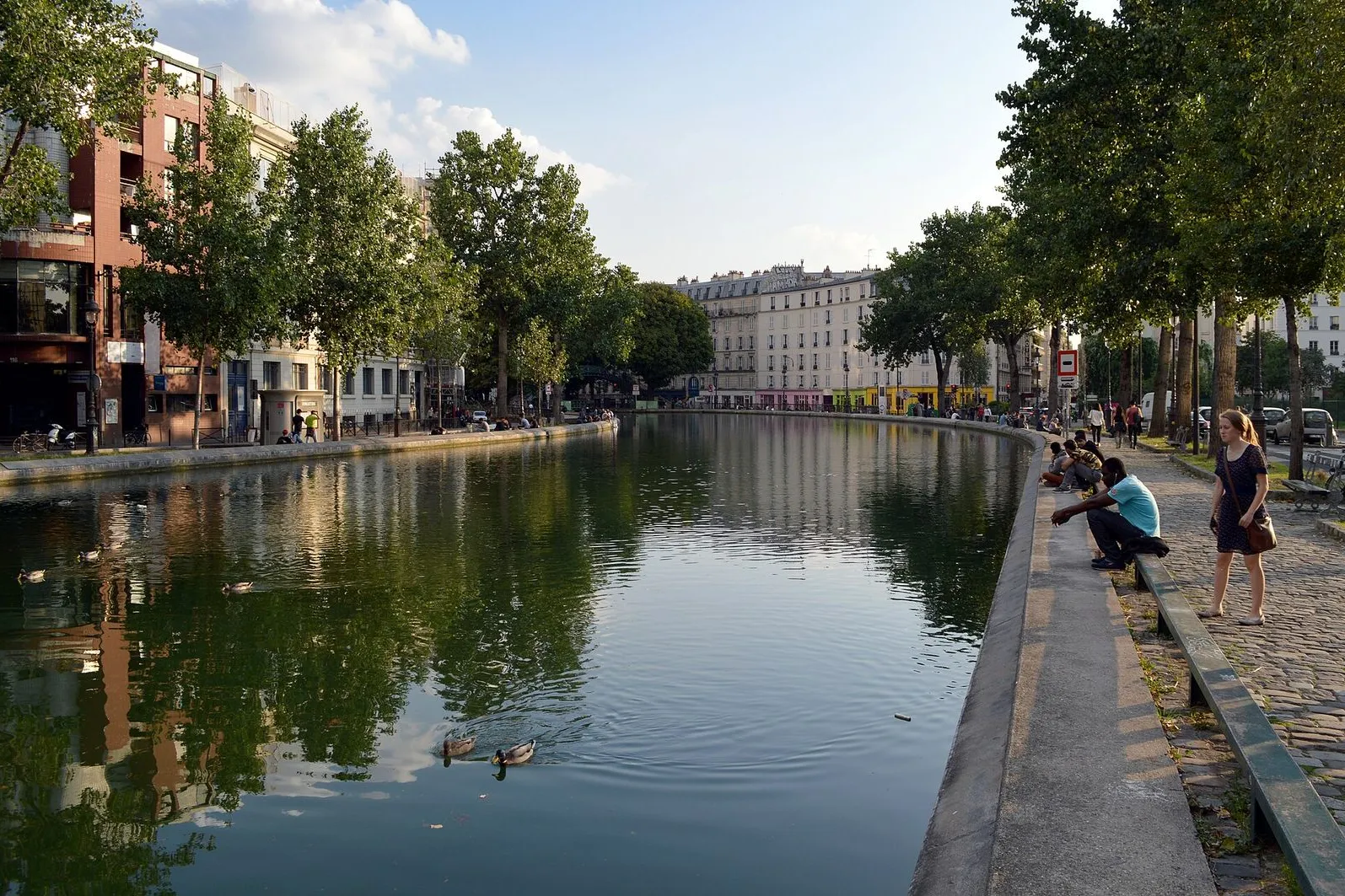
This is the walk for a second visit, or for anyone who wants to see Paris without a selfie stick in the frame. Start at République and follow the Canal Saint-Martin north: the iron footbridges, the double locks, the plane trees, the picnickers on the quays on warm evenings. At the Bassin de la Villette, turn east and climb into Belleville, a working-class hilltop neighborhood with one of the best views in the city from the Parc de Belleville. The streets here mix Tunisian bakeries, Chinese groceries, and old-guard café-tabacs in a way that feels more like real Paris than any postcard. About five kilometers, with a climb at the end; allow around two and a half hours. Finish near métro Pyrénées with the skyline spread out behind you.

Hear it on the street

Get the turn-by-turn audio guide in the app. The narration plays itself as you reach each stop, hands-free and offline.

Stop by stop

The route

Interactive map of the route. The full stop list below works without it.

Place de la RépubliqueMust see

Photo by Dr. Thomas Liptak on Wikimedia Commons

Place de la République

0:00

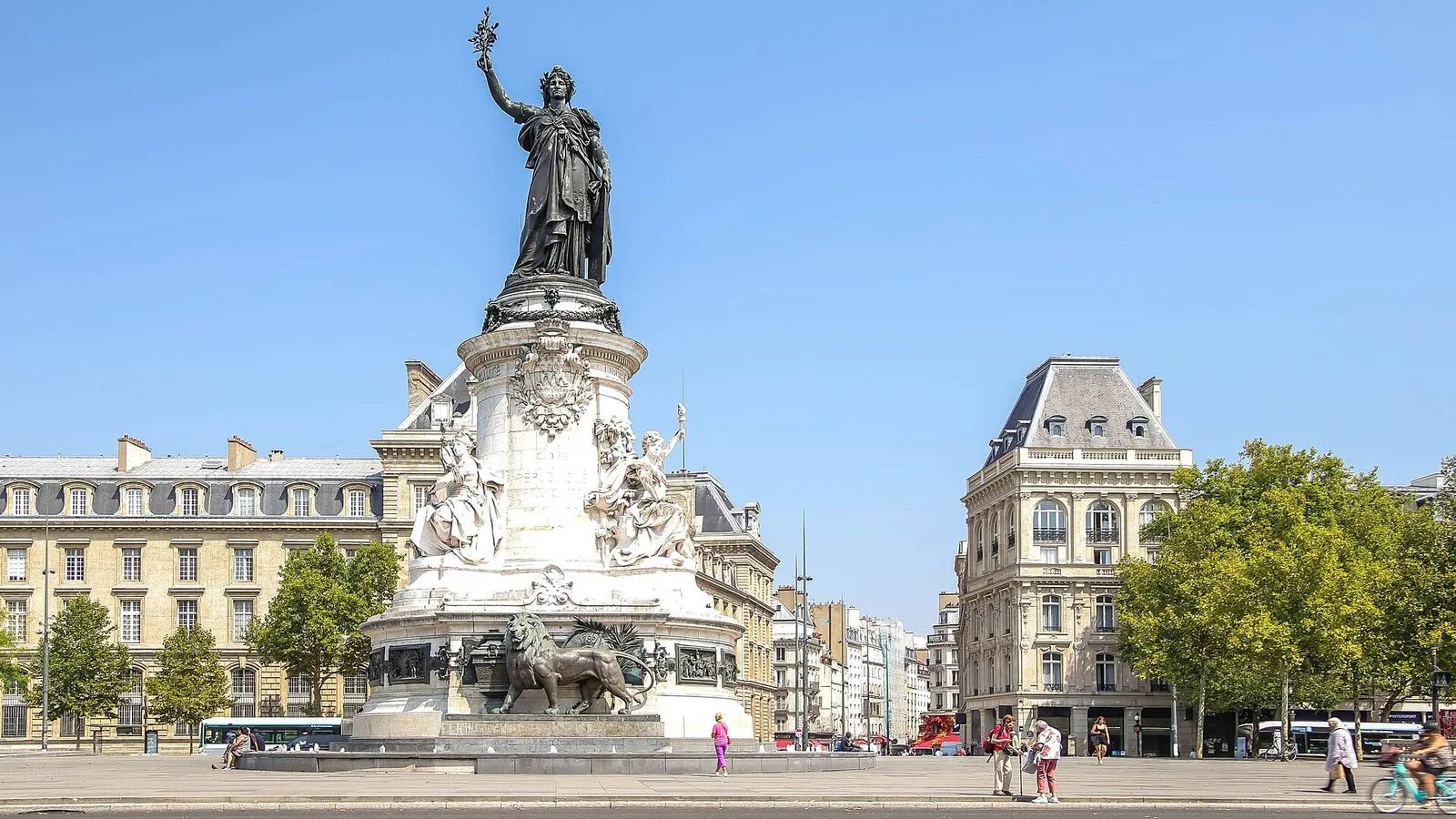
Paris's vast pedestrian square, anchored by a nine-meter bronze Marianne, has been the city's gathering place for celebration and protest since 1883.

You're standing in the middle of Place de la République, and that bronze figure towering above you is Marianne, the symbol of the French Republic. She holds an olive branch in one hand and a tablet of human rights in the other. At her feet, bronze lions guard a plinth carved with the dates of the Revolution. This square was redesigned in 2013 to be a pedestrian island in the middle of the city, and Parisians treat it as their living room.

On any given evening you'll find skateboarders, families, and groups of friends sprawled on the stone benches. But the square is also the city's default gathering point for demonstrations. When something matters to Paris, this is where the crowd comes. The Canal Saint-Martin actually runs directly beneath you here, through a two-kilometer underground vault built under Baron Haussmann in the 1860s.

Turn away from the statue now and walk north up Boulevard de Magenta. In about five minutes you'll reach the water.
≈11 min walk to the next stop
Écluses des RécolletsMust see

Photo by Moonik on Wikimedia Commons

Écluses des Récollets

0:00

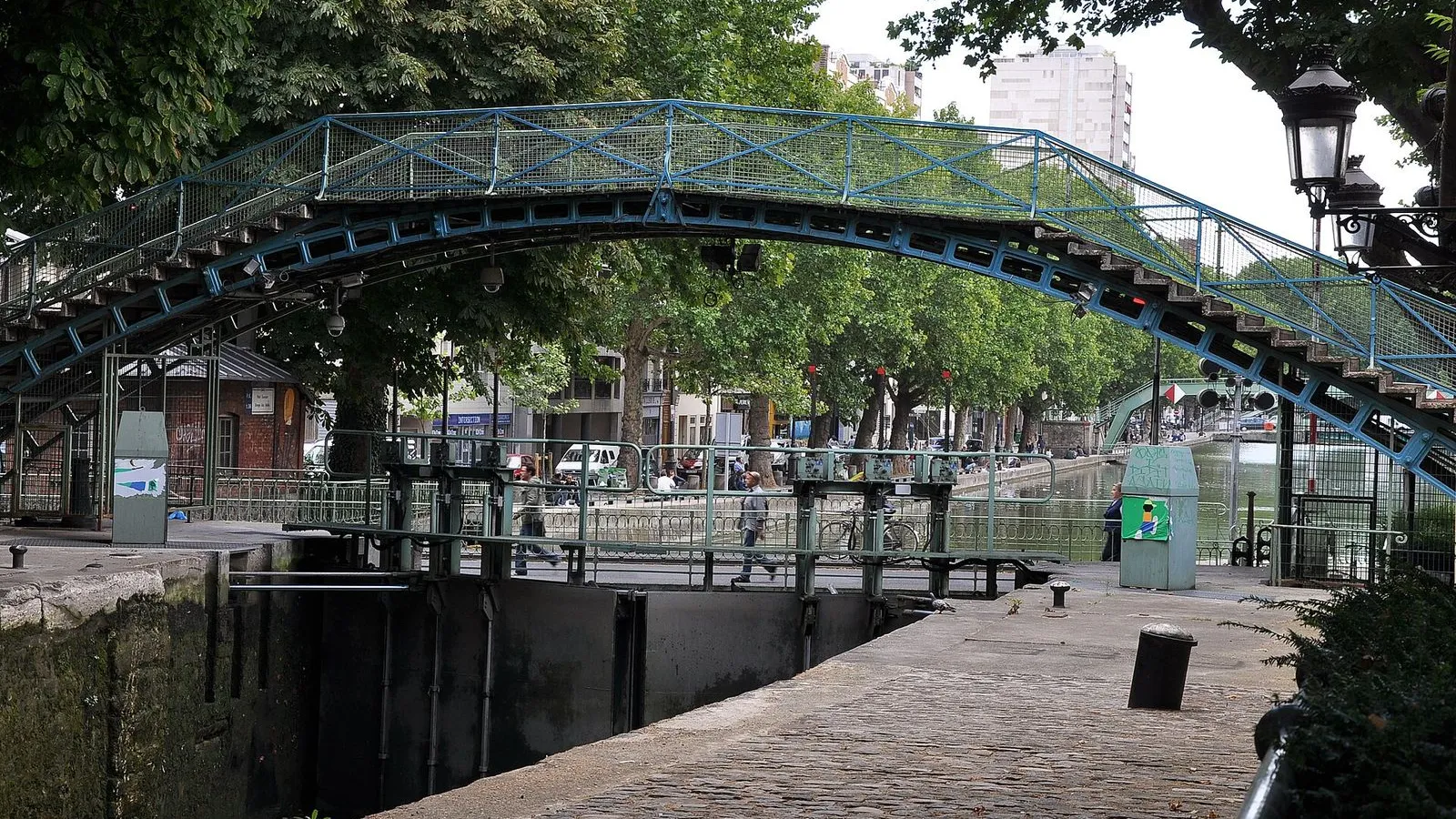
The double iron gates and cast-iron footbridges at the heart of the Canal Saint-Martin, where boats still rise and fall three meters with each lock cycle.

You're now at the Récollets locks, the beating heart of the Canal Saint-Martin. Look at the double iron gates and the dark water between them. A boat enters the chamber. The upstream gates close behind it.

The water drains down, sometimes three full meters, until it matches the lower level. Then the downstream gates swing open and the boat glides through. It's slow, quiet, and entirely mechanical, the same way it has worked since the canal opened in 1825. Napoleon commissioned this waterway to bring fresh drinking water into Paris and to move grain, wine, and timber through the city.

The footbridge beside you is one of five cast-iron passerelles that cross the canal. They're painted a deep green and they creak underfoot. On summer evenings the quays fill with people dangling their legs over the stone edge, wine bottles and baguettes within reach. When you're done watching the water, follow the quai north.

In about a hundred meters the famous facade appears on your right.

≈1 min walk to the next stop
Hôtel du NordMust see

Photo by GFreihalter on Wikimedia Commons

Hôtel du Nord

0:00

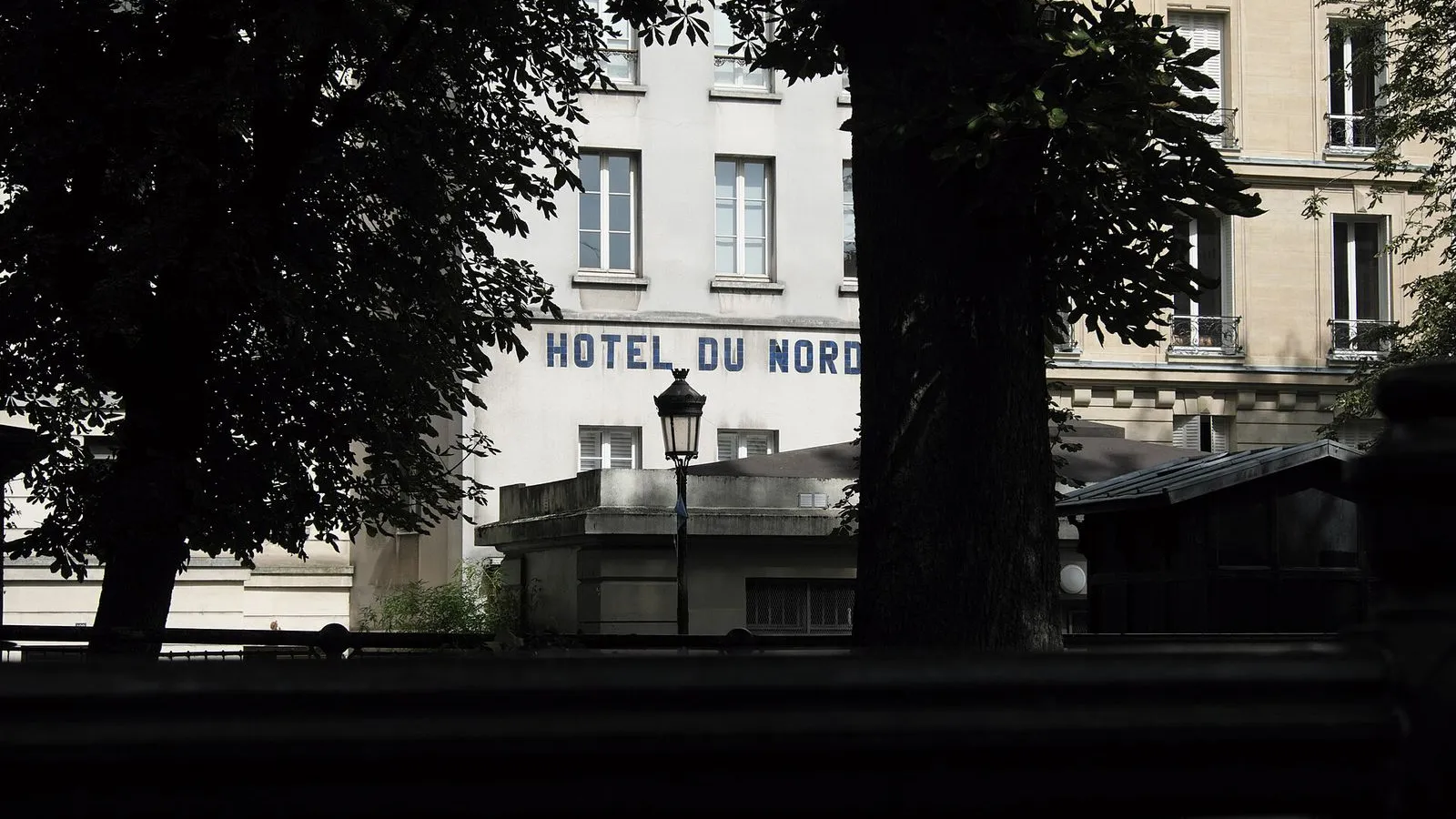
The modest blue-and-white facade at 102 Quai de Jemmapes, immortalized by Marcel Carné's 1938 film and saved from demolition by its own star.

This facade at 102 Quai de Jemmapes is the Hôtel du Nord. It was a real working-class hotel in the 1920s, run by a couple named Dabit. Their son Eugène turned its daily life into a novel, and in 1938 Marcel Carné turned the novel into a film. The movie was shot entirely in a studio.

The canal you saw on screen was a set, the hotel a replica. But the real facade became an icon anyway. Arletty, who played the prostitute Raymonde, delivered the line that still hangs over French cinema: 'Atmosphère, atmosphère. Est-ce que j'ai une gueule d'atmosphère?' The building was nearly demolished in the 1980s to make way for new construction.

Arletty herself, old and blind by then, led the campaign to save it. The facade and roofline were classified as historic monuments in 1989. Today it's a restaurant with a zinc bar and red velvet banquettes. The facade is all that remains of the original, but that's enough.

Keep walking north along the canal.

≈27 min walk to the next stop
Free preview ends here · stops 4 to 7 continue in the app

Bassin de la Villette

The largest artificial body of water in Paris, dug in 1808 as a drinking water reservoir and now the city's favorite spot for pétanque, floating cinemas, and summer swimming.

in app

Rue de Belleville

The spine of Belleville, an old village street turned working-class artery, where Tunisian bakeries and Chinese grocers sit beside century-old café-tabacs.

in app

Rue Denoyez

A narrow pedestrian lane where every wall, shutter, and doorway is a living canvas, the densest concentration of street art in Paris.

in app

Parc de Belleville

The highest park in Paris, at 108 meters, with a panoramic terrace where the Eiffel Tower, Montparnasse, Notre-Dame, and Sacré-Cœur line up in a single sweep.

in app
Good to know

Before you go

Is the Canal to Belleville walk good for a first visit?

The Canal Saint-Martin to Belleville walk is better suited to a second or third visit. It shows a side of Paris that the postcards miss: working-class neighborhoods, immigrant food cultures, street art, and a hilltop view with no selfie sticks in the frame. First-time visitors should walk the islands, the Left Bank, or the Triumphal Way before this one. If you have been to Paris before and want to see where Parisians actually live, this is the walk.

Is Belleville safe?

Belleville is a working-class neighborhood and as safe as any other part of Paris during the day and early evening. The streets are busy with families, market shoppers, and café regulars. The Parc de Belleville is well maintained and popular with local families. Exercise the same caution you would anywhere in the city at night: keep your phone out of sight and stick to well-lit streets.

Provenance · last verified August 9, 2026

Built from the Wayside route itself: the stops, their order, and the walk between them.

Photo by DimiTalen on Wikimedia Commons · CC0

Photo by Dr. Thomas Liptak on Wikimedia Commons · CC BY-SA 4.0

Photo by Moonik on Wikimedia Commons · CC BY-SA 3.0

Photo by GFreihalter on Wikimedia Commons · CC BY-SA 4.0

Photo by Michal Osmenda from Brussels, Belgium on Wikimedia Commons · CC BY-SA 2.0

Photo by Moonik on Wikimedia Commons · CC BY-SA 3.0

Photo by Alexander Baxevanis from London, UK on Wikimedia Commons · CC BY 2.0

Photo by Moonik on Wikimedia Commons · CC BY-SA 3.0

Photo by Basile Morin on Wikimedia Commons · CC BY-SA 4.0

Photo by Simon Infanger on Unsplash

Photo by Claude Attard from Toulouse, France on Wikimedia Commons · CC BY 2.0

Coming soon

Wayside isn't in the app stores yet, but it's in the works. Check back soon.