Paris · Self-guided audio walk

Montmartre: The Village on the Hill

Climb through the old village that artists, winemakers, and rebels called home, from a wall of love to a hillside vineyard to the quiet back lanes most visitors never see.

  • 8Stops
  • 2.3 kmDistance
  • 40+ minTime

Montmartre was a separate village until 1860, and on this walk it still feels like one. You start at the Abbesses métro, with its rare Guimard glass canopy, then climb past the Wall of Love, the Bateau-Lavoir where Cubism was born, and the last working vineyard in Paris. At the summit, Sacré-Cœur gives you the panorama, and Place du Tertre gives you the paintbrushes. Then you leave the crowds behind. The second half of the walk drops into the north slope: a cobbled lane made famous by every postcard, a hidden cul-de-sac of English cottages, and finally the Montmartre cemetery, where Degas, Truffaut, and Dalida rest under chestnut trees. About three kilometers, steep in places. Give it two and a half hours.

Hear it on the street

Get the turn-by-turn audio guide in the app. The narration plays itself as you reach each stop, hands-free and offline.

Stop by stop

The route

Interactive map of the route. The full stop list below works without it.

Place des AbbessesLocal pick

Photo by Guilhem Vellut from Paris, France on Wikimedia Commons

Place des Abbesses

0:00

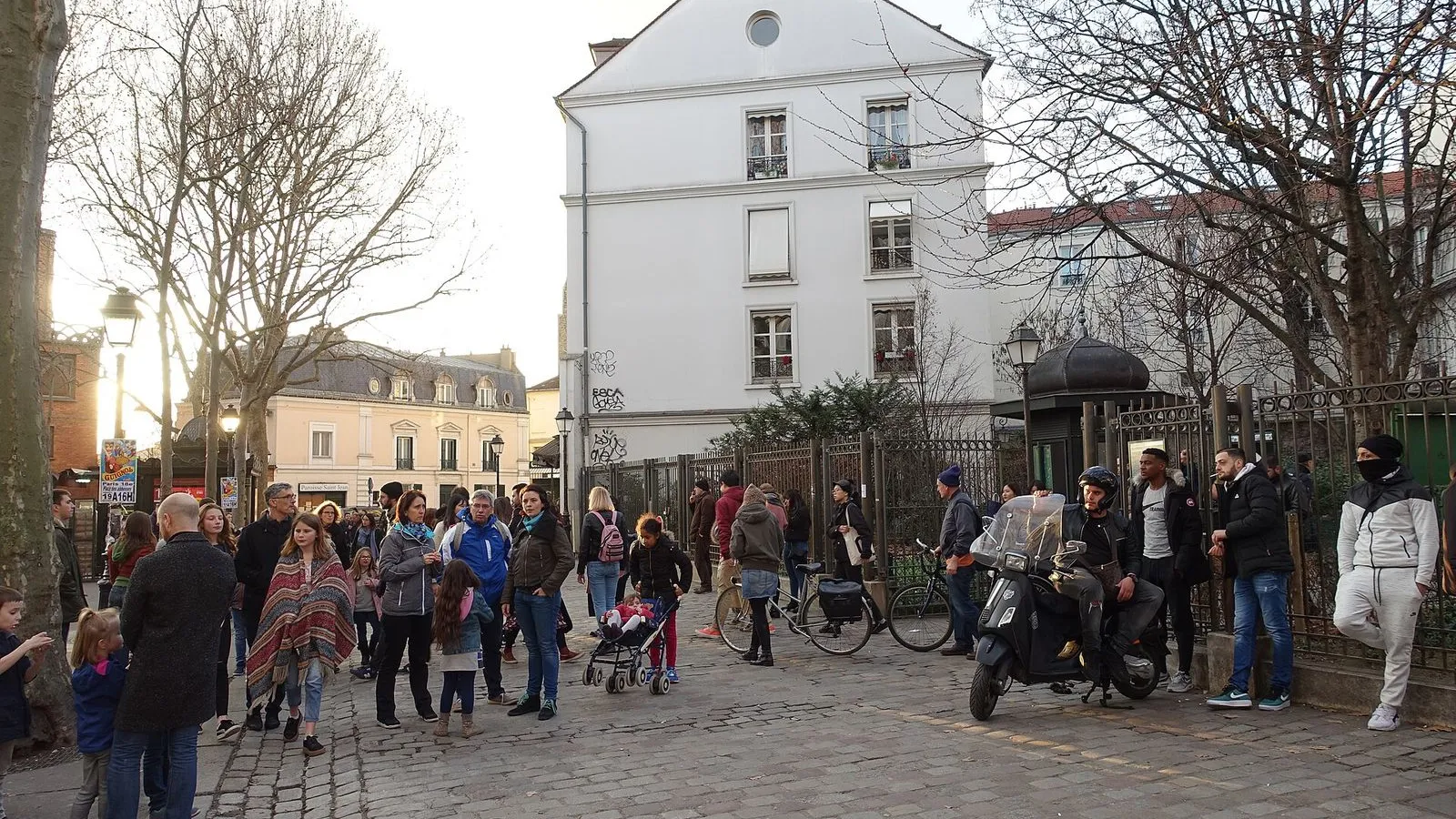
A leafy square in lower Montmartre, home to one of only two surviving Art Nouveau métro entrances with its original glass canopy, designed by Hector Guimard.

You're standing in Place des Abbesses, and the first thing to notice is right behind you: the métro entrance. That swirling glass-and-iron canopy was designed by Hector Guimard for the 1900 World's Fair. Only two covered entrances like this survive in Paris. The other is at Porte Dauphine.

This is the one that still works the hardest, at the foot of the hill. The square takes its name from the abbesses who ran the Benedictine abbey founded up here in 1134 by Louis VI. It did not end well for them. The last abbess, Louise de Montmorency-Laval, was 71, blind, and deaf when she was guillotined in 1794.

Her crime, according to the revolutionary tribunal, was plotting against the Republic, quote, blindly and deafly. The abbey was looted and destroyed. Nothing of it remains. Take a look around the square.

The café terraces, the flower shop, the stream of people coming up from the métro. This is the Montmartre that lives where the abbey once stood. When you're ready, walk to the far side of the square and find the small park behind the metro entrance. That's Square Jehan Rictus, and the Wall of Love is inside.

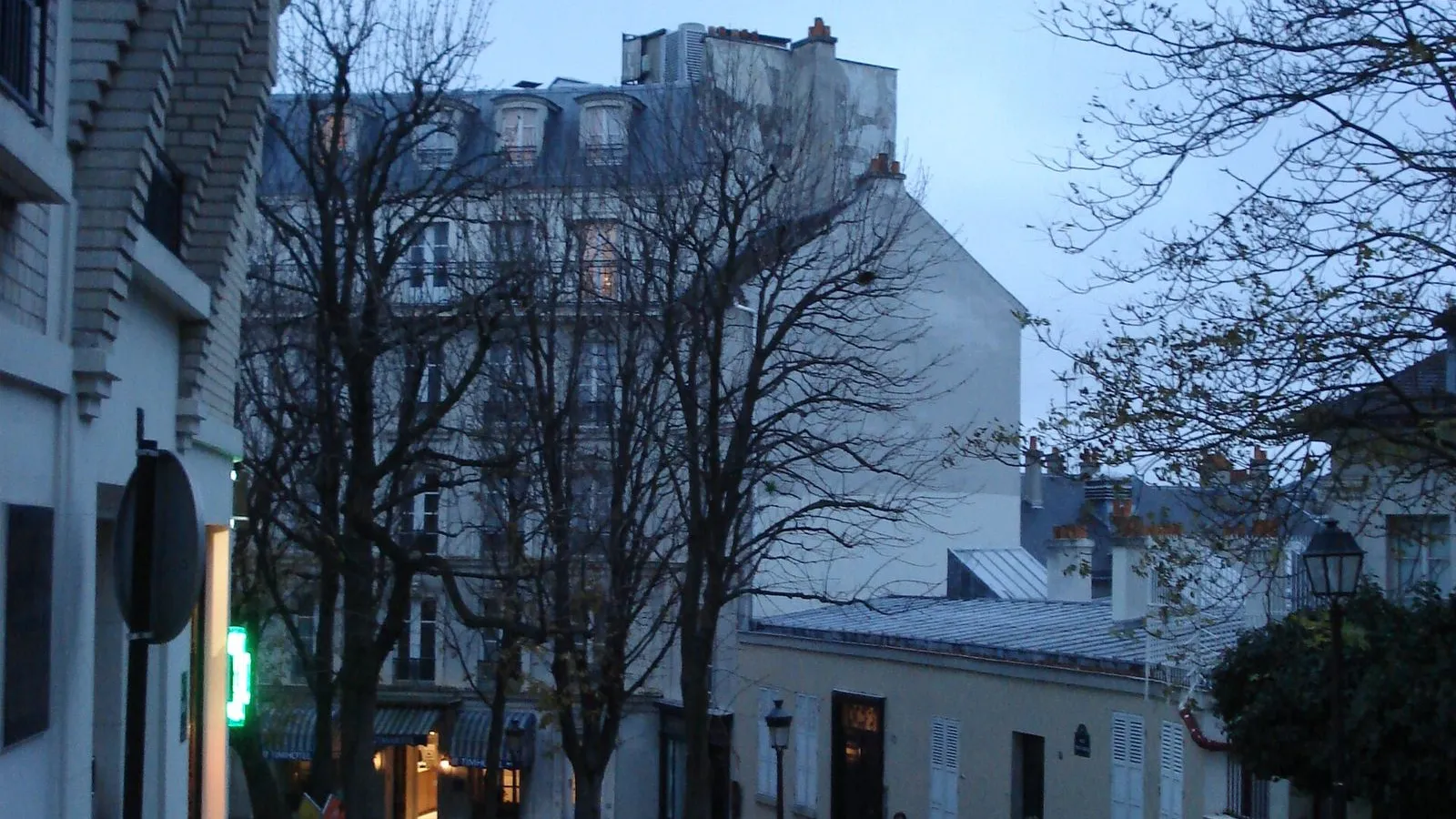
≈1 min walk to the next stop
Le Mur des Je t'aimeLocal pick

Photo by Shadowgate from Novara, ITALY on Wikimedia Commons

Le Mur des Je t'aime

0:00

A wall of blue enameled tiles bearing "I love you" in over 250 languages, tucked inside a small square just off Place des Abbesses.

Six hundred and twelve enameled tiles, deep blue, with white script running across them in every direction. "I love you" in over 250 languages, from Albanian to Zulu, with scattered red splashes where the words break apart and reform. It was made by two artists, Frédéric Baron and Claire Kito. Baron spent years collecting the phrase from strangers, in embassies, from neighbors, from people he stopped on the street.

Kito, a calligrapher, rendered them all by hand. Look at the panel to the left of the wall. It reads "aimer, c'est du désordre.. alors aimons." To love is disorder, so let us love.

The wall sits in Square Jehan Rictus, named after a cabaret poet who performed right here in Montmartre at the turn of the last century. He wrote raw, angry verse about poverty, and his stage name translates roughly as John Grin. A love wall in the square of a man named Grin. When you're ready, leave the park and turn right onto Rue des Abbesses, then take the first right onto Rue Ravignan.

It climbs steeply. Follow it up to Place Émile Goudeau.

≈3 min walk to the next stop
Bateau-LavoirMust see

Photo by Vania Teofilo on Wikimedia Commons

Bateau-Lavoir

0:00

The former piano factory turned artists' residence where Picasso painted Les Demoiselles d'Avignon and Cubism was born. Only the façade survives.

The building at number 13 on your left looks unremarkable. That is the point, and that was always the point. This was a piano factory, then in 1889 it was carved into twenty small studios. No heating.

No running water. The building was so flimsy that when the wind blew hard it creaked and groaned like the laundry barges moored on the Seine. The poet Max Jacob gave it its name: Bateau-Lavoir, the laundry boat. By 1904, a young Spaniard named Pablo Picasso was living here.

So were Kees van Dongen, Juan Gris, and Amedeo Modigliani. Guillaume Apollinaire and Max Jacob themselves were regulars. It was in one of these studios, in 1907, that Picasso painted Les Demoiselles d'Avignon, five women whose fractured faces broke five hundred years of perspective and set painting on a new course. Most of the original building burned in 1970.

The facade you are looking at is what survived. The rest was rebuilt in 1978 and still houses working artists, though the studios are not open to visitors. Stand here a moment. The square is small and quiet now, but a century ago this was one of the most consequential addresses in art.

Now continue up Rue Ravignan. At the top, turn right onto Rue d'Orchampt, then left onto Rue Lepic. Follow it around until you reach Rue des Saules on your right. Take it downhill.

The vineyard appears on your left at the corner of Rue Saint-Vincent.

≈5 min walk to the next stop
Free preview ends here · stops 4 to 8 continue in the app

Vigne de Montmartre

The Clos Montmartre, the last working vineyard in Paris, planted in 1933 on a north-facing slope that once fed the city's taverns and cabarets.

in app

Sacré-Cœur

The white Romano-Byzantine basilica crowning the summit of Montmartre, built as a national penance after the Franco-Prussian War and offering the highest panoramic view in Paris.

in app

Place du Tertre

The old village square of Montmartre, where artists have set up their easels for over a century and where the tourist crowds are themselves part of a much older tradition.

in app

Villa Léandre

A quiet dead-end lane off Avenue Junot, lined with 1920s English-style cottages and front gardens, a pocket of unexpected calm on the back slope of the hill.

in app

Cimetière de Montmartre

The cemetery of Montmartre, opened in 1825 in an old gypsum quarry, where Degas, Truffaut, Dalida, Stendhal, and Nijinsky lie under the same chestnut trees.

in app
Good to know

Before you go

How steep is the Montmartre walk?

Montmartre is a hill. The first half of the walk climbs steadily from Place des Abbesses to Sacré-Cœur, mostly by stairs and sloping streets. The second half descends the north slope on cobbled lanes. The climb is the point: the view from the top is the reward. If stairs are a problem, the Montmartre funicular runs from the base of the butte to the Sacré-Cœur plaza for the price of a metro ticket. The walk can be adapted to use it.

Is Sacré-Cœur free to enter?

Yes. Sacré-Cœur Basilica is free to enter, and the view from the parvis is free and open 24 hours. The dome climb costs €8 and gives you the highest panoramic view in Paris, 30 meters above the parvis. The crypt costs €3.50. The dome is 300 steps up a narrow spiral staircase with no elevator.

Provenance · last verified August 9, 2026

Built from the Wayside route itself: the stops, their order, and the walk between them.

Photo by Simon Infanger on Unsplash

Photo by Guilhem Vellut from Paris, France on Wikimedia Commons · CC BY 2.0

Photo by Shadowgate from Novara, ITALY on Wikimedia Commons · Public domain

Photo by Vania Teofilo on Wikimedia Commons · CC BY-SA 3.0

Photo by Michal Osmenda from Brussels, Belgium on Wikimedia Commons · CC BY-SA 2.0

Photo by DimiTalen on Wikimedia Commons · CC0

Photo by Moonik on Wikimedia Commons · CC BY-SA 3.0

Photo by Alexander Baxevanis from London, UK on Wikimedia Commons · CC BY 2.0

Photo by Moonik on Wikimedia Commons · CC BY-SA 3.0

Photo by Basile Morin on Wikimedia Commons · CC BY-SA 4.0

Photo by Claude Attard from Toulouse, France on Wikimedia Commons · CC BY 2.0

Coming soon

Wayside isn't in the app stores yet, but it's in the works. Check back soon.