Paris · Self-guided audio walk

Art, Empire, and Iron: The 7th Arrondissement Walk

Three great museums, Napoleon's tomb, the Eiffel Tower, and a market street where Parisians shop for dinner, all in one flat, walkable morning.

  • 6Stops
  • 4.6 kmDistance
  • 65+ minTime
Art, Empire, and Iron: The 7th Arrondissement Walk

Photo by Basile Morin on Wikimedia Commons

The 7th arrondissement packs more into a square kilometer than most cities manage in ten. This walk starts at the Musée d'Orsay, a railway station reborn as a temple of Impressionism, then crosses quiet embassy streets to the Musée Rodin, where The Thinker sits in a garden with the gold dome of Les Invalides rising behind it. Louis XIV built Les Invalides for his wounded soldiers; Hardouin-Mansart crowned it with a dome that held the record for tallest building in Paris until the Eiffel Tower came along. You walk the length of the Champ de Mars to reach that tower, then finish on rue Cler, a pedestrian market street where cheese shops, bakeries, and café terraces still belong to the neighborhood. About three and a half kilometers, flat, roughly two hours.

Hear it on the street

Get the turn-by-turn audio guide in the app. The narration plays itself as you reach each stop, hands-free and offline.

Stop by stop

The route

Interactive map of the route. The full stop list below works without it.

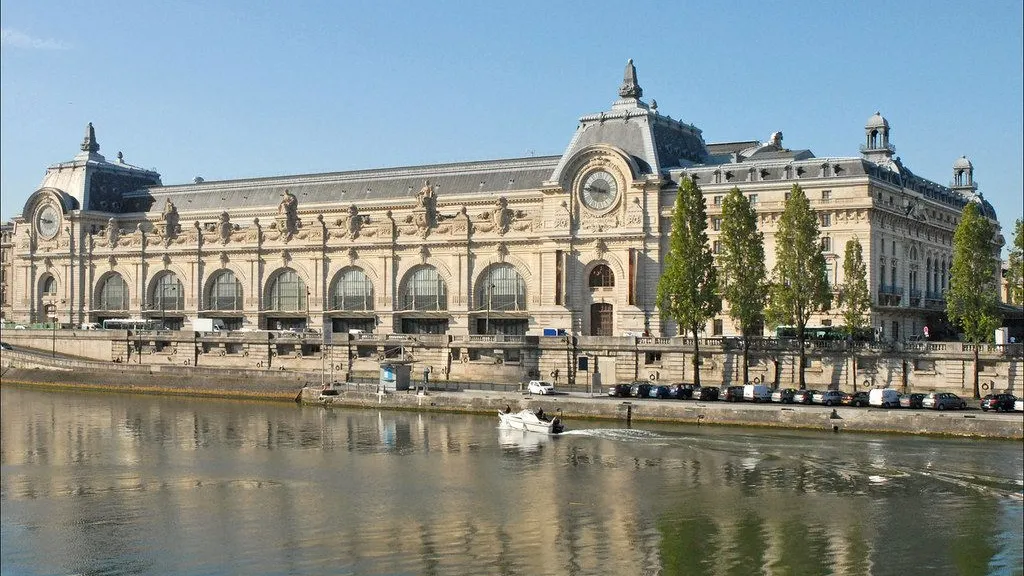
Musée d'OrsayMust see

Photo by dalbera on Openverse

Musée d'Orsay

0:00

A Beaux-Arts railway station turned temple of Impressionism, holding the world's largest collection of Monet, Renoir, Van Gogh, and their contemporaries.

You are standing in front of what was, in 1900, the most modern railway station in the world. The Gare d'Orsay had electric trains, escalators, and a hotel with 370 rooms. Victor Laloux dressed the steel and glass in a Beaux-Arts stone façade so it would not clash with the Louvre across the river. By 1939, trains had grown too long for its platforms and the station fell into disuse.

It sat empty for decades. In 1978, the government decided to turn it into a museum that would bridge the gap between the Louvre's classical collection and the modern art in the Pompidou Centre. François Mitterrand opened it in December 1986. Look up at the great clock set into the façade.

Inside, under a soaring barrel-vaulted ceiling, you can see Monet's water lilies, Renoir's Dance at Le Moulin de la Galette, and Van Gogh's self-portraits. The collection runs from 1848 to 1914 and includes painting, sculpture, photography, and furniture. Take a moment with the Beaux-Arts stonework before we head west.
≈16 min walk to the next stop
Musée RodinMust see

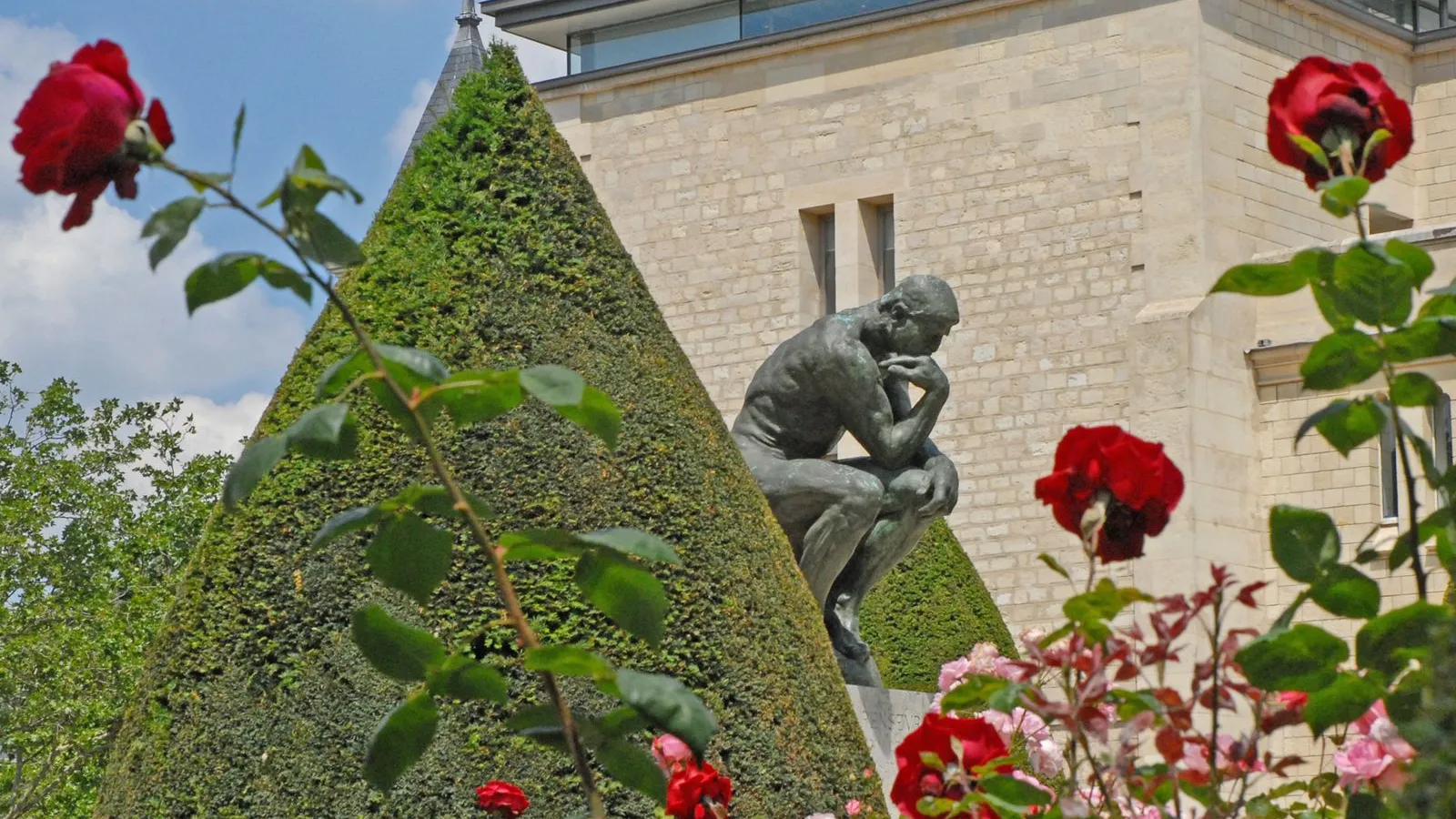
Photo by Jean-Pierre Dalbéra from Paris, France on Wikimedia Commons

Musée Rodin

0:00

Rodin's sculptures fill an 18th-century mansion and its garden, where The Thinker sits under the trees with the gilded dome of Les Invalides rising behind it.

You have just walked through the quiet embassy streets of the 7th arrondissement. The Musée Rodin occupies the Hôtel Biron, a rococo mansion completed in 1732 by the architect Jean Aubert. Rodin discovered the building in 1908, when it sat nearly abandoned and subdivided into rented rooms. He took four ground-floor rooms as a studio, then the whole house by 1911.

Other tenants included Jean Cocteau, Henri Matisse, and the dancer Isadora Duncan. In 1916, Rodin donated his entire collection to the French state on the condition it remain here. The museum opened in 1919. Walk into the garden.

The bronze Thinker sits on a pedestal under the trees, and behind it the gilded dome of Les Invalides catches the light. Rodin originally called this figure The Poet. It was meant to be Dante, perched above the Gates of Hell, leaning forward to observe the damned. The monumental cast in front of you dates from 1904.

Take your time in the garden. The Kiss, Balzac, and The Burghers of Calais are here too.

≈4 min walk to the next stop
Les InvalidesMust see

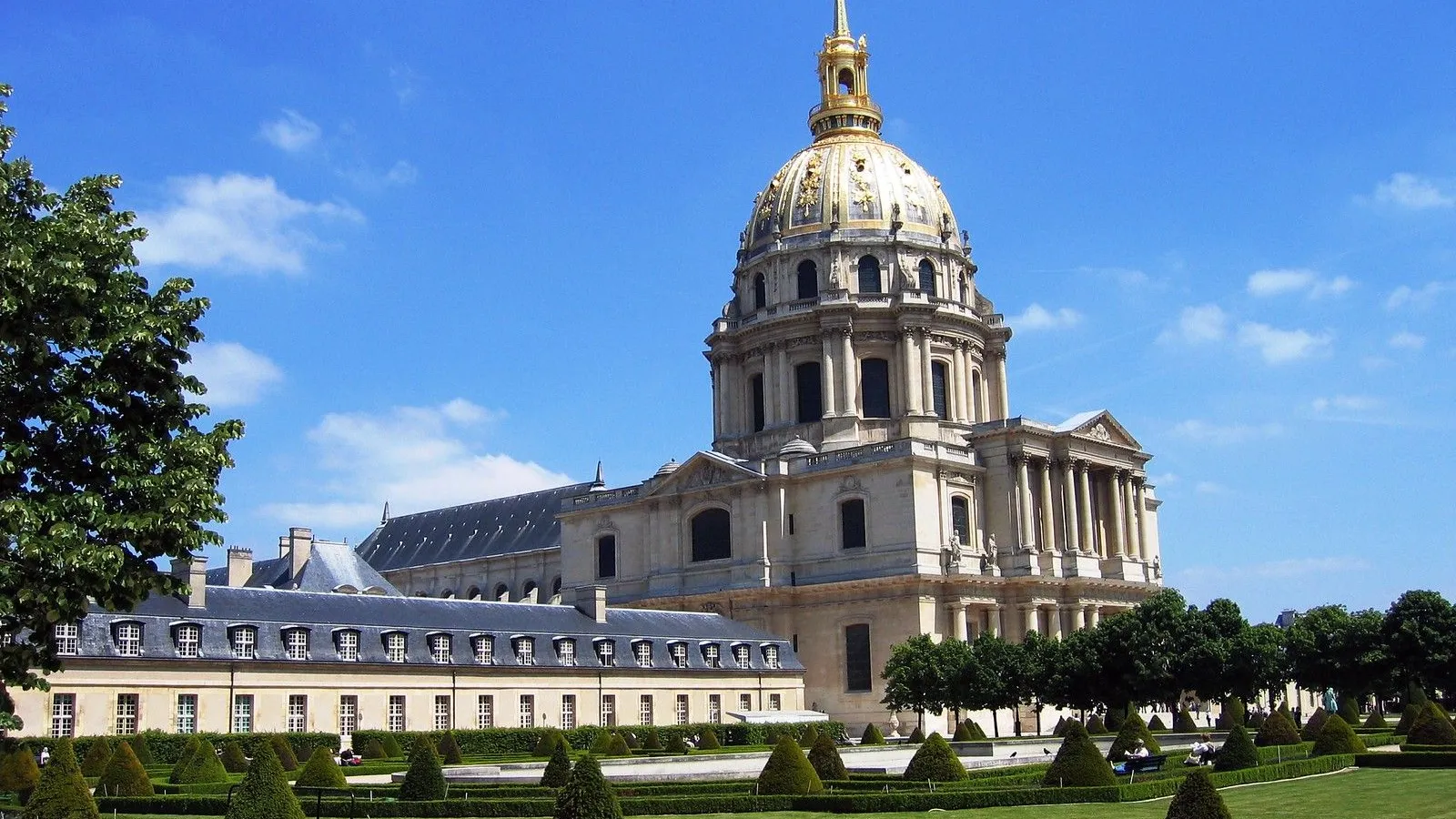
Photo by vigour on Openverse

Les Invalides

0:00

Louis XIV's hospital for wounded soldiers, crowned by Hardouin-Mansart's golden dome that shelters Napoleon's tomb.

The gold dome you saw from Rodin's garden belongs to Les Invalides. Louis XIV ordered it built in 1670 as a hospital and home for soldiers wounded in his wars. The architect Libéral Bruant laid out the complex, and in 1676 the young Jules Hardouin-Mansart was brought in to design the royal chapel. He gave it a dome covered in gold leaf that rises 101 meters.

Until the Eiffel Tower went up in 1889, this was the tallest building in Paris. Inside, beneath the dome, Napoleon Bonaparte lies inside six nested coffins of tin, mahogany, lead, ebony, oak, and red porphyry. His remains were brought back from Saint Helena in 1840, but the tomb took another twenty-one years to complete. The circular gallery around the sarcophagus shows reliefs of his civil reforms, the Napoleonic Code among them.

His brothers, his son, and several of his marshals are buried here too. Step inside if you have time. The Army Museum occupies the wings of the complex.

≈18 min walk to the next stop
Free preview ends here · stops 4 to 6 continue in the app

Champ de Mars

The long green lawn sweeping from the École Militaire to the Eiffel Tower, once a military parade ground and now the city's most famous picnic spot.

in app

Eiffel Tower

Gustave Eiffel's 330-meter iron tower, built for the 1889 World's Fair and still the most recognizable silhouette in Paris.

in app

Rue Cler

A pedestrian market street where cheese shops, bakeries, florists, and café terraces make the 7th feel like a village.

in app
Good to know

Before you go

Do I need tickets for the Musée d'Orsay and Musée Rodin?

Yes, both museums require timed entry tickets. The Musée d'Orsay costs €16 for a standard adult ticket and is closed on Mondays. The Musée Rodin costs €14 and includes access to the sculpture garden where The Thinker sits. Book both online in advance; the Musée d'Orsay queue without a ticket can cost you 45 minutes in high season.

SourceMusée Rodin official site
Can I visit Napoleon's tomb?

Yes. Napoleon's tomb sits under the golden dome of Les Invalides. The Army Museum and the tomb share a combined ticket that costs €15. The church itself, the Dôme des Invalides, is sometimes open for free during services. The Army Museum is closed on the first Monday of every month.

Provenance · last verified August 17, 2026

Built from the Wayside route itself: the stops, their order, and the walk between them.

Photo by Basile Morin on Wikimedia Commons · CC BY-SA 4.0

Photo by dalbera on Openverse · CC BY 2.0

Photo by Jean-Pierre Dalbéra from Paris, France on Wikimedia Commons · CC BY 2.0

Photo by vigour on Openverse · CC BY 2.0

Photo by Michal Osmenda from Brussels, Belgium on Wikimedia Commons · CC BY-SA 2.0

Photo by DimiTalen on Wikimedia Commons · CC0

Photo by Moonik on Wikimedia Commons · CC BY-SA 3.0

Photo by Alexander Baxevanis from London, UK on Wikimedia Commons · CC BY 2.0

Photo by Moonik on Wikimedia Commons · CC BY-SA 3.0

Photo by Simon Infanger on Unsplash

Photo by Claude Attard from Toulouse, France on Wikimedia Commons · CC BY 2.0

Coming soon

Wayside isn't in the app stores yet, but it's in the works. Check back soon.