Honolulu · Self-guided audio walk

Twice Burned: Honolulu's Chinatown

A walk through narrow streets where Chinese, Japanese, Filipino, Vietnamese, and Korean cultures share the same few blocks, rebuilt from the ashes of two great fires.

  • 8Stops
  • 1.7 kmDistance
  • 30+ minTime
Twice Burned: Honolulu's Chinatown

Photo by w_lemay on Wikimedia Commons

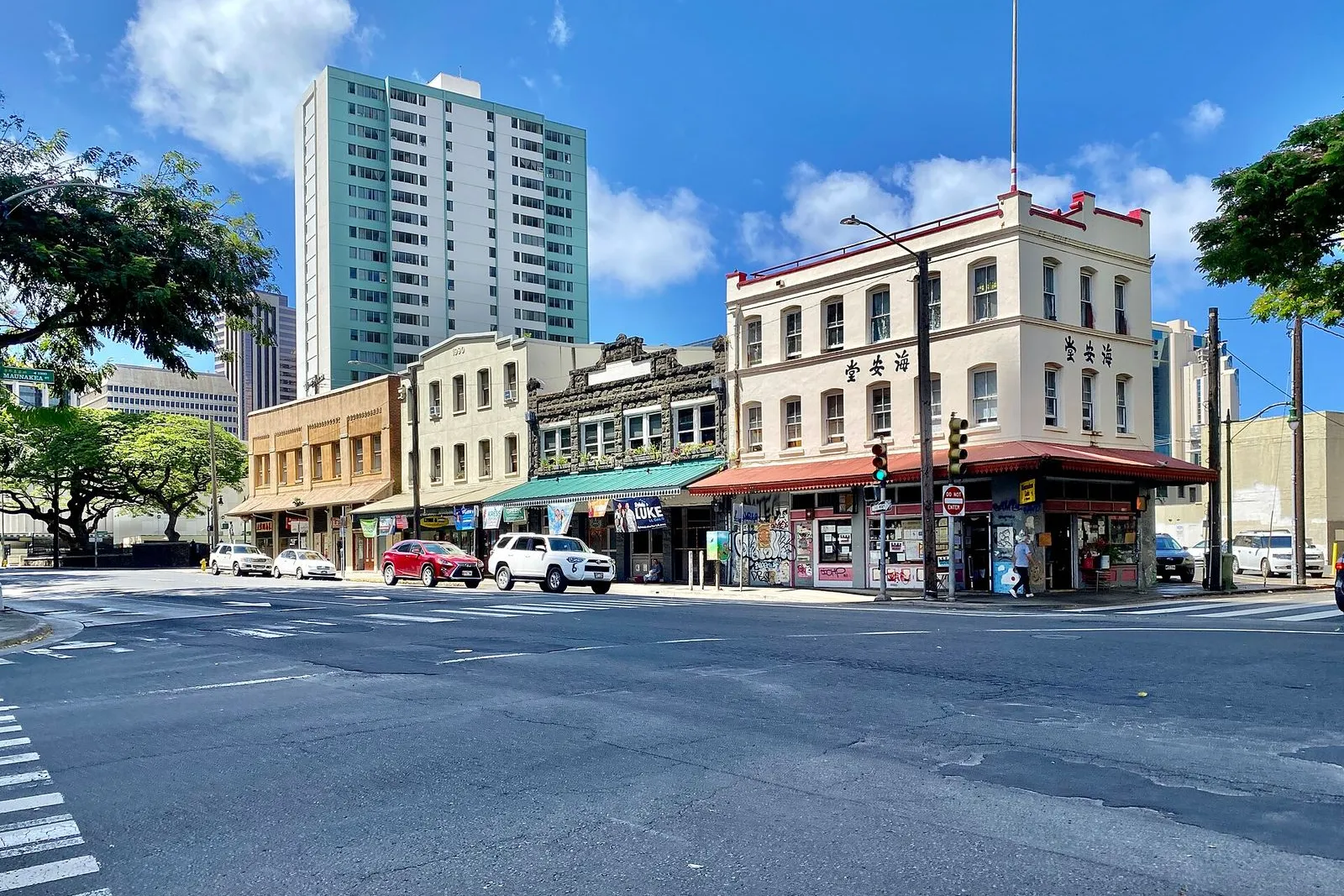
Honolulu's Chinatown is not one culture distilled into a few blocks. It is Chinese, Japanese, Filipino, Vietnamese, Thai, Korean, and Laotian, all sharing the same narrow streets. The district burned twice: once in 1886, and again in the controlled burn that got out of hand in 1900. What stands today was rebuilt on the same ashes. This walk starts at Oʻahu Market, open since 1904, threads through produce stalls and a food court that covers half of Asia, follows ballast-stone sidewalks past century-old storefronts, and ends in the cool green of Foster Botanical Garden. Give it about an hour and three-quarters, more if you stop to eat.

Hear it on the street

Get the turn-by-turn audio guide in the app. The narration plays itself as you reach each stop, hands-free and offline.

Stop by stop

The route

Interactive map of the route. The full stop list below works without it.

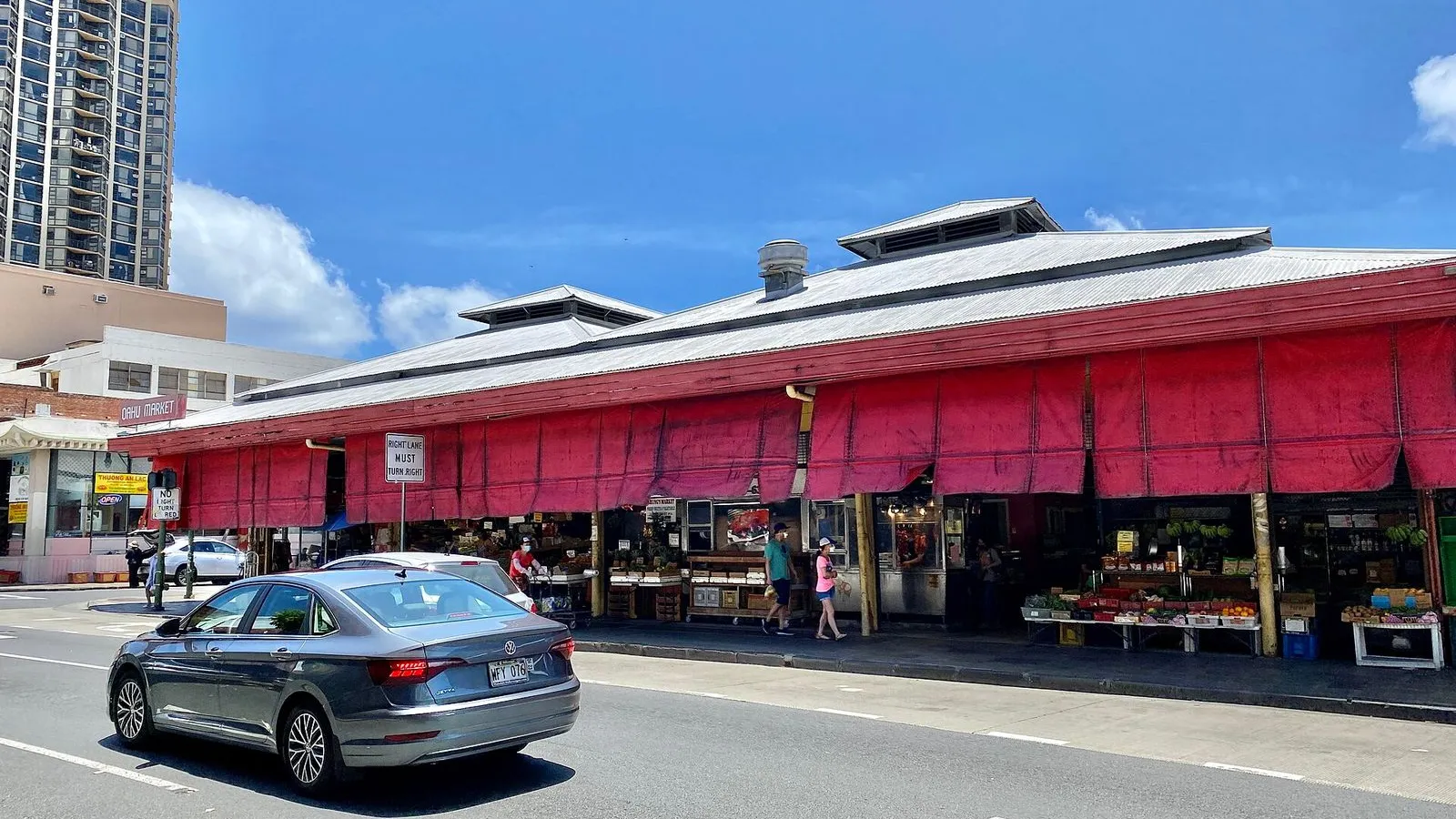
Oʻahu MarketMust see

Photo by w_lemay on Wikimedia Commons

Oʻahu Market

0:00

The oldest open-air market in Honolulu, operating from its original 1904 building of brick, coral blocks, and timber.

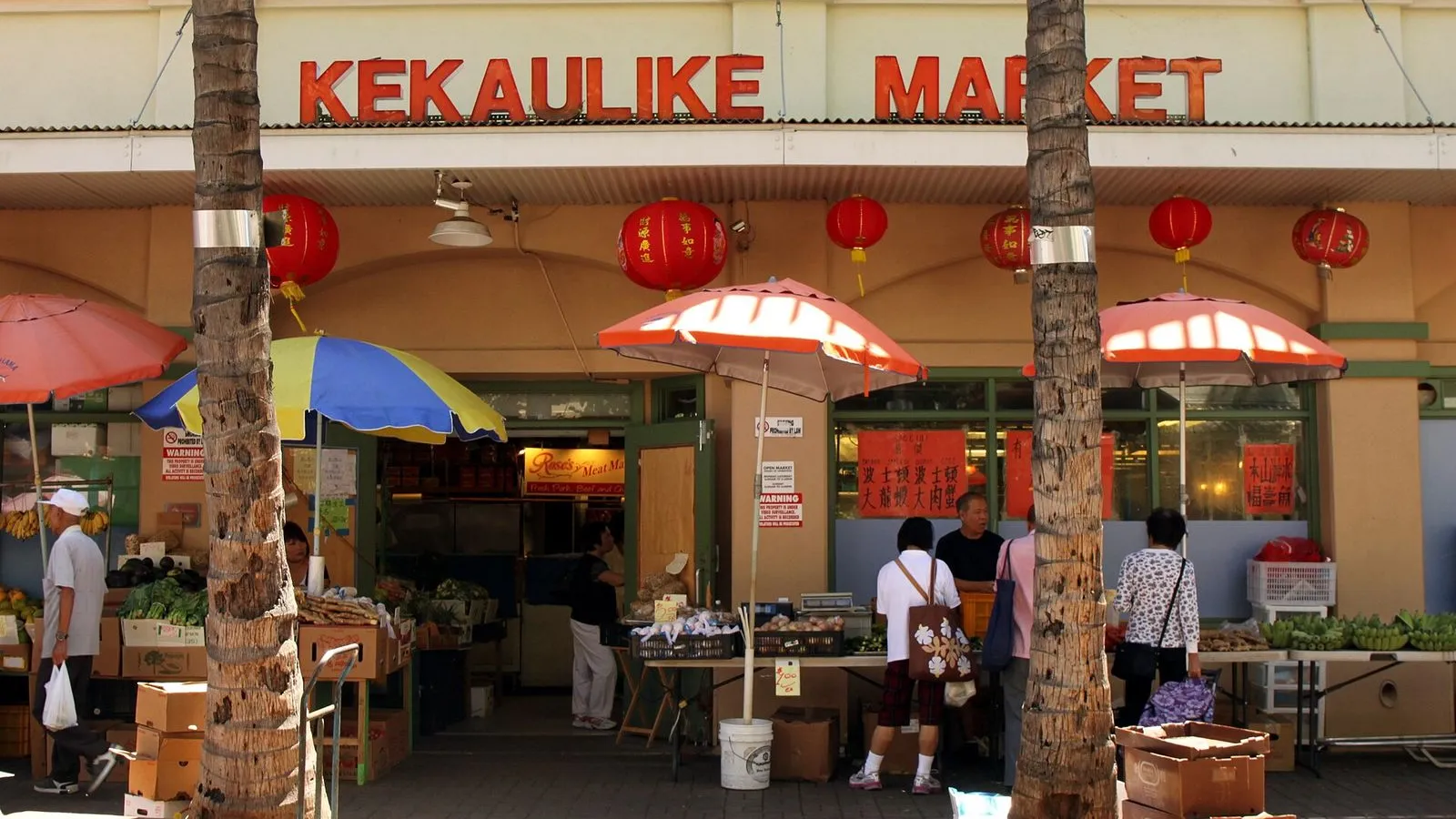
You're standing at the corner of King and Kekaulike, looking at the oldest public market still working in Honolulu. Oʻahu Market opened in 1904, built by a Chinese businessman named Anin Young. The structure around you has not changed much since: brick, coral blocks, a stone foundation, a wooden roof. The stalls open straight to the street, same as they did when the market put the fancier government market on Alakea Street out of business within months.

Step inside. The red shades overhead, the butchers and fishmongers, the whole rhythm of the place: this is how Honolulu has shopped for over a century. The market stayed in the Young family for eighty years, and when they finally sold, it was the tenants themselves, twenty-four of them, who formed a corporation and bought it. They still run it today.
≈1 min walk to the next stop

Kekaulike Mall

0:00

A pedestrian market lane lined with produce stalls, anchored by a red and gold dragon mural.

You're in Kekaulike Mall, the open-air corridor that runs between King and Hotel streets. Every morning from about seven until two, this lane fills with fruit and vegetable vendors. The produce here tells you who lives in this neighborhood now: Thai basil, Filipino bitter melon, Vietnamese mint, Chinese long beans, all piled on the same tables. In 2024 the city finished a four-million-dollar renovation of this mall.

New pavement, shade trees, better drainage. And the dragon, that red and gold decal at the center, was moved here from King Street. A local business association wanted Chinatown to have a heart, something you could point to and say, here. This is it.

≈2 min walk to the next stop
Maunakea MarketplaceLocal pick

Photo by California Cow from Seattle, USA on Wikimedia Commons

Maunakea Marketplace

0:00

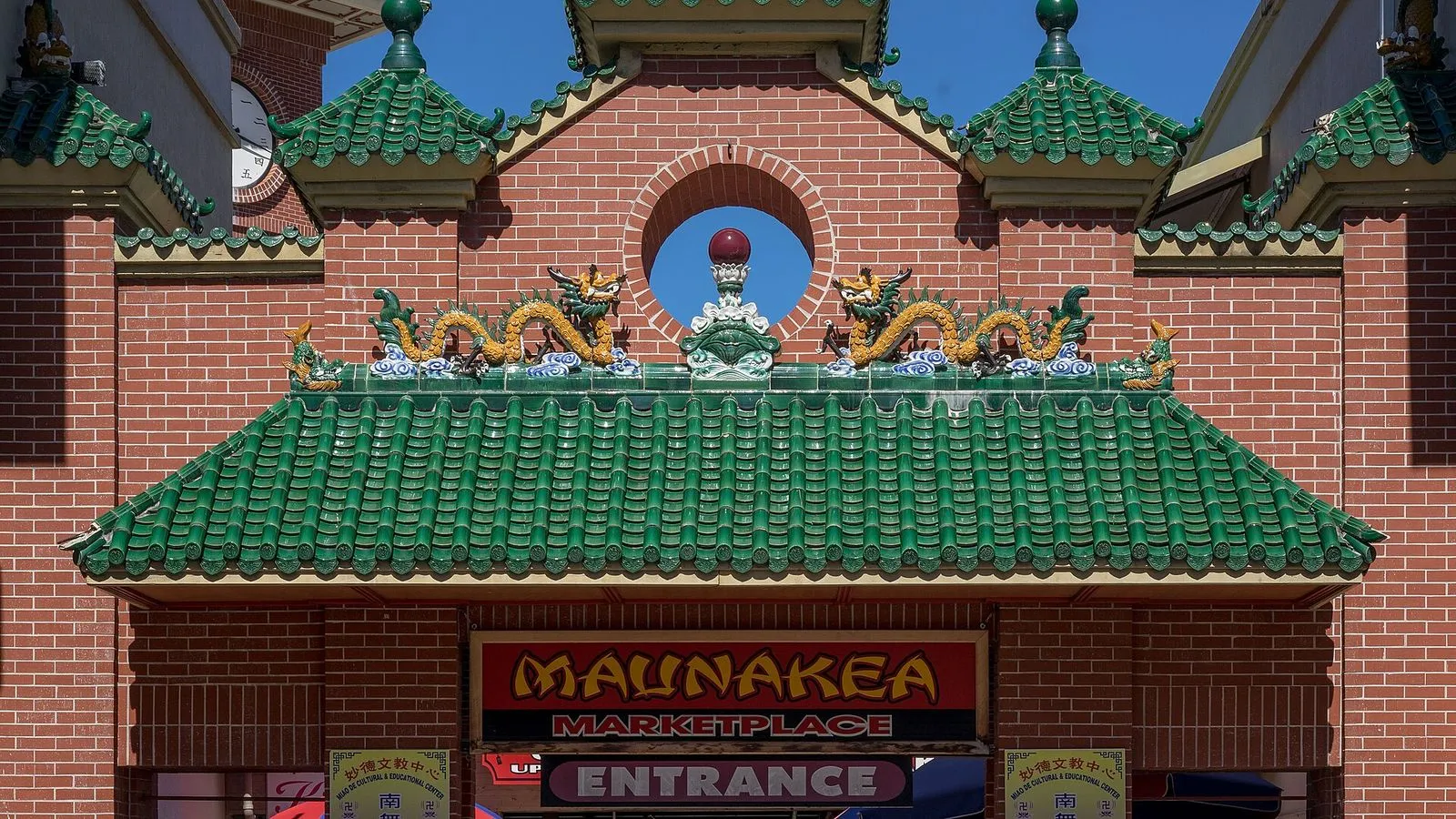
A 1990 market complex built around a courtyard food court, with stalls serving a dozen Asian cuisines.

Maunakea Marketplace opened in 1990, but the food court inside feels like it's been here forever. The complex was built on a vacant city lot and incorporates the facade of an older theater. Find the wide entryway on Maunakea Street and step into the courtyard. The clock tower in the middle stopped at 8:17 years ago and nobody has bothered to fix it.

That tells you something about priorities here. Inside are about fifteen food stalls, cash only, no tax. Chinese, Vietnamese, Thai, Filipino, Korean, Japanese, Malaysian, Singaporean: all in a single squeeze-through space. Triple One does laksa.

Vientiane serves Lao beef salad. Naty's has a pork and shrimp noodle soup that costs five dollars. Order by pointing at the steam trays if you don't know the name. Eat outside in the courtyard.

You'll be back on the street in twenty minutes, but you'll taste this stop for hours.

≈3 min walk to the next stop
Free preview ends here · stops 4 to 8 continue in the app

Hotel Street

The historic spine of Chinatown, lined with early-1900s storefronts and sidewalks paved with ship ballast stones.

in app

Nuʻuanu Avenue

A gallery-lined stretch where the oldest surviving buildings in Chinatown meet the district's contemporary art scene.

in app

Izumo Taishakyo Mission of Hawaii

A Shinto shrine founded in 1906, one of the few active in the United States, tucked beside the Nuʻuanu Stream.

in app

Kuan Yin Temple

A vivid red Buddhist temple dedicated to the Goddess of Mercy, at the northern edge of Chinatown.

in app

Foster Botanical Garden

A 13.5-acre tropical garden and the oldest botanical garden in Hawaii, a cool green counterpoint to the dense streets of Chinatown.

in app
Good to know

Before you go

What is the best time of day to walk Chinatown?

Morning to early afternoon, ideally between 9:00 a.m. and 2:00 p.m. The markets are fully open, the food stalls are serving, and the streets are busy with shoppers. Late afternoon quiets down, and some stalls begin closing by 3:00 or 4:00 p.m. Sunday mornings are quieter but the markets still operate.

Is Honolulu's Chinatown safe to walk through?

During the day, Chinatown is busy with office workers, shoppers, and market vendors. The market streets and Hotel Street are well-trafficked. The blocks immediately north of North Beretania Street can feel rougher; this walk stays south of there. Standard city awareness is all you need.

Provenance · last verified August 17, 2026

Built from the Wayside route itself: the stops, their order, and the walk between them.

Photo by w_lemay on Wikimedia Commons · CC BY-SA 2.0

Photo by w_lemay on Wikimedia Commons · CC BY-SA 2.0

Photo by Prayitno / Thank you for (12 millions +) view from Los Angeles, USA on Wikimedia Commons · CC BY 2.0

Photo by California Cow from Seattle, USA on Wikimedia Commons · CC BY 2.0

Photo by kajikawa on Wikimedia Commons · CC BY 3.0

Photo by George Pearson / George Henry Burgess on Wikimedia Commons · Public domain

Photo by jijake1977 on Openverse · CC BY 2.0

Photo by Brandon Karaca on Unsplash

Photo by Alexandra Nelson on Unsplash

Coming soon

Wayside isn't in the app stores yet, but it's in the works. Check back soon.