San Francisco · Self-guided audio walk

Haight-Ashbury: Stones, Song, and Victorians

Walk the Haight from its famous psychedelic corner through its oldest park to the city's most photographed row of houses.

  • 5Stops
  • 3.8 kmDistance
  • 55+ minTime
Haight-Ashbury: Stones, Song, and Victorians

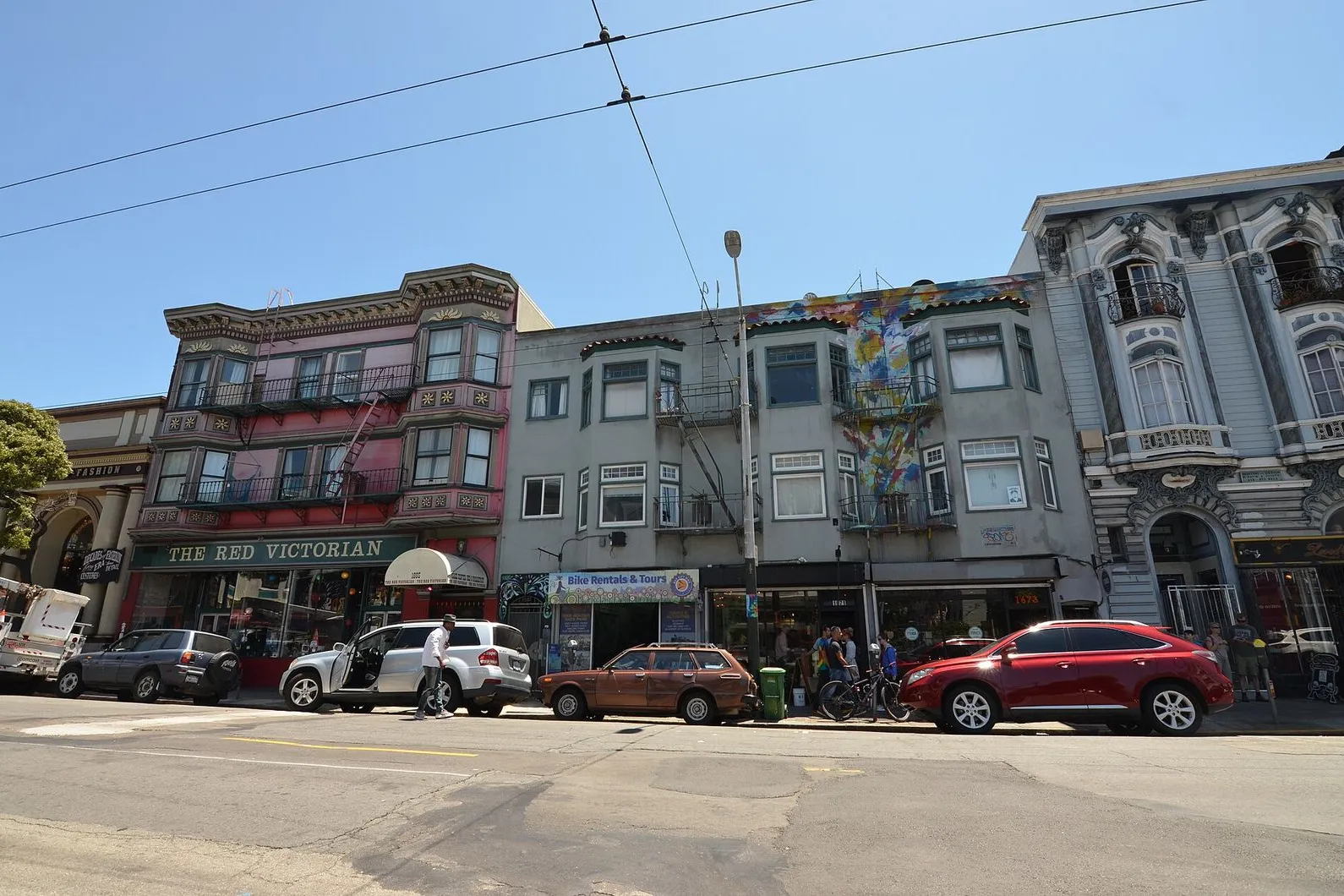
Photo by Steven Lek on Wikimedia Commons

The corner of Haight and Ashbury is where a neighborhood got its name and a generation found its compass point. This walk starts there and moves east, past the Grateful Dead house at 710 Ashbury, Janis Joplin's pink building at 635 Ashbury, and the red facade at 1524 Haight that claims a Hendrix connection few historians accept. Then it leaves the sidewalk shrines behind. Buena Vista Park, San Francisco's oldest, hides WPA footpaths lined with broken Victorian headstones, some still face-up and readable. The Panhandle, a narrow green strip where Hendrix really did play a free show from a flatbed truck in June 1967, runs just north of the neighborhood. Alamo Square closes the walk with the Painted Ladies, seven Victorians at 710 to 720 Steiner Street, the downtown skyline rising behind them.

Hear it on the street

Get the turn-by-turn audio guide in the app. The narration plays itself as you reach each stop, hands-free and offline.

Stop by stop

The route

Interactive map of the route. The full stop list below works without it.

Haight and AshburyMust see

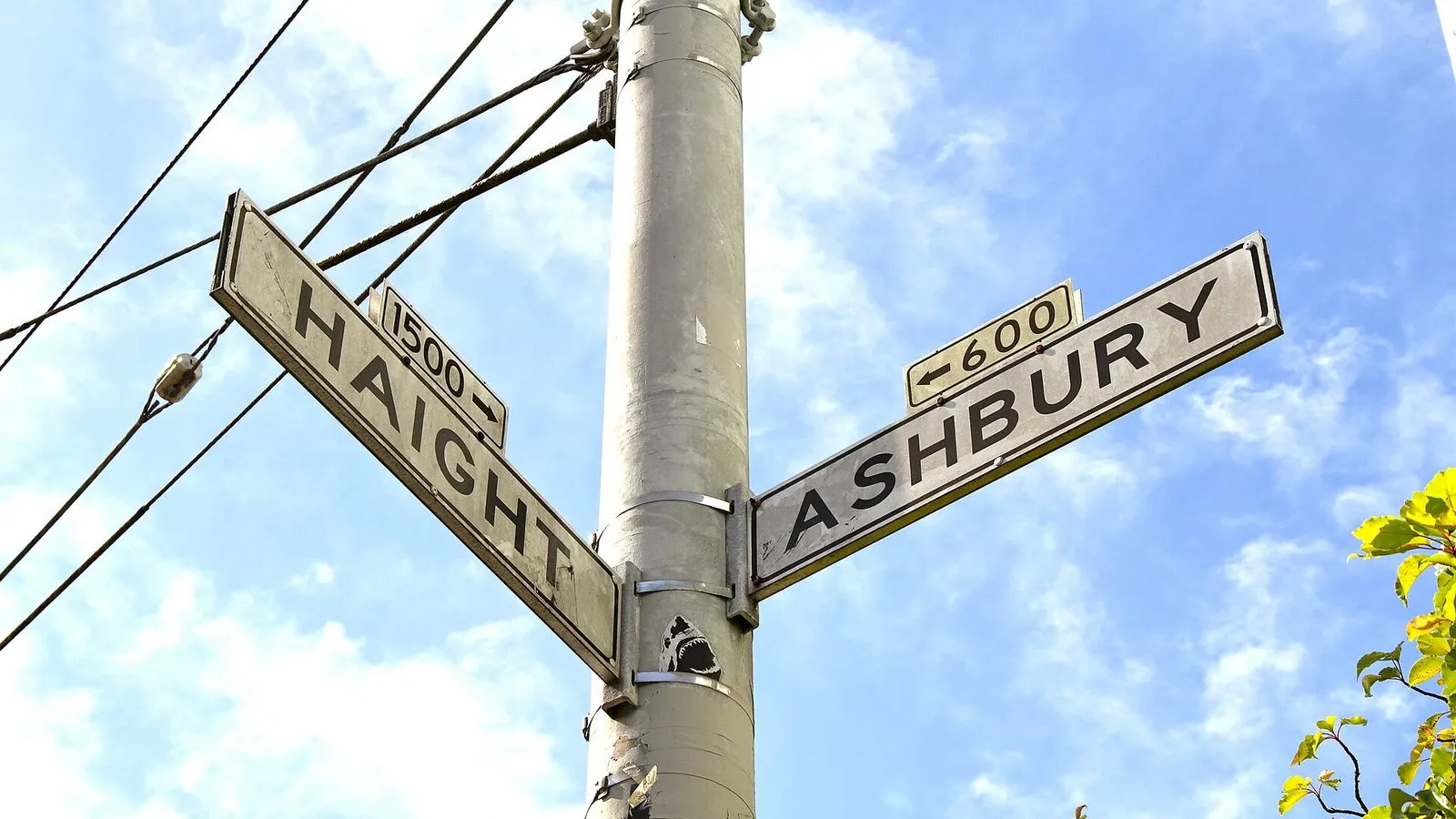
Photo by The Erica Chang on Wikimedia Commons

Haight and Ashbury

0:00

The intersection that gave a neighborhood its name and a generation its compass point.

You are standing at the corner of Haight and Ashbury. The street signs above you are two of the most stolen in America, so the city eventually started selling replicas at the police station. That should tell you something about what this intersection means to people. In 1967 the Haight drew somewhere around 100,000 young people.

The Grateful Dead, Janis Joplin, and Jefferson Airplane all lived within a few blocks of where you are standing. The neighborhood still wears its history on its storefronts, but the Summer of Love was also brief and complicated. A lot of the kids who flooded in that summer were gone by fall, and the Dead themselves had left 710 Ashbury by early 1968. The corner you are on now was never just a tourist stop.

It was a real place where things happened fast and fell apart faster. Look up at the intersection. Take it in. Then turn and walk north up Ashbury Street, climbing the hill toward number 710.
≈3 min walk to the next stop
710 Ashbury StreetMust see

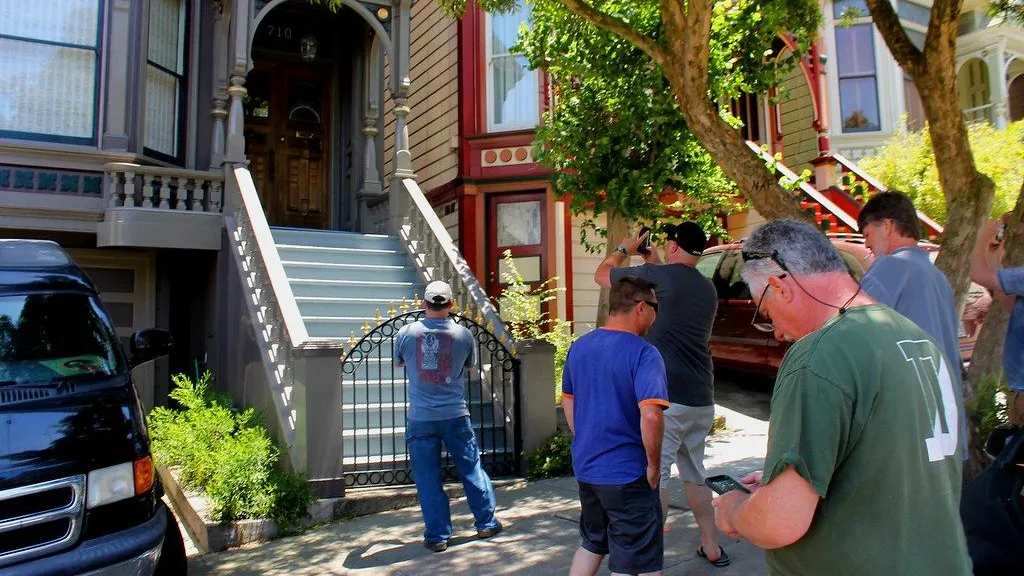
Photo by terryballard on Openverse

710 Ashbury Street

0:00

The Grateful Dead house, where a boarding house became the band's headquarters, photo backdrop, and the site of a front-page pot bust in 1967.

This tall Victorian at 710 Ashbury was a boarding house before it was a legend. The band's managers, Rock Scully and Danny Rifkin, set up the office here first, then rooms opened up one by one until the whole building was theirs. The Grateful Dead posed on this front stoop for a Rolling Stone photograph by Baron Wolman. A thin, beardless Jerry Garcia grins from the doorway; Pigpen holds a rifle.

That image became one of the band's most enduring pictures, and it is why people still pause at this gate today. On October 2, 1967, police raided the house and arrested Bob Weir and Pigpen on marijuana charges, along with several others. The bust made the front page of the Chronicle. The band held a press conference right here, a rare political act from a group that otherwise steered clear.

Ken Kesey once lost his brakes coming down this hill and had to choose between crashing into the Dead's house or the Hells Angels' house across the street. He chose the Angels. Walk back down Ashbury toward Haight. Your next stop is two doors south of the corner, at 635.

≈8 min walk to the next stop
Buena Vista ParkMust see

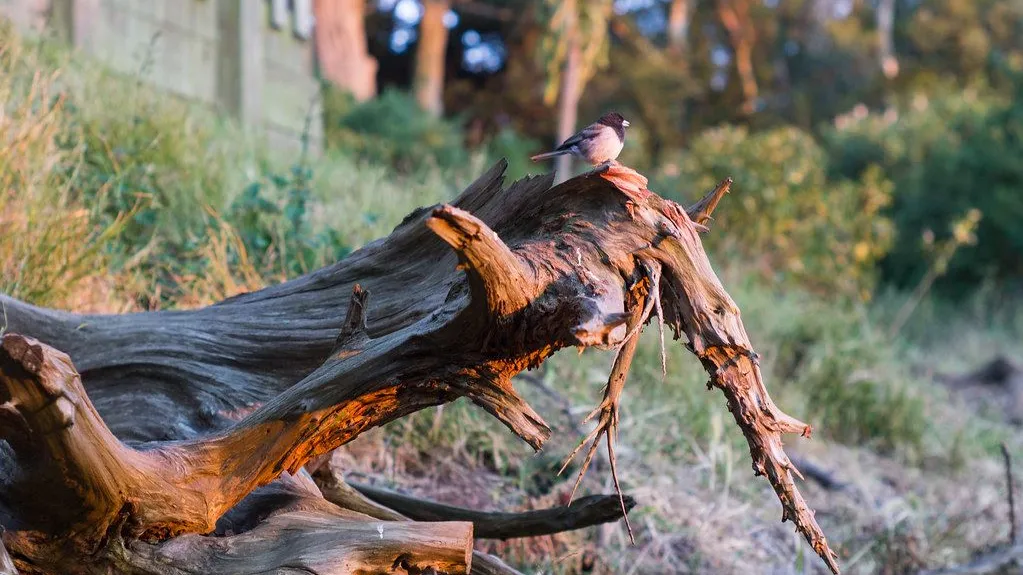
Photo by thelawoffives on Openverse

Buena Vista Park

0:00

San Francisco's oldest park, established in 1867, where WPA workers built footpaths out of broken Victorian headstones. Some inscriptions still face the sky.

Buena Vista Park is 36 acres of steep hill, dense oaks, and eucalyptus, and it is the oldest official park in San Francisco. It was called Hill Park when the city set it aside in 1867, paying squatters $88,250 to leave. In 1906, people gathered on this summit for five days to watch the fires from the earthquake burn across the city. The paths you are walking on were rebuilt by WPA workers in the late 1930s.

They lined the gutters with broken marble headstones taken from the Victorian cemeteries at Lone Mountain, which the city was clearing to move the dead to Colma. Most stones were placed inscription-side down, out of respect. But a few were laid face up. Walk the western paths near the Haight Street entrance and look at the stone borders along the trail edges.

You will find fragments: a number 52, the word 'died,' a partial name. The marble is smooth and white, cut into irregular triangles. These gutters run all the way up the hillside. The park fell into rough shape during the Summer of Love, when people camped in the dense brush and police made regular arrests.

A renovation in 1978 stabilized the path system. Today it is quiet, steep, and full of hidden things. When you are ready, exit the park at its northeast corner and walk north two blocks to Fell Street. Cross Fell and enter the Panhandle.

≈15 min walk to the next stop
Free preview ends here · stops 4 to 5 continue in the app

The Panhandle

A narrow green strip extending east from Golden Gate Park where Jimi Hendrix played a free show from a flatbed truck on June 25, 1967.

in app

Alamo Square

The Painted Ladies at 710 to 720 Steiner Street, seven Victorians with the downtown skyline rising behind them, the most photographed residential view in the city.

in app
Good to know

Before you go

Is Haight-Ashbury still worth visiting?

Haight Street is a mix of well-preserved Victorian architecture, independent bookstores, vintage clothing shops, and a heavy dose of 1960s nostalgia commerce. The corner of Haight and Ashbury is a photo stop. Buena Vista Park and the Panhandle are quiet, beautiful, and largely tourist-free. Alamo Square's Painted Ladies are the most photographed houses in the city. The neighborhood is worth half a day if you care about the architecture and the parkland; if you only want the street and the corner, an hour covers it.

Did Jimi Hendrix really live at 1524 Haight Street?

The red building at 1524 Haight Street calls itself the Jimi Hendrix Red House. Hendrix biographers who have traced his every documented day in the Bay Area have found no evidence he ever lived there. He did play a free show from a flatbed truck in the Panhandle on June 25, 1967, a few blocks north, and that one is undisputed.

Provenance · last verified August 18, 2026

Built from the Wayside route itself: the stops, their order, and the walk between them.

Photo by Steven Lek on Wikimedia Commons · CC BY-SA 4.0

Photo by The Erica Chang on Wikimedia Commons · CC BY 3.0

Photo by terryballard on Openverse · CC BY 2.0

Photo by thelawoffives on Openverse · CC BY-SA 2.0

Photo by Leo_Visions on Unsplash

Photo by Mike McBey on Wikimedia Commons · CC BY 2.0

Photo by Adam Dillon on Unsplash

Photo by Dietmar Rabich on Wikimedia Commons · CC BY-SA 4.0

Photo by Cedric Letsch on Unsplash

Photo by Ligocsicnarf89 on Wikimedia Commons · CC BY 4.0

Photo by Ken Lund from Reno, Nevada, USA on Wikimedia Commons · CC BY-SA 2.0

Coming soon

Wayside isn't in the app stores yet, but it's in the works. Check back soon.