San Francisco · Self-guided audio walk

Alleys and Incense: The Real Chinatown

Behind the souvenir shops, a living neighborhood of temples, mahjong games, and hand-folded fortune cookies.

  • 8Stops
  • 1.3 kmDistance
  • 25+ minTime
Alleys and Incense: The Real Chinatown

Photo by Adam Dillon on Unsplash

San Francisco's Chinatown is the oldest in North America, but most visitors never leave Grant Avenue. This walk takes you off the main drag and into the alleys where Chinatown actually lives. You will climb past painted balconies to a Taoist temple that has burned incense since the 1870s, hear mahjong tiles clacking behind half-open doors on Spofford Alley, and watch fortune cookies get folded by hand on Ross Alley. Portsmouth Square, the city's original plaza, anchors the route. The Chinese Historical Society ties it all together at the end. The whole walk stays inside Chinatown and runs about an hour and three quarters. Come hungry and come curious.

Hear it on the street

Get the turn-by-turn audio guide in the app. The narration plays itself as you reach each stop, hands-free and offline.

Stop by stop

The route

Interactive map of the route. The full stop list below works without it.

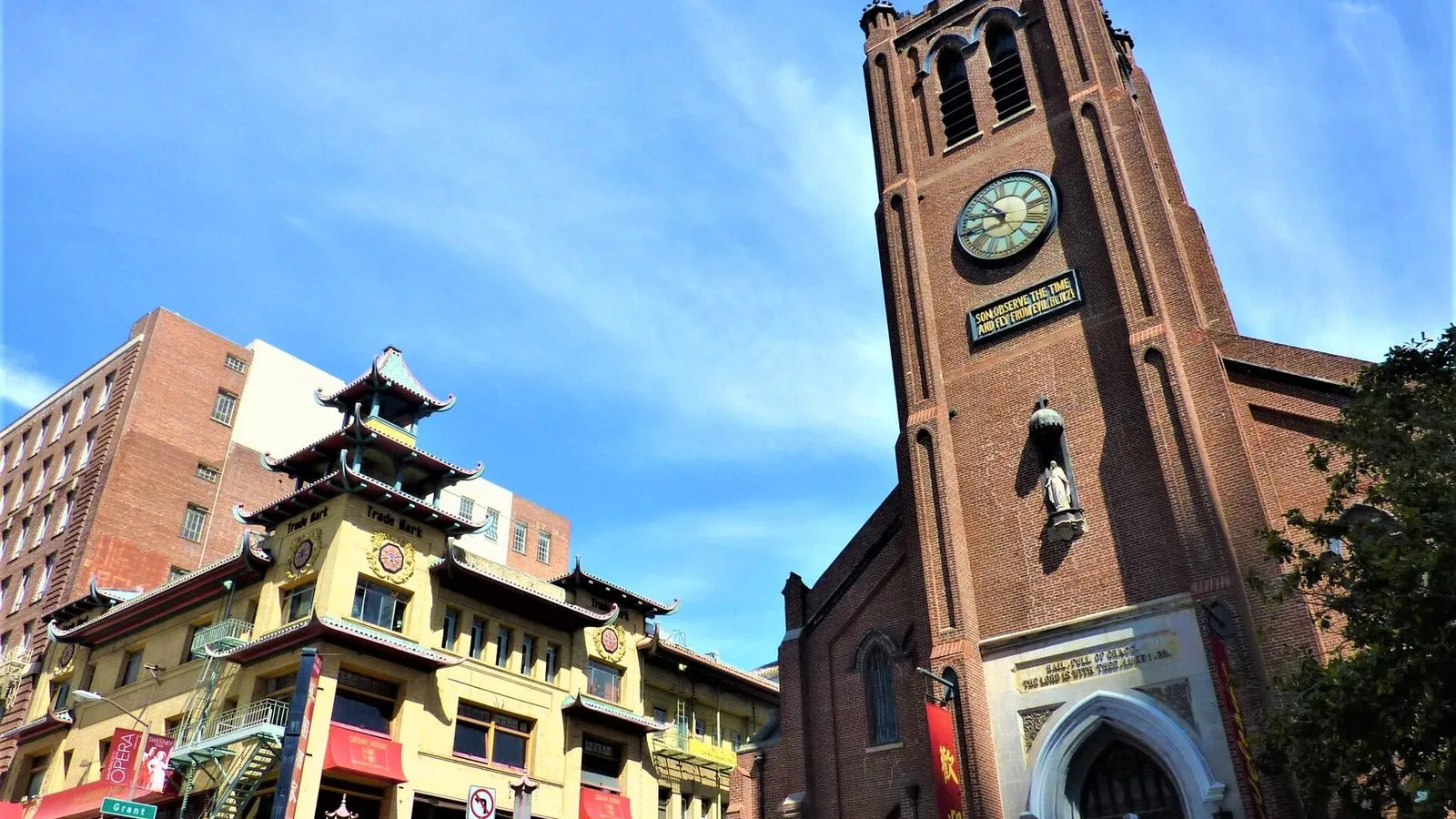
Dragon GateMust see

Photo by Ilkka Simomaa on Wikimedia Commons

Dragon Gate

0:00

The ceremonial southern entrance to Chinatown, dedicated in 1970, with three green-tiled portals, stone guardian lions, and calligraphy by Sun Yat-sen.

You are standing under the Dragon Gate, the ceremonial entrance to Chinatown since 1970. Look up. The three portals face south, following an old Chinese tradition, and the green tile roof was assembled from 120 ceramic tiles donated by Taiwan. Two stone guardian lions flank the pedestrian gates.

The male lion on the west side rests his paw on a pearl. The female on the east has a cub under hers. Above the central arch, Sun Yat-sen's calligraphy reads 'All under heaven is for the good of the people.' The gate took over a decade of planning and cost nearly double the original budget. When it was finally dedicated in October 1970, three thousand people showed up, and about fifty protesters denounced what they called Moon Gates for Tourists.

More than half a century later, it is the most photographed spot in the neighborhood.
≈4 min walk to the next stop
Old St Mary's CathedralLocal pick

Photo by Chris06 on Wikimedia Commons

Old St Mary's Cathedral

0:00

California's first cathedral, built in 1854 with granite cut in China and bricks shipped around Cape Horn. The clock still bears its warning to nineteenth-century sinners.

This is Old St. Mary's, the first cathedral built in California. Its cornerstone was laid in 1853, and it opened at Christmas midnight mass in 1854. The granite in its foundation was quarried and cut in China, then shipped across the Pacific.

The bricks came from New England, carried around Cape Horn as ships' ballast. At the time, it was the tallest building in San Francisco. The 1906 earthquake left it standing, but the fire that followed gutted the interior, burning so hot it melted the church bells and the marble altar. Only the brick shell and the bell tower survived.

Look at the clock face. Below it is a line from Ecclesiasticus: 'Son, observe the time and fly from evil.' That was aimed squarely at the men who visited the brothels that lined this neighborhood in the 1850s. The Paulist Fathers have run the parish since 1894, and in 1903 they opened the first Chinese Catholic mission in the country here. Step inside if the doors are open.

A self-guided pamphlet at the entrance shows photographs of the church before and after the fire.

≈4 min walk to the next stop
Portsmouth SquareLocal pick

Photo by Gary Soup on Openverse

Portsmouth Square

0:00

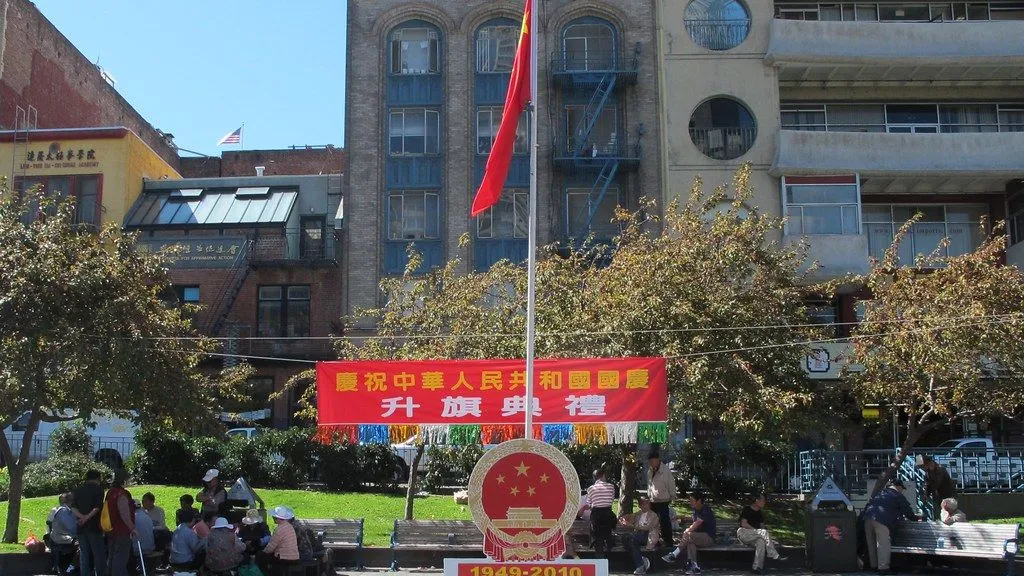
The oldest public square in San Francisco, now Chinatown's living room, where elders play cards, practice tai chi, and gather daily on the benches.

You are in Portsmouth Square, the first public square in San Francisco. It was laid out in the 1830s when the city was still a Mexican village called Yerba Buena. In 1846, Captain John Montgomery of the USS Portsmouth raised the American flag here and claimed the settlement for the United States. The square took his ship's name, and the settlement took the name San Francisco a year later.

Today, this is Chinatown's living room. On any given morning you will see elders practicing tai chi in slow arcs. At the card tables, men play poker and Chinese chess for pocket change. The concrete playground animals near the center represent the Chinese zodiac.

The pedestrian bridge on the east side leads to the Chinese Culture Center inside the Hilton, but the real show is right here on the benches. Pick a spot and watch for a few minutes. The rhythms of the square have not changed much in decades, even as the skyline around it has.

≈3 min walk to the next stop
Free preview ends here · stops 4 to 8 continue in the app

Waverly Place

A two-block alley the Chinese community has called Tin How Temple Street for over a century, lined with painted balconies and the ghosts of vanished temples.

in app

Tin How Temple

The oldest operating Taoist temple in Chinatown, dedicated to the sea goddess Mazu, on the top floor at 125 Waverly. Incense has burned here since the 1870s.

in app

Spofford Alley

A narrow lane between Washington and Clay where the afternoon fills with the sound of mahjong tiles. Sun Yat-sen once used alleys like this to organize a revolution.

in app

Ross Alley

One of the oldest alleys in the city, cut in 1849. The Golden Gate Fortune Cookie Factory has been folding cookies by hand here since 1962.

in app

Chinese Historical Society of America

The oldest and largest archive of Chinese American history, housed in a 1932 Julia Morgan building that was once the Chinatown YWCA.

in app
Good to know

Before you go

Is the Golden Gate Fortune Cookie Factory really worth visiting?

The Golden Gate Fortune Cookie Factory on Ross Alley is a single narrow storefront where three women fold fortune cookies by hand on a conveyor belt. It takes three minutes to watch, the cookies are warm and cost a few dollars for a bag, and the alley itself is one of the oldest in San Francisco. It is not a museum or an attraction with a tour. Go for the five-minute stop it is, not the destination it is sometimes sold as.

Is Chinatown safe to explore on foot?

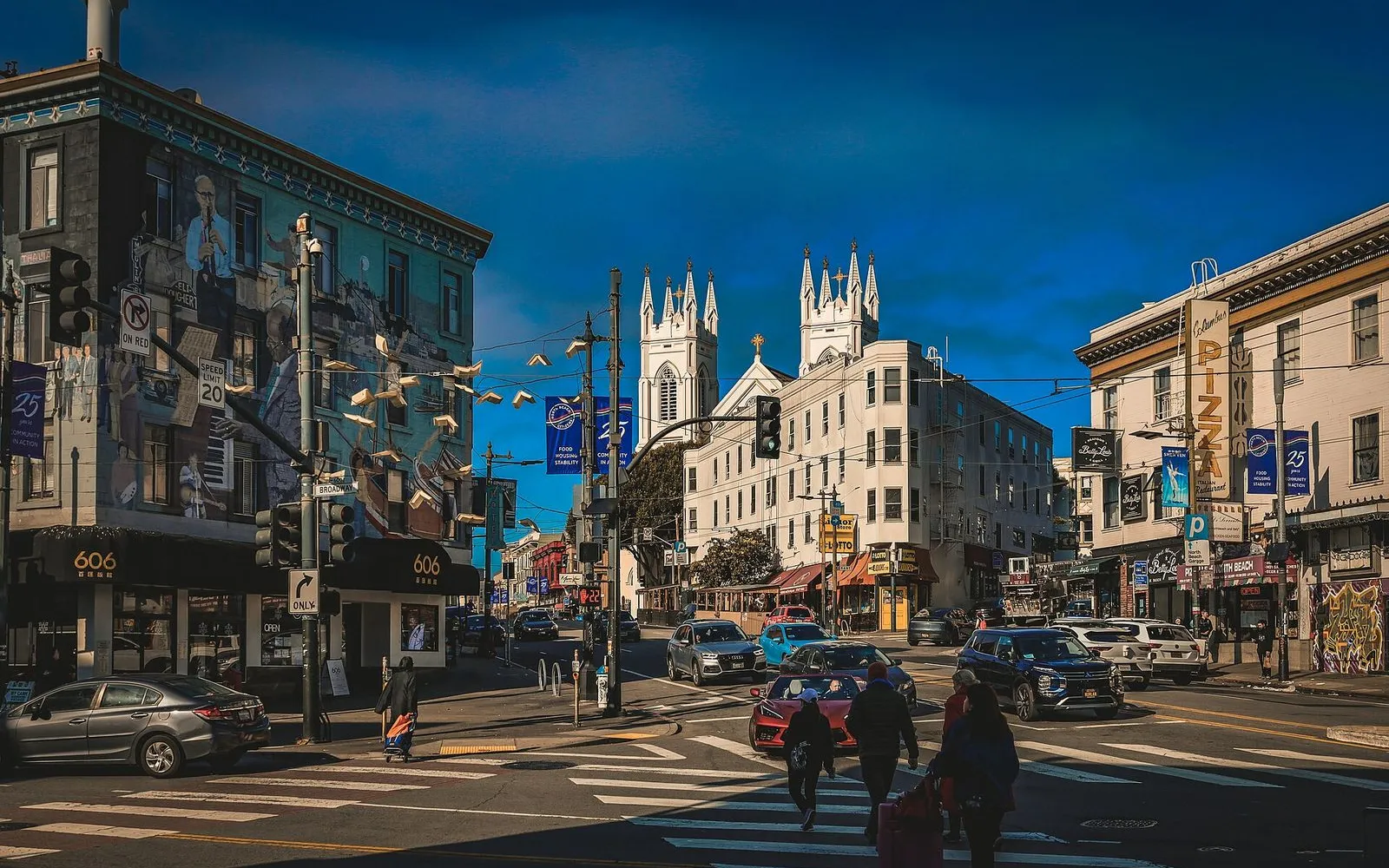
San Francisco's Chinatown is safe to walk during the day and early evening. The main streets (Grant, Stockton, Broadway) are busy with residents and shoppers. The alleys are narrow and some are dimly lit after dark, but they are residential and generally quiet. Exercise the same street awareness you would in any dense urban neighborhood.

Provenance · last verified August 18, 2026

Built from the Wayside route itself: the stops, their order, and the walk between them.

Photo by Adam Dillon on Unsplash

Photo by Ilkka Simomaa on Wikimedia Commons · CC BY 4.0

Photo by Chris06 on Wikimedia Commons · CC BY-SA 4.0

Photo by Gary Soup on Openverse · CC BY 2.0

Photo by Leo_Visions on Unsplash

Photo by Mike McBey on Wikimedia Commons · CC BY 2.0

Photo by Dietmar Rabich on Wikimedia Commons · CC BY-SA 4.0

Photo by Cedric Letsch on Unsplash

Photo by Ligocsicnarf89 on Wikimedia Commons · CC BY 4.0

Photo by Steven Lek on Wikimedia Commons · CC BY-SA 4.0

Photo by Ken Lund from Reno, Nevada, USA on Wikimedia Commons · CC BY-SA 2.0

Coming soon

Wayside isn't in the app stores yet, but it's in the works. Check back soon.