London · Self-guided audio walk

Spitalfields: Four Faiths, One Street

A ninety-minute walk through the London neighbourhood where Huguenot silk weavers, Jewish tailors, and Bengali chefs all left their mark on the same few blocks.

  • 6Stops
  • 1.5 kmDistance
  • 25+ minTime
Spitalfields: Four Faiths, One Street

Photo by beareye2010 on Wikimedia Commons

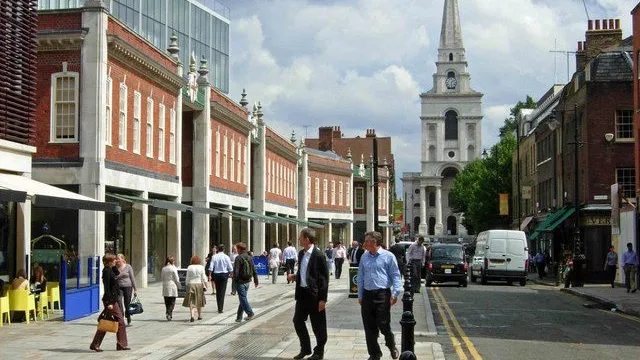
Spitalfields has absorbed Huguenot silk weavers, Jewish refugees, and the Bengali community that gave Brick Lane its curry houses and its mosque. This walk weaves through Fournier Street's Georgian houses, Christ Church's Baroque bulk, the Jamme Masjid (a building that has been a chapel, a synagogue, and a mosque), Old Spitalfields Market, and the rag-trade stalls of Petticoat Lane. Compact, dense with history, and walkable in ninety minutes, it stays with the living layers of a neighbourhood that keeps remaking itself.

Hear it on the street

Get the turn-by-turn audio guide in the app. The narration plays itself as you reach each stop, hands-free and offline.

Stop by stop

The route

Interactive map of the route. The full stop list below works without it.

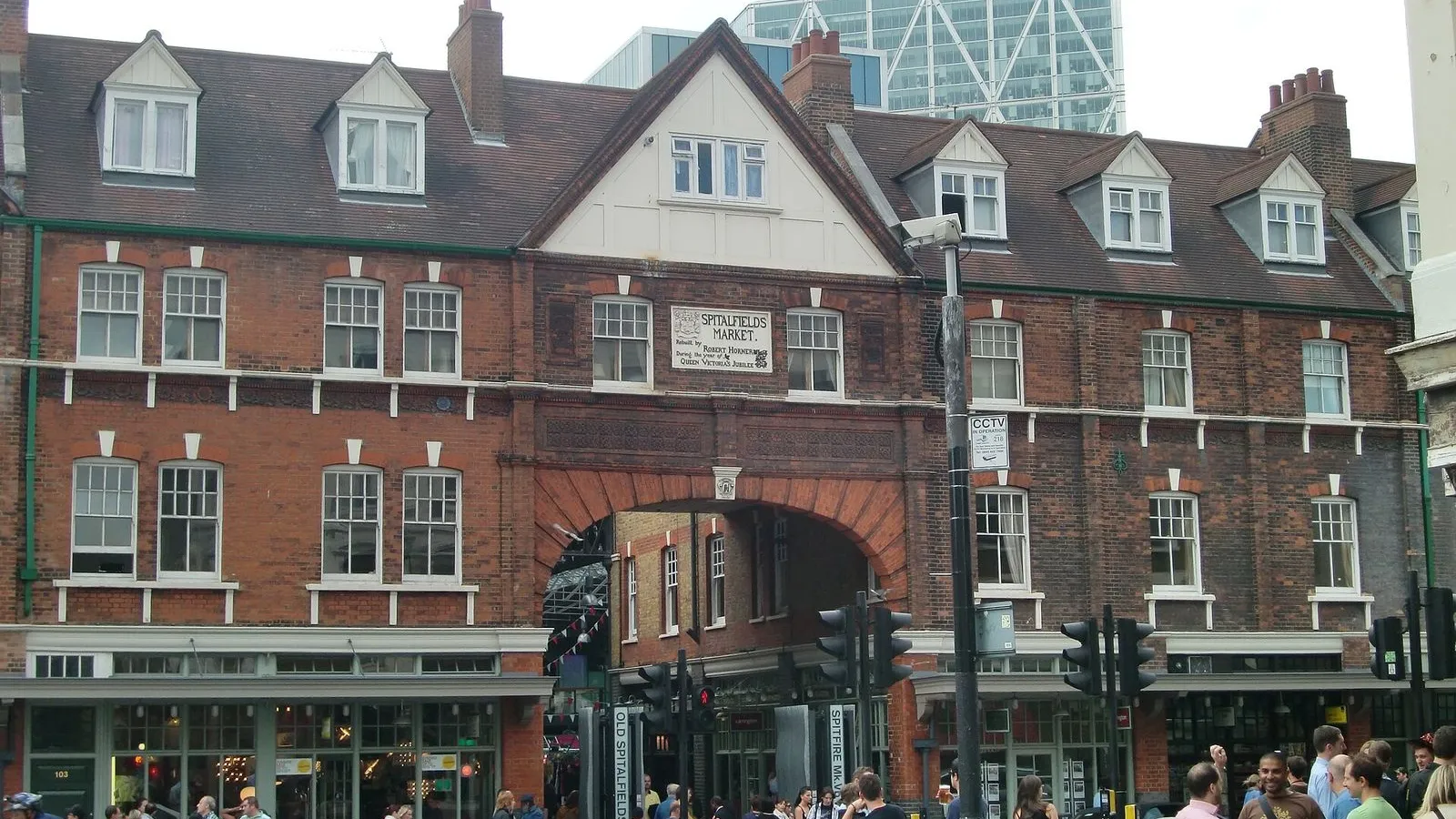
Old Spitalfields MarketMust see

Photo by Jonathan Cardy on Wikimedia Commons

Old Spitalfields Market

0:00

A covered market since 1682, now filled with vintage stalls, street food, and the wrought-iron roof of the 1893 Horner Buildings.

You are standing inside Old Spitalfields Market, under a wrought-iron and glass roof that has sheltered traders since 1893. The market itself is older still. Charles II granted a Royal Charter for a market here in 1682, when this was still open fields east of the City wall. For two centuries it was a fruit and vegetable market, growing from two days a week to six.

The Huguenot weavers who settled the streets around you bought their produce here, and by 1810 more than ten thousand silk looms rattled in the garrets of Fournier Street and Princelet Street just a block away. Robert Horner, a former market porter, paid to replace the old sheds with this Victorian hall in the 1880s. The wholesale market moved to Leyton in 1991, and today the stalls sell vintage clothes, street food, and crafts. Look up at the roof trusses and the red brick arches.

Then walk out the eastern exit onto Commercial Street. Across the road, the great stone spire of Christ Church fills the sky.
≈1 min walk to the next stop
Christ Church SpitalfieldsMust see

Photo by Stephen McKay on Wikimedia Commons

Christ Church Spitalfields

0:00

Nicholas Hawksmoor's Baroque masterpiece, built between 1714 and 1729, with a tower that rises in three stages and an organ from 1735 that was once the largest in England.

Christ Church Spitalfields. Nicholas Hawksmoor built it between 1714 and 1729, and many consider it the finest English Baroque church in the country. Hawksmoor was a former assistant to Christopher Wren, and this was one of twelve churches he designed under the Fifty New Churches Act, paid for by a tax on coal. The Act was meant to put an Anglican church in every fast-growing suburb, and Spitalfields, swelling with Huguenot silk weavers, needed one.

Look at the west tower: it rises in three stages to a steeple that feels almost Gothic, a deliberate choice by Hawksmoor to anchor the church in English tradition. The porch was added later, but the broad, plain nave behind it is pure Baroque confidence. Inside, the organ dates from 1735, built by Richard Bridge, and for many years it was the largest in England. The Huguenot weavers who filled these pews had fled Catholic France; the church they sat in was the Church of England, and that tension is part of the story here.

Now turn around and walk down Fournier Street, which opens directly opposite the church steps.

≈2 min walk to the next stop
Fournier StreetMust see

Photo by Alan Stanton on Wikimedia Commons

Fournier Street

0:00

One of the finest Georgian streets in Britain, built in the 1720s for Huguenot silk weavers, with wide attic windows that lit the looms and doorcases carved one by one.

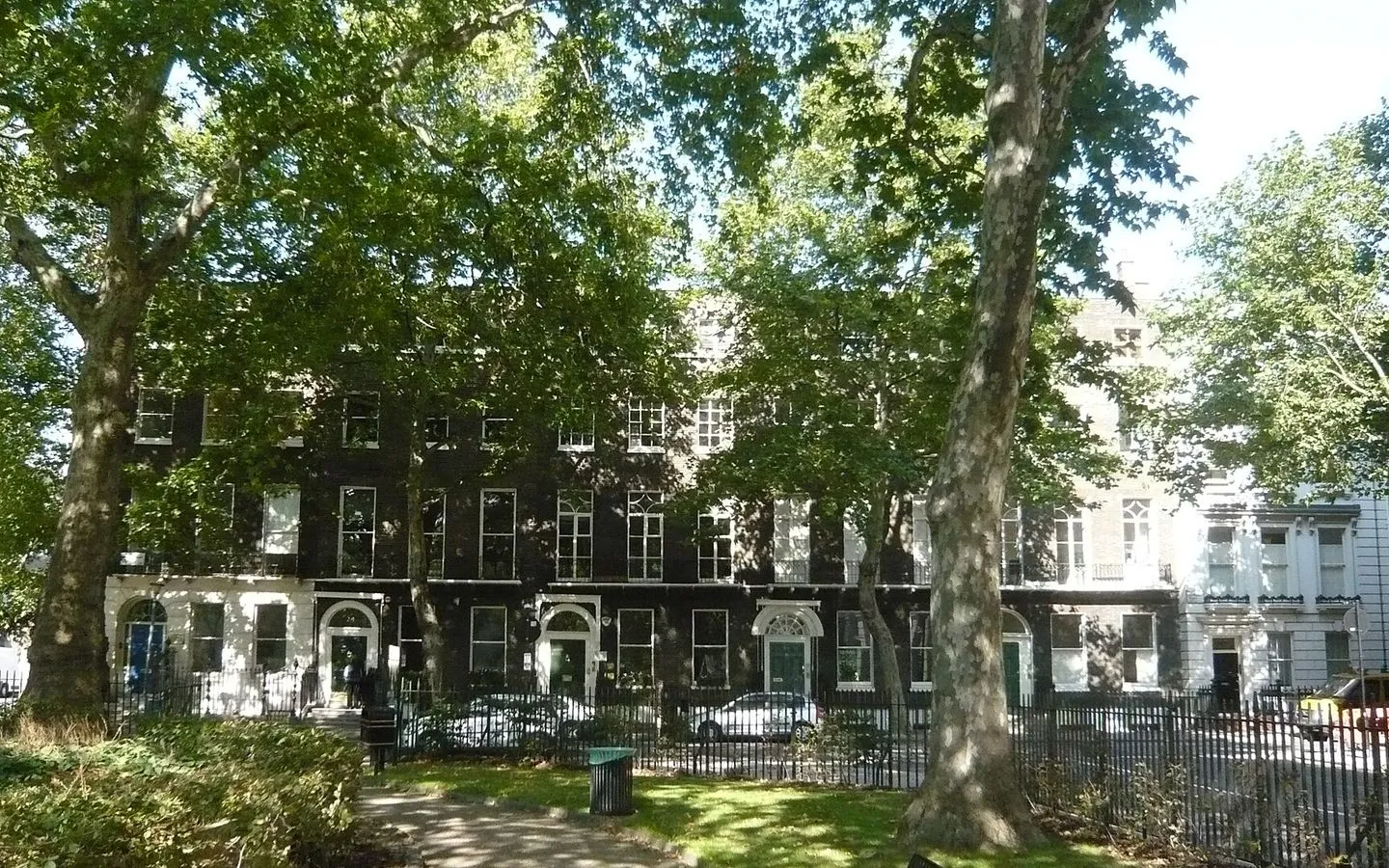
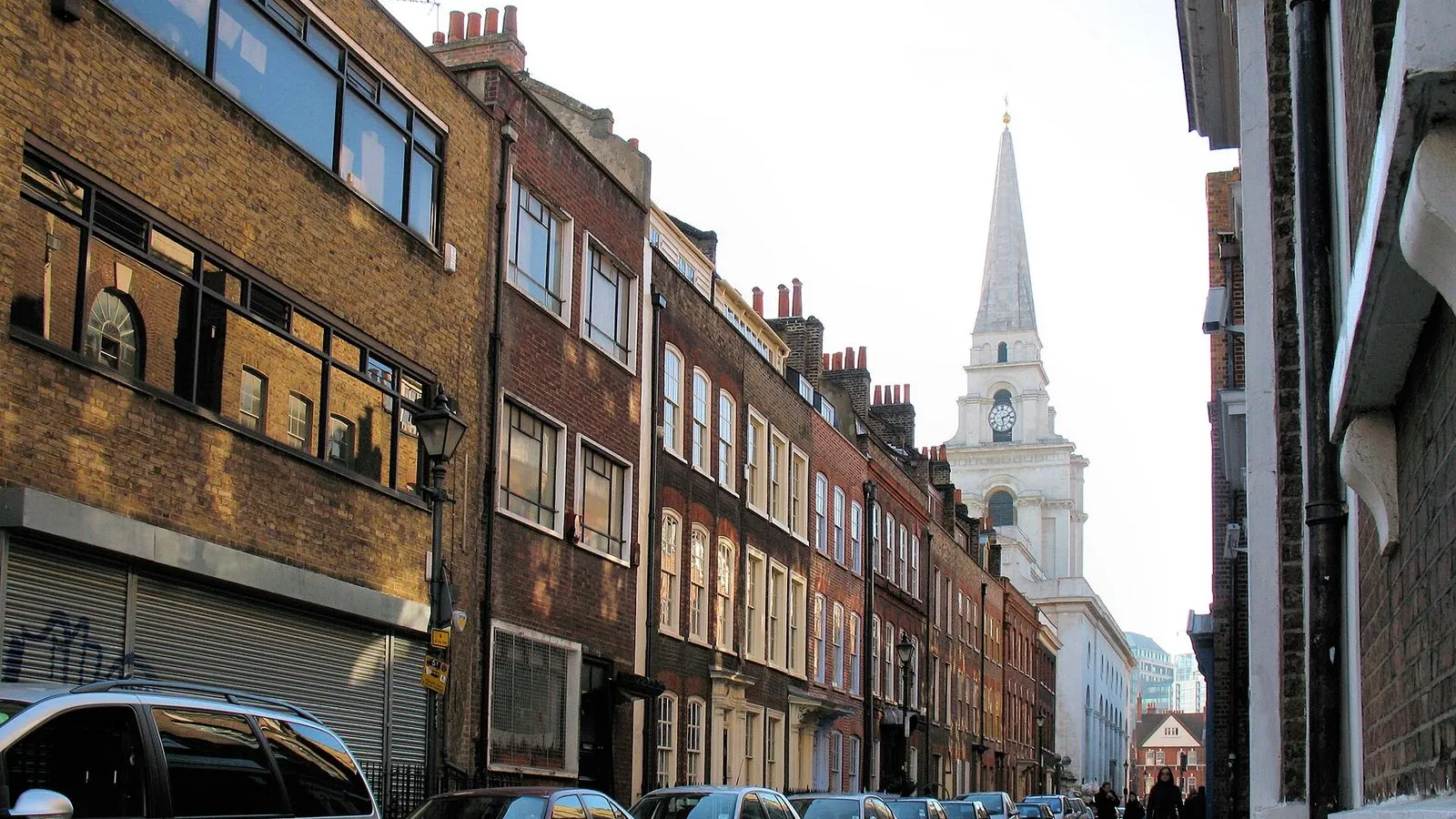
Fournier Street is one of the best-preserved Georgian streets in Britain. Every house on this terrace was built between roughly 1720 and 1728, and nearly all of them are still standing. Look for the wide attic windows: those are weavers' garrets, built to catch every hour of daylight for the looms. Silk weaving was a luxury trade, and the Huguenot masters who lived here used the ground floors as showrooms where merchants from the City could examine the finished cloth.

Number 14, Howard House, is the finest on the street. It was here that the silk for Queen Victoria's coronation gown was woven. Walk slowly and notice the doorcases: each one is different, carved by the same craftsmen who fitted out the interiors with paneling and staircase balustrades. Number 23 is the best surviving example of a simple, single-fronted Georgian townhouse, with its original mansard roof and wide weaver's windows intact.

The street is named after George Fournier, a Huguenot refugee himself. At the eastern end of Fournier Street, where it meets Brick Lane, you will see a building with a steel minaret outside. That is the Jamme Masjid.

≈1 min walk to the next stop
Free preview ends here · stops 4 to 6 continue in the app

Brick Lane Jamme Masjid

A Huguenot chapel from 1743, then a Methodist chapel, then a synagogue, and since 1976 a mosque. Look for the sundial carved Umbra Sumus: we are shadows.

in app

Brick Lane

From brick kilns to bagel bakeries to Banglatown curry houses: Brick Lane is the loudest, most crowded street in the East End, and the one that keeps reinventing itself.

in app

Petticoat Lane

Four centuries of street trading: from Tudor hog lane to Jewish rag fair to the Sunday clothes market that still draws over a thousand stalls.

in app
Good to know

Before you go

Is Spitalfields worth visiting if I only have one day in London?

Spitalfields is compact and dense, and the walk takes about ninety minutes. If you want a break from the grand monuments of Westminster and the South Bank, it offers a different London: Georgian silk-weavers' houses, a mosque that was once a synagogue, and Brick Lane's curry houses. It works as a late-afternoon addition if you finish the main route early.

When is Brick Lane at its best?

Sunday mornings bring the Brick Lane Market and the food stalls in the Old Truman Brewery yard. Sunday is also when Petticoat Lane Market fills with over a thousand clothing stalls. Weekday lunchtimes are quieter and the curry houses are less crowded. Saturday night is loud and busy.

Provenance · last verified August 9, 2026

Built from the Wayside route itself: the stops, their order, and the walk between them.

Photo by beareye2010 on Wikimedia Commons · CC0

Photo by Jonathan Cardy on Wikimedia Commons · CC BY-SA 3.0

Photo by Stephen McKay on Wikimedia Commons · CC BY-SA 2.0

Photo by Alan Stanton on Wikimedia Commons · CC BY-SA 2.0

Photo by Miki Nishimura on Unsplash

Photo by Txllxt TxllxT on Wikimedia Commons · CC BY-SA 4.0

Photo by Txllxt TxllxT on Wikimedia Commons · CC BY-SA 4.0

Photo by ricardo from London on Wikimedia Commons · CC BY 2.0

Photo by Ввласенко on Wikimedia Commons · CC BY-SA 3.0

Photo by Peter Trimming on Wikimedia Commons · CC BY-SA 2.0

Photo by Scalondonuk on Wikimedia Commons · CC BY-SA 4.0

Coming soon

Wayside isn't in the app stores yet, but it's in the works. Check back soon.