Berlin · Self-guided audio walk

The Two Friedrichshains

From the painted Wall to the GDR's grandest boulevard, through Berlin's wildest cultural compound.

  • 6Stops
  • 4.8 kmDistance
  • 70+ minTime
The Two Friedrichshains

Photo by Olivier Cleynen on Wikimedia Commons

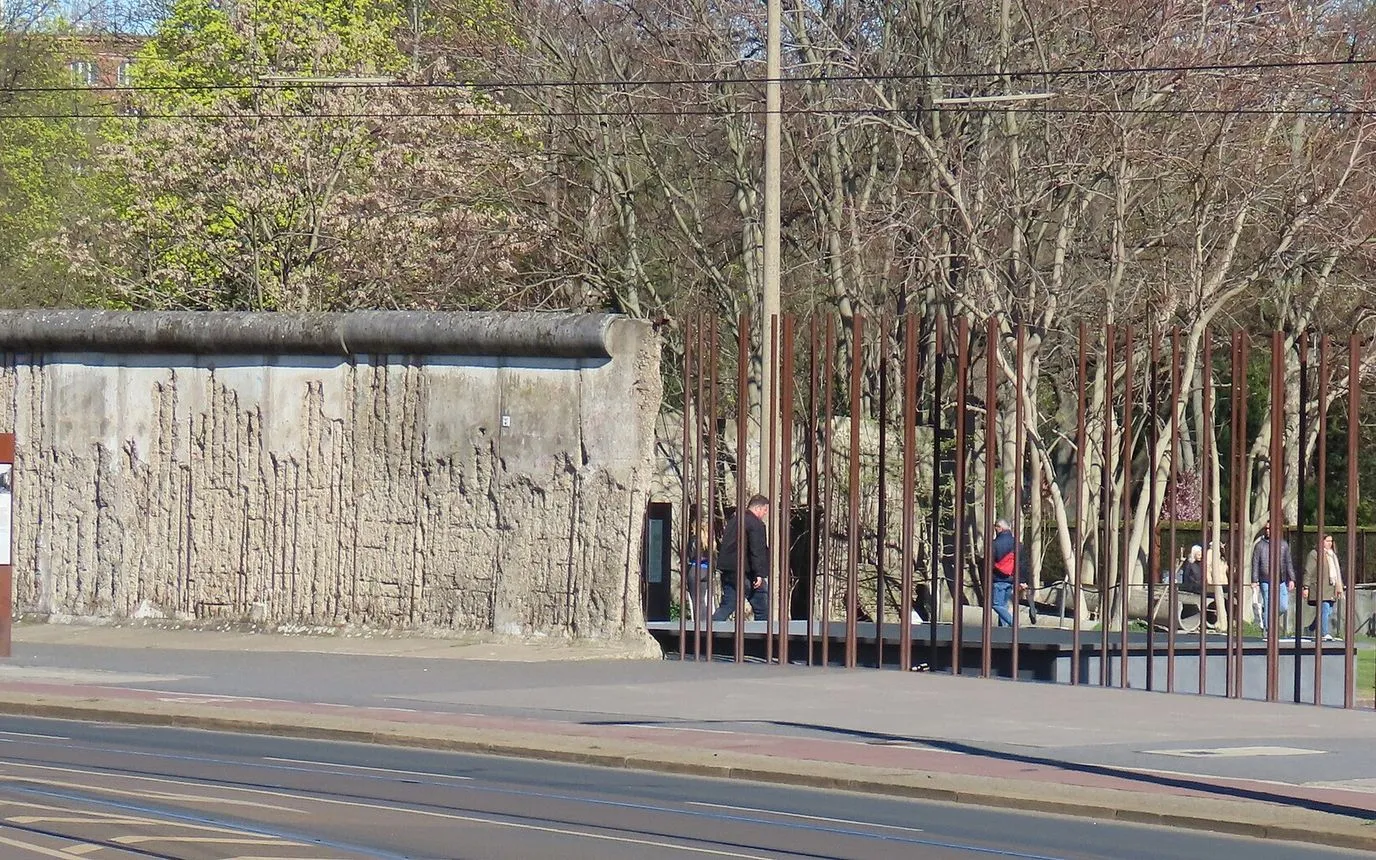
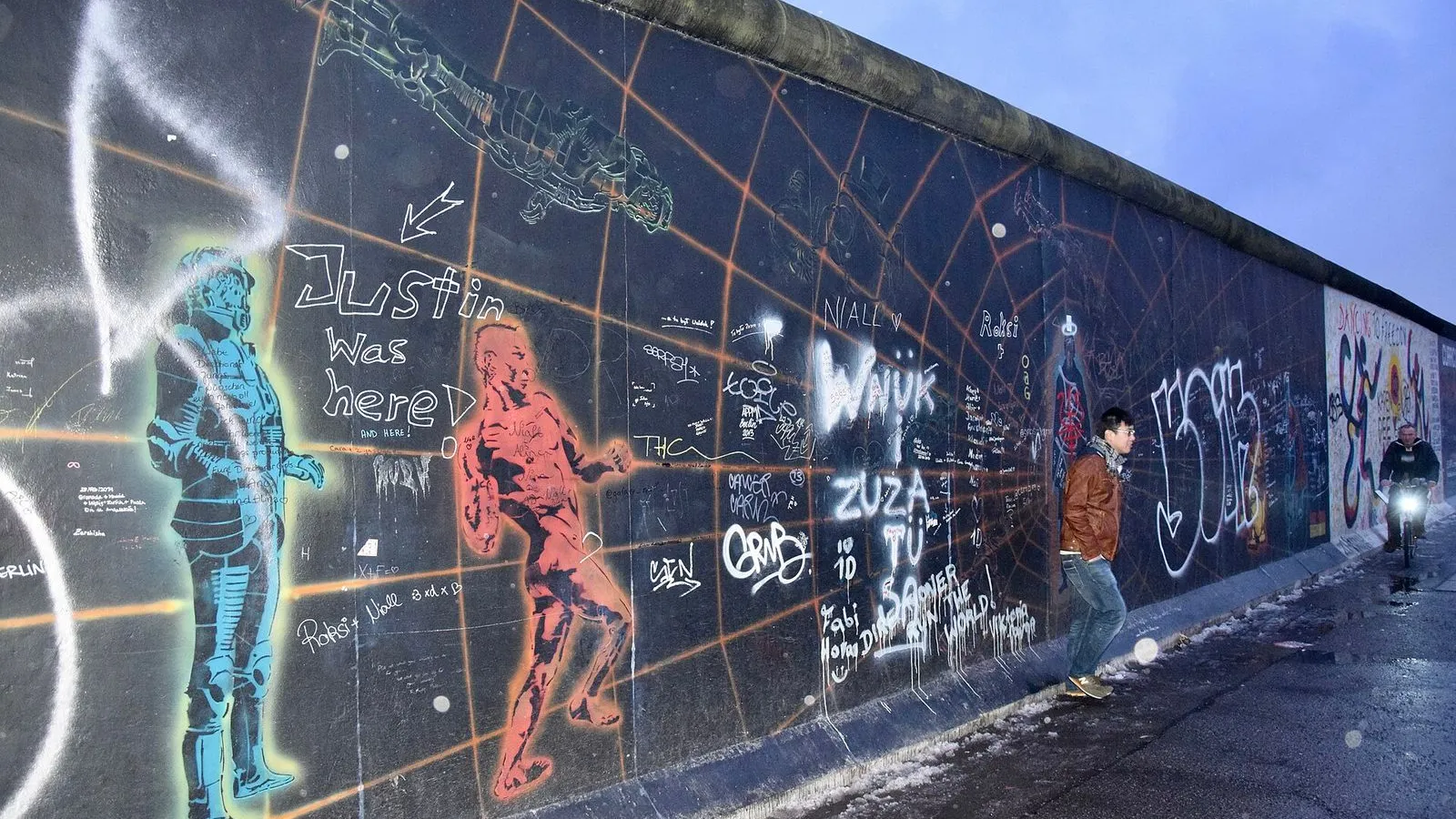
Friedrichshain holds two of Berlin's most striking open-air monuments, and this walk ties them together. Start at the East Side Gallery, the longest surviving stretch of the Berlin Wall, where 118 artists from 21 countries painted murals in 1990, including Vrubel's famous fraternal kiss. The gallery was stripped and fully repainted in 2009, and what you see today is a faithful restoration.

Cross the neo-Gothic Oberbaumbrücke, a bridge that once divided East from West, and duck into the RAW-Gelände, a former railway repair yard now packed with clubs, a skate hall, a climbing bunker, and some of Berlin's densest street art.

The walk then climbs onto Karl-Marx-Allee, the 2.3-kilometer Stalinist boulevard built as the GDR's architectural showcase: 89 meters wide, lined with wedding-cake apartment blocks faced in Meissen ceramics, and the place where the 1953 workers' uprising began. It ends at Strausberger Platz, where the socialist-realist phase gives way to the modernist second act.

Hear it on the street

Get the turn-by-turn audio guide in the app. The narration plays itself as you reach each stop, hands-free and offline.

Stop by stop

The route

Interactive map of the route. The full stop list below works without it.

East Side GalleryMust see

Photo by Ank Kumar on Wikimedia Commons

East Side Gallery

0:00

The longest surviving stretch of the Berlin Wall, painted in 1990 by 118 artists from 21 countries and fully restored in 2009.

You are standing before the East Side Gallery, 1.3 kilometers of the Berlin Wall that 118 artists from 21 countries turned into an open-air gallery in 1990, just months after the border opened. Until the Wall fell, only the western side had graffiti; the eastern side was sterile concrete and death strip. The most famous mural is Dmitri Vrubel's 'My God, Help Me to Survive This Deadly Love,' showing Soviet leader Leonid Brezhnev and East German leader Erich Honecker locked in a socialist fraternal kiss. Look for Birgit Kinder's Trabant, the tiny East German car that appears to burst through the concrete.

These murals have not survived untouched. By the 2000s, weather, vandalism, and souvenir chipping had left them faded and crumbling. In 2009, for the twentieth anniversary of the Wall's fall, the entire gallery was stripped, the concrete restored, and the original artists were invited back to repaint their work with durable paints and a protective varnish. What you see is a restoration, faithful but not identical.

Start at the eastern end and walk west toward the Oberbaumbrücke, the twin-towered bridge you can already see spanning the Spree.
≈2 min walk to the next stop
OberbaumbrückeMust see

Photo by Arild Vågen on Wikimedia Commons

Oberbaumbrücke

0:00

Berlin's most beautiful bridge, a neo-Gothic double-decker that divided East from West during the Cold War.

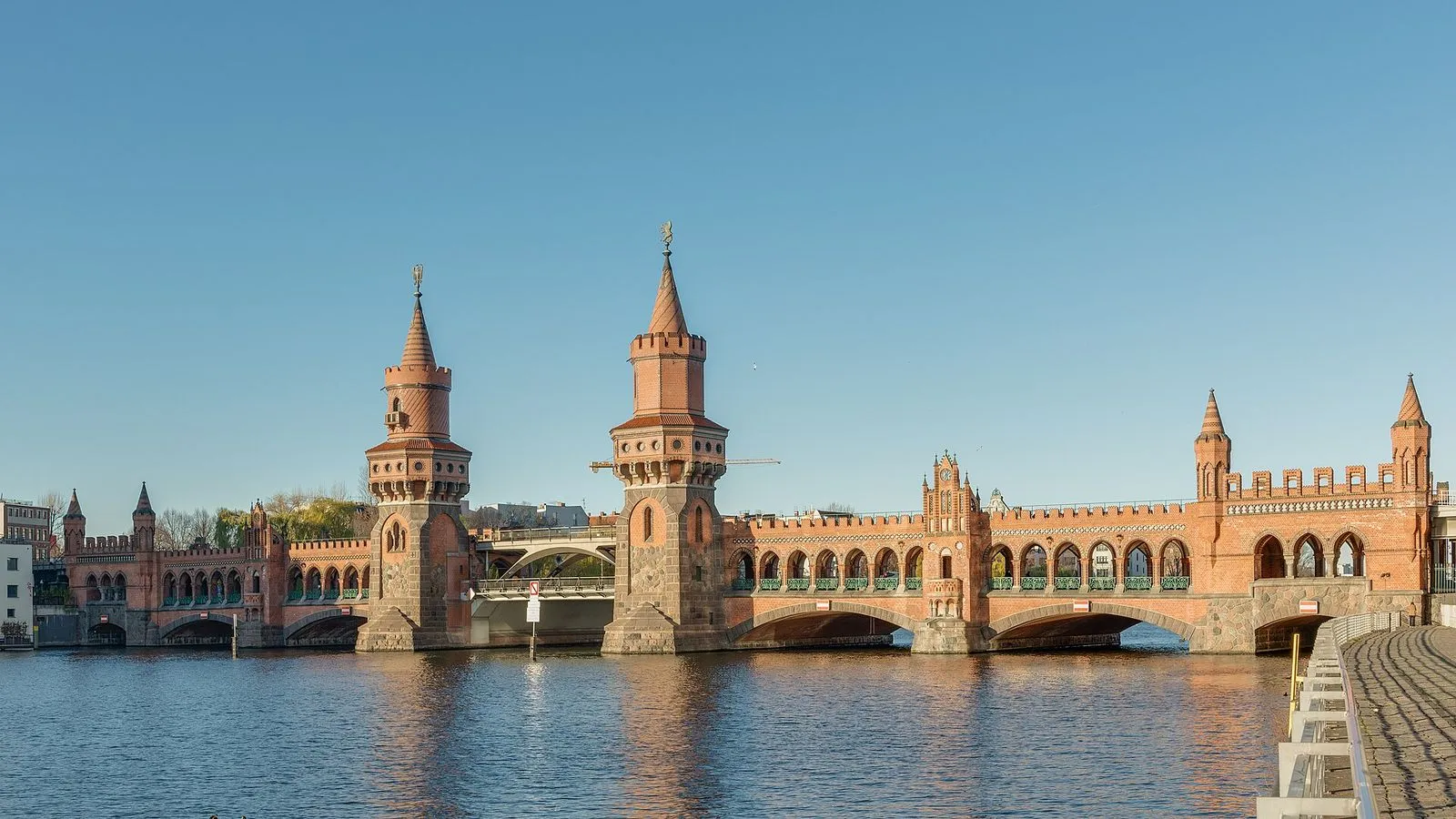
You are on the Oberbaumbrücke, a red-brick neo-Gothic bridge that opened in 1896 and became one of Berlin's defining landmarks. Its name comes from the spiked tree trunk, the Oberbaum, that was lowered into the Spree each night to stop smugglers. Look at the two towers rising from the middle arch. One is octagonal and carries the Berlin bear; the other is round and carries the Brandenburg eagle.

They are purely decorative, built to recall the bridge's old role as a city gate. During the Cold War, this bridge was a hard border. From 1961 to 1989, only pedestrians with West Berlin papers could cross here. At night the U-Bahn trains still rumbled overhead, but the station on the east side, Warschauer Straße, was sealed and silent.

In April 1945, the Wehrmacht blew out the middle section to slow the Red Army. After reunification, the Spanish architect Santiago Calatrava designed the new steel center span, and the bridge reopened on November 9, 1994, five years to the day after the Wall fell. From here you can look back at the East Side Gallery hugging the eastern bank.

≈14 min walk to the next stop
RAW-GeländeLocal pick

Photo by DavideGorla on Wikimedia Commons

RAW-Gelände

0:00

A former railway repair yard turned into a sprawling compound of clubs, street art, a skate hall, and a Sunday flea market.

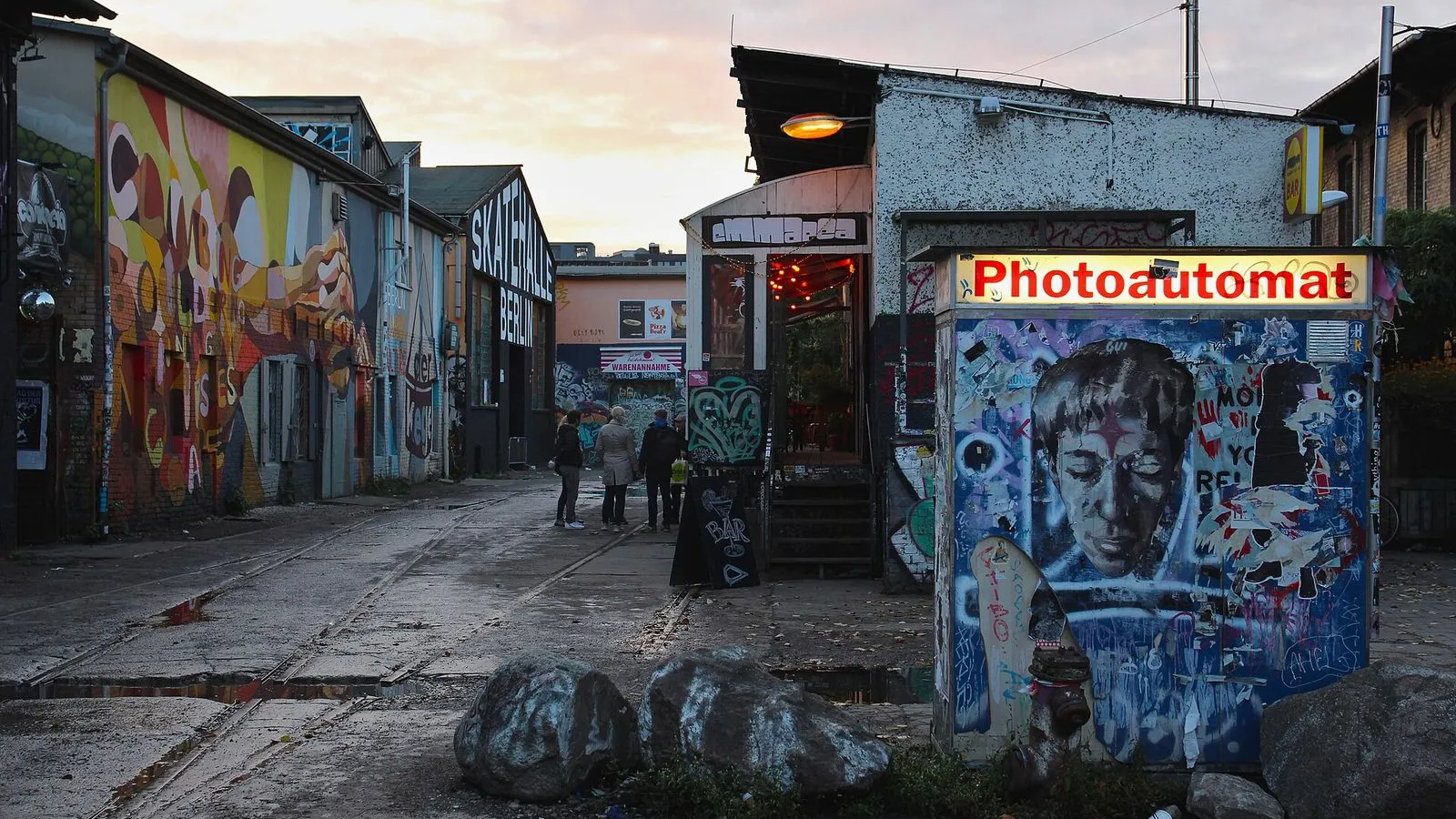
You are standing inside the RAW-Gelände, a 52,000-square-meter former railway repair works that opened in 1867 as the Royal Prussian Railway Workshop. For more than a century, locomotives and freight wagons were rebuilt in these brick halls. The Reichsbahn shut the works down in the mid-1990s, and the site sat empty until 1999, when artists and club organizers began moving in under temporary leases. What grew here is one of the densest alternative-culture compounds in Europe.

There is a climbing wall wrapped around a surviving World War II bunker, Germany's largest indoor halfpipe in the Skatehalle Berlin, and the Urban Spree gallery with its rotating street-art wall facing Warschauer Straße. On Sundays a flea market fills the outdoor spaces with vintage clothes, vinyl, and old East German curios. Cassiopeia and several other clubs run late into the night. The whole compound feels provisional and always has.

A redevelopment master plan has been in the works for years, and several venues have said publicly they do not know if they will survive it. Walk through to the far end and find the murals that make this one of Berlin's richest street-art sites.

≈16 min walk to the next stop
Free preview ends here · stops 4 to 6 continue in the app

Frankfurter Tor

The eastern gate to Karl-Marx-Allee, twin towers with green copper domes designed by Hermann Henselmann.

in app

Karl-Marx-Allee

Berlin's grandest socialist boulevard, 2.3 kilometers of Stalinist apartment blocks built between 1952 and 1958 as workers' palaces.

in app

Strausberger Platz

The western terminus of the first Stalinist phase, a circular square with Henselmann's apartment towers and a grand fountain.

in app
Good to know

Before you go

Is the East Side Gallery free?

Yes, the East Side Gallery is an open-air mural gallery along the Spree riverbank. It is free and always open.

What is RAW-Gelände?

A former railway repair yard turned into a sprawling compound of clubs, a skate hall, a climbing wall inside a bunker, street art, and a Sunday flea market. It is raw, loud, and one of the most Berlin places in Berlin.

Provenance · last verified August 18, 2026

Built from the Wayside route itself: the stops, their order, and the walk between them.

Photo by Olivier Cleynen on Wikimedia Commons · CC BY 4.0

Photo by Ank Kumar on Wikimedia Commons · CC BY-SA 4.0

Photo by Arild Vågen on Wikimedia Commons · CC BY-SA 3.0

Photo by DavideGorla on Wikimedia Commons · CC BY 2.0

Photo by Ad Meskens on Wikimedia Commons · CC BY-SA 4.0

Photo by A.Savin on Wikimedia Commons · CC BY-SA 3.0

Photo by Jorge Royan on Wikimedia Commons · CC BY-SA 3.0

Photo by MB-one on Wikimedia Commons · CC BY-SA 4.0

Photo by Pennello on Openverse · CC BY 2.0

Photo by Tanweer Morshed on Wikimedia Commons · CC BY-SA 3.0

Coming soon

Wayside isn't in the app stores yet, but it's in the works. Check back soon.