New York City · Self-guided audio walk

The Oldest Mile: Lower Manhattan from Battery to Brooklyn

Walk four centuries in an afternoon, from a Dutch fort to a cathedral of commerce, then cross the bridge that rewrote what a city could be.

  • 10Stops
  • 5 kmDistance
  • 75+ minTime

This walk traces the spine of old New York, block by block. You begin where the Dutch first anchored, follow the crooked lanes that were once their cow paths, stand where Washington took the oath, and end suspended above the East River on a bridge that was the longest in the world when it opened. Along the way you pass a bull, a graveyard, a cobblestone street where traders drank ale, and the twin reflecting pools that anchor the city's newest chapter. The walk runs roughly 2.5 miles and takes about two and a half hours at a comfortable pace.

Hear it on the street

Get the turn-by-turn audio guide in the app. The narration plays itself as you reach each stop, hands-free and offline.

Stop by stop

The route

Interactive map of the route. The full stop list below works without it.

The BatteryMust see

Photo by Zoshua Colah on Unsplash

The Battery

0:00

The southern tip of Manhattan, where New York began as a Dutch fort in 1624. Castle Clinton, the harbor views, and the story of eight million immigrants.

You're standing at the southern tip of Manhattan, looking out at the water that made this city possible. The Lenape called this island Manahatta, a place of hills and marshes and oyster beds so thick they rose above the surface at low tide. The Dutch saw a deep natural harbor and built a settlement here in 1624, anchoring it with a fort at this very spot. The park's name comes from the artillery battery that once lined this shore, pointed seaward against the British.

That round sandstone building behind you is Castle Clinton, built in 1807 as a fort, later turned into an opera house where Jenny Lind sang, then the city's first immigrant processing center where eight million people first touched American soil before Ellis Island opened. Take a moment. The harbor, the ferries, the Statue of Liberty out on the water. Everything New York became started right here.
≈4 min walk to the next stop
Bowling GreenMust see

Photo by Gigi alt on Wikimedia Commons

Bowling Green

0:00

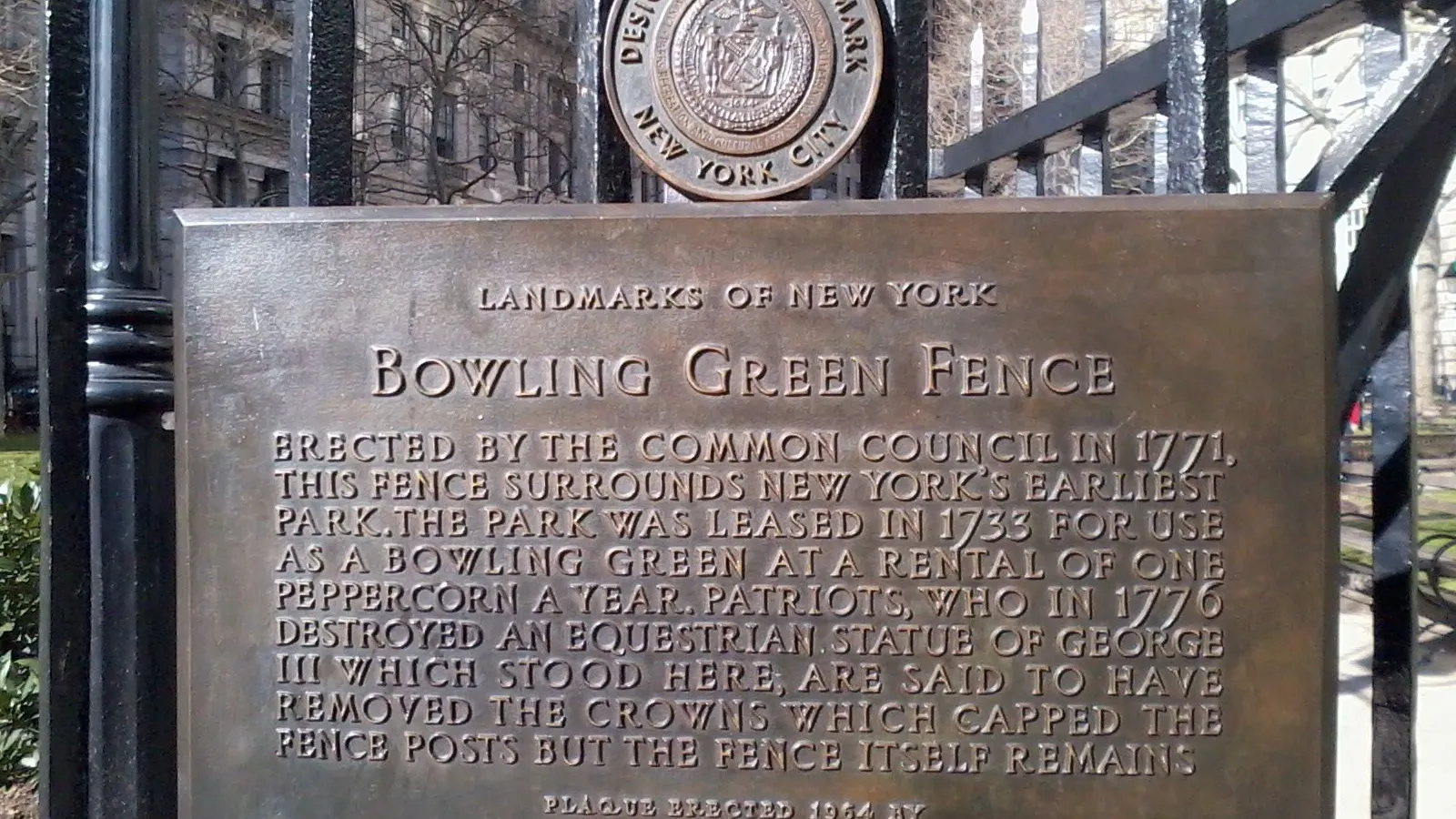
New York's oldest park, ringed by a 1771 iron fence whose crown finials were sawed off by revolutionaries in 1776.

This is New York's oldest public park, laid out in 1733. The iron fence around you is original, cast in 1771, and look at the tops of the posts. Those uneven stubs are where royal crowns once sat. On July 9, 1776, after hearing the Declaration of Independence read aloud for the first time, a crowd marched here and pulled down the gilded lead statue of King George III that stood in the center.

They sawed off the crowns on the fence posts too. Legend says the king's statue was melted into 42,000 musket balls for the Continental Army. The fence survived because nobody could figure out how to make bullets from iron. The building on your left with the Egyptian facade, 5 Broadway, was the White Star Line office.

After the Titanic sank in 1912, families gathered inside those doors waiting for news.

≈1 min walk to the next stop
Charging BullMust see

Photo by Harri P on Unsplash

Charging Bull

0:00

Di Modica's 7,100-pound bronze bull, guerrilla-installed after the 1987 crash and now the Financial District's most photographed icon.

This 7,100-pound bronze bull appeared here in the middle of the night on December 16, 1989. The artist, Arturo Di Modica, had spent two years and his own money casting it in secret after the 1987 stock market crash. He saw it as a gift to the city, a symbol of resilience. The police impounded it that morning, but the public outcry was so loud the city relented and installed it here a few days later.

The bull faces north, head lowered, hindquarters tensed. It is charging, not resting. Touch the horns if you want the tourist photo. The real story is that a sculptor spent his savings to make a city he loved feel strong again.

≈5 min walk to the next stop
Free preview ends here · stops 4 to 10 continue in the app

Stone Street

A 1650s Dutch lane, now a pedestrian-only strip of 1830s buildings that survived the Great Fire, lined with outdoor tables.

in app

Federal Hall

Where Washington took the oath in 1789 and the Bill of Rights was drafted, in a Greek Revival customs house from 1842.

in app

Trinity Church

The 1846 Gothic Revival church whose spire once made it the tallest building in America. Alexander Hamilton's grave in the yard.

in app

National September 11 Memorial

Twin reflecting pools in the towers' footprints, 2,983 names, and the Survivor Tree. The sound of falling water in the heart of the city.

in app

Oculus

Calatrava's four-billion-dollar winged transit hub, with a 160-foot spine of white steel ribs and a skylight that opens to the sky.

in app

Brooklyn Bridge

The halfway point of the 1883 span that was once the longest bridge on earth, with the best skyline view in New York.

in app

DUMBO

The classic Washington Street shot: Manhattan Bridge framing the Empire State Building, at the end of a cobblestone block in old industrial Brooklyn.

in app
Good to know

Before you go

Is the 9/11 Memorial free?

The outdoor memorial with the twin reflecting pools is free and open daily from 8 a.m. to 8 p.m. The Museum, built underground between the tower footprints, requires a ticket ($24 to $36 for adults) and is open Wednesday through Monday from 9 a.m. to 7 p.m. Free admission tickets are available on Mondays from 5:30 p.m. to 7 p.m., released online at 7 a.m. that same day.

Source9/11 Memorial & Museum
Can I walk across the Brooklyn Bridge anytime?

Yes, the pedestrian walkway is open 24 hours a day, every day. Early morning, before 8 a.m., is the quietest time. Sunset is the most crowded. Stay in the pedestrian lane; cyclists use the lower lane to your left and move fast.

How long does the Lower Manhattan walk take?

The walk from The Battery to DUMBO via the Brooklyn Bridge runs about two and a half hours of moving time. With the 9/11 Memorial Museum (allow 90 minutes), lunch on Stone Street, and photo stops on the bridge, plan on a full morning and early afternoon.

Provenance · last verified August 9, 2026

Built from the Wayside route itself: the stops, their order, and the walk between them.

Photo by Florian Wehde on Unsplash

Photo by Zoshua Colah on Unsplash

Photo by Gigi alt on Wikimedia Commons · CC BY-SA 3.0

Photo by Harri P on Unsplash

Photo by Haydn on Unsplash

Photo by Andre Carrotflower on Wikimedia Commons · CC BY-SA 4.0

Photo by Customerly on Unsplash

Photo by Annie Spratt on Unsplash

Photo by Kazuma Sako on Unsplash

Photo by Famartin on Wikimedia Commons · CC BY-SA 4.0

Photo by Jimmy Woo on Unsplash

Coming soon

Wayside isn't in the app stores yet, but it's in the works. Check back soon.