New York City · Self-guided audio walk

Chinatown & the Lower East Side: Immigrant New York

Walk the streets where seven million newcomers first set foot in America, from the Bloody Angle to the oldest deli on the Lower East Side.

  • 8Stops
  • 3.2 kmDistance
  • 50+ minTime
Chinatown & the Lower East Side: Immigrant New York

Photo by Famartin on Wikimedia Commons

This 95-minute walk covers two hundred years of immigration in under two miles. You start on the ground of the old Five Points slum, cross through Chinatown's crooked alleyways and Canal Street markets, pass the church that has served Irish, Italian, and Chinese parishioners in succession, stand inside a restored 1887 synagogue, and end with pastrami at Katz's. Each block has a story, and every story belongs to someone who came here with nothing and built the city you see today.

Hear it on the street

Get the turn-by-turn audio guide in the app. The narration plays itself as you reach each stop, hands-free and offline.

Stop by stop

The route

Interactive map of the route. The full stop list below works without it.

Columbus ParkMust see

Photo by Daniel Schwen on Wikimedia Commons

Columbus Park

0:00

The park that replaced America's most notorious slum, where Five Points once stood.

You are standing in Columbus Park, on ground that was once the most infamous slum in America. Before the park opened in 1897, this was the heart of Five Points, a warren of tenements, saloons, and alleyways where Irish, German, Italian, and African American immigrants packed into crumbling buildings around what had been the Collect Pond. When the city filled the pond in 1808, the landfill sank and rotted, turning the neighborhood into a stinking, disease-ridden swamp that only the poorest could afford. Charles Dickens visited in 1842 and called it a place reeking everywhere with dirt and filth.

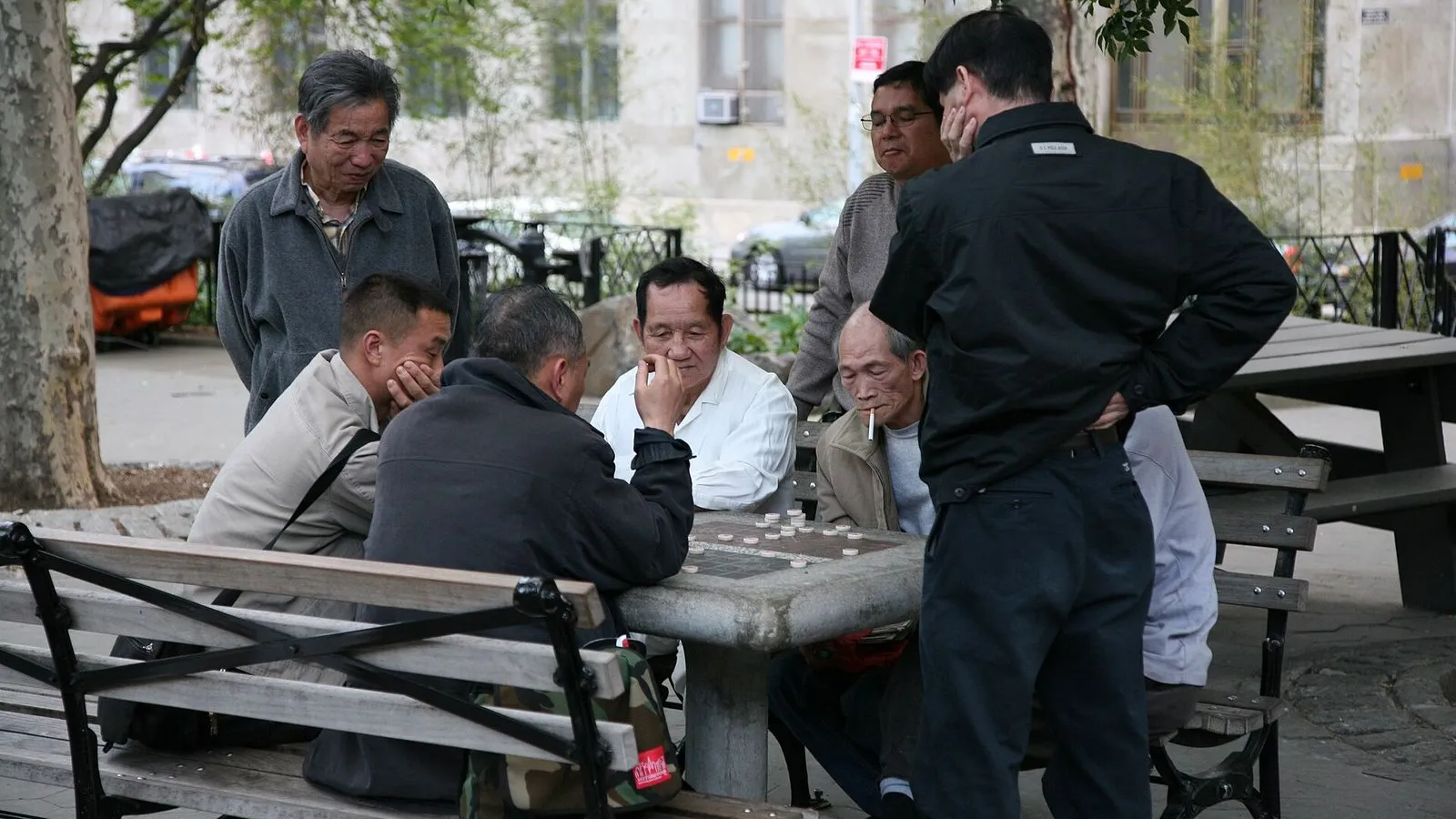
The Danish photographer Jacob Riis campaigned for years to tear it down, and in 1895 the city finally razed the Bend. Calvert Vaux, co-designer of Central Park, laid out this green space to bring light and air into the tenement district. Today the park is Chinatown's communal backyard. You will see card players and mahjong tables, early-morning tai chi, and families who commute from three boroughs just to spend Sunday here.

The story of immigrant New York starts exactly where you are standing.
≈1 min walk to the next stop
Church of the TransfigurationMust see

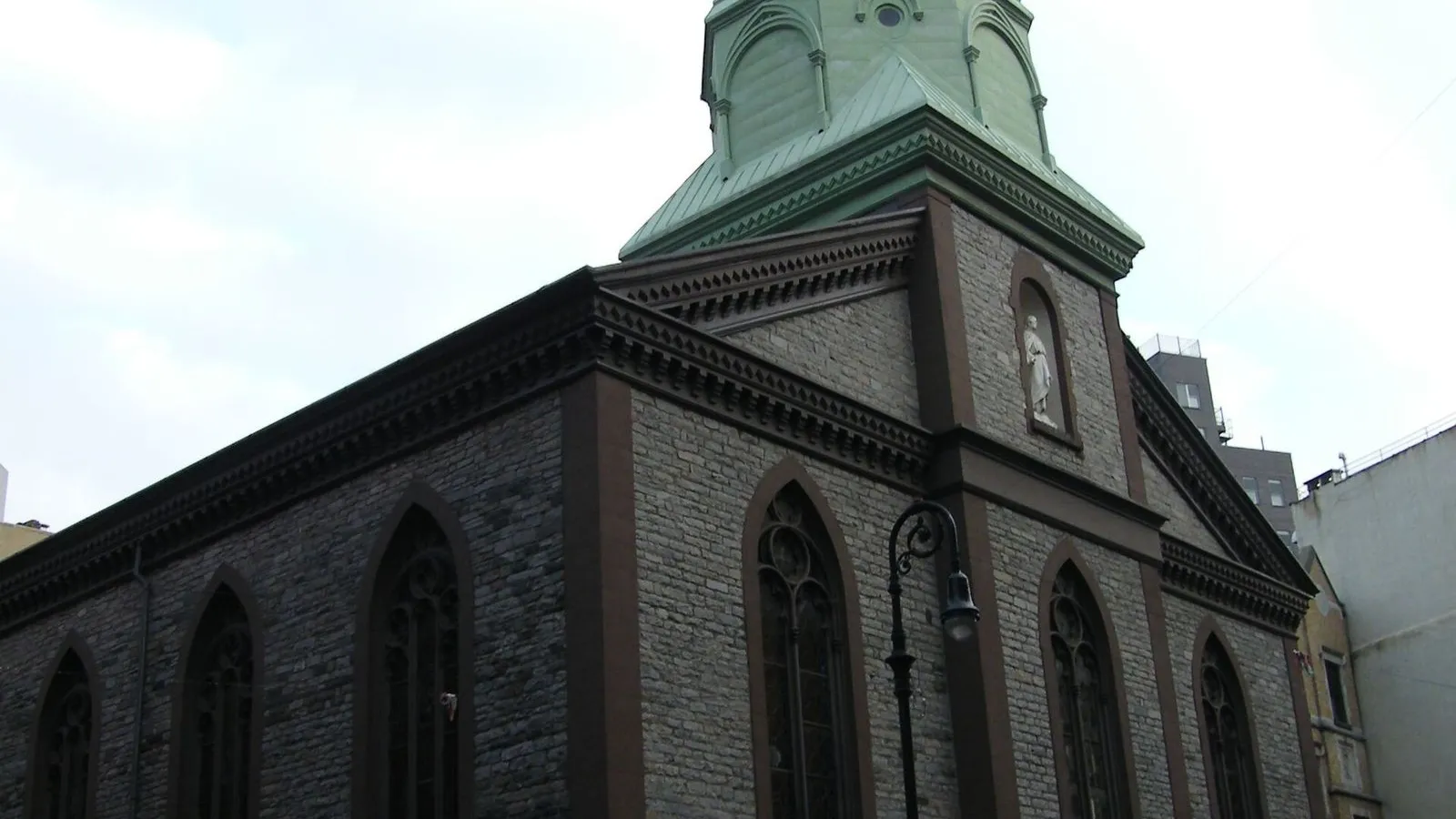
Photo by Americasroof on Wikimedia Commons

Church of the Transfiguration

0:00

A Roman Catholic church that has served three waves of immigrants since 1801.

The Church of the Transfiguration opened in 1801 as a Lutheran church, but it did not stay Lutheran for long. As the neighborhood changed, the church changed with it. Irish immigrants made it their parish in the 1830s. When the Irish moved uptown, Italians filled the pews.

And when Italians gave way to Chinese newcomers after 1965, the church began offering mass in Mandarin and Cantonese. That is why people call it the Church of the Immigrants. Look at the facade. The Georgian Gothic architecture is pure early New York, but the real story is inside the doors.

For over two hundred years, this single building has baptized, married, and buried generations of newcomers from three different continents. Father Raymond Nobiletti, who served here for decades, once said the church has never had its own identity because it has always taken on the identity of whoever was arriving. The red doors are open every day.

≈1 min walk to the next stop
Doyers StreetMust see

Photo by Ken Lund from Reno, Nevada, USA on Wikimedia Commons

Doyers Street

0:00

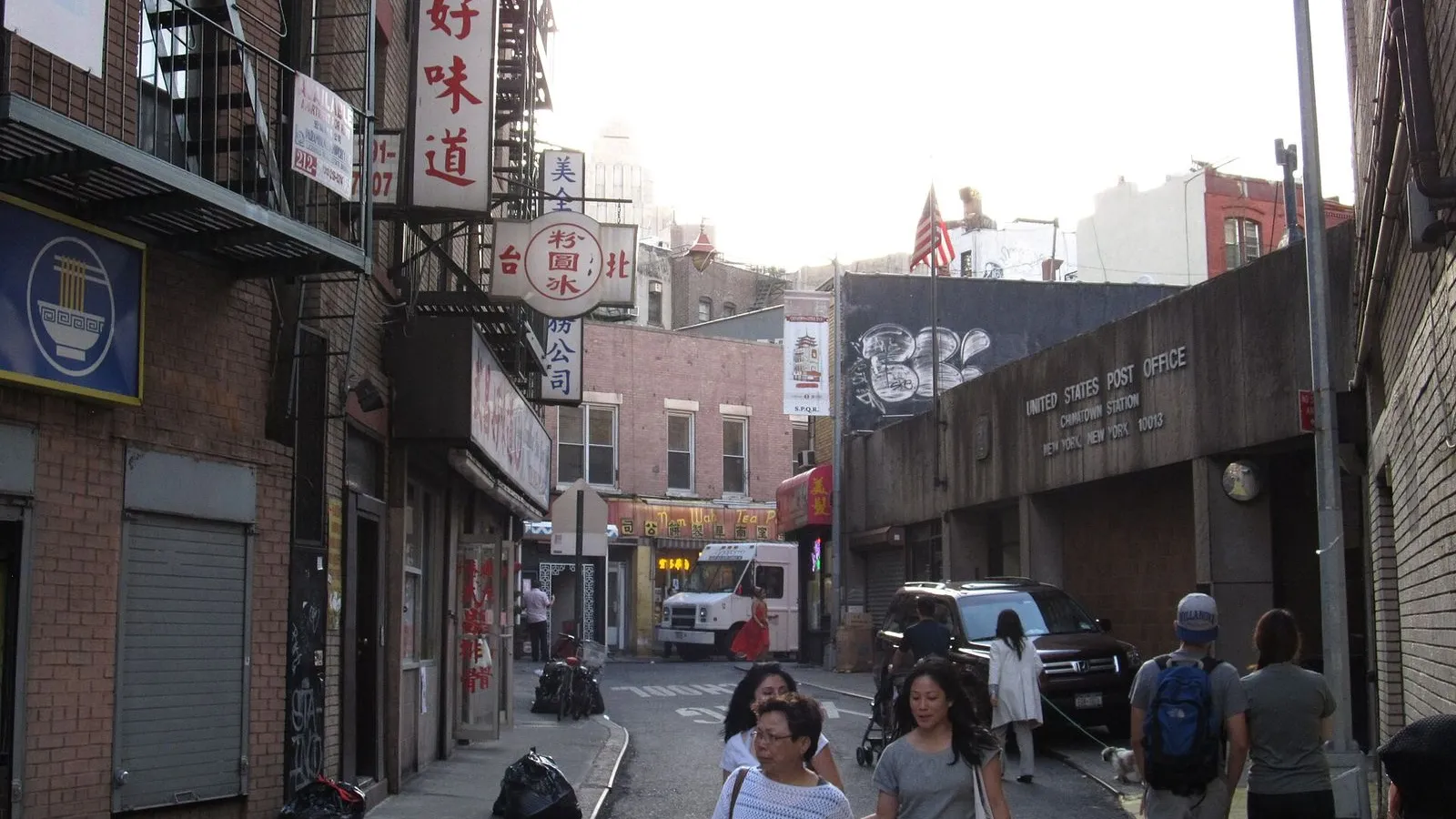
The Bloody Angle, a curved alley that was once the deadliest street in America.

You are on Doyers Street, just two hundred feet long and bent sharply in the middle like a crooked elbow. In the early 1900s, that bend earned this lane the nickname the Bloody Angle. Rival tong gangs, the On Leongs and the Hip Sings, used the blind corner as an ambush point. Hatchets were the weapon of choice, which is where we get the phrase hatchet man.

In 1905, during a packed performance at the Chinese theater at number five to seven, Hip Sing gunmen threw firecrackers onto the stage and opened fire. Four On Leong members and two civilians died. Law enforcement later said more people were killed violently at this single intersection than anywhere else in the United States. The theater is gone, but if you look at numbers five through seven, the building still stands.

Today it is a restaurant. Across the street, Nom Wah Tea Parlor has been serving dim sum since 1920. Run your hand along the brick wall. These tenements once hid trapdoors that led to a network of tunnels running all the way to Chatham Square, used by tong soldiers to escape after a hit.

≈9 min walk to the next stop
Free preview ends here · stops 4 to 8 continue in the app

Canal Street

The chaotic commercial spine of Chinatown, where street vendors and shops spill onto the sidewalk.

in app

Shrine of San Gennaro

A national shrine inside a former Italian parish church, at the edge of what remains of Little Italy.

in app

Eldridge Street Synagogue

The first grand synagogue built by Eastern European Jews in America, now a museum.

in app

Tenement Museum

A historic tenement at 97 Orchard Street that housed 7,000 immigrants from over 20 nations.

in app

Katz's Delicatessen

The iconic Jewish deli that has been serving pastrami since 1888.

in app
Good to know

Before you go

Do I need reservations at Katz's Delicatessen?

No reservations, and no table service for the walk-in line. You get a ticket at the door, take it to a carver behind the counter, and order. Do not lose your ticket; you need it to pay on the way out, and a lost ticket carries a $50 charge. The pastrami on rye is the one to order. The line moves fast, even when it snakes out the door.

Is the Tenement Museum worth the ticket?

Yes. The Tenement Museum at 97 Orchard Street is one of the best small museums in the country. You see the actual apartments where immigrant families lived, layer by layer, across decades. Tickets must be booked in advance at tenement.org; walk-ups rarely find a slot. The neighborhood walking tours they run are also excellent.

How long is the Chinatown and Lower East Side walk?

About 95 minutes of walking. With a stop at the Eldridge Street Synagogue, a walk through the Tenement Museum, and lunch at Katz's, plan on three to four hours. This neighborhood rewards slow wandering and spontaneous dumpling stops.

Provenance · last verified August 9, 2026

Built from the Wayside route itself: the stops, their order, and the walk between them.

Photo by Famartin on Wikimedia Commons · CC BY-SA 4.0

Photo by Daniel Schwen on Wikimedia Commons · CC BY-SA 4.0

Photo by Americasroof on Wikimedia Commons · CC BY 3.0

Photo by Ken Lund from Reno, Nevada, USA on Wikimedia Commons · CC BY-SA 2.0

Photo by Haydn on Unsplash

Photo by Andre Carrotflower on Wikimedia Commons · CC BY-SA 4.0

Photo by Customerly on Unsplash

Photo by Annie Spratt on Unsplash

Photo by Florian Wehde on Unsplash

Photo by Kazuma Sako on Unsplash

Photo by Jimmy Woo on Unsplash

Coming soon

Wayside isn't in the app stores yet, but it's in the works. Check back soon.