Boston · Self-guided audio walk

Downtown Freedom Trail Walk

The downtown blocks where Boston argued its way into a revolution.

  • 5Stops
  • 0.8 kmDistance
  • 15+ minTime

This 95-minute walk follows the downtown Freedom Trail through five places where Boston's revolution was argued, fought, and remembered. You start at Park Street Church, whose 217-foot steeple once towered over the young nation, then cross to the Granary Burying Ground to stand among the graves of Revere, Adams, and Hancock. The route passes King's Chapel, with its 1754 box pews and Revere bell, and the Old State House, where the Boston Massacre spilled into the street and the Declaration of Independence was first read aloud. It ends at Faneuil Hall, the market and meeting room Boston still calls the Cradle of Liberty. Admission is free everywhere except the Old State House museum, fifteen dollars for adults.

Hear it on the street

Get the turn-by-turn audio guide in the app. The narration plays itself as you reach each stop, hands-free and offline.

Stop by stop

The route

Interactive map of the route. The full stop list below works without it.

Park Street ChurchMust see

Photo by Brett Wharton on Unsplash

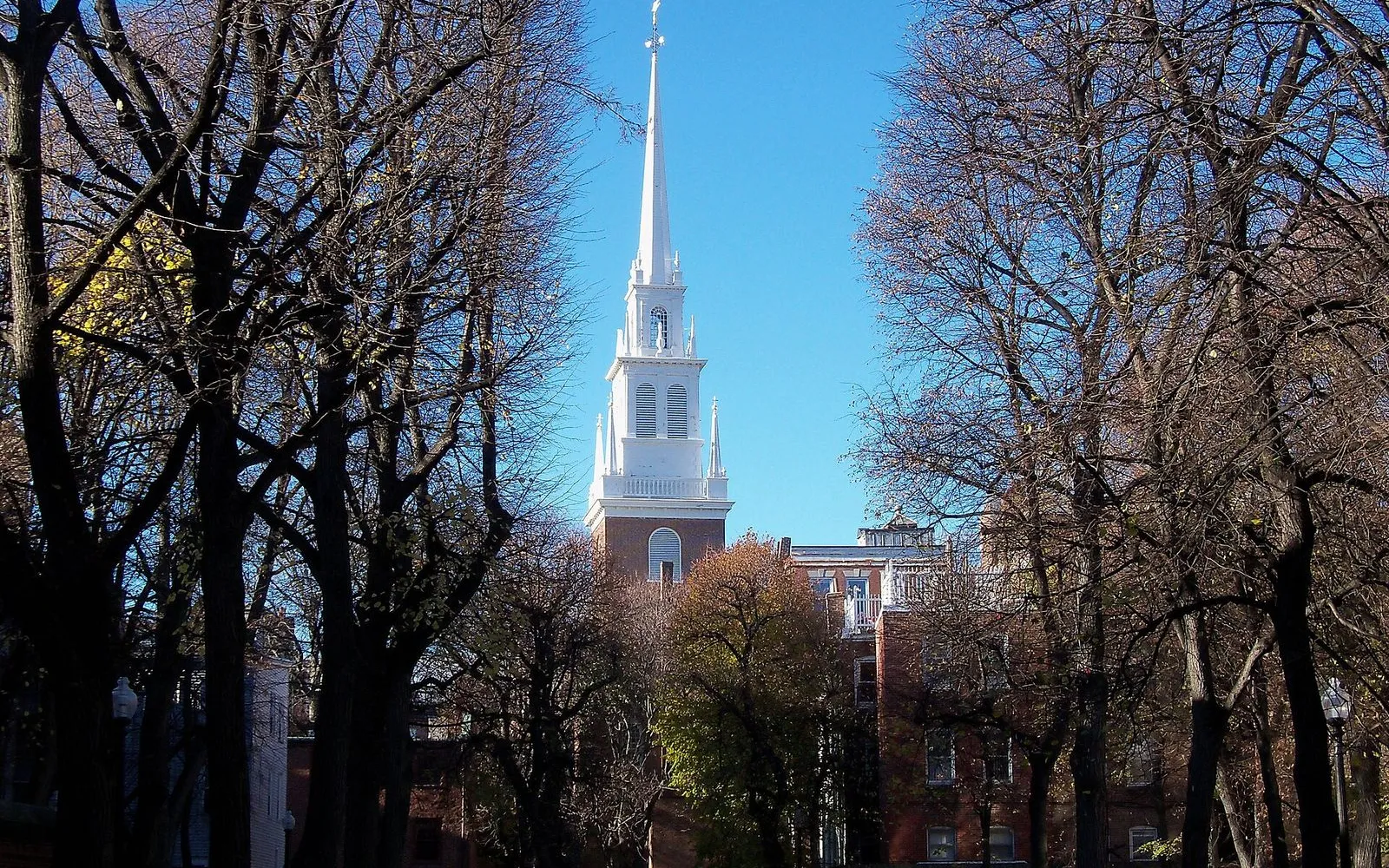
Park Street Church

0:00

A red brick church on Brimstone Corner, crowned by the 217-foot steeple that once towered over the young United States.

You're at the corner of Park and Tremont Streets, where a red brick church has held this intersection since 1809. Look up at the 217-foot steeple; when it went up, it was the first landmark travelers saw coming into Boston, and for years it was the tallest building in the country. The nickname Brimstone Corner stuck to this spot partly because of the fire and brimstone energy of its preachers, and partly because gunpowder was stored here during the War of 1812. Inside, two things that shaped the country happened in this room.

On July 4, 1829, a young William Lloyd Garrison stood in the pulpit and gave his first antislavery address. Two years later, on the same date, a children's choir sang My Country, Tis of Thee for the first time. The building sits where Boston kept its public granary, the grain store that gave the burying ground next door its name. The carillon still sounds from the steeple twice a day.
≈1 min walk to the next stop
Granary Burying GroundMust see

Photo by Wildcat Dunny on Openverse

Granary Burying Ground

0:00

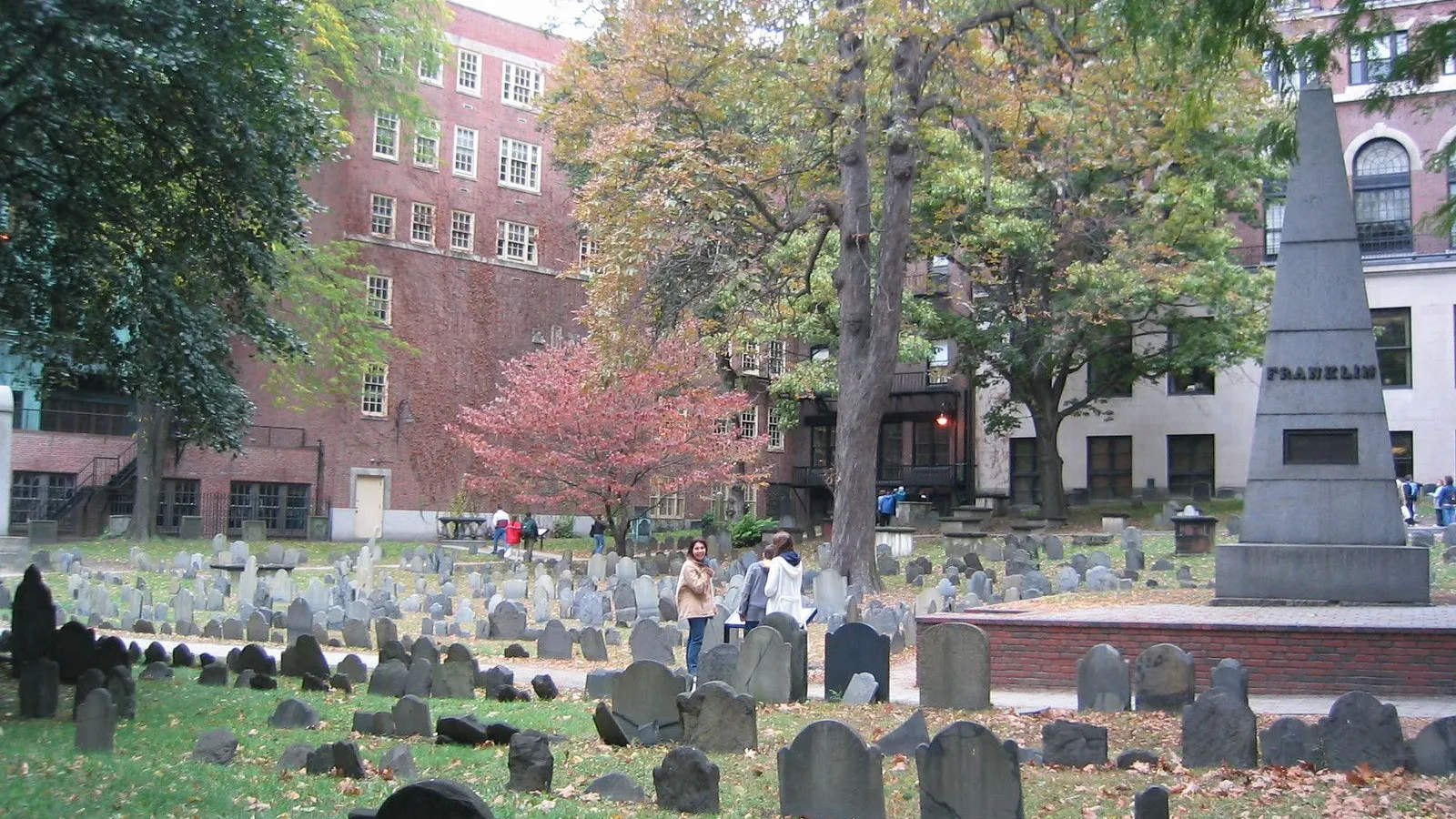
The 1660 cemetery where Paul Revere, Samuel Adams, John Hancock, and the victims of the Boston Massacre are buried.

You're inside a cemetery that has been filling up since 1660, and it is far more crowded than it looks. Roughly 2,300 headstones rise above ground, but something like 5,000 people are buried here, stacked and reused over two centuries. The name comes from the public grain store that once stood on the land beside Park Street Church. Three signers of the Declaration of Independence lie within these walls: Samuel Adams, John Hancock, and Robert Treat Paine.

So does Paul Revere, whose modest stone sits near the back, and James Otis, the lawyer whose courtroom speech against the Writs of Assistance lit a fuse in John Adams. The five men killed in the Boston Massacre share a single grave, and the tall obelisk near the middle honors Benjamin Franklin's parents; Franklin himself is buried in Philadelphia. Walk slowly along the paths. The skull and wings carved on many stones are not meant to frighten, they are reminders of the soul's flight.

≈3 min walk to the next stop
King's ChapelMust see

Photo by User:Chensiyuan on Wikimedia Commons

King's Chapel

0:00

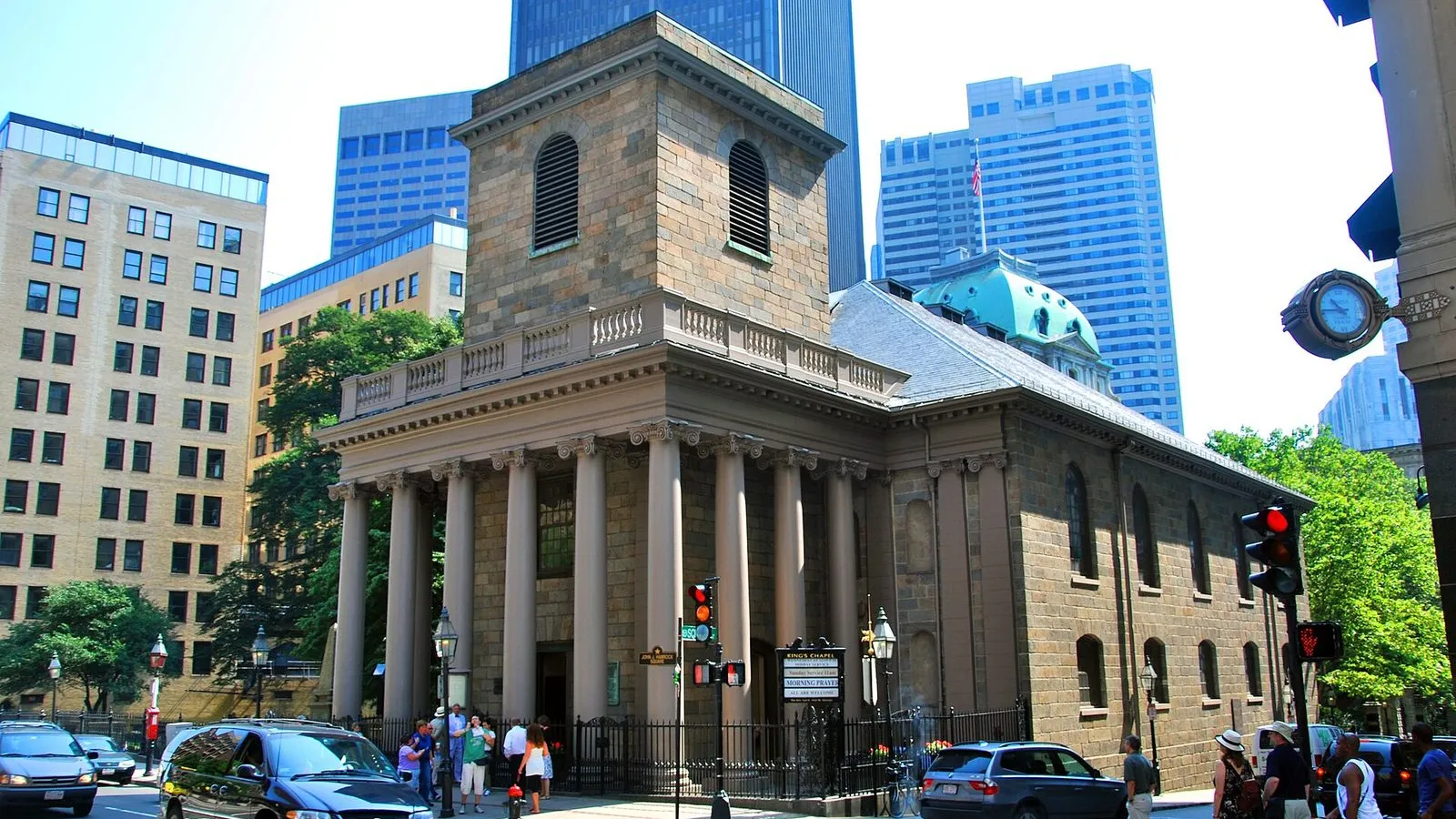
Boston's first Anglican church, finished in 1754, with private box pews, the nation's oldest pulpit still in use, and a bell cast by Paul Revere.

This is the stone box on the corner of Tremont and School Streets that Boston's Puritans never wanted. King's Chapel began in 1686 as the first Anglican congregation in New England, and the present building, designed by Peter Harrison, went up between 1749 and 1754. Step inside and the interior feels more English than almost any other room in the city: rows of tall, private box pews, each one built like a small room with walls and a door, so families could sit together, keep warm, and be seen. The pulpit has been in use since 1717, the oldest pulpit still in service in the United States, and the bell up in the tower was cast by Paul Revere.

During the Revolution the congregation leaned loyalist and most members left with the British. In 1787, those who stayed reorganized as the first Unitarian church in the country. If you look across the street, you'll see the burying ground where John Winthrop, the colony's first governor, lies.

≈4 min walk to the next stop
Free preview ends here · stops 4 to 5 continue in the app

Old State House

The 1713 seat of royal government, Boston's oldest public building, facing the cobblestone circle that marks the Boston Massacre.

in app

Faneuil Hall

The 1742 market and meeting hall known as the Cradle of Liberty, still open beneath its original grasshopper weathervane.

in app
Good to know

Before you go

Is the Downtown Freedom Trail walk free?

Most of it is. Park Street Church, the Granary Burying Ground, and Faneuil Hall cost nothing to visit. The only admission on this route is the Old State House museum at $15 for adults, and that ticket also covers the Old South Meeting House.

SourceRevolutionary SpacesNational Park Service
Is the Old State House museum worth going inside?

Yes. You stand in the rooms where the Massachusetts colonial government met, and the Boston Massacre happened on the square directly below the balcony. The cobblestone circle out front marks the spot, and the Declaration of Independence was first read from that balcony.

SourceNational Park Service
Where does the Downtown Freedom Trail walk start and end?

It starts at Park Street Church on the corner of Tremont and Park Streets, across from Boston Common, and ends at Faneuil Hall on Congress Street. The whole line is downhill and easy to follow on the red brick path.

Provenance · last verified August 20, 2026

Built from the Wayside route itself: the stops, their order, and the walk between them.

Photo by Brett Wharton on Unsplash

Photo by Brett Wharton on Unsplash

Photo by Wildcat Dunny on Openverse · CC BY 2.0

Photo by User:Chensiyuan on Wikimedia Commons · CC BY-SA 4.0

Photo by Jimmy Woo on Unsplash

Photo by Arturoramos on Wikimedia Commons · CC BY-SA 3.0

Photo by King of Hearts on Wikimedia Commons · CC BY-SA 4.0

Photo by Jon Platek on Wikimedia Commons · CC BY-SA 3.0

Photo by Eganjm18 on Wikimedia Commons · CC BY-SA 4.0

Photo by Matt Collamer on Unsplash

Coming soon

Wayside isn't in the app stores yet, but it's in the works. Check back soon.