Bath · Self-guided audio walk

Pulteney Bridge to Sydney Gardens

Cross the Pulteney estate's grandest set piece, from an Adam bridge lined with shops to a Georgian pleasure garden, where a canal, a railway and a towpath cut through what was built to sell houses.

  • 9Stops
  • 1.4 kmDistance
  • 30+ minTime
Pulteney Bridge to Sydney Gardens

Photo by Stephen Richards on Wikimedia Commons

The Pulteney estate built its own suburb across the River Avon, and this walk follows the campaign from start to finish: a bridge that was a shop-lined advertisement, a square and a street meant to look like palaces, a hotel that served a private pleasure garden, and then the canal and railway that cut straight through it.

You begin on Pulteney Bridge, one of only four bridges in the world with shops across its full span on both sides, and you end on the Kennet and Avon towpath below the gardens. In between come Laura Place, Great Pulteney Street, the Holburne Museum, Sydney Gardens with its temple and two Coalbrookdale footbridges, and Cleveland House sitting over the canal tunnel.

The streets, gardens and towpath are always open. The Holburne opens at ten, at eleven on Sundays, and closes at five. It is flat, takes around an hour at an easy pace, and the museum's shop, café and garden are free, with gallery tickets at £16.50.

Hear it on the street

Get the turn-by-turn audio guide in the app. The narration plays itself as you reach each stop, hands-free and offline.

Stop by stop

The route

Interactive map of the route. The full stop list below works without it.

Pulteney BridgeMust see

Photo by David Martin on Wikimedia Commons

Pulteney Bridge

0:00

Robert Adam's shop-lined crossing of the Avon, finished by 1774.

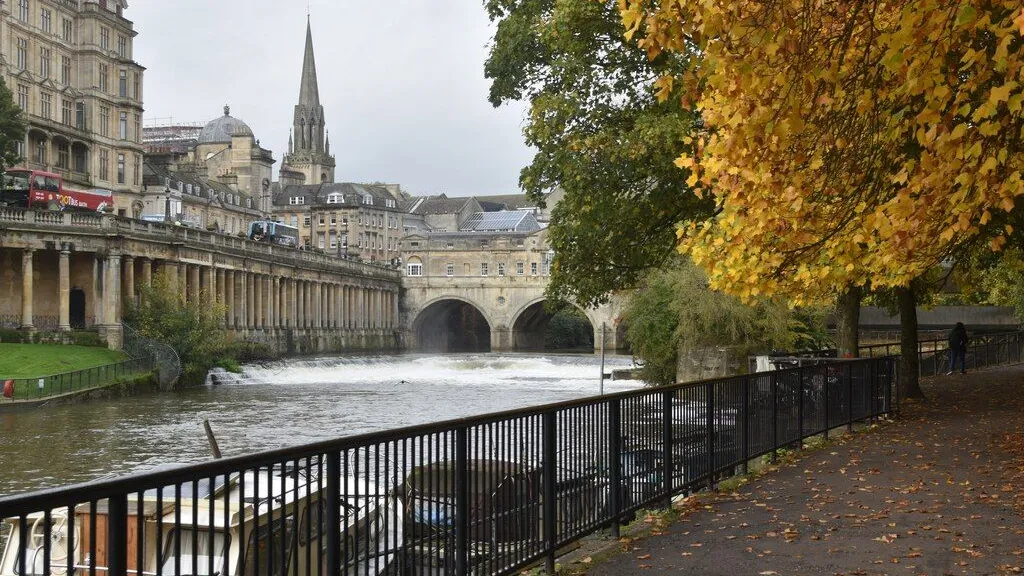
You're standing on a bridge that was built as a sales pitch. In 1764 Frances Pulteney inherited the fortune of the Earl of Bath, and within a few years she and her husband William owned the Bathwick estate across the water, six hundred acres of farmland you could reach only by ferry. So the crossing came before the houses. Robert Adam designed it, lining the whole span with shops in the manner of the Ponte Vecchio in Florence, and the bridge was finished by 1774 at a cost of nearly 11,000 pounds.

Very few bridges anywhere carry shops right across on both sides, and the Ponte Vecchio and the Rialto in Venice are two of them. Now lean over the parapet. The weir below was built between 1968 and 1972 for flood control, and it is where Javert dies in the 2012 film of Les Misérables. The bridge is Grade I listed, and buses and taxis still cross the street that Adam lined with shopfronts.

For years after 1774, though, his bridge landed you in fields.
≈2 min walk to the next stop
Laura PlaceLocal pick

Photo by Steve Daniels on Wikimedia Commons

Laura Place

0:00

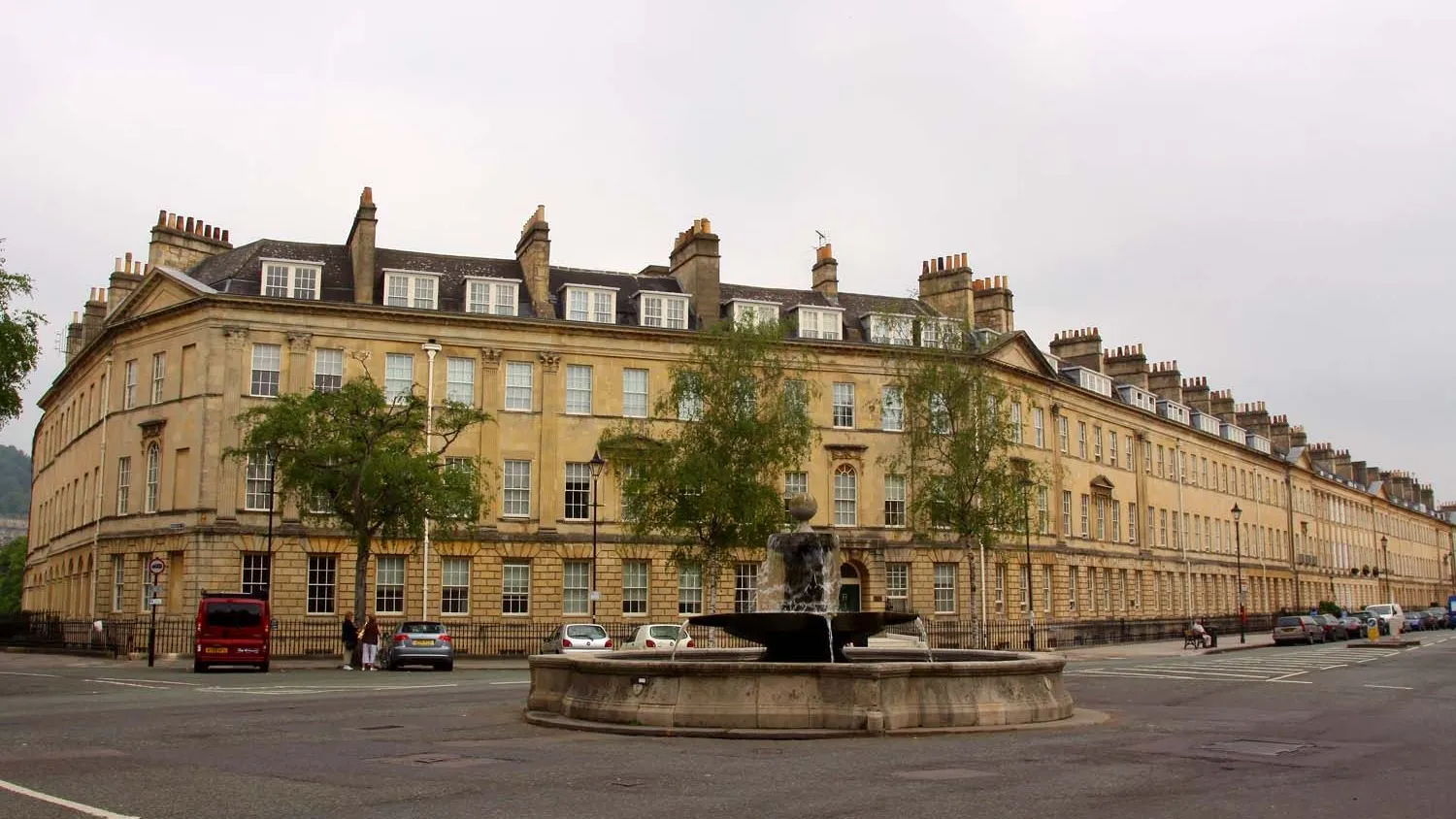
Georgian square and fountain where Great Pulteney Street begins.

Laura Place is the hinge of the estate, the square where the crossing becomes a street. The fountain, the terraces around it and the view down Great Pulteney Street were designed as one composition: water in the foreground, two long terraces framing the perspective, and the museum façade closing it about a third of a kilometre away. Nothing about that is accidental. The square carries the name of Henrietta Laura Pulteney, the only child of Frances and William, made Baroness Bath in 1792 and Countess of Bath in 1803.

She died without a will in 1808, and William Vane, the first Duke of Cleveland, laid claim to her estate. Later on this walk you'll pass a house over the canal tunnel that still carries his title. The bridge you crossed had been open for more than a decade before these houses went up, and that tells you how long William Pulteney waited for a crossing to turn into a town.

≈3 min walk to the next stop
Great Pulteney StreetMust see

Photo by Jonathan Billinger on Wikimedia Commons

Great Pulteney Street

0:00

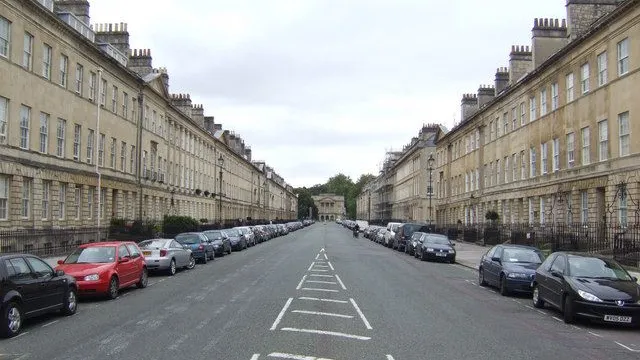
A 335 metre processional street built to sell Bathwick.

Great Pulteney Street is 335 metres long and 30 wide, and the honorary guides who show visitors around Bath call it one of the finest formal streets in the country. It was built between 1789 and 1792 from designs by Thomas Baldwin and others, and every part of the layout does the same job: palatial terraces, uniform stone, and one long straight view that finishes on the museum. The width is deliberate. The estate was selling a processional route from the bridge to the new town.

The houses were the shop window for the rest of Bathwick. Walk the north side and look for the stretch with no front doors. That was Connaught Mansions, numbers one and two, which opened as Stead's private hotel in 1866 and swallowed the neighbouring doorways as it grew. By 1914 the doors and their entrance steps were gone.

Plaques along these walls remember William Wilberforce, William Smith and Napoleon III. Baldwin's own finances collapsed soon after, and other architects carried the street on.

≈5 min walk to the next stop
Free preview ends here · stops 4 to 9 continue in the app

Holburne Museum

Former Sydney Hotel, now galleries and Lady Danbury's house.

in app

Sydney Gardens

Bath's oldest park, a pleasure ground since 1795.

in app

Minerva's Temple

A 1911 exhibition temple and the remains of a loggia.

in app

Sydney Gardens Footbridges

Two Coalbrookdale iron bridges cast for the canal in 1800.

in app

Cleveland House

Canal company headquarters standing over the tunnel.

in app

Kennet and Avon Canal Towpath

The working edge of the canal, down to Sydney Wharf.

in app
Good to know

Before you go

Is the Holburne Museum free?

The Holburne charges £16.50 general admission for the collections and displays, free for under 18s, and the ground-floor shop and café are free to walk into even without a ticket. Collection displays are free on Wednesdays after 3pm. The museum opens daily at 10am, at 11am on Sundays and bank holidays, and takes last admissions at 4:30pm.

SourceHolburne Museum, ticket information
Are Sydney Gardens and the towpath always open?

Sydney Gardens and the Kennet and Avon towpath are public ground and stay open every day, and the streets on this walk have no gates either. That makes it the walk to keep for a late afternoon or an early start when the museum is still shut.

Why does Pulteney Bridge have shops on it?

Pulteney Bridge was built as an advertisement: the Pulteney estate wanted buyers for its new suburb across the river, and a shop-lined crossing in the style of Florence's Ponte Vecchio was the pitch. Robert Adam's design on the Avon was finished by 1774, and the shops still run across its full span on both sides.

Provenance · last verified September 27, 2026

Built from the Wayside route itself: the stops, their order, and the walk between them.

Photo by Stephen Richards on Wikimedia Commons · CC BY-SA 2.0

Photo by David Martin on Wikimedia Commons · CC BY-SA 2.0

Photo by Steve Daniels on Wikimedia Commons · CC BY-SA 2.0

Photo by Jonathan Billinger on Wikimedia Commons · CC BY-SA 2.0

Photo by Hulki Okan Tabak on Unsplash

Photo by Derek Harper on Wikimedia Commons · CC BY-SA 2.0

Photo by Bradley Pritchard Jones on Unsplash

Coming soon

Wayside isn't in the app stores yet, but it's in the works. Check back soon.