Edinburgh · Self-guided audio walk

The New Town

A grid drawn in 1766 by a 26-year-old, then built street by street. Walk Edinburgh's New Town from Charlotte Square east to St Andrew Square, and finish among the monuments and gardens at its eastern edge.

  • 8Stops
  • 2.8 kmDistance
  • 45+ minTime

Edinburgh's New Town began as a competition. In March 1766 the town advertised for a plan for a suburb on the fields north of the castle, and the winner was a 26-year-old architect named James Craig. His grid runs from St Andrew Square in the east to Charlotte Square in the west, with George Street as its spine.

This walk traces that drawing. You start in Charlotte Square, follow George Street east past the Assembly Rooms into St Andrew Square, climb to Queen Street for the Portrait Gallery, then drop to Princes Street for Register House, the Scott Monument and the Floral Clock. Eight stops, west to east across the grid.

Notice how weighted the eastern half is: a column paid for by naval officers, a bank inside a Georgian mansion, the nation's records, a tower of 287 steps. The plan stayed the plan. What filled it changed, fastest at the east end.

Hear it on the street

Get the turn-by-turn audio guide in the app. The narration plays itself as you reach each stop, hands-free and offline.

Stop by stop

The route

Interactive map of the route. The full stop list below works without it.

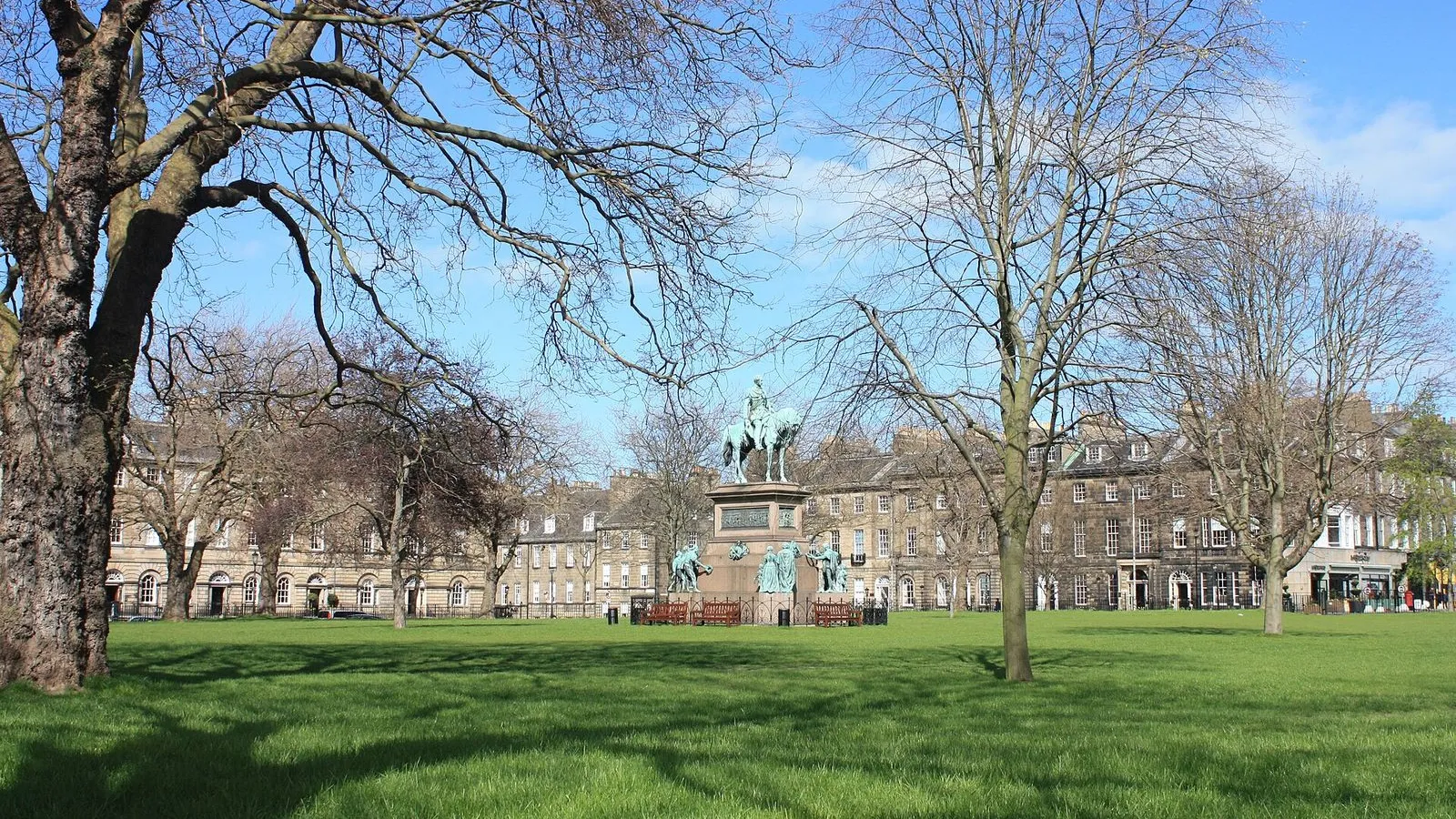
Charlotte SquareLocal pick

Photo by Stephencdickson on Wikimedia Commons

Charlotte Square

0:00

The western edge of Craig's grid, with Prince Albert on horseback.

You're at the western end of the first New Town, and it began with a competition. In March 1766 the town advertised for designs for a suburb on the fields north of the castle, and the winner was a 26-year-old architect named James Craig. The judges awarded him the prize without agreeing to build his plan as drawn, thinking it would give others hints to improve on. He got a gold medal and the freedom of the city in a silver box, and the plan was adopted the following year.

What was built is the grid around you. George Street runs east from this square to St Andrew Square, Princes Street sits on one side and Queen Street on the other, and the cross streets meet them at right angles. The square was built out to Robert Adam's design by 1820, and the garden in the middle stays private, kept for the owners of the surrounding houses. Look through the railings at Prince Albert on horseback, Sir John Steell's statue, unveiled in 1876.
≈10 min walk to the next stop
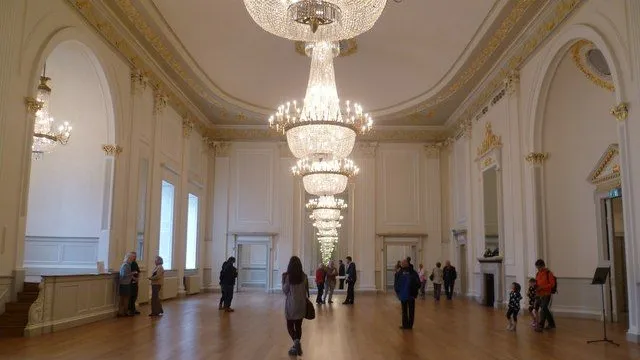
Assembly RoomsLocal pick

Photo by kim traynor on Wikimedia Commons

Assembly Rooms

0:00

George Street's ballroom, opened in 1787 for the Caledonian Hunt Ball.

Number 54 George Street. The Assembly Rooms were built by public subscription on a site the town council gave for nothing, in the middle of the new street. The foundation stone went down in May 1783, and the building opened unfinished on 11 January 1787 with the Caledonian Hunt Ball. The architect, John Henderson, won the commission in a competition worth 25 guineas and died before the work was done; his father David, a mason who had worked with Robert Adam on Register House, took it over.

The cost came to more than 6,000 pounds, and a decade later more subscription money paid for the chandeliers, the mirrors and the Corinthian pilasters. For the next hundred years this was where Edinburgh assembled: balls and concerts, public meetings, and a banquet in Charles Dickens's honour in 1841. It still fills up every August, when the Fringe moves in. Look at the outside: plain neoclassical stone around a hall built for people to be seen in.

≈6 min walk to the next stop
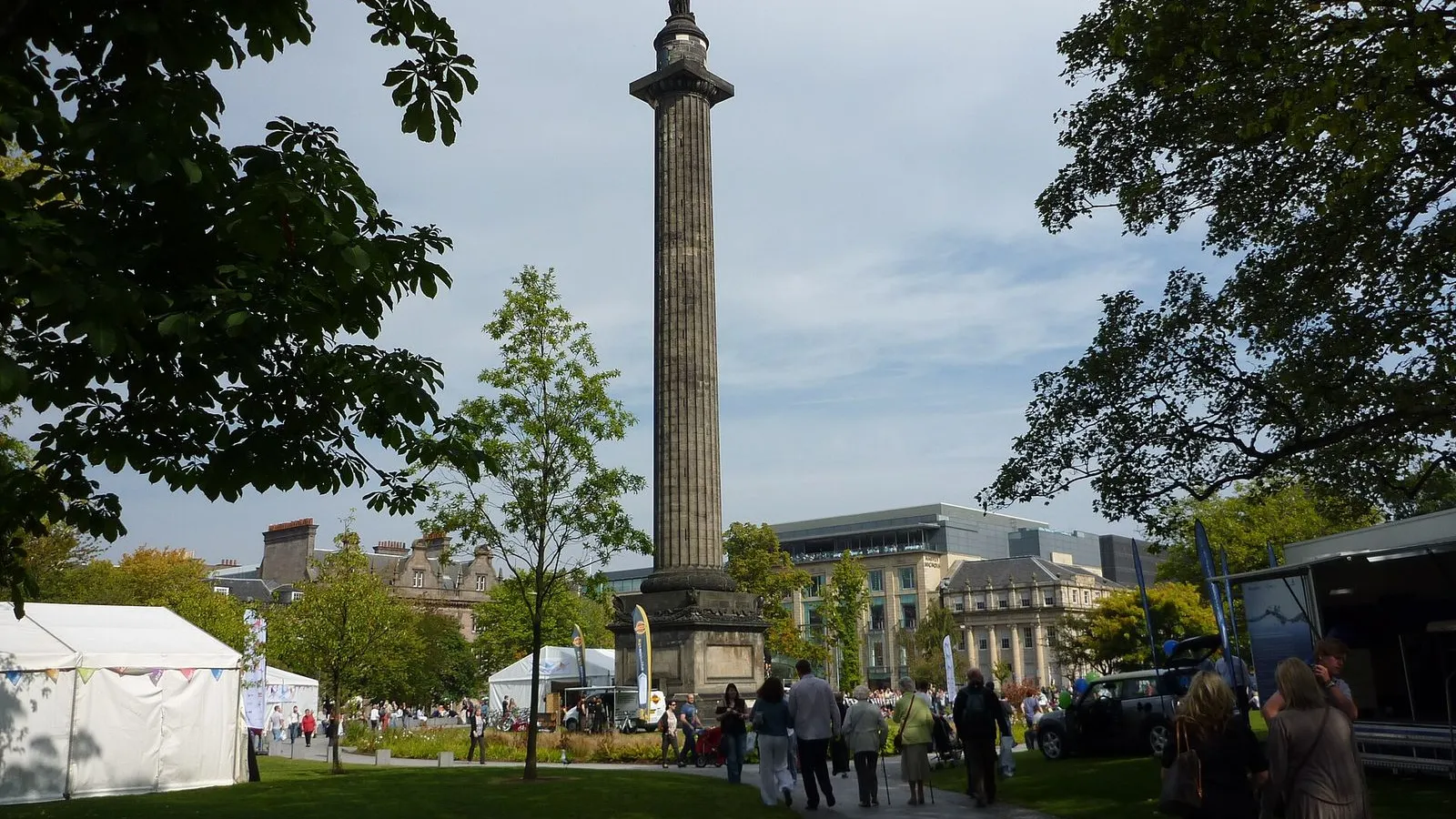
St Andrew SquareMust see

Photo by Richard West on Wikimedia Commons

St Andrew Square

0:00

Craig's eastern square, with a 150-foot column at its centre.

The first part of the New Town to be built: feuing started here in 1767 and the square was complete by 1781. Craig's plan put an equestrian statue in its middle. What stands there instead is Henry Dundas, first Viscount Melville, on a fluted column 45 metres tall, or 150 feet, designed by William Burn and modelled on Trajan's Column in Rome without its carvings. The column went up between 1821 and 1823; the statue on top, designed by Francis Chantrey and carved by Robert Forrest, followed in 1827.

The money came largely from Royal Navy officers, a tribute to Dundas as the seaman's friend for measures that helped sailors and their families. Calton Hill, Arthur's Seat and the top of Leith Walk were all proposed before this square was chosen. The gardens around the column stayed private until 2008, when the square opened to the public and the monument was restored. Dundas was Home Secretary, then Secretary of State for War under William Pitt, and the monument is now a focus of debate about how the city remembers figures from the empire.

≈2 min walk to the next stop
Free preview ends here · stops 4 to 8 continue in the app

Dundas House

A Georgian mansion built for a laird, now a bank.

in app

Scottish National Portrait Gallery

Free gallery of Scotland's faces, in red sandstone Gothic.

in app

General Register House

Robert Adam's archive at the east end of Princes Street.

in app

Scott Monument

A 287-step Gothic rocket to Walter Scott, in the gardens.

in app

Floral Clock

The world's first floral clock, in West Princes Street Gardens.

in app
Good to know

Before you go

How did Edinburgh's New Town begin?

Edinburgh's New Town began with a competition: in March 1766 the town advertised for a plan for the fields north of the castle, and the winner was James Craig, an architect of 26. His grid runs from St Andrew Square in the east to Charlotte Square in the west, with George Street as the spine.

Is the Scottish National Portrait Gallery free?

The Scottish National Portrait Gallery is free to enter, as are the other National Galleries sites, and it opens daily from 10:00 to 17:00; some exhibitions carry a charge.

SourceNational Galleries of Scotland: Scottish National Portrait Gallery
Can I climb the Scott Monument?

The Scott Monument can be climbed, 287 steps up the Gothic tower for a view over the gardens and the castle. It's the one in East Princes Street Gardens, built for Walter Scott.

Keep exploring

More walks in Edinburgh

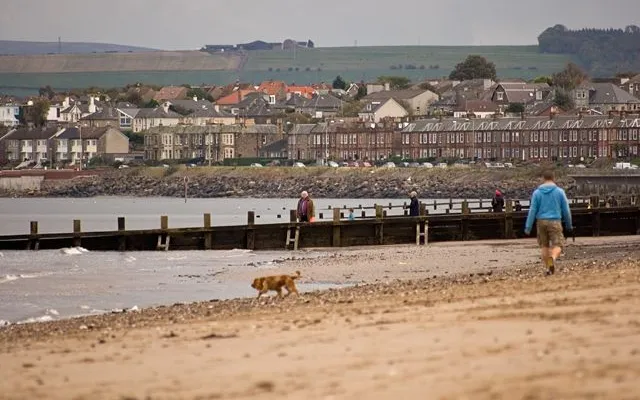
PortobelloThe local mix

Portobello

Two miles of sand, a promenade finished in 1891 and a high street that works in February: Edinburgh's seaside, walked from the bookshop and its kilns to the rocks at Joppa.

4 stops2.1 km30+ min
The Royal MileThe local mix

The Royal Mile

From castle to palace on one ridge of rock, told through the closes that drop off it: a free writers' museum, a 17th-century-style garden, and a courtyard the London coaches left from.

8 stops2.2 km40+ min
Leith and the ShoreThe hidden side

Leith and the Shore

Leith ran its own affairs until 1920, and the harbour still behaves like a town of its own: a royal yacht, a nine-storey distillery, a swing bridge, and a waterfront of bars.

6 stops1.9 km30+ min
Holyrood Park and DuddingstonThe local mix

Holyrood Park and Duddingston

Skip the summit. This walk goes around Arthur's Seat instead, past two lochs and a ruined chapel, over the park's quiet side to a village with a twelfth-century kirk and one of Scotland's oldest pubs.

5 stops3.1 km45+ min
Calton HillThe hidden side

Calton Hill

A short climb from Waterloo Place through a graveyard, a free gallery in an old observatory and a Parthenon the city never finished, with the whole of Edinburgh laid out below.

4 stops0.8 km15+ min
Dean Village and the Water of LeithThe hidden side

Dean Village and the Water of Leith

A river walk from the gallery above the gorge, down past Telford's bridge of 1831 and a mill village's courtyard, to the Sunday market and the co-operative terraces of Stockbridge.

6 stops2.5 km40+ min
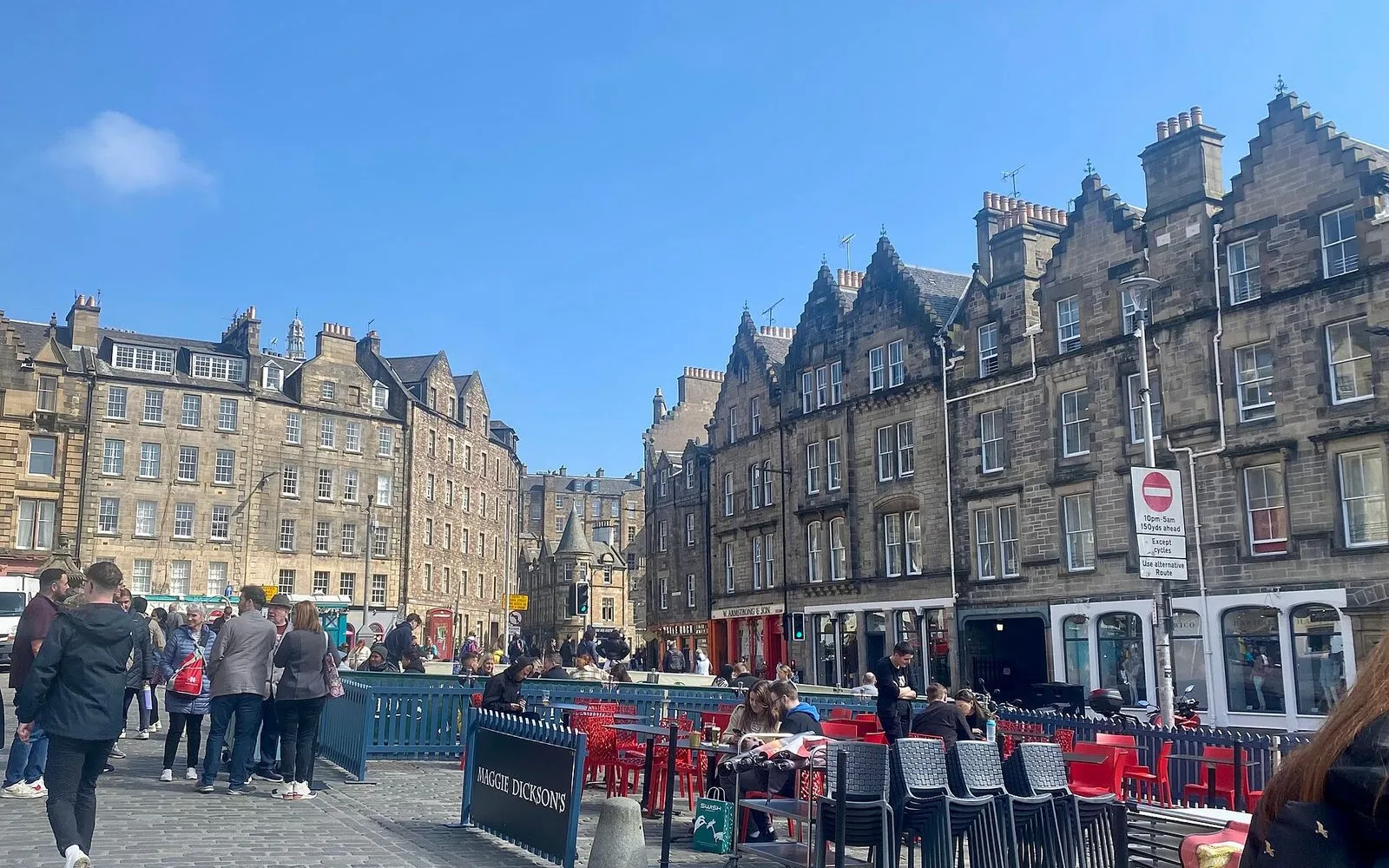
Grassmarket and GreyfriarsThe essentials

Grassmarket and Greyfriars

Below the castle, a market square that was also a gallows; above it, a town wall, a graveyard with a faithful dog, and a museum roof looking back over the Old Town.

6 stops1.1 km20+ min

Provenance · last verified September 26, 2026

Built from the Wayside route itself: the stops, their order, and the walk between them.

Photo by Çağlar Canbay on Unsplash

Photo by Stephencdickson on Wikimedia Commons · CC BY-SA 4.0

Photo by kim traynor on Wikimedia Commons · CC BY-SA 2.0

Photo by Richard West on Wikimedia Commons · CC BY-SA 2.0

Photo by Paul Harrop on Wikimedia Commons · CC BY-SA 2.0

Photo by Wyatt Simpson on Unsplash

Photo by Stuart Hay on Unsplash

Photo by Adam Bouse on Unsplash

Photo by Connor Mollison on Unsplash

Photo by Daniel J. Schwarz on Unsplash

Photo by Kalisa66 on Wikimedia Commons · CC0

Coming soon

Wayside isn't in the app stores yet, but it's in the works. Check back soon.