Edinburgh · Self-guided audio walk

Calton Hill

A short climb from Waterloo Place through a graveyard, a free gallery in an old observatory and a Parthenon the city never finished, with the whole of Edinburgh laid out below.

  • 4Stops
  • 0.8 kmDistance
  • 15+ minTime

Calton Hill is the easy hill. From the steps at Waterloo Place you're on it in a few minutes, and the top does two jobs at once: it holds the monuments that earned Edinburgh the name Athens of the North, and it shows you the whole city from above.

The walk starts in the Old Calton Burial Ground, which the Incorporated Trades of Calton opened in 1718, and climbs past the City Observatory, which now holds Collective, a free contemporary art centre, to the National Monument and Nelson's tower beside it, begun in 1826 and abandoned in 1829 with twelve columns standing.

It finishes at the Burns Monument on Regent Road, on the way down. The walking and listening goes quickly; the view keeps most people up there a good deal longer, and the sunset crowd arrives late in the day.

Hear it on the street

Get the turn-by-turn audio guide in the app. The narration plays itself as you reach each stop, hands-free and offline.

Stop by stop

The route

Interactive map of the route. The full stop list below works without it.

Old Calton Burial GroundLocal pick

Photo by Kristijrn on Wikimedia Commons

Old Calton Burial Ground

0:00

Bought by Calton's tradesmen in 1718, filled with martyrs and philosophers.

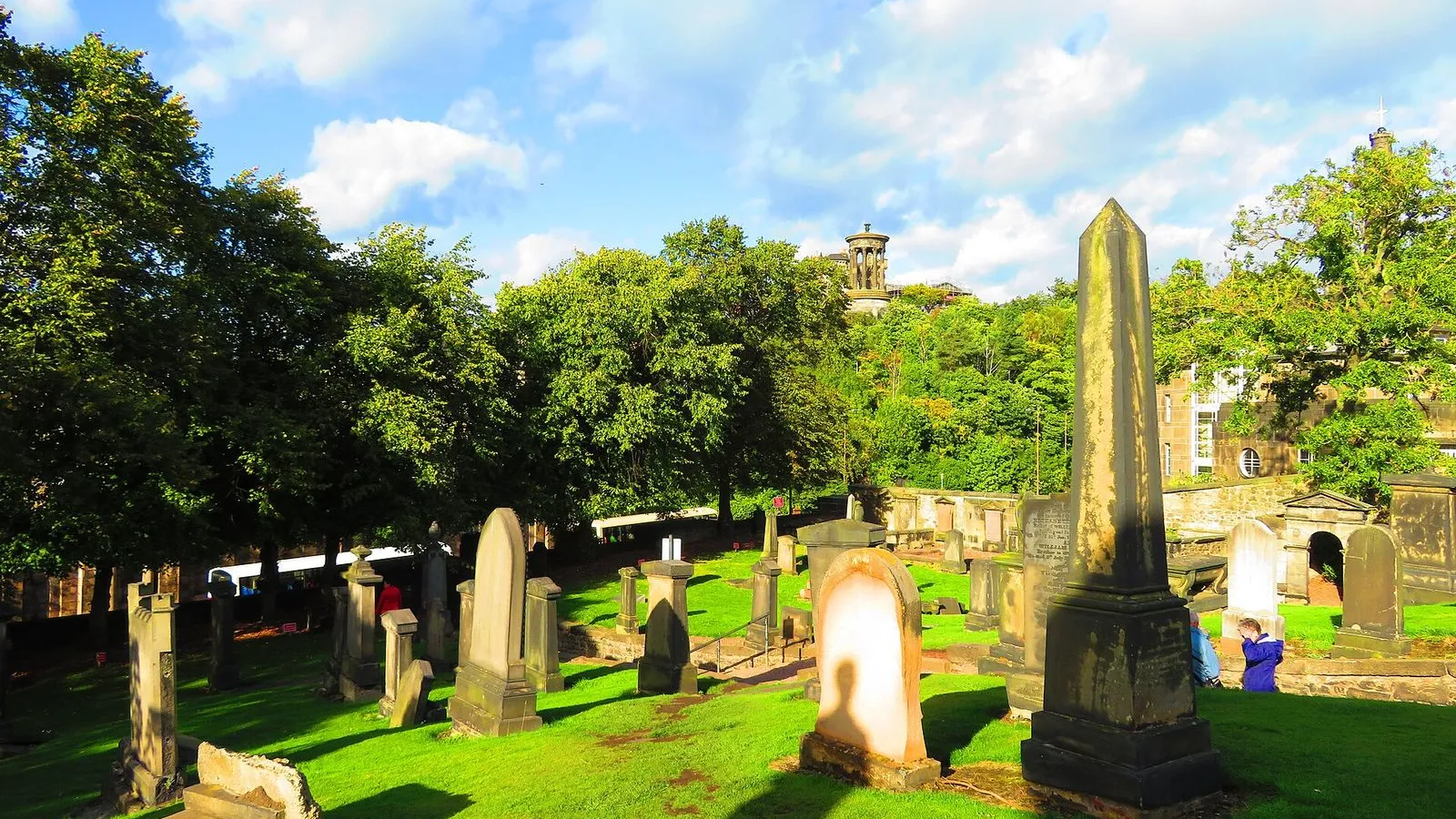
The people of Calton buried their dead at South Leith Parish Church, a long walk away, so in 1718 the Incorporated Trades of Calton bought this half acre on the slope of the hill and made their own burial ground, with a road cut up from the village to reach it.

The tall obelisk on the high ground is the Political Martyrs' Monument, put up in 1844 to five men transported to Australia in 1793 for demanding parliamentary reform. Near it stands Abraham Lincoln, unveiled on 21 August 1893: the only American Civil War memorial outside the United States, paid for by subscribers across the Atlantic, with a freed slave rising at his feet. Then find the plain cylinder in the southwest corner, Robert Adam's mausoleum for David Hume, finished in 1778. Hume asked for his name and dates on it and nothing else. Even so, his grave was guarded for eight days after the burial, because a fair part of Edinburgh wanted to be sure the atheist stayed down.
≈4 min walk to the next stop
City ObservatoryLocal pick

Photo by Godot13 on Wikimedia Commons

City Observatory

0:00

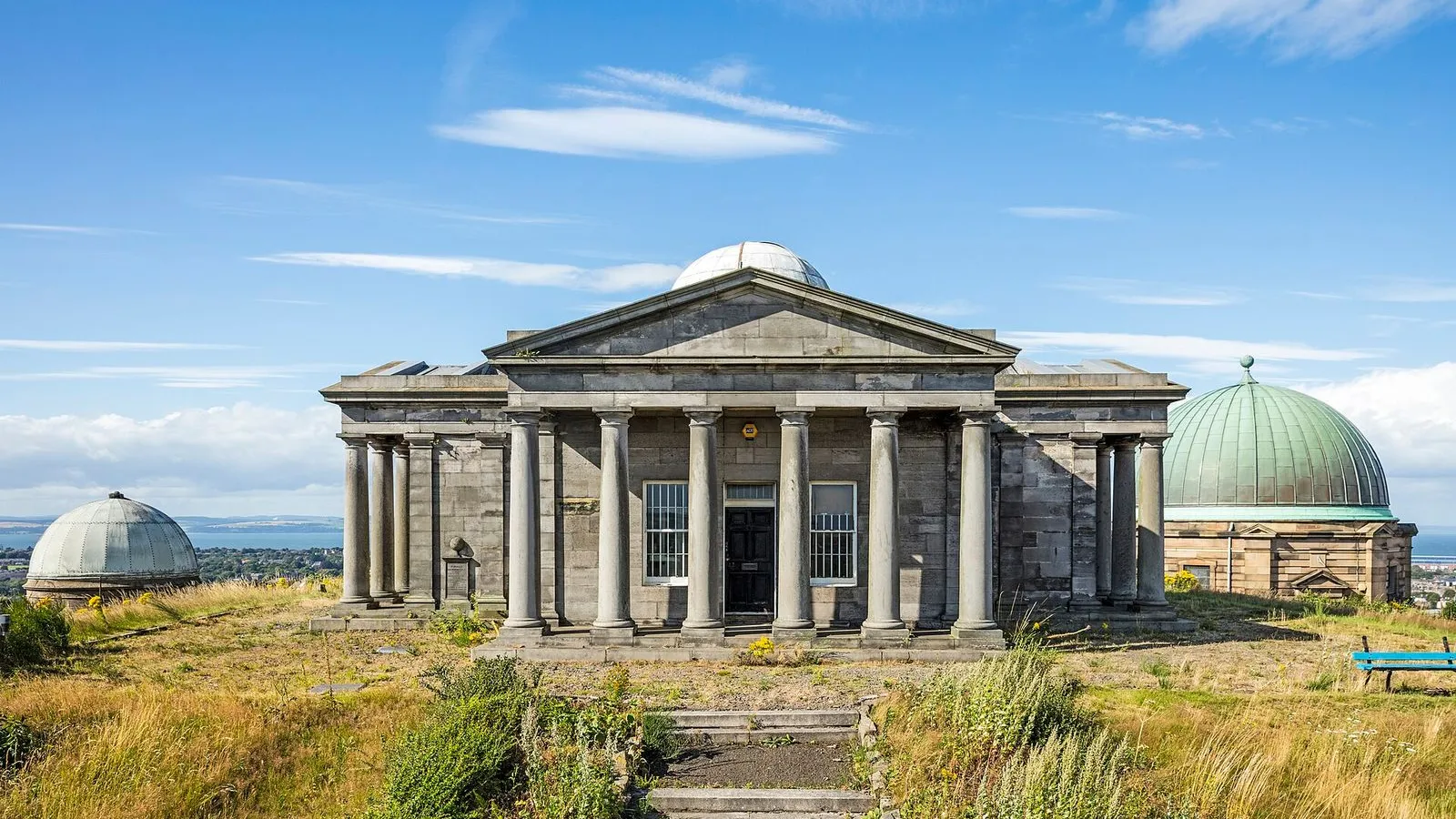
Free contemporary art in the observatory, with Playfair's Stewart monument at the gate.

The compound at the top of the hill is the City Observatory, and the gallery inside it, Collective, is free and open Wednesday to Sunday, ten in the morning to four in the afternoon. Collective started in 1984 as an artist-run initiative and now occupies these buildings, restored and reopened to the public in 2018. The domes on the roofs held telescopes, and the small Gothic tower on the southwest corner was built to face Princes Street and the castle. Stop at the corner of the compound wall, at the Dugald Stewart Monument, Playfair's round temple of nine Corinthian columns, finished in September 1831 and modelled on the Choragic Monument of Lysicrates in Athens.

The Royal Society of Edinburgh commissioned it for a professor of moral philosophy. From here the whole city lies below you: the Castle on its crag, the Old Town ridge dropping to Holyrood, the Firth of Forth beyond. The observatory kept time for ships, and its clock is what dropped the ball on Nelson's tower.

≈2 min walk to the next stop
National Monument of ScotlandMust see

Photo by Daniel Kraft on Wikimedia Commons

National Monument of Scotland

0:00

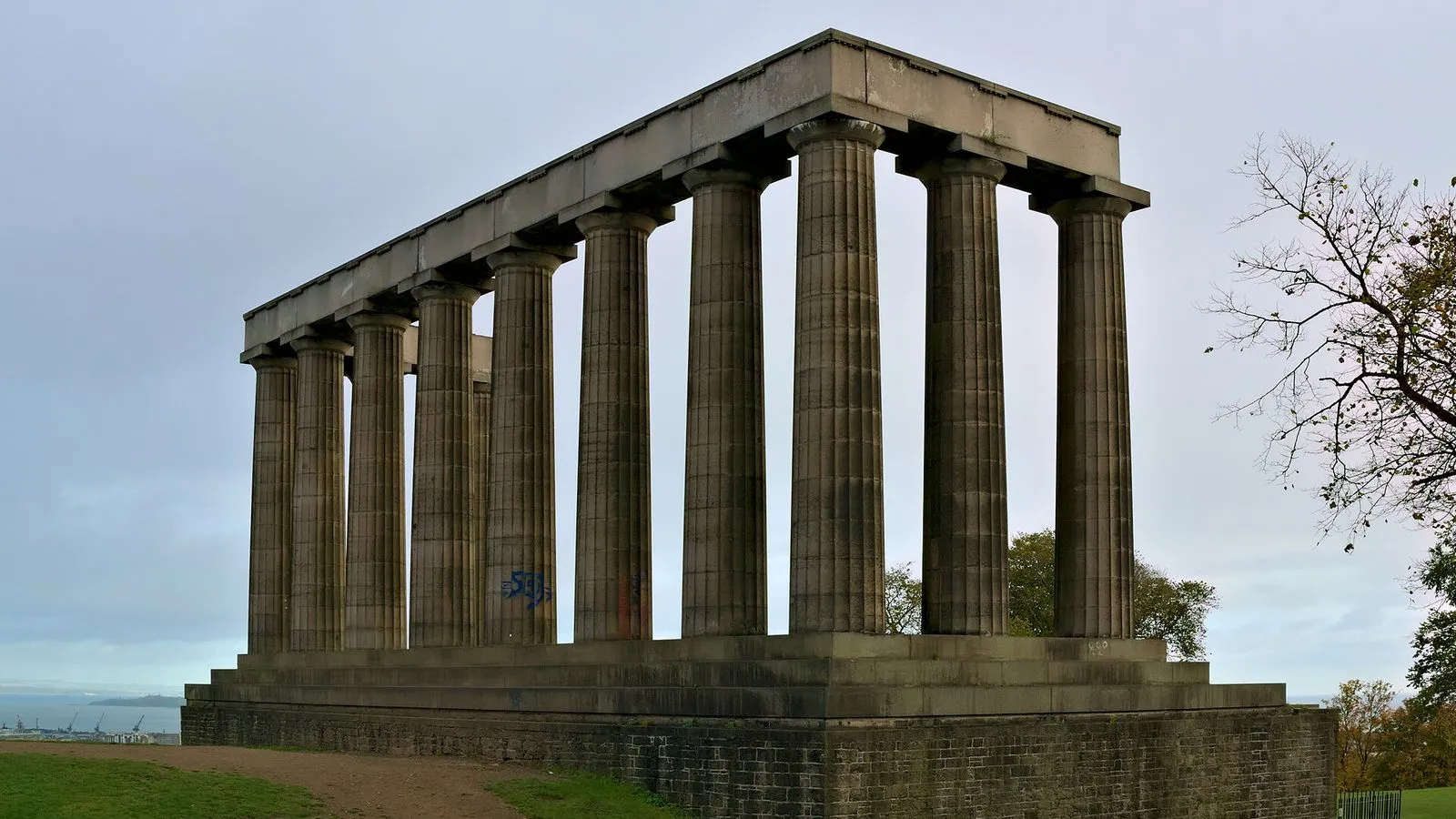
Twelve columns of a Parthenon Scotland could not pay for.

Scotland's National Monument was begun in 1826 and abandoned in 1829 with its base and twelve columns complete, and it has stood unfinished ever since: the west front of a Parthenon on a bare hill, designed by Charles Robert Cockerell and William Henry Playfair as a memorial to the Scots who died in the Napoleonic Wars. The appeal aimed for 42,000 pounds, the money never arrived, and the work stopped. Twelve horses and seventy men were needed to drag the biggest stones up here, all of them Craigleith sandstone, cut and fitted as finely as anything in the city. The monument earned a bitter nickname: the pride and poverty of Scotland.

A few steps away stands the Nelson Monument, a tower built between 1807 and 1816 on public subscriptions, with a castellated base and a mast on top. It has recently reopened to climbers, up a ticketed spiral stair to the platform at the top. In 1853 a time ball was fitted to it, dropped at one o'clock each day so that ships in Leith and the Forth could set their clocks, wired underground to the observatory you just left.

≈4 min walk to the next stop
Free preview ends here · stops 4 to 4 continue in the app

Burns Monument

Hamilton's temple for Burns, built to hold a statue that left.

in app
Good to know

Before you go

Does Calton Hill cost anything to visit?

Calton Hill is free, and so is Collective, the contemporary art centre inside the City Observatory, which opens Wednesday to Sunday 10:00 to 17:00 and closes Monday and Tuesday.

SourceCollective: City Observatory
When is the best time to climb Calton Hill?

Calton Hill is best late in the day, for the sunset: the listening up there goes quickly, but the view keeps most people longer, and the sunset crowd arrives in the evening. The National Monument and Nelson's tower are at the top, with the Burns Monument on the way down toward Regent Road.

How hard is the climb?

The Calton Hill climb is the easy one in Edinburgh: from the steps at Waterloo Place the way up is short, and the paths at the top are paved.

Keep exploring

More walks in Edinburgh

The New TownThe hidden side

The New Town

A grid drawn in 1766 by a 26-year-old, then built street by street. Walk Edinburgh's New Town from Charlotte Square east to St Andrew Square, and finish among the monuments and gardens at its eastern edge.

8 stops2.8 km45+ min
PortobelloThe local mix

Portobello

Two miles of sand, a promenade finished in 1891 and a high street that works in February: Edinburgh's seaside, walked from the bookshop and its kilns to the rocks at Joppa.

4 stops2.1 km30+ min
The Royal MileThe local mix

The Royal Mile

From castle to palace on one ridge of rock, told through the closes that drop off it: a free writers' museum, a 17th-century-style garden, and a courtyard the London coaches left from.

8 stops2.2 km40+ min
Leith and the ShoreThe hidden side

Leith and the Shore

Leith ran its own affairs until 1920, and the harbour still behaves like a town of its own: a royal yacht, a nine-storey distillery, a swing bridge, and a waterfront of bars.

6 stops1.9 km30+ min
Holyrood Park and DuddingstonThe local mix

Holyrood Park and Duddingston

Skip the summit. This walk goes around Arthur's Seat instead, past two lochs and a ruined chapel, over the park's quiet side to a village with a twelfth-century kirk and one of Scotland's oldest pubs.

5 stops3.1 km45+ min
Dean Village and the Water of LeithThe hidden side

Dean Village and the Water of Leith

A river walk from the gallery above the gorge, down past Telford's bridge of 1831 and a mill village's courtyard, to the Sunday market and the co-operative terraces of Stockbridge.

6 stops2.5 km40+ min
Grassmarket and GreyfriarsThe essentials

Grassmarket and Greyfriars

Below the castle, a market square that was also a gallows; above it, a town wall, a graveyard with a faithful dog, and a museum roof looking back over the Old Town.

6 stops1.1 km20+ min

Provenance · last verified September 26, 2026

Built from the Wayside route itself: the stops, their order, and the walk between them.

Photo by Connor Mollison on Unsplash

Photo by Kristijrn on Wikimedia Commons · CC BY-SA 4.0

Photo by Godot13 on Wikimedia Commons · CC BY-SA 4.0

Photo by Daniel Kraft on Wikimedia Commons · CC BY-SA 3.0

Photo by Çağlar Canbay on Unsplash

Photo by Paul Harrop on Wikimedia Commons · CC BY-SA 2.0

Photo by Wyatt Simpson on Unsplash

Photo by Stuart Hay on Unsplash

Photo by Adam Bouse on Unsplash

Photo by Daniel J. Schwarz on Unsplash

Photo by Kalisa66 on Wikimedia Commons · CC0

Coming soon

Wayside isn't in the app stores yet, but it's in the works. Check back soon.