Glasgow · Self-guided audio walk

The City Centre and Merchant City

A walk from Glasgow's shopping street to the ground where the city began, taking in the civic square, the merchants' lanes, and the murals painted over the same walls.

  • 8Stops
  • 2.1 kmDistance
  • 35+ minTime

Glasgow's centre moved west. This walk goes the other way, from the shopping street through the civic square to the lanes of the old Merchant City and the ground the burgh grew up on.

You start on Buchanan Street, first laid out in 1777 on garden ground by a tobacco lord, then cut through Royal Exchange Square, where the Duke of Wellington wears a traffic cone and the Gallery of Modern Art is free. George Square and the City Chambers carry the city's public face: the Scott column, the marble staircase.

Then east, into the merchants' quarter and the City Centre Mural Trail. Rogue One's butterflies, Smug's towering figure on Candleriggs, the galleries of Trongate 103 and the Tron's blue clock, the tolbooth steeple of 1626 at Glasgow Cross, and Smug's Saint Mungo on High Street, where the walk ends close to where the city began.

Hear it on the street

Get the turn-by-turn audio guide in the app. The narration plays itself as you reach each stop, hands-free and offline.

Stop by stop

The route

Interactive map of the route. The full stop list below works without it.

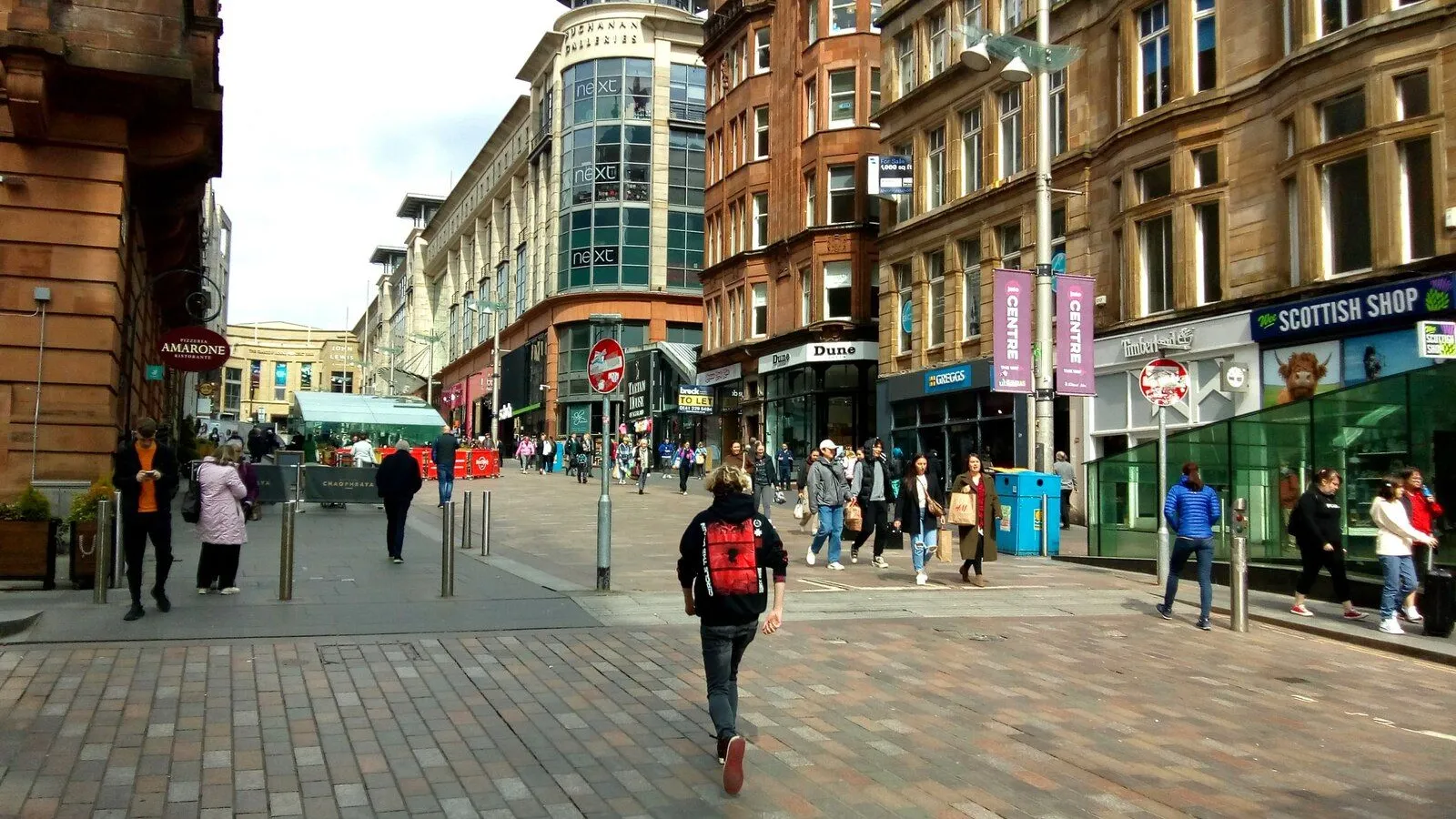
Buchanan StreetMust see

Photo by Stephen Armstrong on Wikimedia Commons

Buchanan Street

0:00

Glasgow's shopping street, laid out in 1777 by a tobacco lord.

You're standing on Buchanan Street, and this is the newest ground on the walk. The street was first feued in 1777 and named after Andrew Buchanan, a tobacco lord, plantation owner, and former Lord Provost. His money came from tobacco, and when the American Revolution cut that trade, the family moved into textiles. For its first decades this was a street of villas and gardens on the western edge of a small, crowded old town, and the city's wealth has been moving west ever since.

Now it's Glasgow's shopping street, closed to cars and paved in granite. Look for the Argyll Arcade, opened in 1827, a covered run of jewellers' windows you can walk through. Nelson Mandela Place, at the far end, was renamed in the 1980s, and the statue of Donald Dewar, unveiled in 2002, stands at the top of the street. From here, everything else on this walk lies east, where the city started.
≈2 min walk to the next stop
Gallery of Modern ArtMust see

Photo by 3BRBS on Wikimedia Commons

Gallery of Modern Art

0:00

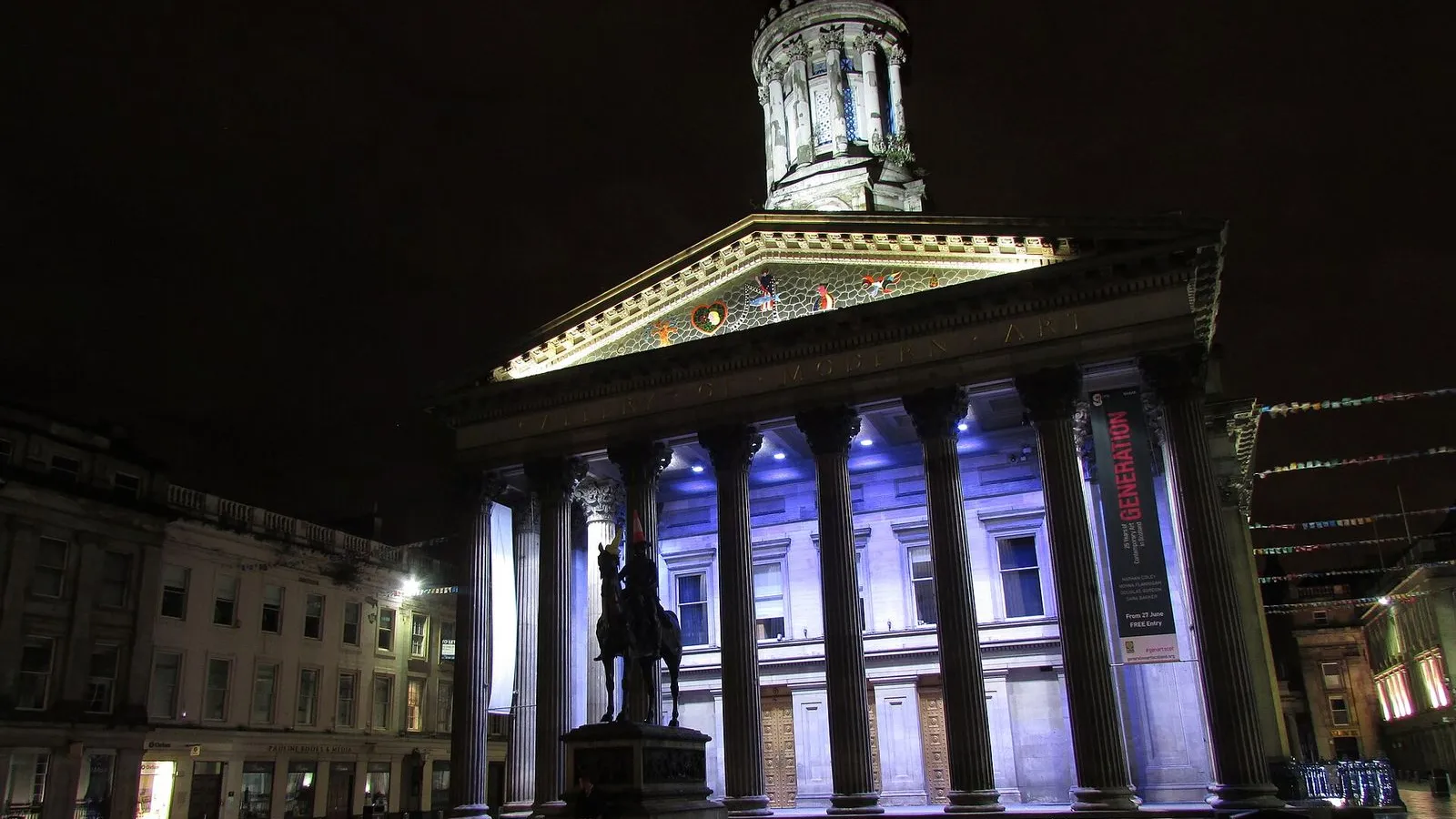
Free gallery in a former exchange, with a cone-topped duke outside.

Royal Exchange Square opens off the street through a low arch, and it holds three generations of Glasgow money in one small space. William Cunninghame, tobacco lord, built his mansion and gardens here in 1778. In 1829 the city got David Hamilton's Royal Exchange on the same ground, a hall where merchants traded commodities and stocks. In 1949 Glasgow Corporation bought the building for Stirling's Library, and it now houses the Gallery of Modern Art, which is free to walk into.

Outside, Carlo Marochetti's bronze Duke of Wellington has stood on his granite plinth since 1844, with reliefs of the battles of Assaye and Waterloo on the base. The cone on his head isn't official, and never has been. People have balanced one there since the 1980s, the council takes it down, someone puts it back, and for the 2014 Commonwealth Games somebody painted one gold. The statue is listed, cone and all.

≈3 min walk to the next stop
George SquareMust see

Photo by MSeses on Wikimedia Commons

George Square

0:00

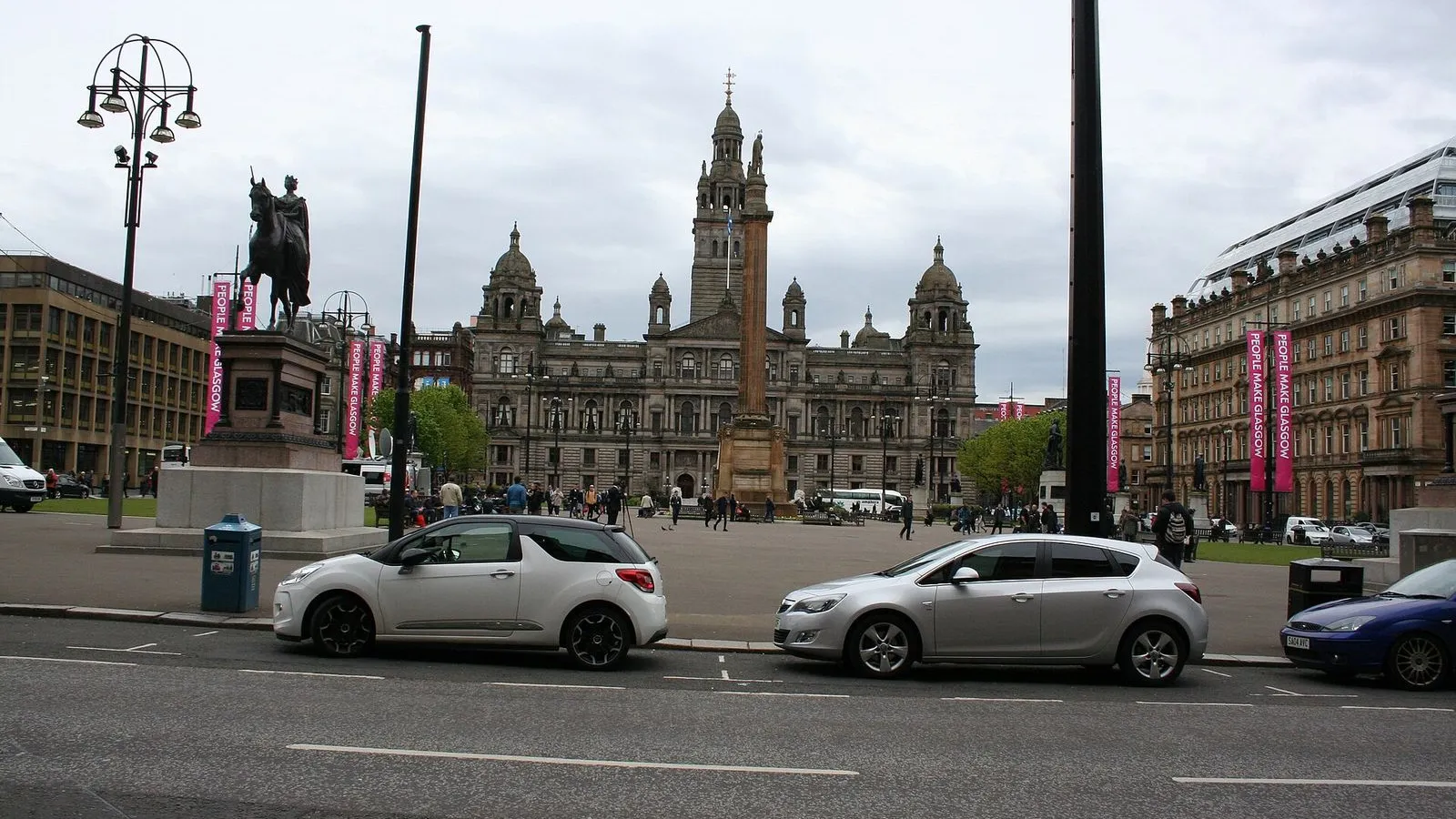
The city's civic front room, named for King George III in 1781.

George Square was laid out in 1781 and named for King George III. Its first statue went up in 1819, Sir John Moore on the south side facing Miller Street, and the square has been filling with bronze ever since: eleven more public figures, among them Robert Burns, James Watt, and Marochetti's Queen Victoria on horseback with her Albert nearby. The centre belongs to a column of Giffnock stone, 80 feet of it, finished by 1837. The man on top is Walter Scott, and this was the first monument anywhere to the novelist, put up well before Edinburgh built its own.

Around the edges the city keeps its business. The Merchants' House faces the square from the west, and the council's chambers stand opposite on the east. The terrace of houses that stood there came down in 1883 to make room for them, and the square has been the city's front room ever since.

≈2 min walk to the next stop
Free preview ends here · stops 4 to 8 continue in the app

City Chambers

Council headquarters of 1889, with a staircase of Carrara marble.

in app

Keeper of Light

Smug's Keeper of Light and Rogue One's butterflies on one corner.

in app

Trongate 103

Edwardian warehouse turned arts centre, with the Tron steeple a few doors east.

in app

Tolbooth Steeple

The 1626 tower that outlived the tolbooth it belonged to.

in app

Saint Mungo mural

Smug's 2016 saint on a High Street gable end.

in app
Good to know

Before you go

Is the Gallery of Modern Art free, and when is it open?

The Gallery of Modern Art is free, opening 10am to 5pm Monday to Thursday and Saturday and 11am to 5pm Friday and Sunday, and it stands behind the Duke of Wellington statue in Royal Exchange Square.

SourceGlasgow Life: Gallery of Modern Art
Where should I eat on the city centre and Merchant City walk?

The Merchant City stretch has the best lunch stops: Paesano on Miller Street for pizza, and The Spanish Butcher on the same street for a longer, meatier meal. Both put you a few steps off the mural trail, so you can eat and carry on without a detour.

SourceFoodie Explorers: where to eat in Glasgow
Do I need tickets for the murals?

No. The murals are painted on gable ends and walls along the route, from Rogue One's butterflies at Candleriggs to Smug's Saint Mungo on High Street, so there's nothing to book or pay. Treat the trail as a walk with stops rather than a single exhibit, and look up as you go.

SourceVisit Glasgow: Finnieston

Provenance · last verified September 26, 2026

Built from the Wayside route itself: the stops, their order, and the walk between them.

Photo by Vishnu Prasad on Unsplash

Photo by Stephen Armstrong on Wikimedia Commons · CC BY-SA 2.0

Photo by 3BRBS on Wikimedia Commons · CC BY-SA 3.0

Photo by MSeses on Wikimedia Commons · CC BY-SA 4.0

Photo by Wiki.cullin on Wikimedia Commons · CC0

Photo by Euan Cameron on Unsplash

Photo by Phil Reid on Unsplash

Photo by habiloid on Wikimedia Commons · CC BY-SA 2.0

Photo by JThomas on Wikimedia Commons · CC BY-SA 2.0

Coming soon

Wayside isn't in the app stores yet, but it's in the works. Check back soon.