Glasgow · Self-guided audio walk

The West End

One corridor through Glasgow's West End, from the free museum by the Kelvin to a Victorian glasshouse in the Botanic Gardens, past cloisters, a cobbled lane and the university on its hill.

  • 7Stops
  • 2.5 kmDistance
  • 40+ minTime

Glasgow's West End is one corridor, and almost all of it is free. This walk runs from the doors of Kelvingrove Art Gallery and Museum up through Kelvingrove Park to the university on Gilmorehill, then down Byres Road to the Botanic Gardens.

You get 22 galleries at Kelvingrove, a daily organ recital, cloisters you can walk through, a cobbled lane full of bars, and a Victorian glasshouse at the end. The only ticket on the route is the Mackintosh House, 12 pounds for an adult.

The thread is how this part of the city was paid for and then handed over: a museum built partly with an exhibition's profits, a fountain celebrating clean water, a private glasshouse bought for a public garden. About two and a half kilometres end to end.

Hear it on the street

Get the turn-by-turn audio guide in the app. The narration plays itself as you reach each stop, hands-free and offline.

Stop by stop

The route

Interactive map of the route. The full stop list below works without it.

Kelvingrove Art Gallery and MuseumMust see

Photo by dalbera on Openverse

Kelvingrove Art Gallery and Museum

0:00

Scotland's free museum: 22 galleries, a Dalí, and an organ played daily.

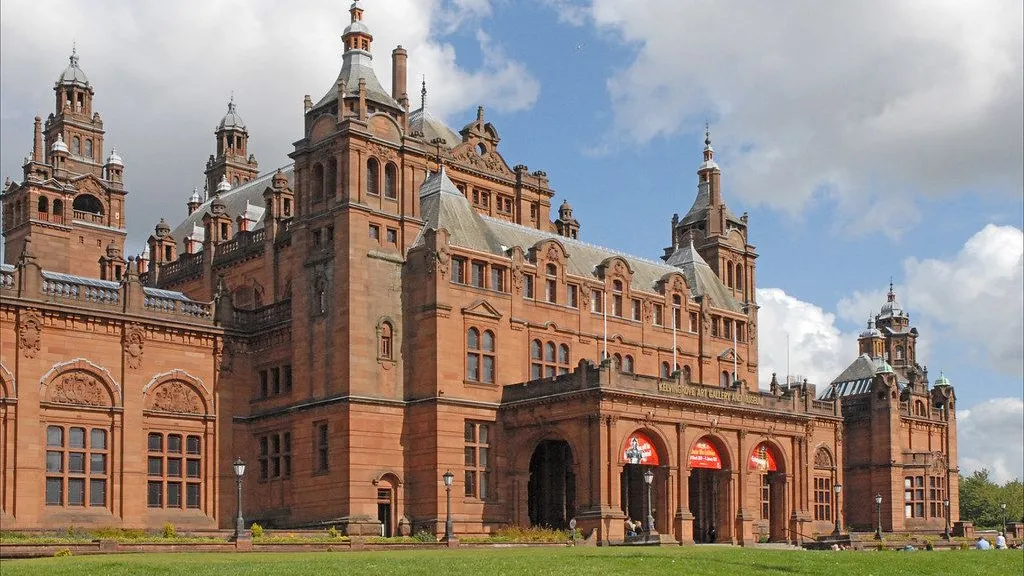
The building in front of you opened in 1901 as the Palace of Fine Arts for Glasgow's International Exhibition, and the city took it over as its museum the following year. Towers, turrets, red sandstone, and entry to the permanent collection is free, with 22 galleries inside. Go first to the Dalí. Christ of Saint John of the Cross, painted in 1951, shows a body hanging over dark water, seen from above, and a lot of people come here for it alone.

Then find the Centre Hall and the pipe organ built by Lewis and Company for that same 1901 exhibition, standing under its walnut case. It's played every day, usually around one o'clock and at three on Sundays. Sit down for it. The sound fills a hall that was built for exactly that.

The collection is jumbled on purpose, around 8,000 objects split into two halves called Life and Expression, so a Spitfire hangs above a Rembrandt a short walk from an Egyptian coffin.
≈7 min walk to the next stop
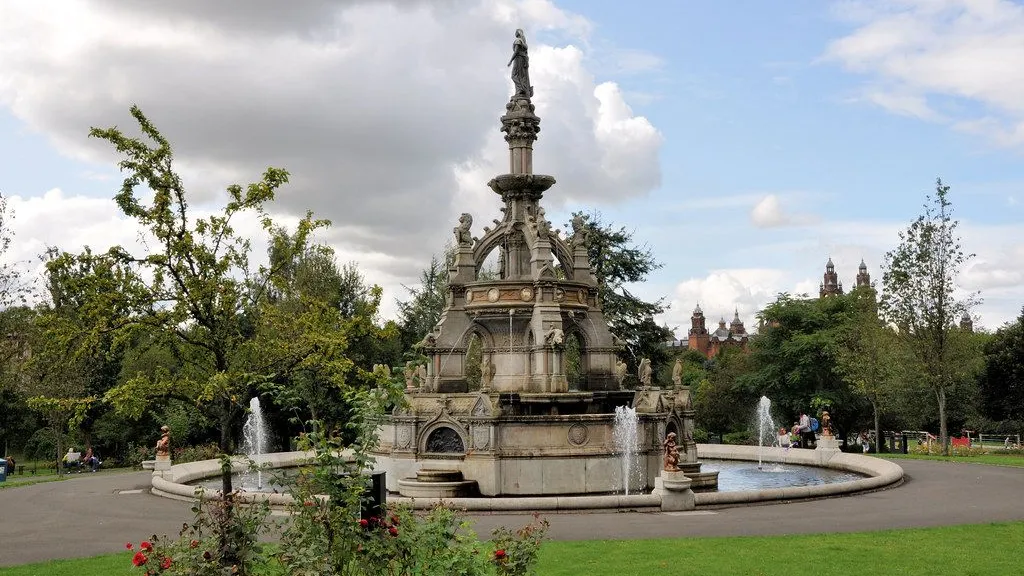
Stewart Memorial FountainLocal pick

Photo by Robert Cutts on Openverse

Stewart Memorial Fountain

0:00

A Gothic fountain that celebrates the water it brought from Loch Katrine.

This fountain remembers a man and a pipe. Robert Stewart was Glasgow's Lord Provost from 1851 to 1854, and clean water was the argument of his career. The city had been drinking from wells and the river, and disease came with it. Stewart drove through the scheme that brought water from Loch Katrine in the Trossachs; Queen Victoria opened the works in 1859, and the supply was running by 1860.

When Stewart died in 1866, the council decided to mark both the man and the achievement, ran a competition in 1870 that drew 75 entries, and gave the job to the architect James Sellars, with sculpture by John Mossman. The bronze panels are worth a slow circle. Two carry Stewart's portrait and the dedication. The east and west panels show Loch Katrine on one side and Glasgow on the other, the water and the city it reached.

The figure on top, once gilded, is Ellen Douglas, the heroine of Walter Scott's The Lady of the Lake. It was restored and running again by 2009, after work costing 500,000 pounds.

≈8 min walk to the next stop
University of GlasgowMust see

Photo by Johnny Briggs on Unsplash

University of Glasgow

0:00

Founded in 1451, with cloisters and two quadrangles you can walk through.

You're walking into a university founded in 1451, the fourth-oldest in the English-speaking world, and you can walk in as a visitor. The building ahead is the Gilbert Scott Building, named for the architect Sir George Gilbert Scott, who died before it was finished; his son John Oldrid completed it in 1891. The tower was meant to hold a clock and grew too tall for the plan to work. Go through the archway and up the steps into the quadrangles, east and west, with the cloisters running between them: fluted columns, ribbed stone vaults overhead, light coming in low from one side.

Bute Hall sits directly above, where graduations happen. Film crews use these arches constantly, for Outlander, Cloud Atlas, Outlaw King. Students cross here between lectures, so the place belongs to the working day as much as to visitors. On the Memorial Gates below you, names the university claims are cut into stone: James Watt, Adam Smith, Isabella Elder.

Watt's instruments are in the Hunterian Museum a few steps away.

≈3 min walk to the next stop
Free preview ends here · stops 4 to 7 continue in the app

Mackintosh House

Mackintosh's own rooms, rebuilt inside the Hunterian. Stairs only, shut Mondays.

in app

Ashton Lane

Cobbles, bars and a 1921 picture house, steps from Hillhead station.

in app

Òran Mór

A derelict church reborn as a bar, whisky bar and auditorium.

in app

Kibble Palace

A private iron and glass palace, now the city's house of tree ferns.

in app
Good to know

Before you go

How much is the Mackintosh House, and when can I visit?

The Mackintosh House costs £12 for adults and £8 for concessions, and under-18s go free. It opens Tuesday to Sunday, 10am to 5pm, with last admission at 4:15pm, and closes on Mondays; on Friday and Saturday mornings general admission starts at 11am, after the booked guided tours.

SourceThe Hunterian: The Mackintosh House
Is Kelvingrove free to enter?

Kelvingrove is free, opening 10am to 5pm Monday to Thursday and Saturday and 11am to 5pm Friday and Sunday. There's a free organ recital daily on the 1901 Lewis organ, and a café on the lower level if the walk has earned a sit-down.

SourceGlasgow Life: Kelvingrove Art Gallery and Museum
Is the Botanic Gardens glasshouse free?

Entry to the Botanic Gardens is free, and the Friends of Glasgow Botanic Gardens run free guided tours through the season. The Kibble Palace, the iron and glass house at the top of the walk, is the reason to finish the route here rather than turn back at the university.

SourceFriends of Glasgow Botanic Gardens

Provenance · last verified September 26, 2026

Built from the Wayside route itself: the stops, their order, and the walk between them.

Photo by Euan Cameron on Unsplash

Photo by dalbera on Openverse · CC BY 2.0

Photo by Robert Cutts on Openverse · CC BY-SA 2.0

Photo by Johnny Briggs on Unsplash

Photo by Vishnu Prasad on Unsplash

Photo by Wiki.cullin on Wikimedia Commons · CC0

Photo by Phil Reid on Unsplash

Photo by habiloid on Wikimedia Commons · CC BY-SA 2.0

Photo by JThomas on Wikimedia Commons · CC BY-SA 2.0

Coming soon

Wayside isn't in the app stores yet, but it's in the works. Check back soon.