Lyon · Self-guided audio walk

Vieux Lyon: The Renaissance City and Its Traboules

Follow the hidden passages of the UNESCO-listed old town from Saint-Paul to Saint-Georges, with the Saône never far away.

  • 8Stops
  • 2.3 kmDistance
  • 35+ minTime
Vieux Lyon: The Renaissance City and Its Traboules

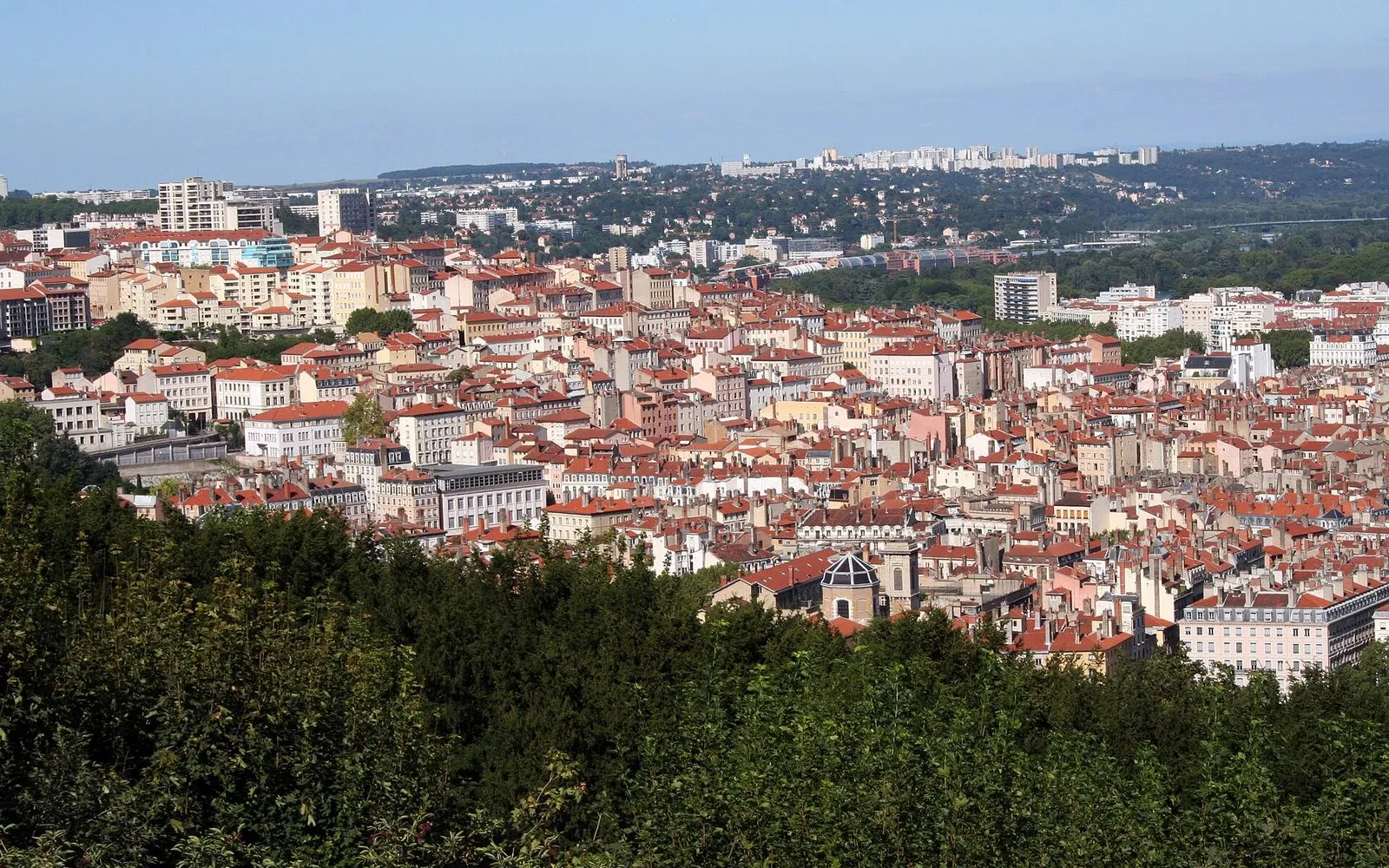
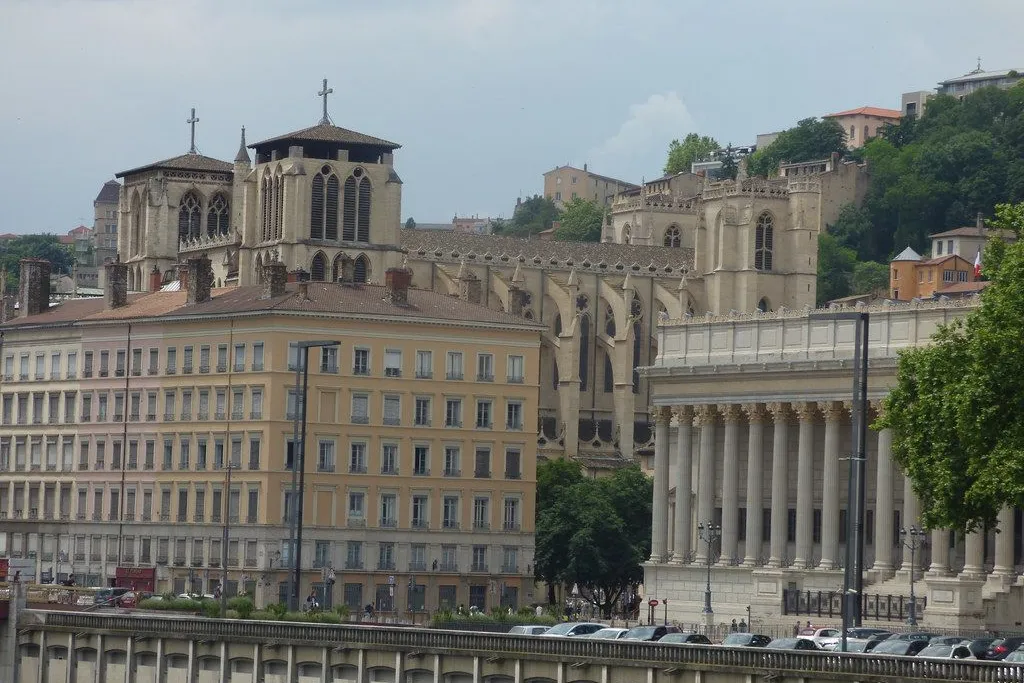
Photo by ell brown on Openverse

This walk follows the right bank of the Saône through Vieux Lyon, the Renaissance quarter that UNESCO added to the World Heritage list in 1998. It starts at the medieval church of Saint-Paul and ends at the neo-Gothic church of Saint-Georges, threading through the public traboules and courtyards that make the district work. Along the way you pass the Loge du Change, once the financial heart of the city's great fairs, the pink spiral staircase of the Tour Rose, and the courtyard and garden of the Musée Gadagne. The last stops bring you to the red Passerelle du Palais de Justice for a look back at the Saône facades, and to the primatial cathedral of Saint-Jean with its 14th-century astronomical clock. Allow about an hour. The traboules are private passageways opened by agreement with their owners, so they are generally open in the daytime but can close without notice.

Hear it on the street

Get the turn-by-turn audio guide in the app. The narration plays itself as you reach each stop, hands-free and offline.

Stop by stop

The route

Interactive map of the route. The full stop list below works without it.

Église Saint-PaulMust see

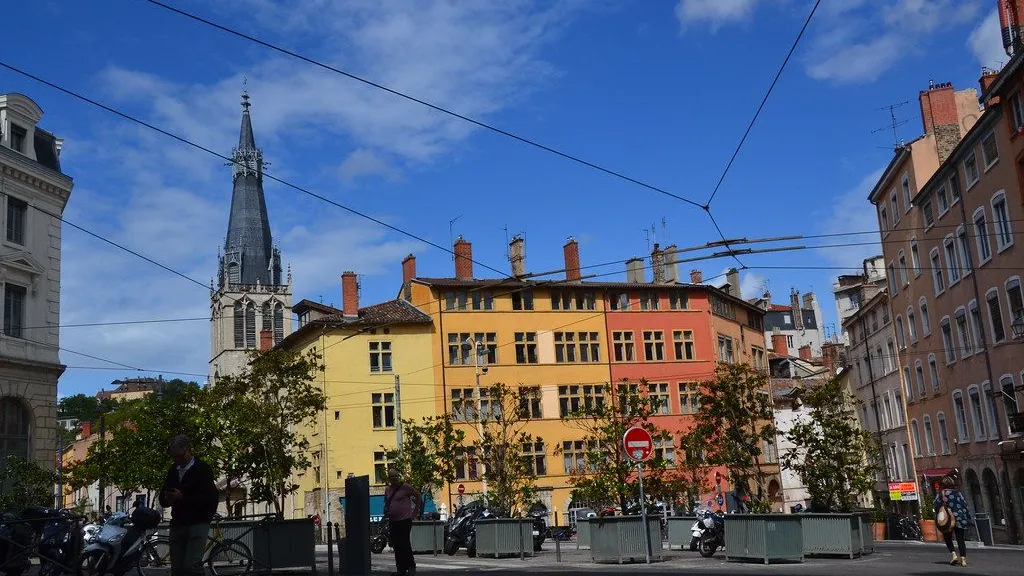
Photo by Jeanne Menjoulet on Openverse

Église Saint-Paul

0:00

One of Lyon's oldest churches, with an octagonal lantern tower and a carillon of eleven bells over place Gerson.

You're standing in place Gerson, at the top of Vieux Lyon. The church in front of you, Saint-Paul, is one of the oldest in the city. A first church was founded here around 549 by Bishop Sacerdos, and what you see today mixes a Romanesque core from the 12th and 13th centuries with Gothic additions. The square tower is capped by a wooden spire, 24 meters high, and the tower has held a carillon of eleven bells since the 19th century. The square itself is named for Jean Gerson, the theologian who spent his last years in Lyon.

And the church has seen harder use: in 1793, during the Revolution, it was pillaged and turned into a saltpeter store. Before you leave, notice the mix on the facade. Romanesque stone, Gothic windows, a neo-Gothic doorway added in 1877. That doorway shows Saint Paul on the road to Damascus. Take a last look, then head south into the old quarter.
≈4 min walk to the next stop
Place du ChangeMust see

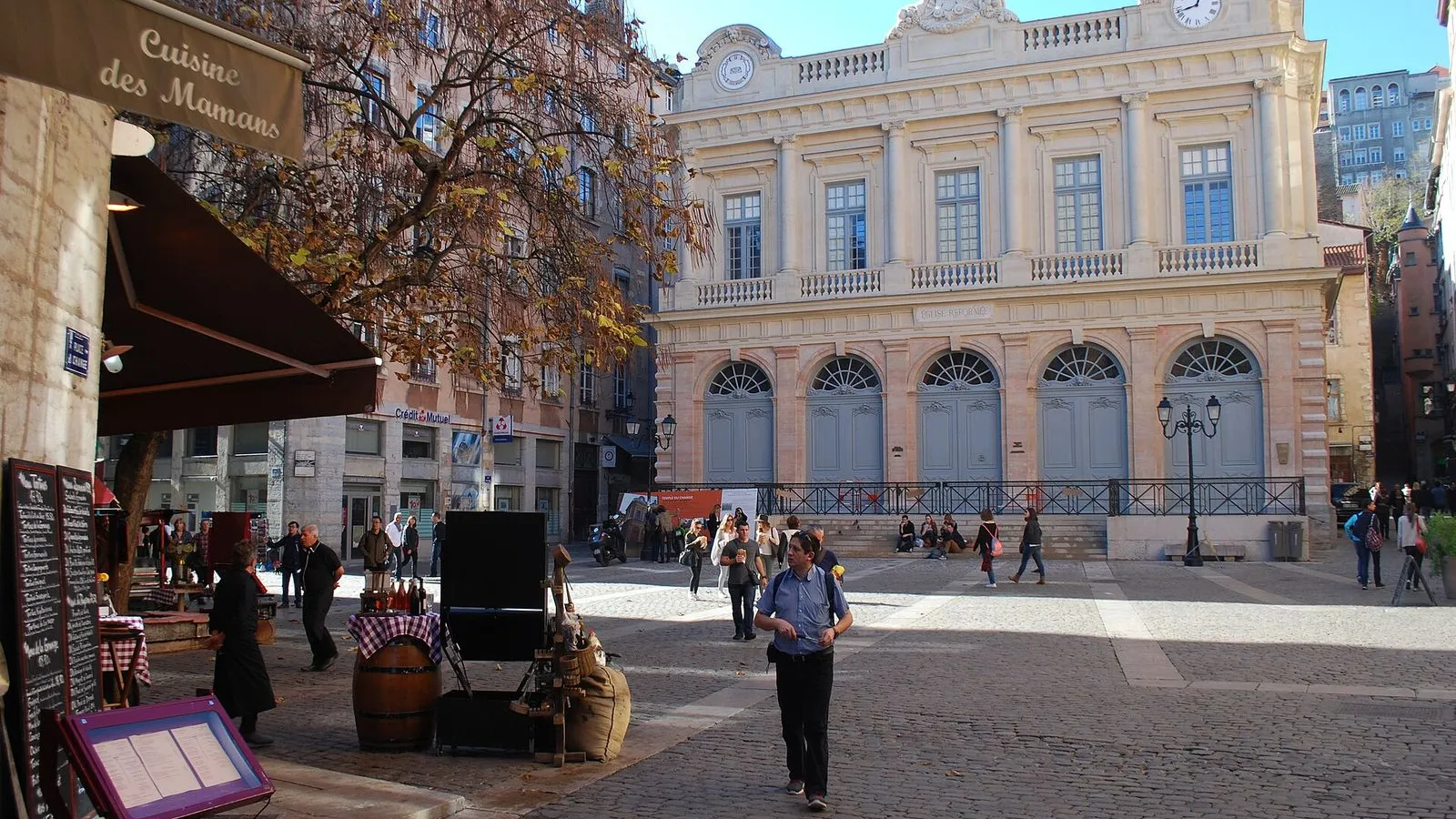
Photo by Jean Housen on Wikimedia Commons

Place du Change

0:00

The old money market of Renaissance Lyon, watched over by the pillared Loge du Change.

This small square was once the money market of Lyon. Money-changers worked here from the 13th century, at the foot of the old Saône bridge, and in the 16th century the square held a two-week fair where merchants settled their accounts. Under King François I, Lyon became the first financial center of Europe. The pillared building is the Loge du Change. It was built in 1653 by the architect Simon Gourdet, then enlarged in 1748 to 1750 by Soufflot, who gave it the portico you see.

Above it once ran a line from Cicero, 'Virtute duce, comite fortuna', fortune following where virtue leads. In 1793 the Revolution turned the loggia into a gunpowder works. In 1803 the city handed it to the Protestant community, and it became the Temple du Change. It was the first building in Lyon to be listed as a historic monument, on 3 May 1913. In 1938, four Protestant churches merged inside these walls to form the Reformed Church of France.

≈5 min walk to the next stop
The Long TrabouleMust see

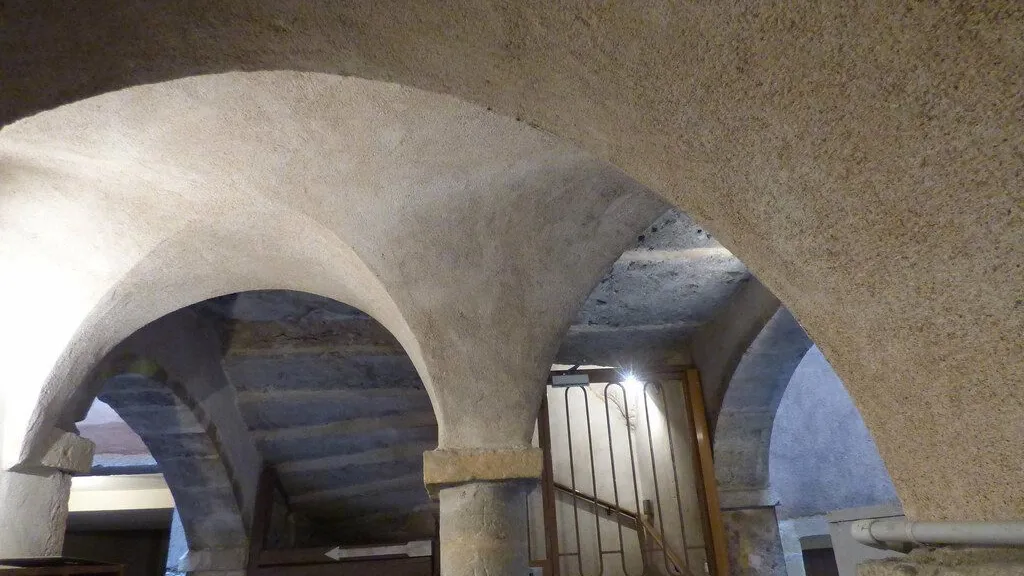
Photo by ell brown on Openverse

The Long Traboule

0:00

Lyon's longest traboule, a public passage cutting through five courtyards and four buildings between rue du Boeuf and rue Saint-Jean.

Number 27 rue du Boeuf is the door to the longest traboule in Vieux Lyon, which is how it earned its name. A traboule is Lyon's word for a passage that cuts straight through a building block, from one street to the next. This one threads five courtyards and four buildings between rue du Boeuf and rue Saint-Jean, the two main streets of the old town. Step in when the gate is open. You pass a 16th-century facade, then a spiral staircase in the first courtyard.

After that, corridors and half-covered passages link one courtyard to the next. Silk weavers once used these passages to carry their bolts under cover, and residents still use the route every day. These are private courtyards opened by agreement with their owners, so they are usually accessible during the day, from morning to around seven or eight in the evening, but they can close without notice. If the door is shut, try the rue Saint-Jean end at number 54, or come back a little later. Keep your voice down as you pass through.

≈1 min walk to the next stop
Free preview ends here · stops 4 to 8 continue in the app

Tour Rose

The district's emblem: a pink tower staircase hidden in the courtyard of the 17th-century Maison du Crible.

in app

Musée Gadagne

The largest Renaissance ensemble in Lyon, holding two museums and a free garden above the rooftops.

in app

Passerelle du Palais de Justice

A red cable-stayed footbridge from 1983, and the best spot to look back at the Renaissance facades along the Saône.

in app

Cathédrale Saint-Jean-Baptiste

The primatial cathedral of Lyon, three centuries in the making, with a 14th-century astronomical clock.

in app

Église Saint-Georges

A neo-Gothic church by Pierre Bossan, rebuilt in the mid-1800s on a site of worship that goes back to the 6th century.

in app
Good to know

Before you go

Can I enter the traboules on my own?

Yes. The traboules of Vieux Lyon are private passageways opened to visitors by agreement with their owners, so they are generally open in the daytime and can close without notice. Stay quiet and treat them as borrowed space.

Is the astronomical clock at Saint-Jean easy to see?

The primatial cathedral of Saint-Jean keeps its 14th-century astronomical clock inside, and it is easiest to see when the cathedral is open for visitors outside services. Check the cathedral's notice for the day's times.

Where should I eat in Vieux Lyon?

Place Saint-Jean and rue Saint-Jean are full of bouchons, Lyon's traditional restaurants. L'Auberge des Canuts at 8 Place Saint-Jean is a certified bouchon facing the cathedral.

SourceL'Auberge des Canuts

Provenance · last verified August 22, 2026

Built from the Wayside route itself: the stops, their order, and the walk between them.

Photo by ell brown on Openverse · CC BY-SA 2.0

Photo by Jeanne Menjoulet on Openverse · CC BY 2.0

Photo by Jean Housen on Wikimedia Commons · CC BY-SA 4.0

Photo by ell brown on Openverse · CC BY-SA 2.0

Photo by Jacmin on Wikimedia Commons · CC BY-SA 3.0

Photo by Blueberry-026 on Wikimedia Commons · CC BY-SA 4.0

Photo by genevieveromier on Openverse · CC BY 2.0

Photo by SashiRolls on Wikimedia Commons · CC BY-SA 4.0

Photo by corno.fulgur75 on Openverse · CC BY 2.0

Photo by Thomas K on Unsplash

Coming soon

Wayside isn't in the app stores yet, but it's in the works. Check back soon.