Nice · Self-guided audio walk

Cimiez: Two Thousand Years on One Hill

Roman stones, Franciscan gardens, and the painters who chose to stay.

  • 7Stops
  • 4.1 kmDistance
  • 60+ minTime
Cimiez: Two Thousand Years on One Hill

Photo by Broenberr on Wikimedia Commons

A walk through the oldest layer of Nice, on a hill that was once the capital of the Roman Alps. You begin inside a 2,000-year-old arena, trace the baths and streets of Cemenelum, then step into the villa where Matisse's works fill rooms above an olive grove. The Franciscan monastery, its rose garden, and the quiet cemetery hold the graves of Matisse and Dufy. Downhill, the Musée Chagall gathers the painter's Biblical visions in a low, light-filled building. The tour ends at the Belle Époque palace where Queen Victoria wintered and Matisse spent his final years.

Hear it on the street

Get the turn-by-turn audio guide in the app. The narration plays itself as you reach each stop, hands-free and offline.

Stop by stop

The route

Interactive map of the route. The full stop list below works without it.

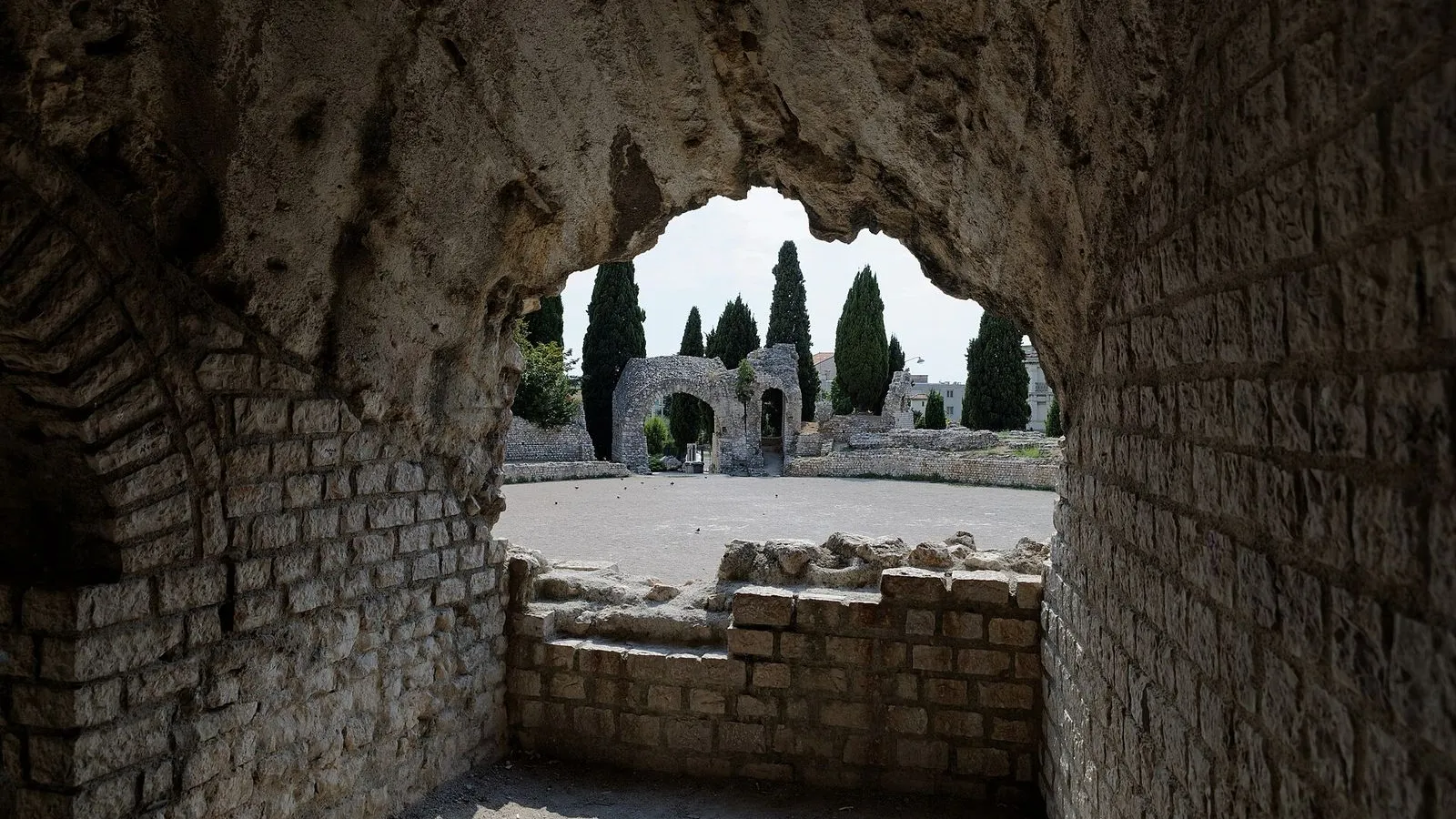
Arènes de CimiezMust see

Photo by François de Dijon on Wikimedia Commons

Arènes de Cimiez

0:00

The Roman amphitheatre of Cemenelum, built around 75 AD, seated 4,000 spectators for gladiatorial games on this hilltop above Nice.

You are standing inside a Roman amphitheatre that has never been buried. Unlike most ruins in France, these stones have always stayed above ground. Builders cut them between 70 and 80 AD, when Cemenelum was capital of the Roman province Alpes Maritimae. The arena is modest: 68 meters long, 57 wide, one of the smallest in Gaul.

But it held 4,000 people, and the crowd came for gladiatorial combat. Look at the ring of sockets near the top of the outer wall. Those held the wooden masts that supported the velum, a canvas canopy that shaded the spectators. In 258 AD, according to tradition, a Christian named Pontius faced the beasts here.

The animals refused to attack him, and he was beheaded down by the Paillon river. His name survives in the Saint-Pons district below. The arena fell quiet after the fourth century, but it never disappeared. Until 2011, the Nice Jazz Festival filled these stones with music every summer.

Walk the full ellipse before you go. The south entrance was the Porta Triumphalis, the gate through which the opening parade entered.
≈3 min walk to the next stop
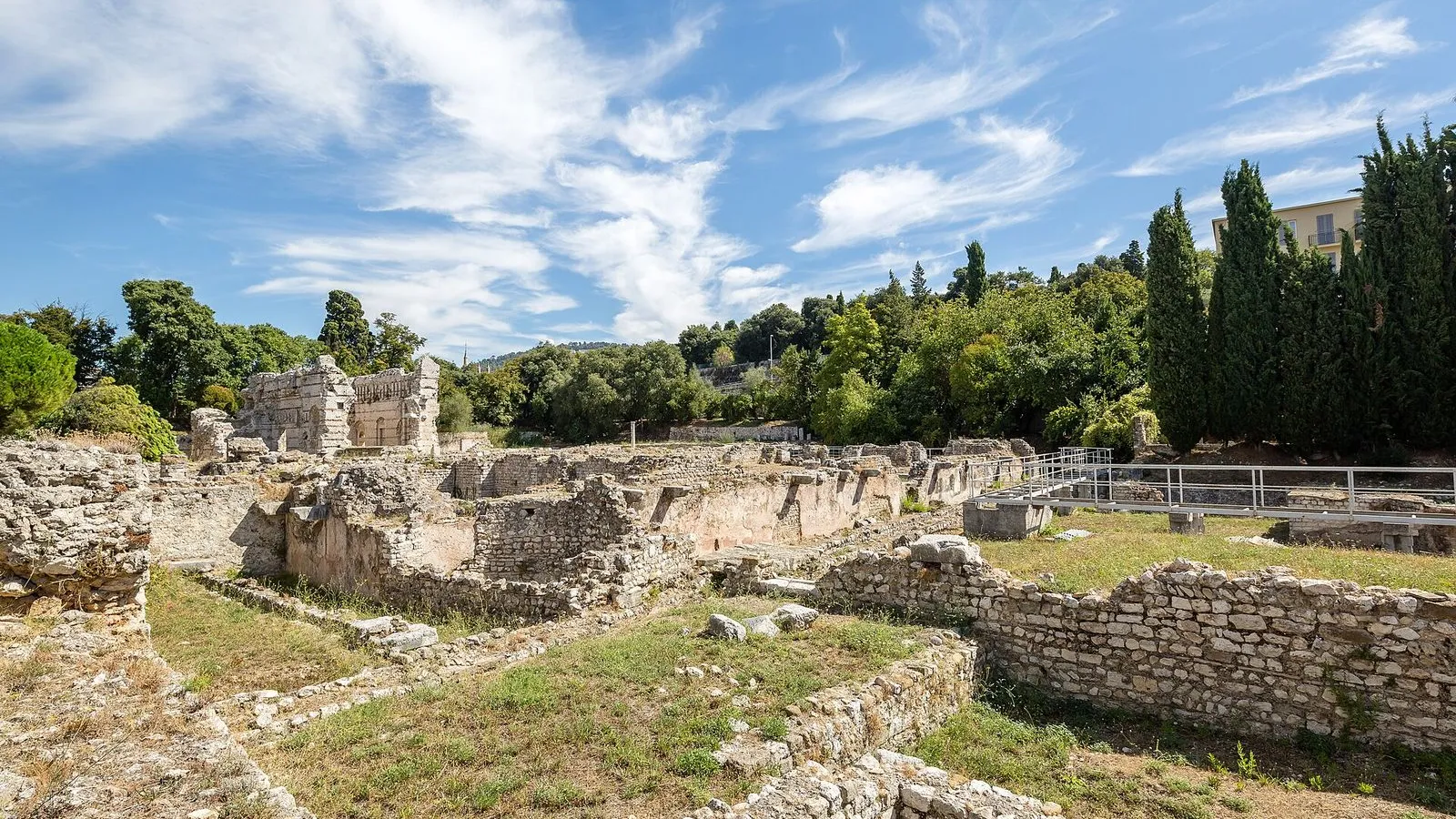
Thermes romains de CimiezMust see

Photo by User:EdouardHue on Wikimedia Commons

Thermes romains de Cimiez

0:00

Three Roman bath complexes, a paved street, and an early Christian cathedral lie exposed on the site of ancient Cemenelum, capital of the Alpes Maritimae.

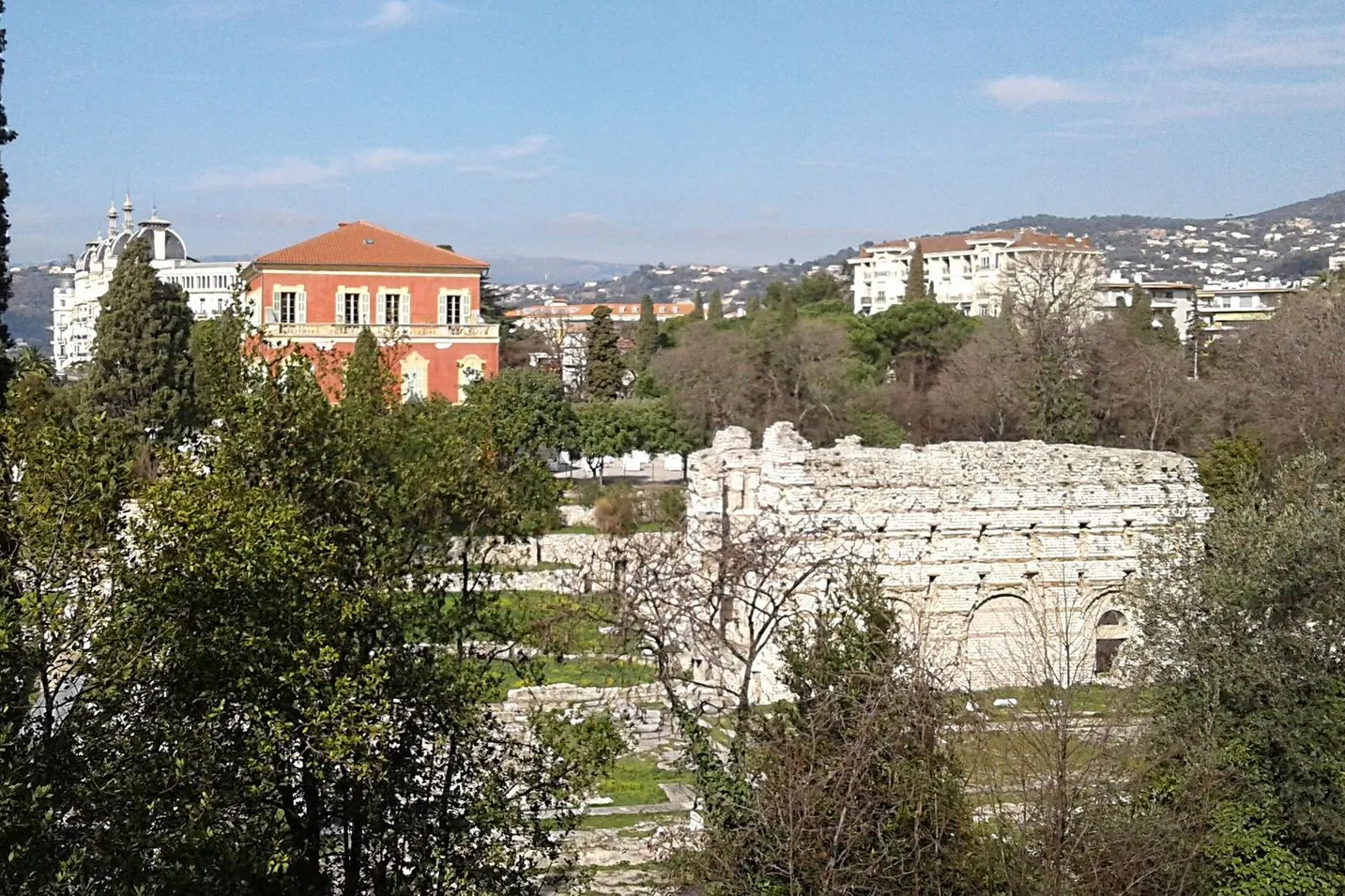
You have just stepped from the arena into the daily life of a Roman provincial capital. Cemenelum spread over at least 20 hectares, and this open-air site preserves its bath quarter. Three separate bathhouses served the city. The North baths are the largest: the frigidarium wall still rises ten meters above you, and for centuries locals called it the Temple of Apollo, because no one remembered it was a cold room.

The standard Roman bathing routine ran through the frigidarium, the warm tepidarium, the dry laconicum, and the hot caldaria. Look at the East baths for the hypocaust, the underfloor heating system of terracotta pillars that carried hot air from a central furnace. Two aqueducts, one from Falicon and one from Mouraille, fed the baths. Walk the decumanus, the paved east-west Roman street.

At the West baths, something remarkable happened: in the fifth century, the frigidarium became the choir of an early Christian cathedral, and a hexagonal baptismal pool was built over the old furnace. The city of Cemenelum was reinventing itself.

≈1 min walk to the next stop
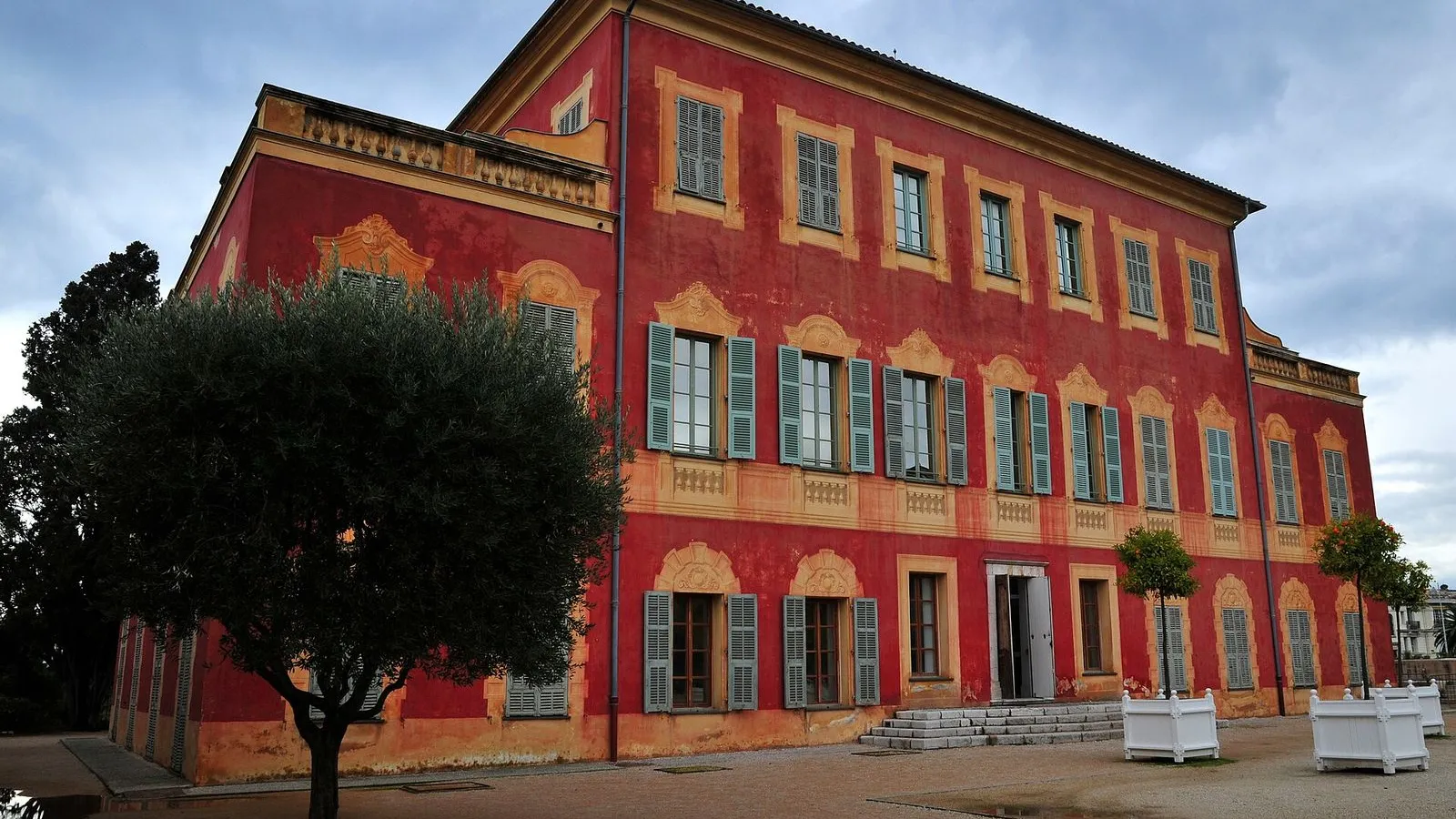
Musée MatisseMust see

Photo by takato marui on Wikimedia Commons

Musée Matisse

0:00

Matisse's personal collection fills a 17th-century Genoese villa set among centuries-old olive trees, steps from the Roman arena.

The villa facing you was built in 1695 by the Gubernatis family, who served as consuls of Nice. Its pink ochre façade and trompe-l'œil decoration are pure Genoese style. For two centuries it was a country house surrounded by olive groves and Roman ruins. The city bought it in 1950 and renamed it the Villa des Arènes.

When Henri Matisse died in 1954, his heirs donated a large body of his work to Nice, and the museum opened here in 1963. Matisse had lived just up the road at the Hôtel Regina since 1938, working in a combined apartment on the third floor. The collection traces his entire career: from the early Fauve canvases to the late cut-outs, when scissors had become his primary tool. The museum holds the largest Matisse collection in France.

Before you go inside, walk around the forecourt. The black stabile-mobile by Alexander Calder is a deliberate counterpoint to the villa's classical lines. The olive grove around you is more than a century old. Matisse looked out on these same trees from his apartment window.

≈4 min walk to the next stop
Free preview ends here · stops 4 to 7 continue in the app

Monastère de Cimiez

A 16th-century Franciscan monastery with a 15th-century church holding three Bréa masterpieces and a garden where mesclun salad was born.

in app

Cimetière de Cimiez

The quiet hillside cemetery where Henri Matisse and Raoul Dufy rest under cypress trees, beside the monastery they both knew.

in app

Musée national Marc Chagall

The largest public collection of Chagall's works, built around his Biblical Message cycle, in a low, light-filled building surrounded by calm gardens.

in app

Hôtel Regina

The Belle Époque palace where Queen Victoria wintered, later converted to apartments where Henri Matisse made his final home and studio.

in app
Good to know

Before you go

How do I get to Cimiez from central Nice?

Take bus 5, 17, or 33 from the city center to the Arènes / Musée Matisse stop. The ride takes about 15 minutes. You can also walk uphill from the train station in about 30 minutes, or take a short taxi. The walk back down is pleasant and takes you through quieter residential streets with views of the Baie des Anges.

Are the Matisse and Chagall museums open on the same days?

Both museums are closed on Tuesdays and on January 1, May 1, and December 25. The Musée Matisse (municipal) is open 10:00 to 18:00 in summer and 10:00 to 17:00 in winter. The Musée National Marc Chagall (national) is open 10:00 to 18:00 from May to October with a midday closure from 13:00 to 14:30, and 10:00 to 17:00 from November to April, also with a midday closure. Check both websites before you go, as the national museum sometimes closes additional rooms between exhibitions.

SourceMusée Matisse: Practical InformationMusée National Marc Chagall: Practical Information

Provenance · last verified August 18, 2026

Built from the Wayside route itself: the stops, their order, and the walk between them.

Photo by Broenberr on Wikimedia Commons · CC BY-SA 4.0

Photo by François de Dijon on Wikimedia Commons · CC BY-SA 4.0

Photo by User:EdouardHue on Wikimedia Commons · CC BY-SA 3.0

Photo by takato marui on Wikimedia Commons · CC BY-SA 2.0

Photo by Patrice Semeria on Wikimedia Commons · Public domain

Photo by Steffen Rehfuß on Unsplash

Photo by cricketsblog on Openverse · CC BY 2.0

Photo by Leicester Holyday on Wikimedia Commons · CC BY 3.0

Coming soon

Wayside isn't in the app stores yet, but it's in the works. Check back soon.