Reims · Self-guided audio walk

The Crowning City

Roman gate, coronation cathedral, and the Art Deco streets rebuilt after the Great War: one compact walk through the three Reims that made France's crowning city.

  • 12Stops
  • 2.8 kmDistance
  • 50+ minTime
The Crowning City

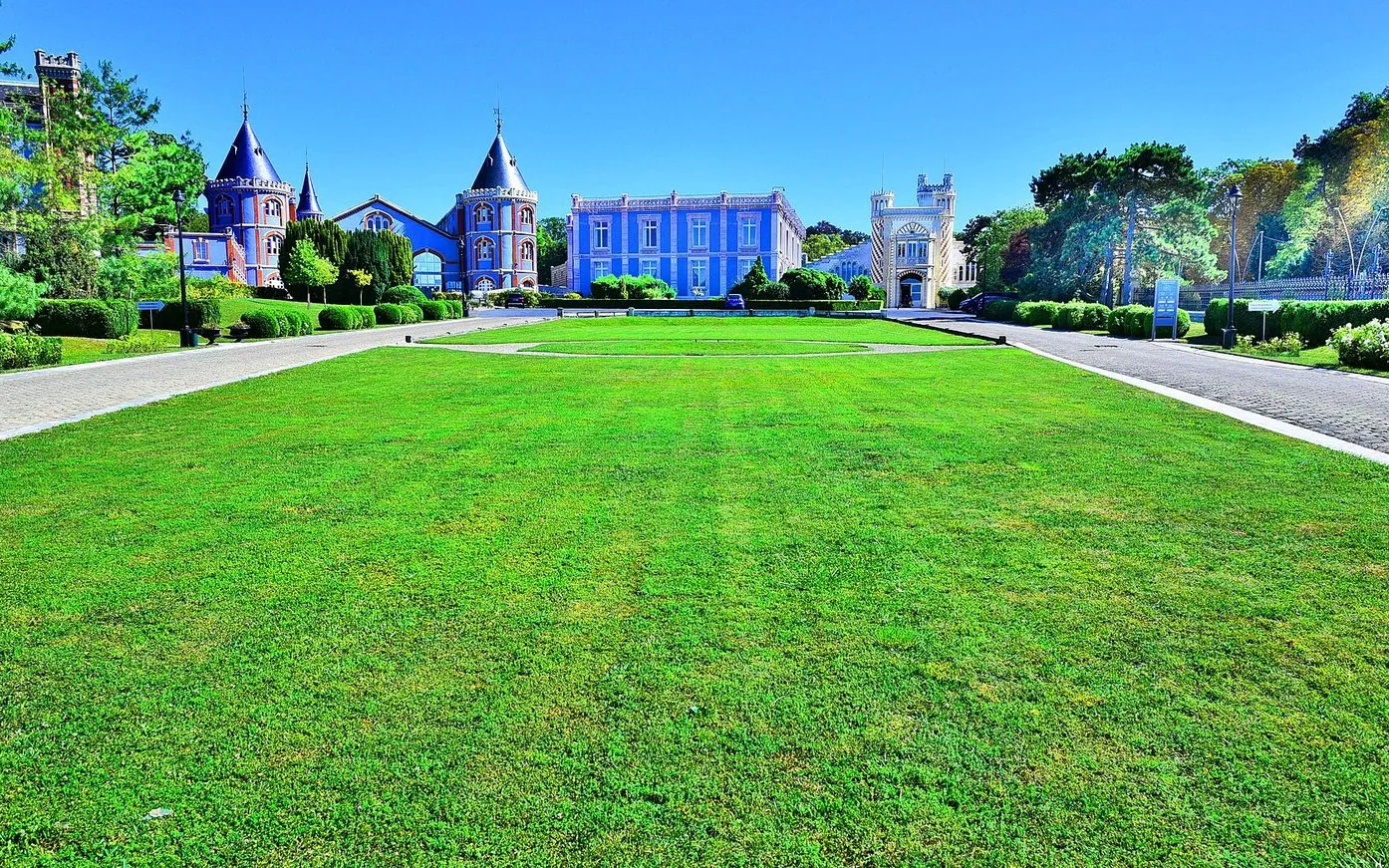
Photo by Philippe Alès on Wikimedia Commons

Reims packs three cities into a few hundred metres, and this walk lets you see all three in one go. It begins at the Porte de Mars, the third-century Roman gate that still stands where the city of Durocortorum met the road north. From there the route slips through the rebuilt market hall and town hall into the Art Deco centre that rose from the ruins after the First World War.

Along the way you pass a covered shopping passage, a century-old tearoom, and a church remade with modern glass, before the walk turns toward its reason for being: the cathedral where thirty-three French kings were crowned. It ends beside that cathedral, at the Carnegie library that American money built for a city starting over.

Allow about an hour, or more if you linger over a pastry or a glass of champagne.

Hear it on the street

Get the turn-by-turn audio guide in the app. The narration plays itself as you reach each stop, hands-free and offline.

Stop by stop

The route

Interactive map of the route. The full stop list below works without it.

Porte de MarsMust see

Photo by Carole Raddato from FRANKFURT, Germany on Wikimedia Commons

Porte de Mars

0:00

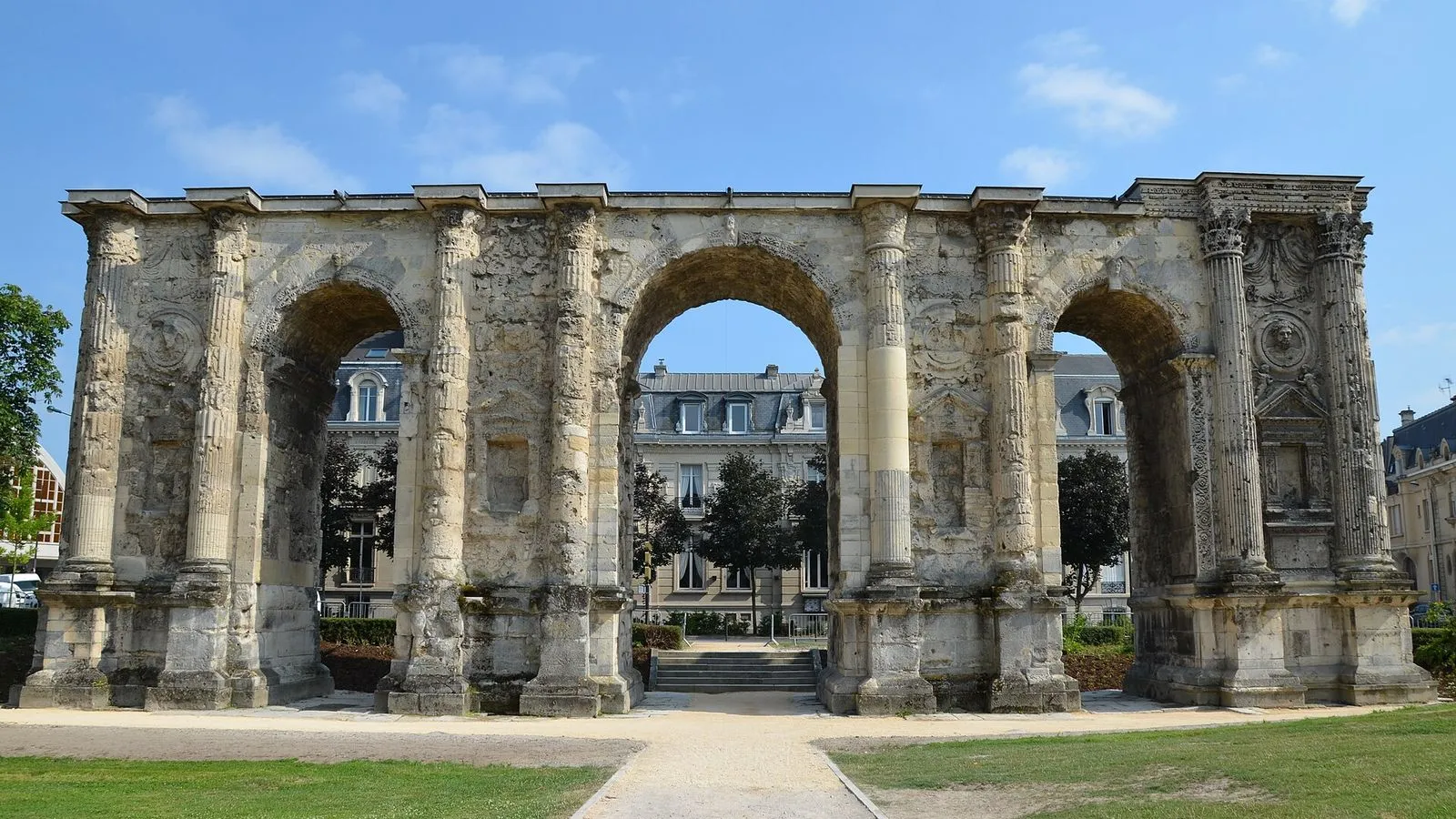
Reims's Roman gate, three arches wide and free to wander.

You're standing before the oldest monument still standing in Reims, and it predates the city's fame by more than a thousand years. The Porte de Mars is a Roman gate from the first quarter of the third century, three arches wide and thirty-three metres long, built when Reims was Durocortorum, a provincial capital of Roman Gaul. It was one of four monumental arches that marked the city's entrances. The other three are gone; this one survived because later builders kept using it. In the late fourth century it was folded into the city ramparts, and in the Middle Ages it was walled into the archbishops' château.

Walk beneath the vaults and look up. The undersides of the vaults carry a Roman harvest calendar, and under one of the side arches sits the she-wolf suckling Romulus and Remus, the myth that tied this northern city to Rome. The wheel ruts worn into the stone come from centuries of carts. The gate stood sealed for a long stretch of its life; it was only uncovered and restored in the mid nineteenth century, and its latest restoration finished in 2024. It is free, it is open ground, and it is where the crowning city begins.
≈3 min walk to the next stop
Halles du BoulingrinLocal pick

Photo by Fab5669 on Wikimedia Commons

Halles du Boulingrin

0:00

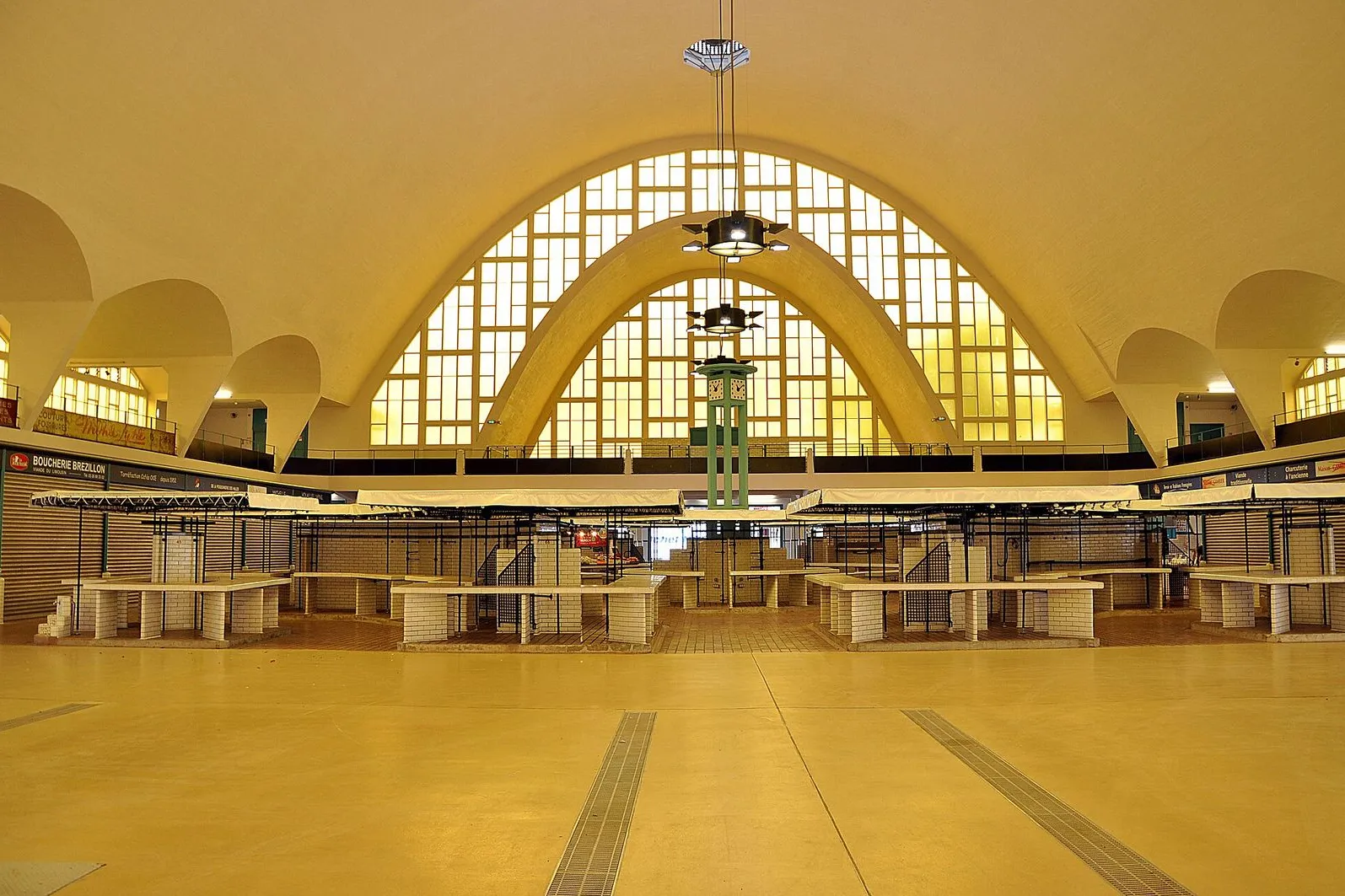
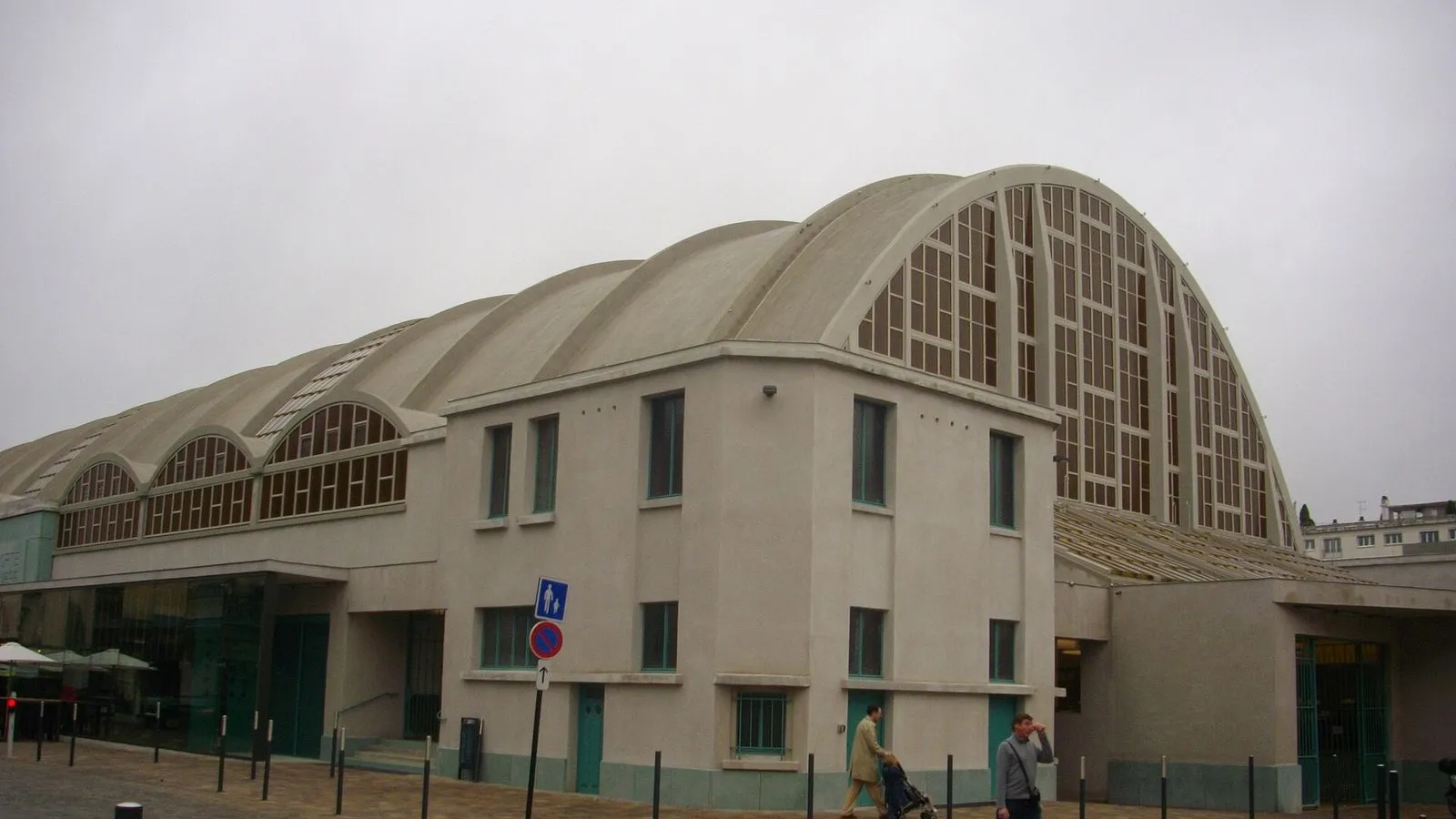
A 1920s market hall roofed by a seven-centimetre concrete shell.

This long hall is a 1920s experiment in making concrete behave like an eggshell. The Halles du Boulingrin were built between 1927 and 1929 by the architect Émile Maigrot and the engineer Eugène Freyssinet. The roof you are looking at is a single parabolic vault that spans more than thirty-eight metres and rises nearly twenty metres above the stalls, yet its reinforced-concrete shell is only seven centimetres thick. Freyssinet was already famous for the concrete airship hangars at Orly, and he brought the same thin-shell thinking here.

The hall replaced an older market on the Place du Forum that the war destroyed, and it was one of the first pieces of the rebuilt city. Notice the four side doors, each named after a nearby river: the Suippe, the Marne, the Vesle, and the Aisne. The building was classified in 1990 and restored between 2010 and 2012, after decades when the thin roof had begun to shed flakes of concrete. Come back on a Friday or Saturday morning and the aisles fill with market traders. On other days the building still does what great architecture should: it shows you the bones of the city it belongs to.

≈4 min walk to the next stop
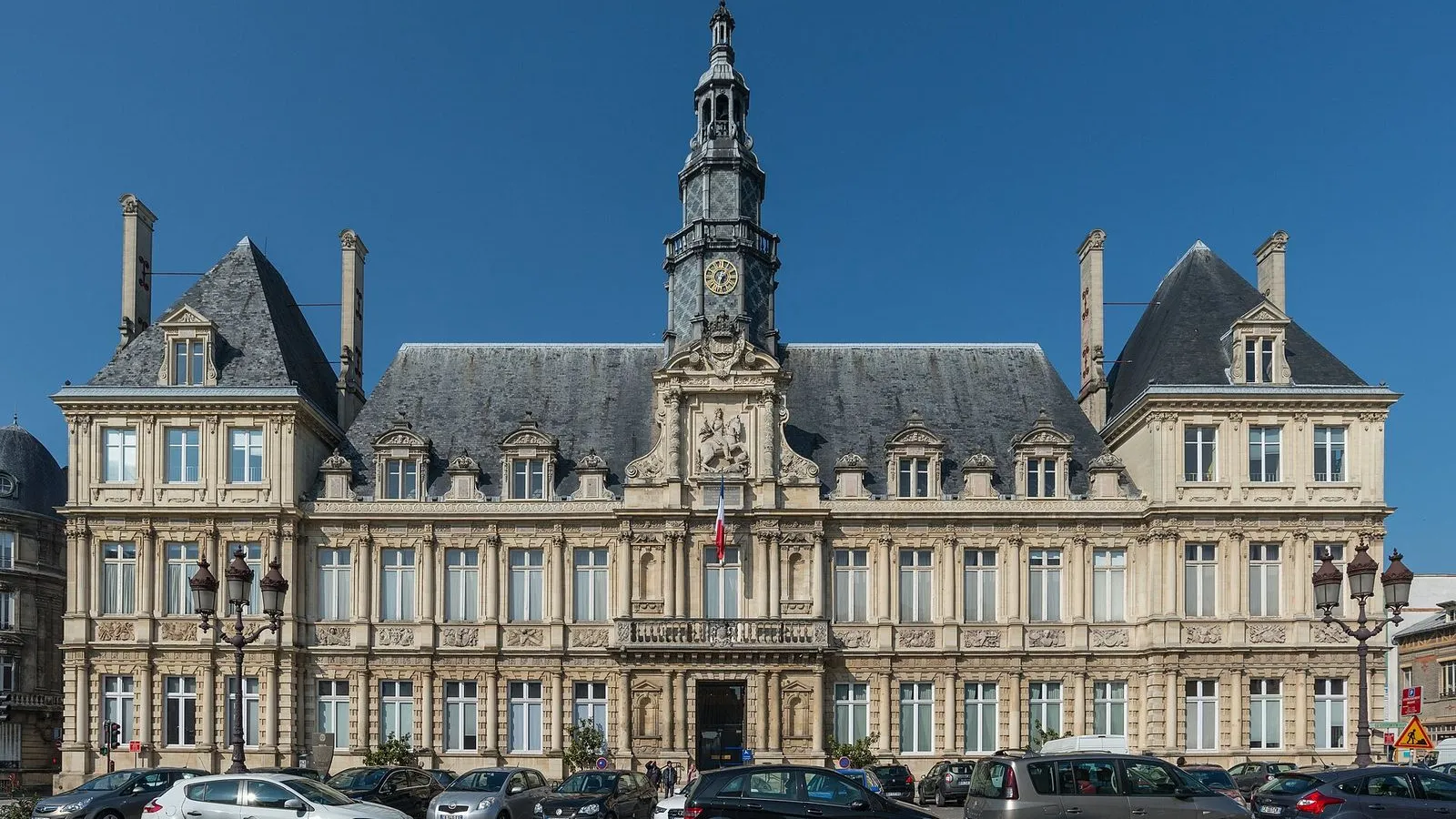
Hôtel de VilleLocal pick

Photo by DXR on Wikimedia Commons

Hôtel de Ville

0:00

The town hall that burned in 1917 and rose again.

This square building began long before the war, but almost everything you see is the work of the 1920s. The first stone of the Hôtel de Ville was laid in 1627, to a design by the architect Jean Bonhomme, and the facade was finished in 1636. For nearly three centuries the building served as the city's offices, its archive, and, from the early nineteenth century, its library.

On 3 March 1917 a shell set it on fire, and only the facade was left standing. Reconstruction began in 1924 under the architect Bernard Humbold, with Roger-Henri Expert and Paul Bouchette, and the sculpture is by Paul Berton. It was inaugurated on 10 June 1928, and the date matters for this whole walk: on the same day, the city also opened its new Carnegie library, the last stop of the tour. Look up at the campanile and its quarter-hour clock, and at the statue above the entrance. The town hall has been a listed historic monument since 1862. Today it is still working civic space, not a museum.

≈8 min walk to the next stop
Free preview ends here · stops 4 to 12 continue in the app

Place Drouet d'Erlon

France's longest square, rebuilt in Art Deco after the war.

in app

Passage Subé

A glass-roofed shopping passage from the 1920s.

in app

Waïda

A family tearoom from 1923 in original Art Deco.

in app

Église Saint-Jacques

A medieval church whose light comes from modern masters.

in app

Opéra de Reims

A 19th-century opera hiding a lavish Art Deco interior.

in app

Café du Palais

A family café from 1930 under a 1928 glass sky.

in app

Place du Forum

A Roman gallery beneath the square, a Renaissance mansion above.

in app

Cathédrale Notre-Dame

The cathedral where thirty-three French kings were crowned.

in app

Bibliothèque Carnegie

The Art Deco library built with American generosity.

in app
Good to know

Before you go

Is the cathedral free to enter?

The cathedral nave is free and opens at 8:00. There are no visits on Sunday mornings during services, and the tower climb costs 9 euros.

SourceTours de la cathédrale de Reims
How long does the Crowning City walk take?

The route itself takes about an hour at a steady pace. With coffee at Waïda, a look inside Saint-Jacques, and lunch at Café du Palais, allow half a day.

Is the Palais du Tau open?

The Palais du Tau is closed for renovation and reopens in 2027. Its bookshop and the cathedral tower visits stay open.

SourcePalais du Tau
Where can I stop to eat on the route?

Waïda is a 1923 tearoom for coffee and pastry, and Café du Palais, a family café from 1930, sits under a 1928 glass ceiling near the cathedral.

Provenance · last verified August 28, 2026

Built from the Wayside route itself: the stops, their order, and the walk between them.

Photo by Philippe Alès on Wikimedia Commons · CC BY-SA 4.0

Photo by Carole Raddato from FRANKFURT, Germany on Wikimedia Commons · CC BY-SA 2.0

Photo by Fab5669 on Wikimedia Commons · CC BY-SA 3.0

Photo by DXR on Wikimedia Commons · CC BY-SA 3.0

Photo by Edison McCullen on Wikimedia Commons · CC BY-SA 4.0

Coming soon

Wayside isn't in the app stores yet, but it's in the works. Check back soon.