Seattle · Self-guided audio walk

Pioneer Square Underground and Above

A 95-minute loop through Seattle's first downtown, from a gilded pergola to the basement where a delivery giant began.

  • 5Stops
  • 0.7 kmDistance
  • 15+ minTime
Pioneer Square Underground and Above

Photo by Jrozwado on Wikimedia Commons

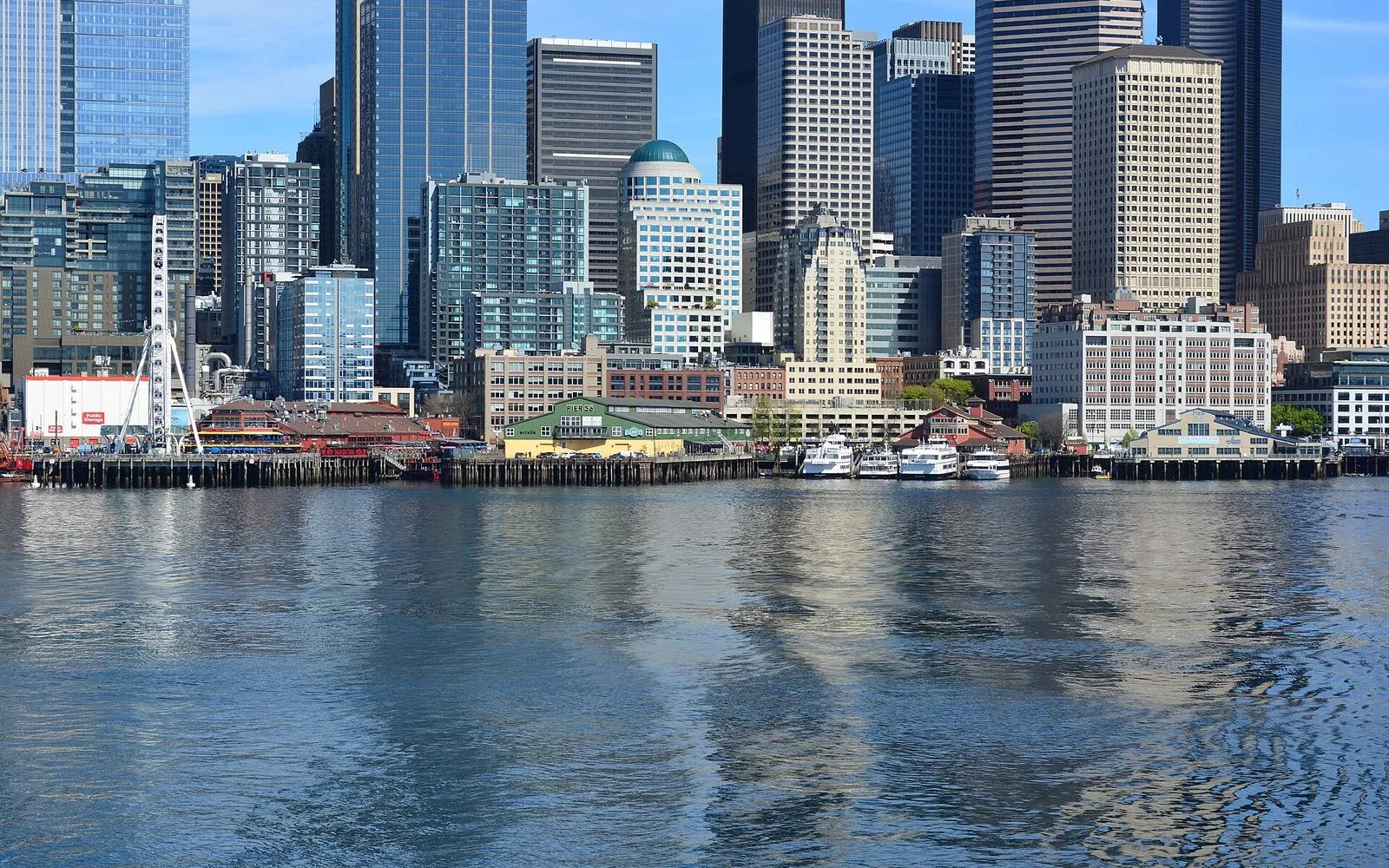
Seattle started here, on a grid of Romanesque brick that rose from the Great Fire of 1889. This 95-minute loop stays within a few blocks of Pioneer Square and follows the city's origin story both above and below the sidewalk. You'll stand under the 1909 pergola with its buried marble restroom, look up at the white 1914 Smith Tower, and duck into Waterfall Garden Park on the corner where UPS began with a hundred-dollar loan. Then wander the gallery-lined brick mall of Occidental Square before finishing at the Klondike Gold Rush museum, where two free floors explain why Seattle was the last big supply stop before the Yukon. Five stops, a little over an hour and a half, with time to sit by a waterfall and poke into a gallery or two.

Hear it on the street

Get the turn-by-turn audio guide in the app. The narration plays itself as you reach each stop, hands-free and offline.

Stop by stop

The route

Interactive map of the route. The full stop list below works without it.

Pioneer Square PergolaMust see

Photo by Joe Mabel on Wikimedia Commons

Pioneer Square Pergola

0:00

A 1909 cast iron and glass canopy over a long-closed marble restroom, at the corner where Seattle rebuilt after the Great Fire.

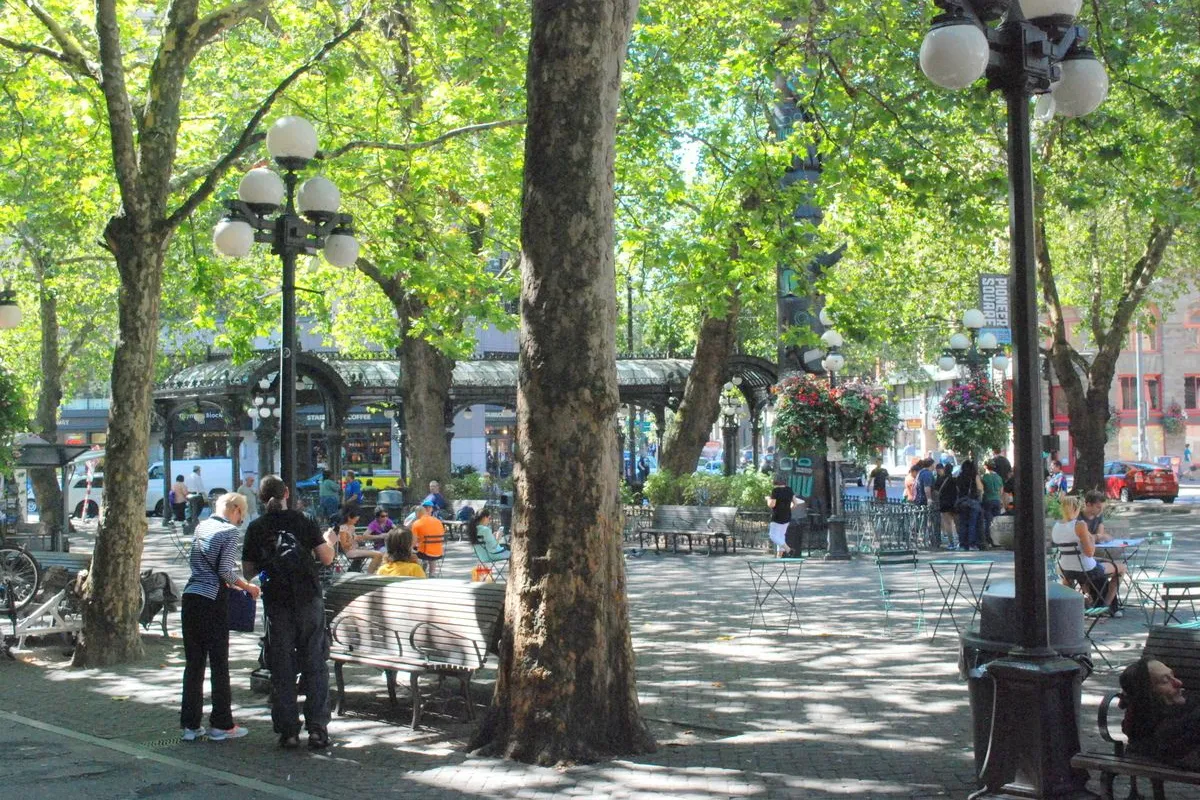
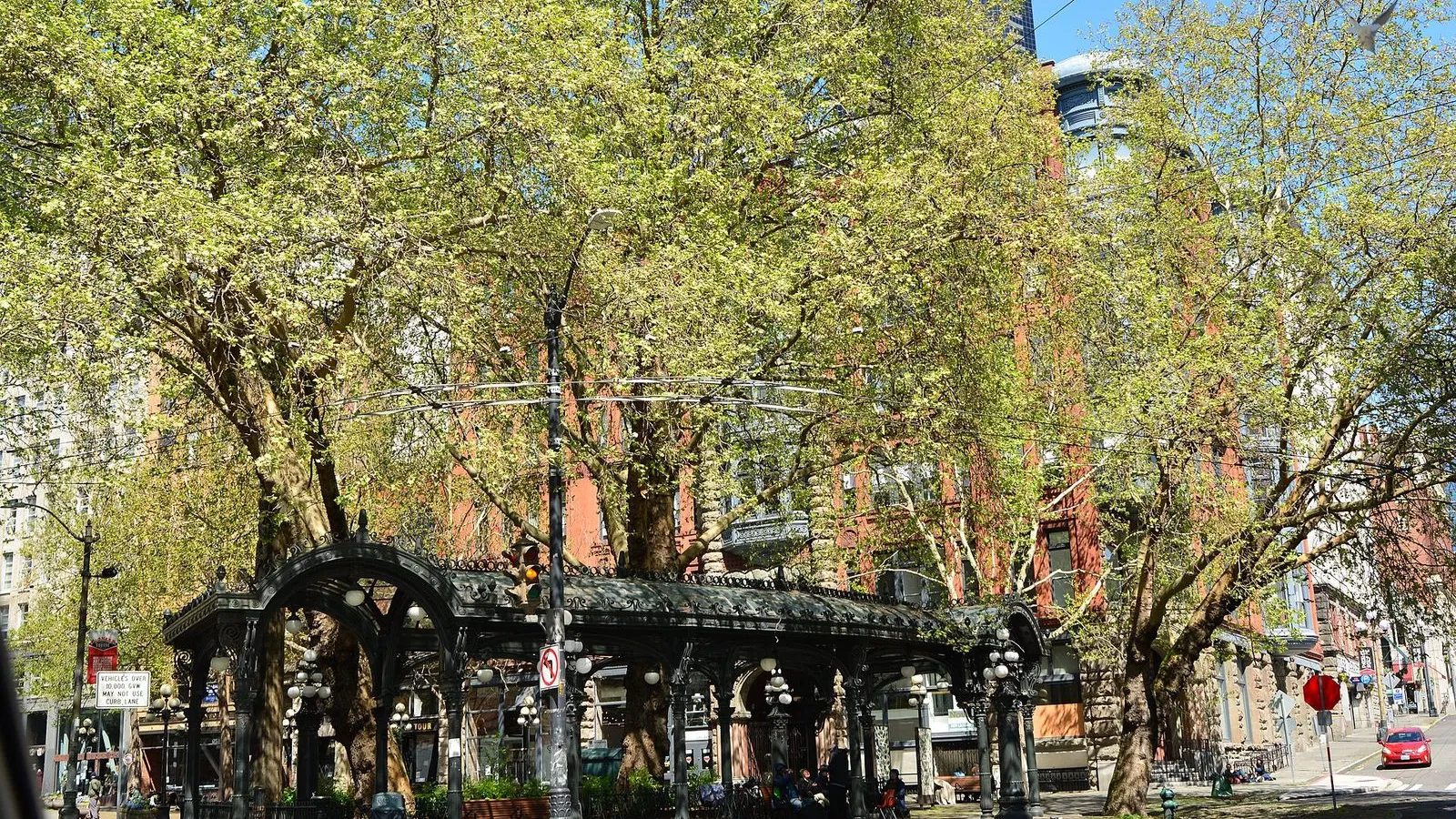
You're standing under a cast iron and glass canopy at First Avenue and Yesler Way, the exact corner where Seattle rebuilt itself after the Great Fire of eighteen eighty-nine. The pergola went up in nineteen oh nine, designed by local architect Julian Everett. It had a practical job: cable car passengers waited here out of the rain. Under your feet there was another job, a stairway down to an underground comfort station with terrazzo floors, brass and nickel fixtures, and stalls lined in white Alaska marble.

Sixteen stalls for men, nine for women. Newspapers called it the most lavish public restroom west of the Mississippi. The bathroom closed in nineteen forty-eight, but the pergola survived rust, earthquakes, and, in two thousand one, a semi truck that clipped it on a turn. It was rebuilt from scratch for three point four million dollars.

Restoration money in nineteen seventy-two had come from James Casey, the UPS founder whose story you'll meet in a few minutes. Before you leave, notice how the sidewalks here sit above the old street level. That rise is the whole reason Seattle has an underground.

≈3 min walk to the next stop
Smith TowerMust see

Photo by Bruce W on Unsplash

Smith Tower

0:00

A 462-foot, 1914 terra cotta tower that was the tallest building west of the Mississippi for 17 years.

This white tower rose in nineteen fourteen, and for a while it was the tallest building west of the Mississippi. It is four hundred sixty-two feet and thirty-eight stories, granite at the base and glazed white terra cotta above. The name comes from Lyman Cornelius Smith, who made his money in typewriters and guns. He died in nineteen ten, a month after the first permit, so his son Burns finished the project with the Syracuse architects Gaggin and Gaggin.

It sits on one thousand two hundred seventy-six concrete piles and holds about two thousand windows. Seattle had never built anything close, and on July fourth, nineteen fourteen, more than four thousand people rode the elevators to the thirty-fifth floor observation deck. The room up there is lined with carved teak and blackwood furniture long said to be a gift from China's empress dowager, a story the tower itself keeps alive. There's a legend about the Wishing Chair: an unmarried person who sits in it is supposed to be married within a year.

The terra cotta exterior has been washed exactly once, in nineteen seventy-six. Smith Tower stayed the tallest building on the West Coast until the Space Needle passed it in nineteen sixty-two.

≈3 min walk to the next stop
Waterfall Garden ParkMust see

Photo by Joe Mabel on Wikimedia Commons

Waterfall Garden Park

0:00

A tiny waterfall park on the corner where UPS began as a two-boy messenger service in 1907.

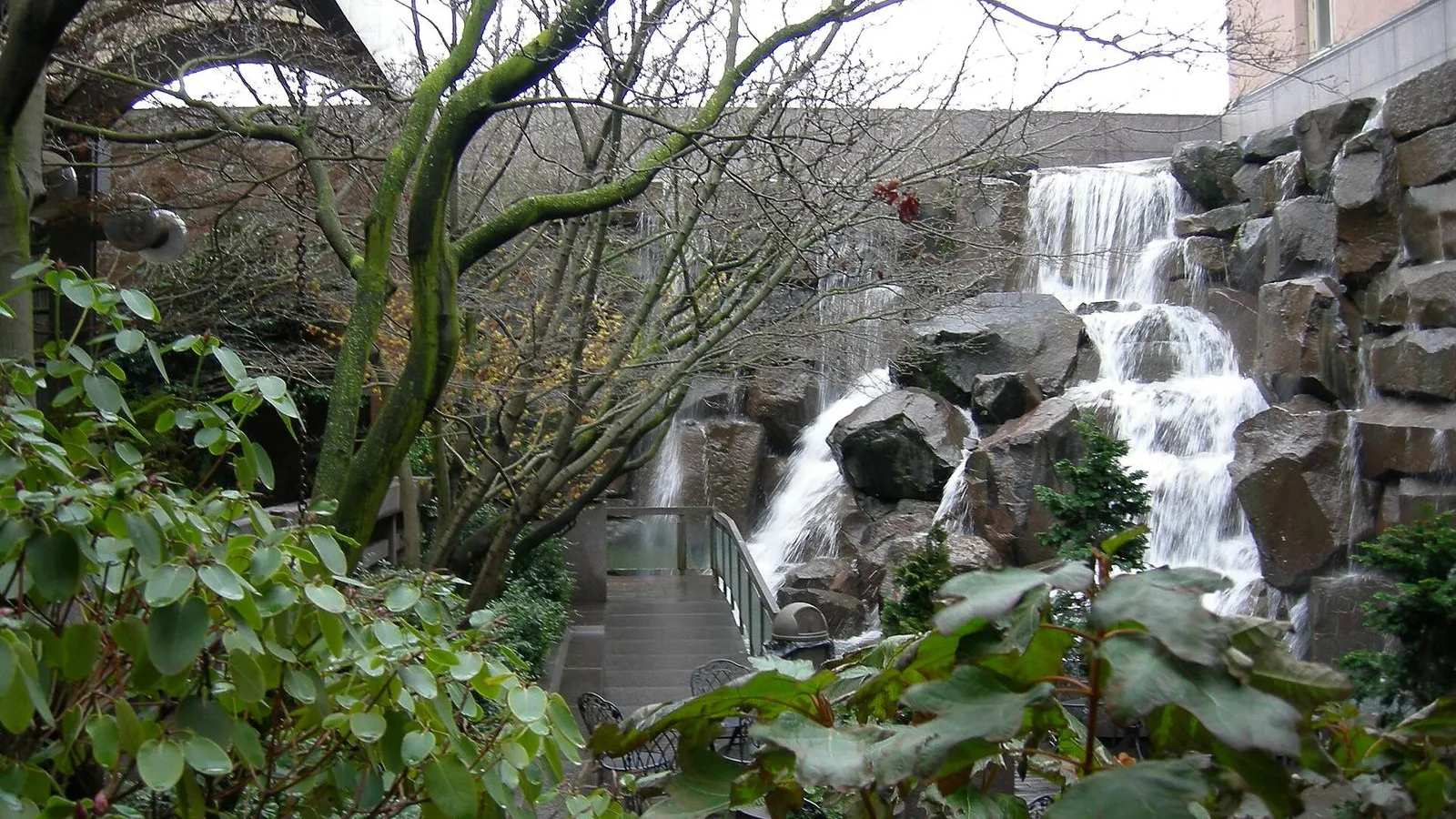
Step through the gate at Second and Main and the city drops away. This is Waterfall Garden Park, sixty by eighty feet of ferns and stone built around a twenty-two-foot waterfall that pushes five thousand gallons of water a minute. The roar is the point. It hides the traffic and gives you a place to think about what started here.

In nineteen oh seven, two teenagers named Jim Casey and Claude Ryan borrowed a hundred dollars and opened the American Messenger Company in the basement of a saloon on this corner. They ran messages on foot, on bicycles, and on streetcars at a time when few people had phones. The business grew, moved to California, and in nineteen nineteen became United Parcel Service. Casey later paid for this park through his foundation, and it opened in nineteen seventy-eight with a design by Masao Kinoshita.

It is open in the daytime and locked at night. Sit on a bench near the water for a minute. That corner doorway is where one of the world's biggest delivery companies was a two-boy operation.

≈1 min walk to the next stop
Free preview ends here · stops 4 to 5 continue in the app

Occidental Square

A gallery-lined brick mall with tables and bocce courts, built on the site of the old Carrollton Hotel.

in app

Klondike Gold Rush National Historical Park Museum

A free two-floor museum in an 1890 brick hotel, telling why Seattle outfitted the stampeders heading to the Yukon.

in app
Good to know

Before you go

What is the pergola in Pioneer Square?

It is a 1909 cast iron and glass canopy at First Avenue and Yesler Way, built over an underground marble restroom that has been closed for decades. It marks the corner where Seattle rebuilt after the Great Fire of 1889.

Is the Klondike Gold Rush museum free?

Yes, the Klondike Gold Rush National Historical Park museum is free, with two floors inside an 1890 brick hotel explaining why Seattle outfitted the stampeders heading to the Yukon.

Is the Smith Tower observation deck worth it?

The 1914 Smith Tower was the tallest building west of the Mississippi for 17 years, and its observatory gives a close look over the old downtown. Go on a clear day.

Provenance · last verified August 19, 2026

Built from the Wayside route itself: the stops, their order, and the walk between them.

Photo by Jrozwado on Wikimedia Commons · CC BY-SA 4.0

Photo by Joe Mabel on Wikimedia Commons · CC BY-SA 4.0

Photo by Bruce W on Unsplash

Photo by Joe Mabel on Wikimedia Commons · CC BY-SA 3.0

Photo by Ntowle98 on Wikimedia Commons · CC BY-SA 4.0

Photo by Kingofthedead on Wikimedia Commons · CC BY-SA 4.0

Photo by Joe Mabel on Wikimedia Commons · CC BY-SA 3.0

Photo by Joe Mabel on Wikimedia Commons · CC BY-SA 3.0

Photo by Lalit Gupta on Unsplash

Photo by Joe Mabel on Wikimedia Commons · CC BY-SA 4.0

Coming soon

Wayside isn't in the app stores yet, but it's in the works. Check back soon.