Orlando · Self-guided audio walk

Winter Park: Two Sides of the Tracks

A New England village in the Florida sun: Tiffany glass, a lakeside college, and the Black neighborhood the town was also built on.

  • 6Stops
  • 4.3 kmDistance
  • 65+ minTime
Winter Park: Two Sides of the Tracks

Photo by Ebyabe on Wikimedia Commons

Winter Park was drawn on paper in 1881 by two men from Massachusetts who wanted a winter colony for wealthy northerners. They laid out a central park, a main street called Park Avenue, and a railroad depot to deliver guests right to the green. This walk follows that plan from the gracious storefronts of Park Avenue into the Morse Museum, home to the world's largest Tiffany glass collection, then south to Rollins College with its Ralph Adams Cram chapel and its bronze Fred Rogers. It crosses the tracks to Hannibal Square, the historically Black west side platted in the same 1881 survey, where photographs and oral histories at the Heritage Center tell the other half of the town's story. About two miles of level walking, roughly two hours with stops.

Hear it on the street

Get the turn-by-turn audio guide in the app. The narration plays itself as you reach each stop, hands-free and offline.

Stop by stop

The route

Interactive map of the route. The full stop list below works without it.

Park Avenue at Central ParkMust see

Photo by Leslie Gray Photography on Unsplash

Park Avenue at Central Park

0:00

The gracious main street of a town platted in 1881 by two New Englanders who dreamed of a winter colony in the Florida sun.

You are standing at the civic heart of Winter Park, a town that two men from Massachusetts drew on paper in 1881 before a single brick was laid. Loring Chase and Oliver Chapman bought six hundred acres of scrub and lakefront for thirteen thousand dollars, then hired a civil engineer to plat a proper New England village around a central green. That green is the park on your left. The street under your feet is Park Avenue.

The founders wanted a place where wealthy northern families could spend the winter, and they marketed it that way: a town named for the season and its central park, served by a railroad that deposited guests steps from the hotels. The New York Times called it 'a bright New England town in Central Florida' in 1896. Look down Park Avenue. The commercial buildings facing the park date from several eras, a few from the 1880s, many from the 1920s land boom, some from the mid-century.

The whole stretch was added to the National Register of Historic Places in 2011. Charles Hosmer Morse, the Chicago industrialist who wintered here, deeded the park itself to the city in 1906 with one condition: it must remain open and undeveloped forever. When you are ready, turn north on Park Avenue and walk toward the museum that bears Morse's name. It is three blocks ahead on your right.
≈8 min walk to the next stop
Charles Hosmer Morse Museum of American ArtMust see

Photo by Leonard J. DeFrancisci on Wikimedia Commons

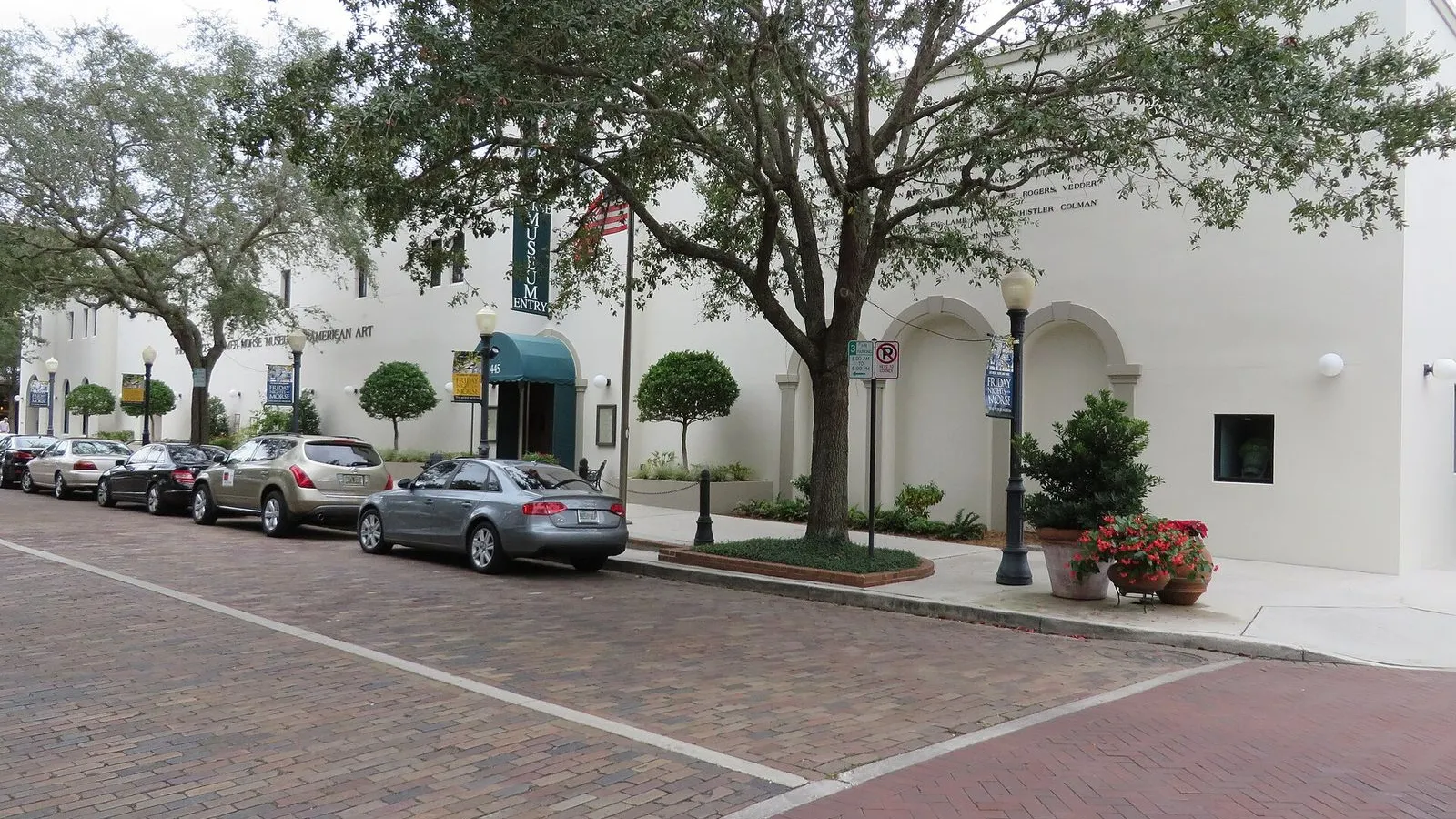
Charles Hosmer Morse Museum of American Art

0:00

Home to the world's most comprehensive collection of Louis Comfort Tiffany's work, rescued from his burned Long Island estate in 1957.

This museum holds more Tiffany glass than any place on earth, and the story of how it got here begins with a fire. In 1957, Louis Comfort Tiffany's Long Island mansion, Laurelton Hall, burned. His daughter called Hugh and Jeannette McKean. Hugh had studied at Laurelton Hall as a young artist.

Jeannette had just curated one of the first Tiffany exhibitions in decades at a small gallery she ran on the Rollins College campus, a gallery named for her grandfather, Charles Hosmer Morse. The McKeans drove to Long Island, bought the unwanted windows and architectural fragments, and brought them to Winter Park. For years, much of it sat in crates while they tracked down chapel furnishings scattered after Tiffany's death. In 1999, the museum reassembled the chapel Tiffany built for the 1893 World's Columbian Exposition in Chicago.

It had not been seen complete since that fair closed. Inside are lamps, jewelry, mosaics, Favrile glass, paintings, and room after room of leaded windows. About a quarter of the collection is on view at any time. The museum does not crowd the walls with labels.

It wants you to walk through and simply look. The building opened on this site in 1995 with nineteen thousand square feet of gallery space, all of it built to house the obsession of two people who understood what Tiffany had made before the rest of the world caught up.

≈6 min walk to the next stop
Winter Park StationLocal pick

Photo by James Roberts (Jampp… on Wikimedia Commons

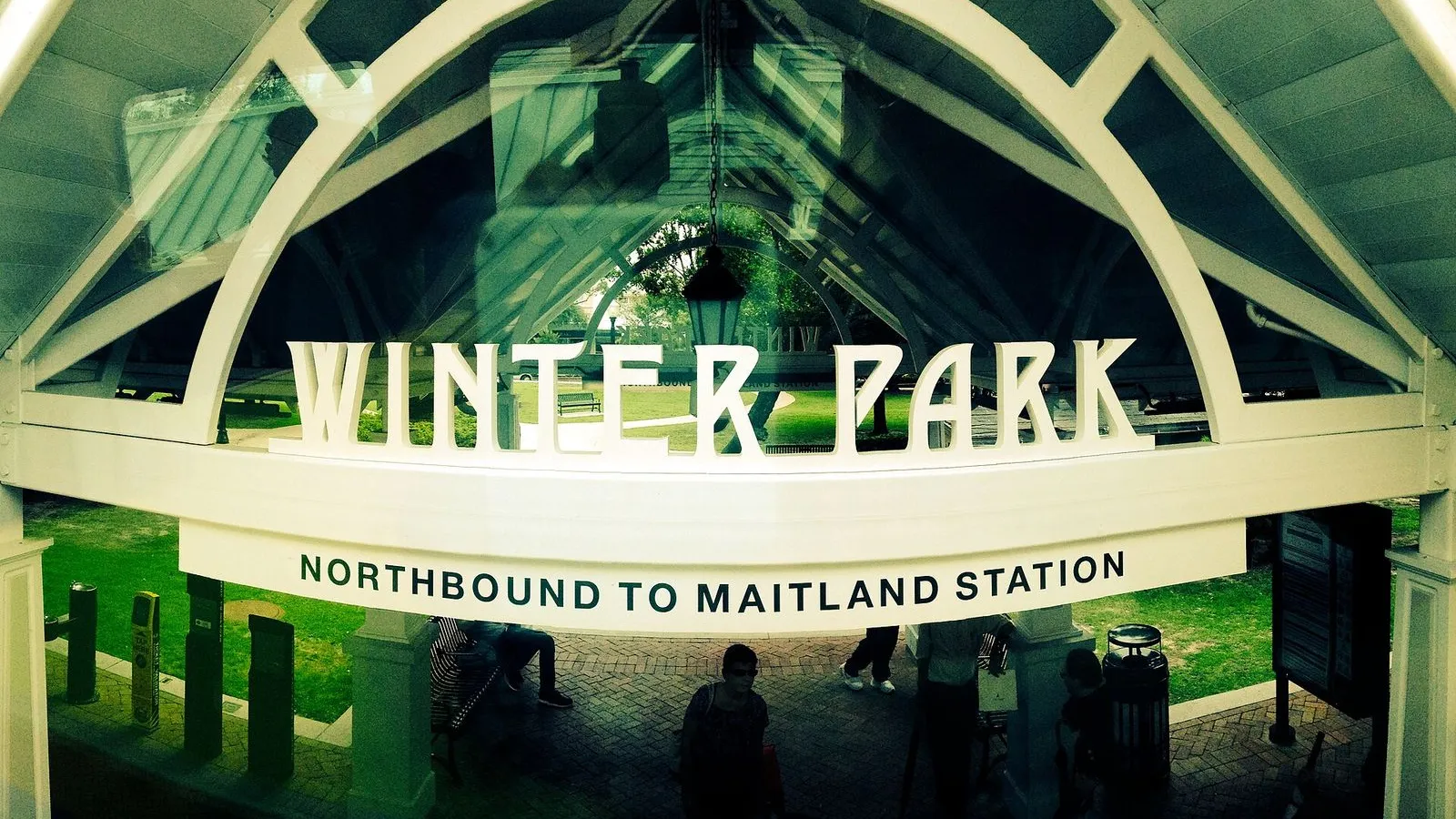
Winter Park Station

0:00

The depot that made the town possible, where wealthy northerners first stepped off the train into the Florida winter.

This depot is why Winter Park exists where it does. In 1880, the South Florida Railroad laid tracks between Sanford and Orlando, curving along the west side of what would become Central Park. Chase and Chapman platted their town around that curve. The first commercial building in Winter Park was a railroad passenger depot, finished early in 1882.

For decades the train was the only practical way to reach the town. The station you see now is a later building, but it still serves Amtrak and SunRail commuters. Step inside the waiting room if the doors are open and look at the photographs on the walls. They show a Winter Park where passengers in wool suits and long dresses stepped onto the platform and walked straight into Central Park, which the founders had designed as the town's front door.

A short line called the Dinky Line once ran from here six miles into Orlando. It cost fifteen cents, took half an hour, and its two steam engines were nicknamed the Teapot and the Coffee Pot. The train itself was called the Little Wiggle, a name that tells you about the ride. The tracks also mark a border.

The town founders drew them as a line between the white commercial center on Park Avenue and the Black neighborhood they platted on the west side. That neighborhood, Hannibal Square, is where you will finish this walk.

≈13 min walk to the next stop
Free preview ends here · stops 4 to 6 continue in the app

Rollins College

Florida's oldest college, a lakeside campus of Spanish Mediterranean buildings, a Cram chapel, and a bronze Fred Rogers.

in app

Hannibal Square Heritage Center

A museum of photographs and oral histories preserving the story of Winter Park's historically Black west side neighborhood.

in app

New England Avenue

The street named for the founders' roots, where the two halves of Winter Park meet across the railroad tracks.

in app
Good to know

Before you go

How do I get to Winter Park from downtown Orlando?

SunRail is the easiest way. Trains run Monday through Friday from Church Street Station to Winter Park Station in about 10 minutes; a one-way fare is roughly $2 to $3. The Winter Park station sits right on Park Avenue, a block from Central Park and the Morse Museum. By car or rideshare, Winter Park is a 20-minute drive north of downtown via I-4 or Orange Avenue. Parking on Park Avenue is free but can be tight on weekends.

SourceDay Travel 365: SunRail GuideShort Stay Guide: Winter Park
Is the Morse Museum worth visiting?

The Charles Hosmer Morse Museum holds the world's most comprehensive collection of Louis Comfort Tiffany's work, including the 1,082-piece Tiffany Chapel built for the 1893 World's Columbian Exposition in Chicago. The chapel was reassembled here in 2002 after decades in storage. The museum also displays reconstructed rooms from Tiffany's Long Island estate, Laurelton Hall, which was destroyed by fire in 1957. At $6 for adults and free for students, it is one of the best small museums in America and easily worth the trip from downtown.

SourceShort Stay Guide: Morse Museum

Provenance · last verified August 10, 2026

Built from the Wayside route itself: the stops, their order, and the walk between them.

Photo by Ebyabe on Wikimedia Commons · CC BY-SA 4.0

Photo by Leslie Gray Photography on Unsplash

Photo by Leonard J. DeFrancisci on Wikimedia Commons · CC BY-SA 3.0

Photo by James Roberts (Jampp… on Wikimedia Commons · CC BY-SA 3.0

Photo by Karen Kleis on Openverse · CC BY 2.0

Photo by pokemonprime on Openverse · CC BY-SA 2.0

Photo by JER3L1337 on Wikimedia Commons · CC BY 4.0

Coming soon

Wayside isn't in the app stores yet, but it's in the works. Check back soon.