Miami · Self-guided audio walk

South Beach Art Deco

Pastel facades, porthole windows, and neon that still glows at dusk. A walk through the largest concentration of Art Deco architecture anywhere on Earth.

  • 11Stops
  • 3.2 kmDistance
  • 50+ minTime

More than 800 protected buildings crowd a square mile and a half between 5th and 23rd Streets in South Beach, making this the largest Art Deco district anywhere. This walk traces Ocean Drive from the Art Deco Welcome Center down to the Colony, loops back through Lummus Park, and climbs past the Carlyle and Cardozo before ducking into the Mediterranean quiet of Española Way and ending on Collins Avenue. You will learn to spot the racing stripes, the eyebrow shelves, the stepped ziggurat rooflines, and the nautical porthole windows that give Miami Beach its unmistakable silhouette. The walk works best in the early morning, when the sun hits the east-facing facades and the sidewalk cafes are still quiet. Budget roughly two hours at a relaxed pace.

Hear it on the street

Get the turn-by-turn audio guide in the app. The narration plays itself as you reach each stop, hands-free and offline.

Stop by stop

The route

Interactive map of the route. The full stop list below works without it.

Art Deco Welcome CenterMust see

Photo by Don Ramey Logan on Wikimedia Commons

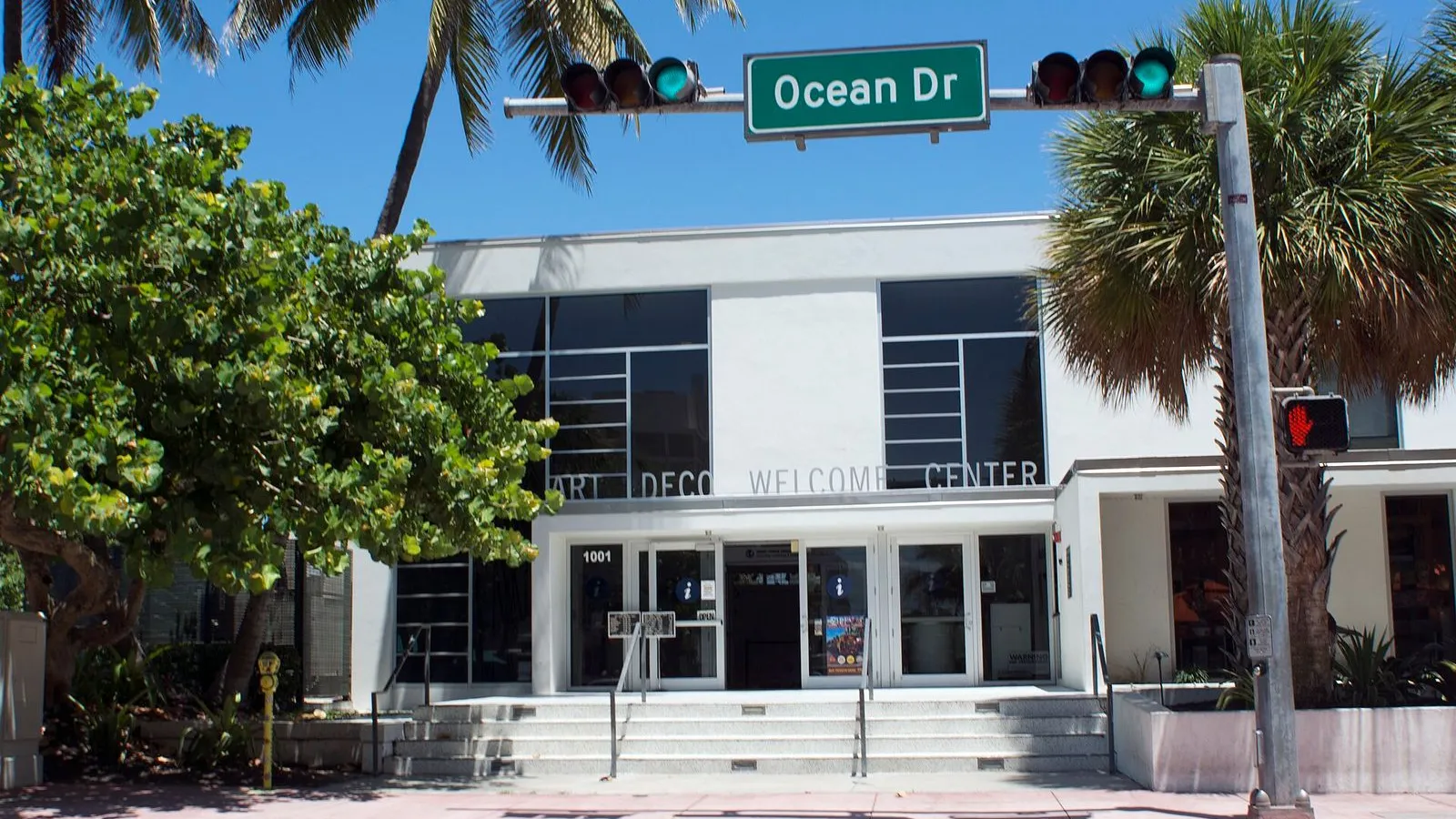
Art Deco Welcome Center

0:00

The old beach patrol station that became the nerve center of the preservation movement.

You are standing at 1001 Ocean Drive, inside a restored 1930s beach patrol station wrapped in the Streamline Moderne curves that define this district. This building is the headquarters of the Miami Design Preservation League, the group founded by Barbara Baer Capitman in 1976. Capitman and her allies fought to save these blocks when most people saw only faded, decaying hotels. In 1979, under her leadership, this district became the first urban twentieth-century historic district on the National Register.

The museum inside is worth ten minutes. You will see scale models of the district's signature buildings, exhibits on the three architectural styles that shaped Miami Beach, and oral histories from people who lived it. Pick up a map if you like. When you walk back out, face south.

The Breakwater's twin fins rise two blocks ahead.
≈1 min walk to the next stop
Breakwater HotelMust see

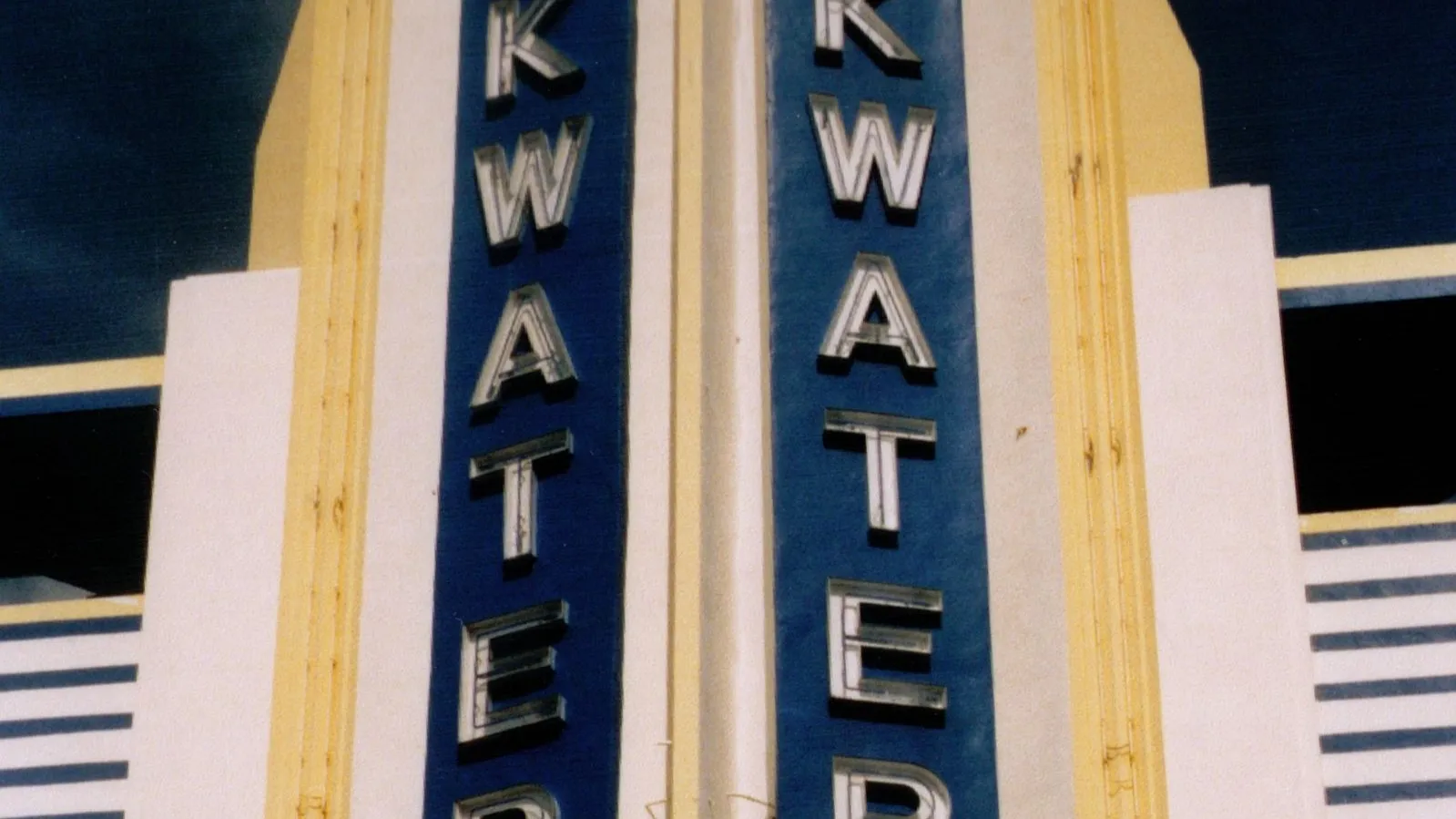
Photo by Ad Meskens on Wikimedia Commons

Breakwater Hotel

0:00

Twin fin pylons, a maritime name, and one of the most photographed silhouettes on Ocean Drive.

The Breakwater, completed in 1939 by architect Anton Skislewicz, solves a problem every Ocean Drive hotelier faced. The lots here are narrow, the buildings limited to three stories, and everyone was competing for attention on the same street. Skislewicz's answer was to go vertical. Those two blade-like fins shoot up from the roofline to roughly double the building's height, making the Breakwater visible from blocks away.

The name and the fins both nod to the ocean-liner aesthetic that dominated late-1930s design. Porthole windows punctuate the side elevations. At street level, the entrance canopy curves out over the sidewalk in a shallow arc, its underside carrying low-relief geometric decoration. The white and cobalt color scheme you see now dates from the 1980s restoration, after the building weathered decades of military use in World War Two, postwar decline, and near abandonment before preservationists stepped in.

Keep walking south. The Colony is two blocks down, at the corner of 7th Street.

≈5 min walk to the next stop
Colony HotelMust see

Photo by Luise and Nic on Unsplash

Colony Hotel

0:00

Henry Hohauser's 1935 masterstroke: maximum visual impact at minimum cost, capped by the most famous neon sign on the beach.

The Colony Hotel, designed by Henry Hohauser and opened in 1935, is the building that taught Ocean Drive how to do less with more. Hohauser kept the structure almost brutally simple: a flat-roofed three-story stucco box, its only ornament a shallow cornice, continuous eyebrow projections over the windows, and a cantilevered canopy at street level. What transformed it into an icon was the sign. The vertical blade reading COLONY in blue neon rises a full story above the roofline.

In daylight it is white paint on concrete. At dusk it becomes a blue and white glow you can see from a hundred meters away. Hohauser understood that in South Florida, light itself could be ornament. The Colony was built as a working-class resort hotel for tourists arriving by Greyhound from the Northeast.

Its stucco was cheap, its drama came from the sign and the way the sun raked across the eyebrow shades. The hotel's postwar arc followed the familiar Ocean Drive trajectory: military housing, decline, and then rescue by the preservation movement. Look up at the geometric wave pattern painted just below the roofline, and then at the inverted-T hotel sign. Those are Hohauser's calling cards.

Continue south. Park Central is one block ahead, at the corner of 6th Street.

≈2 min walk to the next stop
Free preview ends here · stops 4 to 11 continue in the app

Park Central Hotel

Seven stories of stepped Deco, once the tallest thing on this stretch of Ocean Drive.

in app

Lummus Park

Ten blocks of palms and green between Ocean Drive and the Atlantic, with the best view of the Deco skyline.

in app

The Tides

L. Murray Dixon's 1936 tower, unusually tall for its era, with a central spire visible across South Beach.

in app

The Carlyle

Streamline Moderne at full maturity, built in 1941 just before the war stopped everything. You might recognize it from The Birdcage.

in app

Cardozo Hotel

The first Art Deco building restored in the district, later owned by Gloria and Emilio Estefan.

in app

Cavalier Hotel

Roy France's 1936 Deco with a stepped roofline and decorative reliefs, now a restored boutique hotel.

in app

Española Way

A surprise slice of Mediterranean Revival tucked two blocks west of the Deco strip, built as a Spanish artists' village in the 1920s.

in app

Essex House

Henry Hohauser's 1938 Streamline Moderne on Collins Avenue, with a central tower, porthole windows, and a quieter presence than its Ocean Drive cousins.

in app
Good to know

Before you go

When is the best time of day to see the Art Deco district?

Early morning, roughly 9am to 11am, when the light hits the east-facing Ocean Drive facades and the sidewalk cafes are still setting up. The Welcome Center opens at 9am, so you can grab a map and start as the light is best.

Do I have to pay to see the Art Deco buildings?

No. The buildings and Lummus Park are free to view from the street. Inside the Welcome Center, the Art Deco Museum charges $7 general admission, and students, military, and Miami-Dade County residents enter free with ID.

SourceMiami Design Preservation League

Provenance · last verified August 9, 2026

Built from the Wayside route itself: the stops, their order, and the walk between them.

Photo by Nils Huenerfuerst on Unsplash

Photo by Don Ramey Logan on Wikimedia Commons · CC BY 4.0

Photo by Ad Meskens on Wikimedia Commons · CC BY-SA 3.0

Photo by Luise and Nic on Unsplash

Photo by Hector Falcon on Unsplash

Photo by Infrogmation on Wikimedia Commons · CC BY-SA 4.0

Photo by Anthony Quintano from Mount Laurel, United States on Wikimedia Commons · CC BY 2.0

Photo by Jairo Gonzalez on Unsplash

Photo by Marc Averette on Wikimedia Commons · CC BY 3.0

Photo by Hector Falcon on Unsplash

Coming soon

Wayside isn't in the app stores yet, but it's in the works. Check back soon.