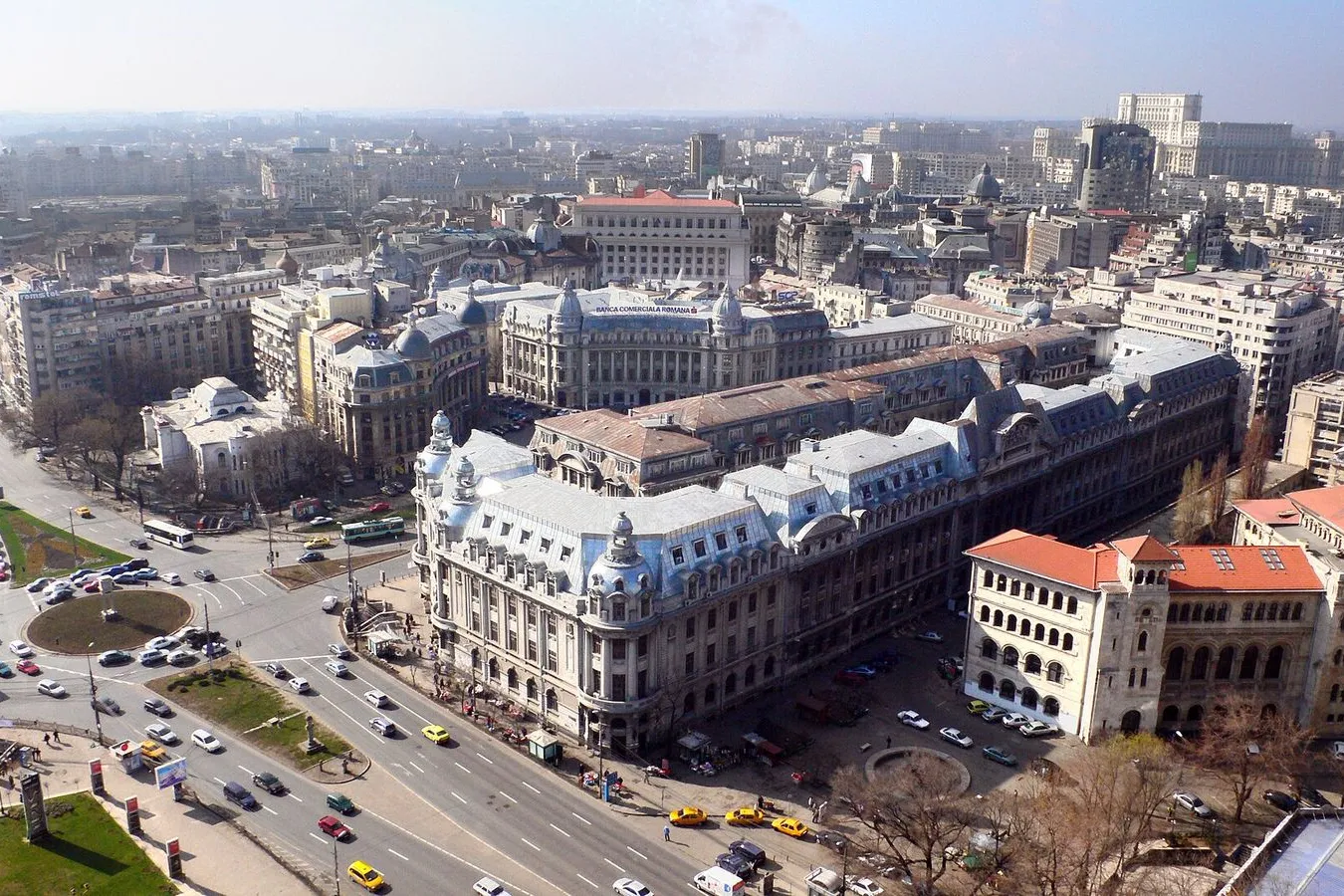
This is the practical briefing for Bucharest: how to get in from Otopeni airport, how the metro and buses work, what to watch for on the street, and which months reward a walk along Calea Victoriei. For Romania-wide essentials such as visa and entry rules, the leu, plug type, inter-city trains and national public holidays, see the Romania country guide.
Bucharest levies a 10 lei per night city tax per guest in licensed accommodation, a fixed sum rather than a percentage of the room rate.SourceRadio România Actualități
Tap water in Bucharest is safe to drink straight from the tap.SourceU.S. State Department
Bus 100 runs from Otopeni airport to the centre around the clock, and a 90-minute ride costs 3 lei.SourceBucharest Airports
A single metro ride costs 5 lei, and contactless bank cards work directly at the turnstile.SourceExpatZone
When to go
When is the best time to visit Bucharest?
Spring
Months
March to May
Weather
Daytime highs climb from about 11°C in March to 23°C in May, sitting in the comfortable spring band.SourceWeather Month
Crowds
The shoulder season does it best: mild weather, short museum queues, and linden trees leafing out over the Cotroceni villa streets.
Summer
Months
June to August
Weather
July and August average highs around 29°C, and June is the rainiest month of the year.SourceWeather Month
Crowds
Peak season, though Bucharest's crowds stay modest next to Western European capitals. The wide, shadeless Unirii boulevard bakes, so walk it early or late.
Autumn
Months
September to November
Weather
September still reaches about 23°C by day, cooling to around 10°C by November.SourceWeather Month
Crowds
September is the pick of the year: summer warmth without the peak, and the parks turn gold before November's chill.
Winter
Months
December to February
Weather
January is the coldest month, with a high around 3°C and a low near -5°C; snow falls but does not cover the city all season.SourceWeather Month
Crowds
The quietest and cheapest stretch. Christmas markets and the Palace of the Parliament interior make it a good indoor-visit season.
When to visit Bucharest, by season
Season
Months
Weather
Crowds
Spring
March to May
Daytime highs climb from about 11°C in March to 23°C in May, sitting in the comfortable spring band.SourceWeather Month
The shoulder season does it best: mild weather, short museum queues, and linden trees leafing out over the Cotroceni villa streets.
Summer
June to August
July and August average highs around 29°C, and June is the rainiest month of the year.SourceWeather Month
Peak season, though Bucharest's crowds stay modest next to Western European capitals. The wide, shadeless Unirii boulevard bakes, so walk it early or late.
Autumn
September to November
September still reaches about 23°C by day, cooling to around 10°C by November.SourceWeather Month
September is the pick of the year: summer warmth without the peak, and the parks turn gold before November's chill.
Winter
December to February
January is the coldest month, with a high around 3°C and a low near -5°C; snow falls but does not cover the city all season.SourceWeather Month
The quietest and cheapest stretch. Christmas markets and the Palace of the Parliament interior make it a good indoor-visit season.
The practical guide
Everything to sort before you go
Getting in from the airport
Bucharest has one commercial airport, Henri Coandă International, which everyone calls Otopeni (OTP), about 17 km north of the centre. Bus 100 is the cheap, round-the-clock link: it runs day and night from the arrivals and departures terminals to Piața Victoriei, Piața Romană, Universitate and Unirii Square, so it drops you into the city rather than at a station. A 2026 renovation has shifted some airport access points, so follow the signs on the day. The train is the fastest way if you are heading to Gara de Nord, the main station, and it never sits in traffic. After a late or heavy arrival, Uber or Bolt is the smoothest door-to-door option.
Bus 100 runs every 15 minutes by day and every 30 minutes at night, and a 90-minute journey costs 3 lei; you can pay by contactless bank card on the bus or at a machine in the arrivals hall. SourceBucharest Airports
The Otopeni to Gara de Nord train runs about every 40 minutes and takes 20 to 25 minutes. A second-class single is 6.50 lei with no reservation, and you should buy before boarding to avoid a surcharge. SourceCFR Călători·Romania Guided Tours
A taxi or ride-hailing trip into the centre takes 25 to 45 minutes and typically costs 50 to 70 lei; Uber and Bolt quote the price upfront. SourceRomania Guided Tours
Getting around
The metro, run by Metrorex, is the fastest way across the city, while STB runs the buses, trams and trolleybuses on the surface. The two systems use different tickets unless you buy an integrated one, so know which you are riding before you pay. For a short visit the simplest move is to tap a contactless bank card or phone at the metro turnstile or the on-board validator, no machine queue needed. Validate every single ride: inspectors board often, and forgetting to validate is the classic visitor fine. A handful of night buses run the main corridors after the metro closes.
A single metro ride costs 5 lei, and the network runs roughly 05:00 to 23:00; contactless bank cards and phones work directly at the turnstile. SourceExpatZone·IsItSafeToVisit
From 1 July 2026 a single metro ride rises to 7 lei under the transport ministry's new fare order. SourceMinistry of Transport fare order
A bus, tram or trolleybus journey costs 3 lei and is valid for 90 minutes across the entire STB surface network, so you can transfer on one ticket. SourceSTB SA
Caught without a validated ticket, you pay an 80 lei surcharge to the inspector on the spot. SourceExpatZone
Money and payments
The only city-specific charge most visitors meet is the Bucharest tourist tax, a flat 10 lei per guest per night added in licensed accommodation, so a three-night stay adds 30 lei. Cards and contactless payments work almost everywhere in the centre, and you will rarely need more than small cash for markets and loose change. For the currency itself, tipping norms and what the notes look like, the Romania country guide covers it.
Bucharest levies a 10 lei per night city tax per guest in licensed accommodation, fixed rather than a percentage of the room rate. SourceRadio România Actualități
Safety and common scams
Bucharest is one of Europe's safer capitals, and violent crime against visitors is rare. The realistic risks are petty and easy to dodge: pickpockets in crowded Old Town bars and on packed transport, plus taxi drivers who overcharge at the airport and Gara de Nord. Use Uber or Bolt, which quote a price before you get in, and treat any taxi without a visible company name and rate card as one to skip. The one district with no reason to wander is Ferentari, in the south-east.
Uber and Bolt run citywide and are the most reliable way to avoid taxi overcharging; a licensed taxi should show a company name and prices on the side of the car. SourceGOV.UK
The one area to skip is the Ferentari district in the south-east, and pickpockets concentrate on crowded Old Town venues and rush-hour transport. SourceIsItSafeToVisit
Health and emergencies
Tap water in Bucharest is safe to drink, so refill your bottle at the hotel and skip the plastic. The city has public hospitals and round-the-clock private clinics if you need care, and pharmacies (farmacii) sit on nearly every main street. The seasonal health note is summer heat: the wide, shadeless boulevards such as Bulevardul Unirii bake between June and August, so carry water if you walk the Civic Centre route.
Tap water in Bucharest is safe to drink and use in cooking, and many restaurants and hotels serve it unless you specifically request bottled. SourceU.S. State Department
Bucharest has 26 public hospitals and several 24/7 private clinics for visitor care. SourceIsItSafeToVisit
Staying connected
Mobile data is the reliable default in Bucharest. Free WiFi is patchy on public transport and not something to plan a day around, while a local SIM or an eSIM keeps maps, ride-hailing and ticket apps running all day. Coverage in the centre is good on 4G and 5G. Two apps are worth installing before you arrive: InfoTB, for live bus and tram positions, and 24pay, for buying surface tickets on your phone.
Free WiFi is not consistently available on Bucharest's buses, trams and metro, so rely on a local SIM or an eSIM for navigation and mobile tickets. SourceMegaPass
Etiquette and tipping
Cover shoulders and knees when you step into an Orthodox church such as Stavropoleos or the Old Court Church, and keep your voice down inside; these are active places of worship, so behave as you would in a working church. Bucharest locals are direct but warm, and neat appearance counts in restaurants and theatres. One legal line matters in the Old Town: drinking alcohol on the street is banned outside registered bars and café terraces.
Drinking alcohol on the street is banned in Bucharest except at registered bars and café terraces; fines run 110 to 500 lei. SourceU.S. State Department
Dress modestly at Orthodox churches, covering shoulders and knees, and stay quiet inside. SourceIsItSafeToVisit
The language
Romanian is the language everywhere, but in the centre and the tourist trade you will find enough English to get by, especially among younger people and in hotels, museums and shops. Signs and tickets are usually Romanian only, so learn a handful: bună ziua for hello, mulțumesc for thank you, vă rog for please, and cât costă? for how much is it. At STB ticket kiosks staff may not speak English, so have your destination written down or show it on your phone.
Signs and tickets are typically in Romanian, but staff and stations in central Bucharest generally offer basic English help. SourceMegaPass
STB ticket kiosk staff often do not speak English, so showing your destination on a phone is the easiest workaround. SourceExpatZone
Accessibility
The Old Town's cobbled lanes, uneven kerbs and stepped historic courtyards are the main challenge for wheelchairs and reduced mobility, and some of the prettiest passages have no flat route. The metro has step-free access at a number of stations, but it is not uniform across the network, so check your specific station before relying on it. For reaching a particular door, ride-hailing and taxis are often the simplest answer.
The metro and major stops offer accessibility options, but step-free access varies by station, so confirm your specific station in advance. SourceMegaPass
What to book ahead
Two places in Bucharest reward booking before you land. The Palace of the Parliament runs timed guided tours of its interior, a separate hour from walking the grounds, and the slots sell out, so reserve ahead and bring a passport for the security check. The Cotroceni Museum's royal apartments are by appointment only. For the airport, buy your train ticket before boarding to avoid a surcharge, and if you want a driver waiting with a sign, book a private transfer ahead.
Buy your Otopeni airport train ticket before boarding to avoid a surcharge; a second-class single is 6.50 lei. SourceCFR Călători
A pre-booked private transfer from Otopeni to the centre typically costs 150 to 180 lei. SourceRomania Guided Tours