Dijon · Self-guided audio walk

The Owl, the Market, and the Ducal Palace

Two hundred years of mustard and gingerbread, a market hall Dijon built after turning down Eiffel's, half-timbered lanes, and the worn owl that leads to the dukes' tombs: one west to east line through the old town.

  • 8Stops
  • 1.1 kmDistance
  • 25+ minTime
The Owl, the Market, and the Ducal Palace

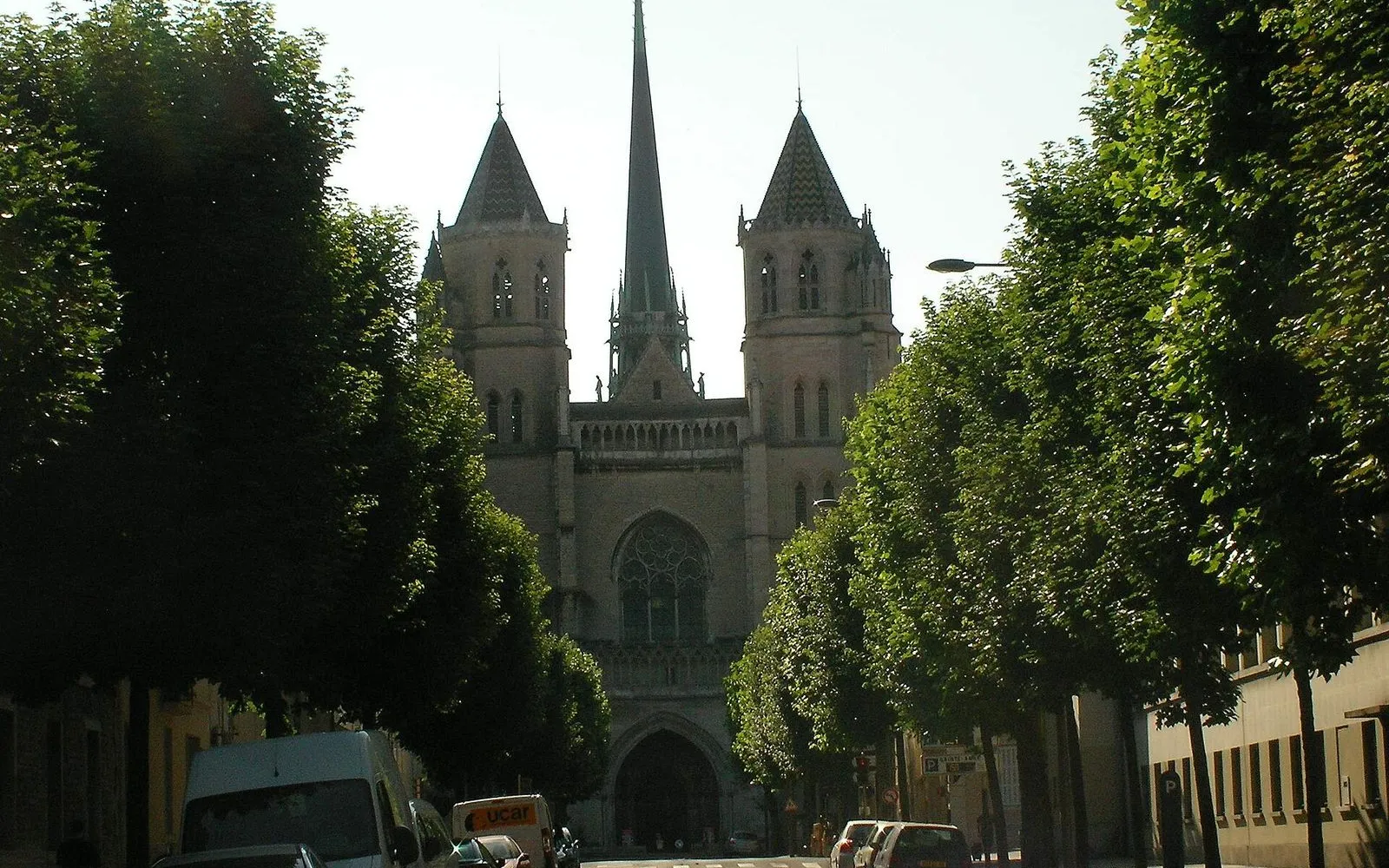
Photo by Christophe.Finot on Wikimedia Commons

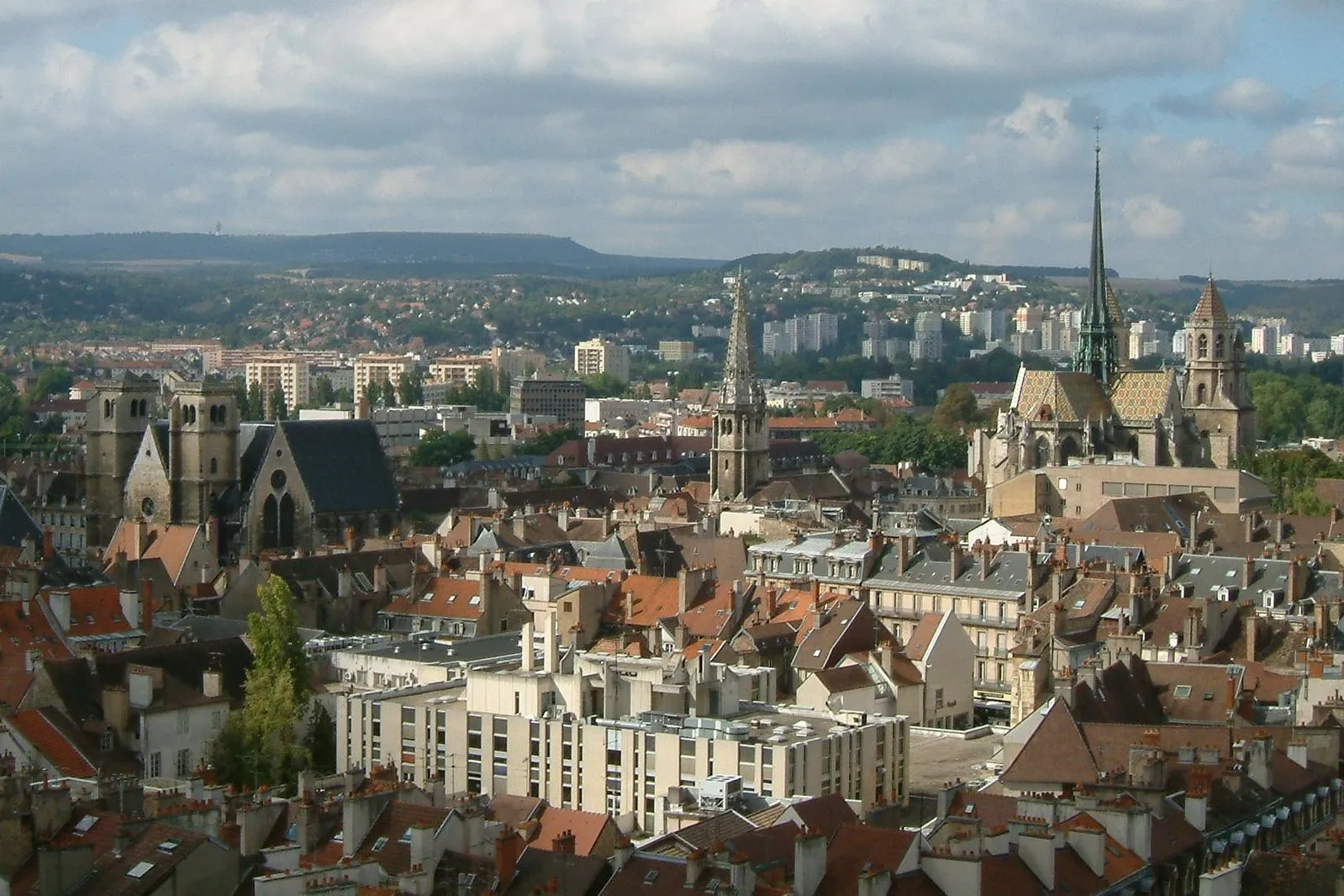
Dijon's whole historic centre fits on one line, and this walk takes it at a browsing pace: about 25 minutes, from the mustard pumps on rue de la Liberté to the tombs of the dukes inside their palace.

You taste mustard at Maille, open at number 32 since 1845, and buy gingerbread a few doors along at Mulot et Petitjean. You cross the Bareuzai fountain on place François-Rude, walk the market through the 1870s halls, and take the medieval lanes north toward the church.

In between come the courtyard of the Hôtel Chambellan, the worn owl on the north side of Notre-Dame, and the great hemicycle of place de la Libération. It ends in the free Musée des Beaux-Arts, in the hall where Philip the Bold and John the Fearless lie with their alabaster mourners.

Come on a market morning if you can, and make it Thursday, Friday or Saturday: the market runs on Tuesday too, but the museum this walk ends in is closed that day.

Hear it on the street

Get the turn-by-turn audio guide in the app. The narration plays itself as you reach each stop, hands-free and offline.

Stop by stop

The route

Interactive map of the route. The full stop list below works without it.

Rue de la LibertéMust see

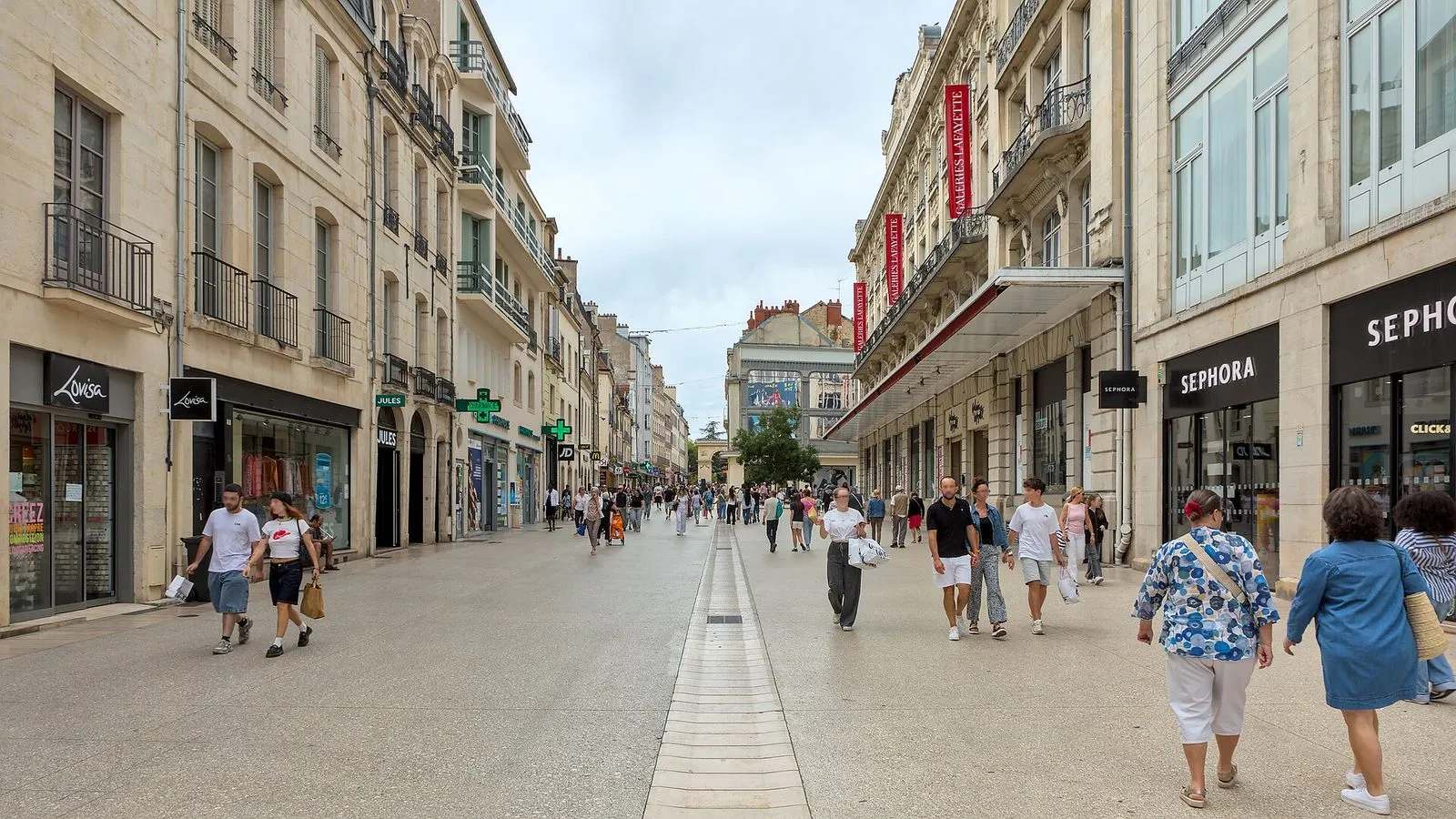
Photo by Benjamin Smith on Wikimedia Commons

Rue de la Liberté

0:00

Mustard drawn from the pump at 32, gingerbread at 16

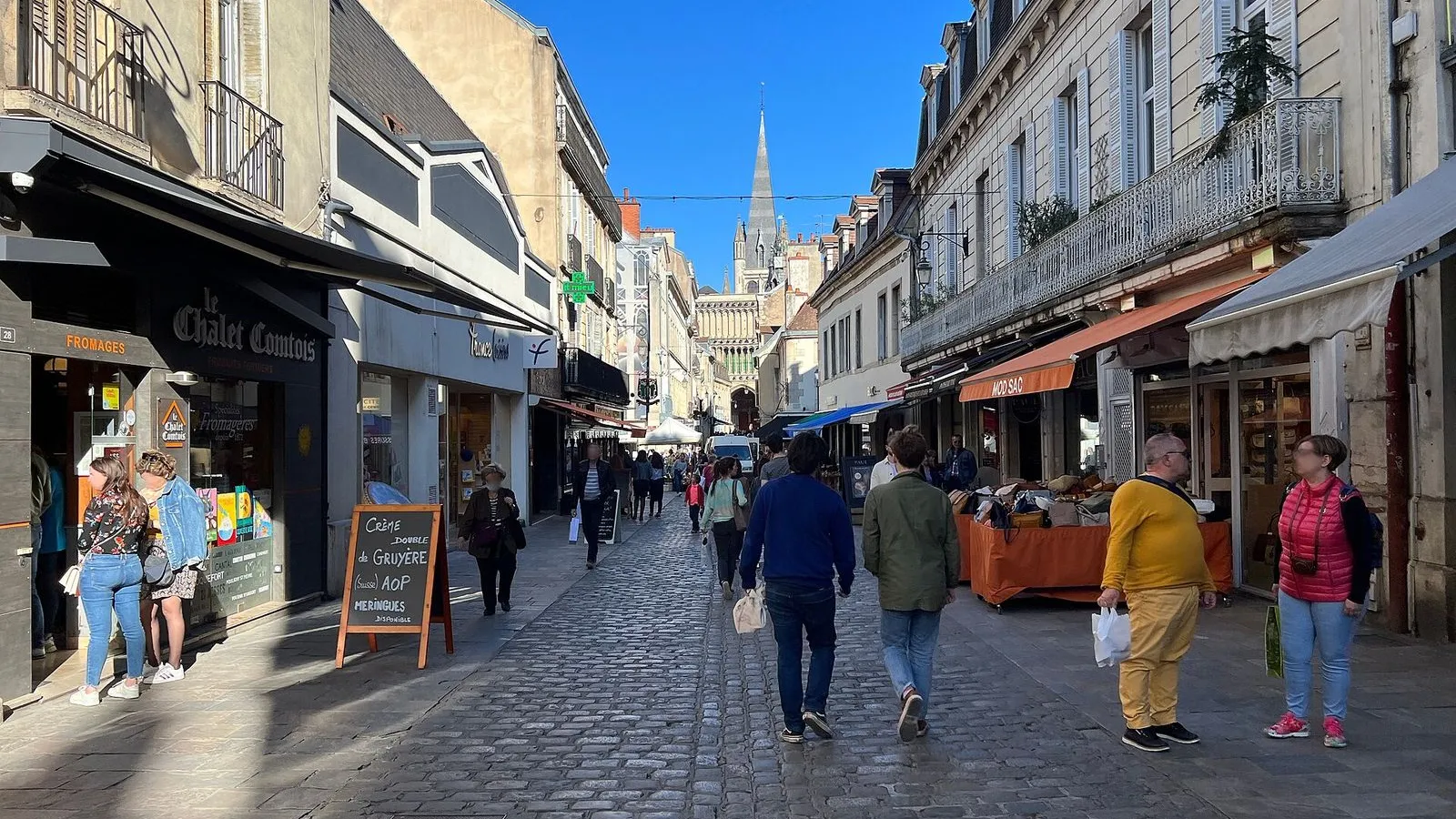
Rue de la Liberté runs about 500 metres from place Darcy to the ducal palace, and the stretch under your feet is younger than it looks. Before the Revolution this half toward the palace was rue Condé, driven through the medieval grid between 1721 and 1725; the narrow lanes crossing it belong to the town that was here before. Two shops on the street tell the same story, old trade in a newer shell. Number 32 is Maille, open at this address since 1845, where mustards are still drawn by hand from the pumps into stoneware pots stopped with cork.

A few doors along at number 16 stands Mulot et Petitjean, gingerbread bakers since 1796. In 1939 Dijon had fourteen gingerbread houses; by 1975 only three were left, and this is the last one still baking. Maille took over the address, and even the wall signs, from the Grey Poupon mustard shop that traded at this corner before it. The truffle mustard the house is known for leaves in the same corked pots the pumps fill.
≈2 min walk to the next stop
Place François-RudeMust see

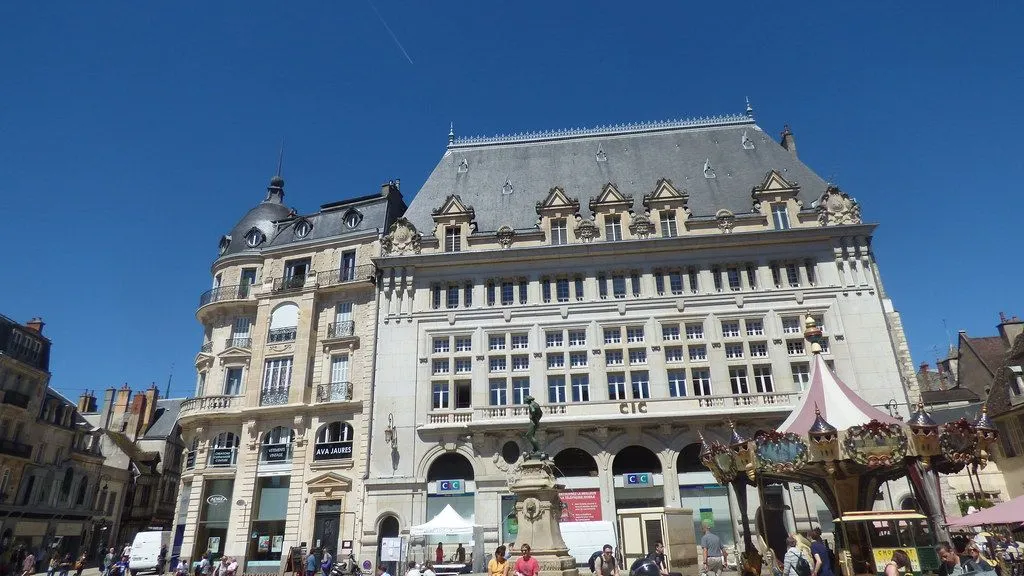
Photo by ell brown on Openverse

Place François-Rude

0:00

A grape treader in bronze, a square opened in 1904

There's a man standing in a wine vat on top of the fountain, and the square takes its nickname from him. Bareuzai is old Burgundian for bas rosés, pink legs, because the men who trod the harvest climbed out of the vat stained to the knee. The bronze is Le Vendangeur foulant le raisin by Noël-Jules Girard, modelled in the 1850s, cast by the Thiébaut foundry, and shown at the 1855 Exposition universelle in Paris, where the state bought it. Napoleon III gave it to Dijon, and in 1904 the city set it on this fountain by the architect Paul Deshérault.

The square appeared in that same year, when the old houses between rue du Lacet and rue de la Tonnellerie came down. Its official name remembers the sculptor François Rude, born a few steps away at number 5 rue François-Rude, whose Departure of the Volunteers still stands on the Arc de Triomphe in Paris. Around the square, look for the medieval half-timbered house with Au Moulin à Vent under it, and the 15th-century tower of the hôtel Jacqueron, roofed in glazed tiles.

≈2 min walk to the next stop
Rue MusetteLocal pick

Photo by Chabe01 on Wikimedia Commons

Rue Musette

0:00

The old lane down to the market, older than the street

This lane is older than the street you left two minutes ago. When the 1720s drove rue Condé through toward the palace, the lanes running north and south such as this one were already in place, and they stayed, which is why the map of Dijon still reads like the medieval town it was. Lanes of this kind carried the trades that served the market, and the market is what you're walking toward. On Tuesdays, Thursdays, Fridays and Saturdays, from seven in the morning until one, the stalls spill out of the halls and into the surrounding streets, and the whole quarter smells of cheese, gingerbread and mustard.

Even on a closed day these two minutes are worth it, because from here you see the market building from the side most visitors never notice: the iron and glass hall behind the rooftops, ringed by plain stone houses that have watched the same business for centuries. Nothing on this street is grand, and that's the point. This is the working town that paid for the famous one.

≈2 min walk to the next stop
Free preview ends here · stops 4 to 8 continue in the app

Halles centrales

Iron, glass and the market Dijon opens four mornings a week

in app

Hôtel Chambellan

A draper's gothic courtyard behind a passage at 34 to 36

in app

Notre-Dame

A 13th-century front, 51 carved figures and the owl

in app

Place de la Libération

The palace hemicycle, a king gone, three fountains now

in app

Musée des Beaux-Arts

Two ducal tombs, alabaster mourners, and free entry

in app
Good to know

Before you go

Which day should I walk the Owl, the Market, and the Ducal Palace?

Thursday, Friday or Saturday. The Halles market runs on Tuesday, Thursday, Friday and Saturday mornings, but this route ends inside the Musée des Beaux-Arts, which closes on Tuesdays, so Tuesday costs you the last stop; Thursday to Saturday gives you both the market and the museum.

SourceVille de DijonDijon Musées
Is the Musée des Beaux-Arts free?

Yes. Dijon's municipal museums are free for their permanent collections, and have been since 2004; only temporary exhibitions at the Beaux-Arts carry a ticket, at €9 full price and €5 reduced. The museum closes on Tuesdays and public holidays.

SourceDijon Musées
Where do I taste the mustard and buy the gingerbread?

Both are on rue de la Liberté, a few doors apart: Maille at number 32, where mustard comes from the pump at the counter, and Mulot et Petitjean at number 16, where gingerbread and nonnettes have been made since 1796.

SourceMulot et Petitjean

Provenance · last verified September 12, 2026

Built from the Wayside route itself: the stops, their order, and the walk between them.

Photo by Christophe.Finot on Wikimedia Commons · CC BY-SA 2.5

Photo by Benjamin Smith on Wikimedia Commons · CC BY-SA 4.0

Photo by ell brown on Openverse · CC BY-SA 2.0

Photo by Chabe01 on Wikimedia Commons · CC BY-SA 4.0

Photo by Fabian Kleiser on Unsplash

Photo by Gzen92 on Wikimedia Commons · CC BY-SA 4.0

Coming soon

Wayside isn't in the app stores yet, but it's in the works. Check back soon.