Montpellier · Self-guided audio walk

Antigone

Walk a kilometre of columns, squares, and precast palaces. This is Antigone, Ricardo Bofill's audacious answer to a fast-growing city, built from 1983 and aimed straight at the river Lez.

  • 7Stops
  • 1.4 kmDistance
  • 25+ minTime
Antigone

Photo by Gerd Eichmann on Wikimedia Commons

Antigone is Montpellier's boldest 20th-century quarter, a nearly one-kilometre pedestrian axis that Ricardo Bofill designed from 1978 and built from 1983. It runs from the edge of the old center to the river Lez, and it does something rare: it turns social housing, offices, and a market into one continuous work of architecture.

This walk follows the axis from the golden-ratio square where it begins to the regional government building across the water. Along the way it stops at the Halles Jacques Cœur food market, three columned squares, and the free five-level Médiathèque Émile Zola.

It ends on the lawns of the Esplanade de l'Europe, beside a restored copy of the Winged Victory of Samothrace, with café terraces behind you and the river in front. The whole route takes about twenty-five minutes and barely leaves a pedestrian boulevard, though a few streets do cross it with traffic.

Hear it on the street

Get the turn-by-turn audio guide in the app. The narration plays itself as you reach each stop, hands-free and offline.

Stop by stop

The route

Interactive map of the route. The full stop list below works without it.

Place du Nombre d'OrMust see

Photo by Fred Romero from Paris, France on Wikimedia Commons

Place du Nombre d'Or

0:00

The golden-ratio square where Antigone's axis begins.

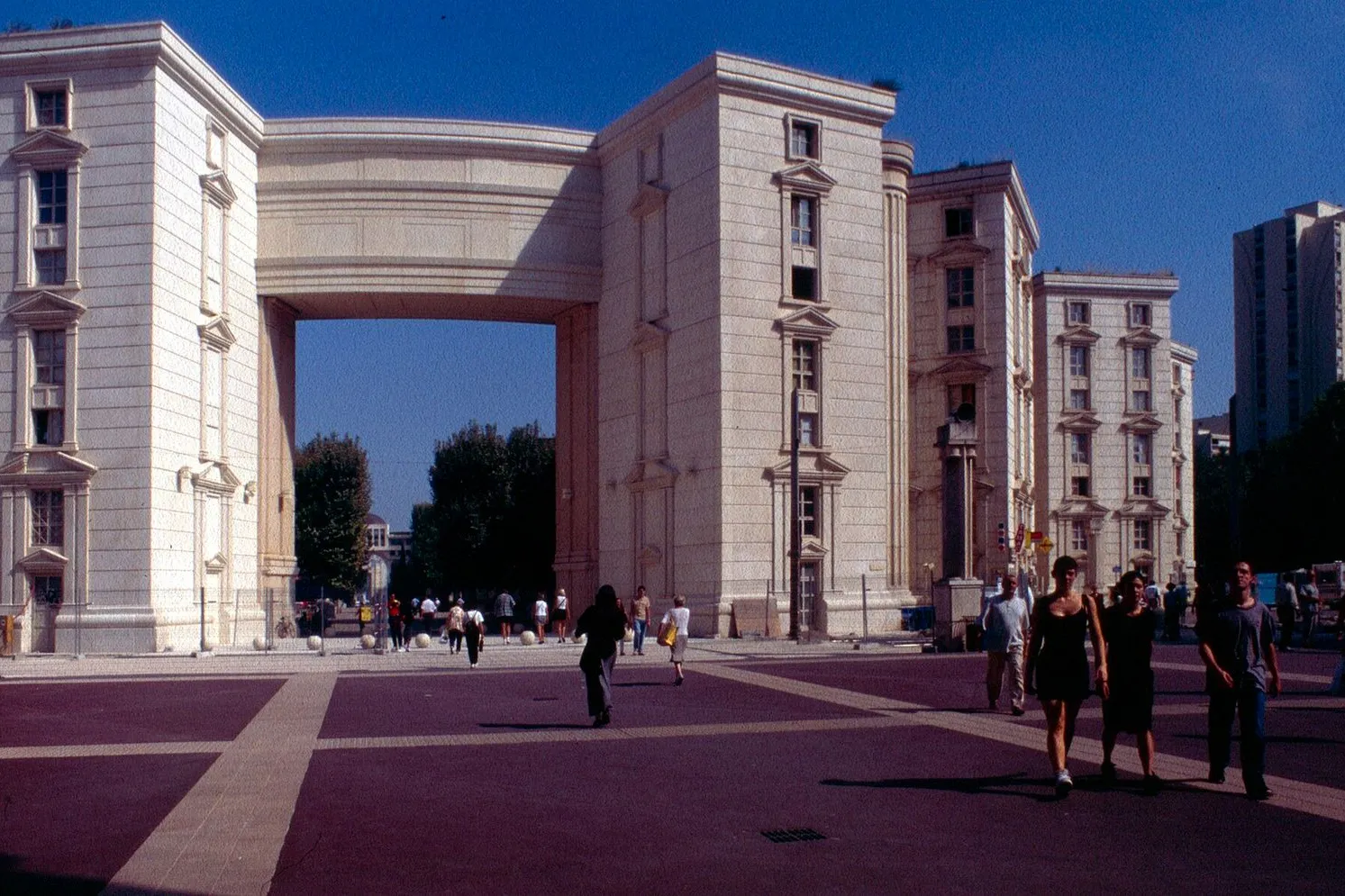
Welcome to Place du Nombre d'Or, the first square of Antigone and the point where the quarter's axis opens in front of you. Everything you see was designed by the Catalan architect Ricardo Bofill from 1978 and built from 1983. Look at the facades: giant pediments, pilasters, and columned galleries, cast in prefabricated concrete, not cut stone. Bofill took the proportions of classical Greece and scaled them up into housing, much of it social housing.

Behind those ochre walls sit 288 apartments and shops, ordinary homes dressed as a palace for the people. The square is named for the golden ratio, the mathematical proportion behind so much classical design. On Wednesdays about thirty traders set up here from seven in the morning to half past five in the afternoon April through September, and until two in the afternoon October through March. Since 1991 the Sunday Marché Paysan has brought fifty-two producers from eight to half past one.

Face east and the whole nine-hundred-metre axis runs toward the Lez, one long classical argument about who a city should be built for.
≈4 min walk to the next stop
Halles Jacques CœurLocal pick

Photo by Fred Romero on Wikimedia Commons

Halles Jacques Cœur

0:00

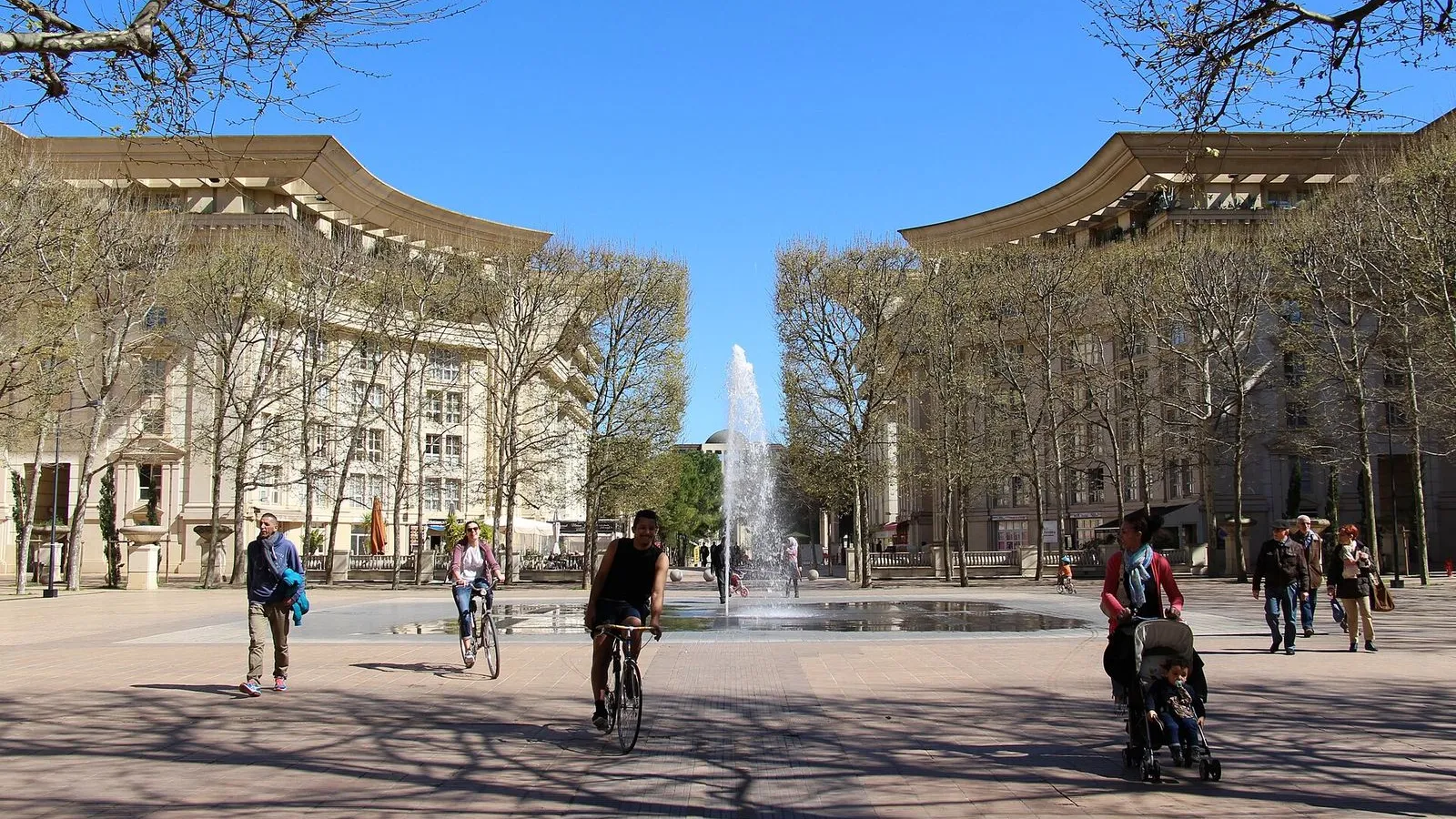
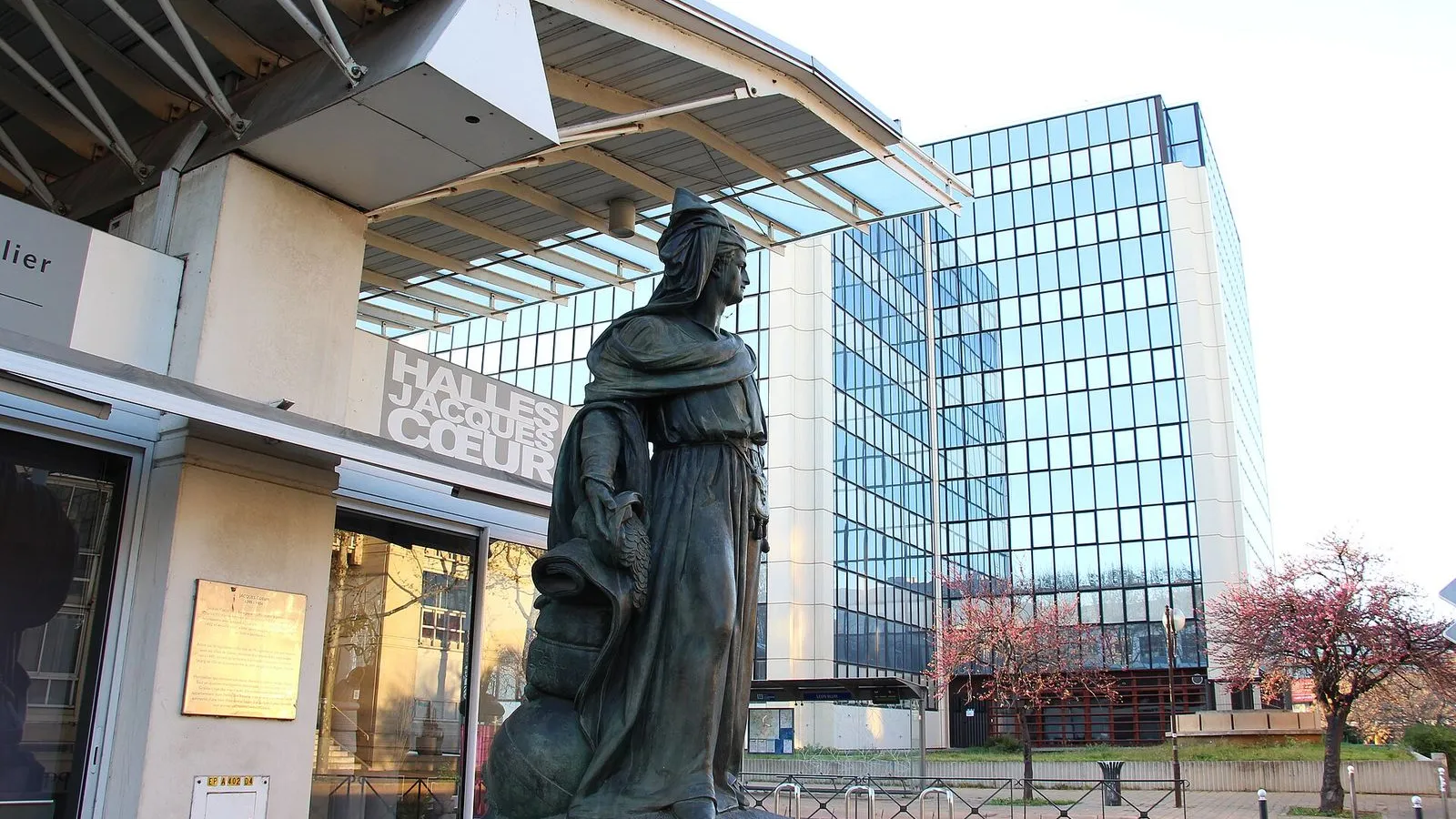
The quarter's covered food market under a wing-shaped roof.

This is Halles Jacques Cœur, the covered food market where Antigone does its daily shopping. Twenty-two traders work inside, selling cheese, produce, charcuterie, fish, and prepared lunches. The hall is named for Jacques Cœur, the great merchant whose name became a byword for prosperous trade in Montpellier, and its awning spreads over the stalls like a pair of wings. Step inside and you meet the other half of Bofill's plan.

Antigone was never meant to be a stage set; it had to house a working population, and a working population needs a market. It opens Monday to Saturday from seven in the morning to eight in the evening, and on Sundays and holidays from seven to two in the afternoon. Come back at lunchtime and the traders' prepared dishes turn the aisles into the neighborhood canteen. The concrete columns outside may quote ancient Greece, but inside it smells of cheese rind and roast chicken.

A district built as a palace still has to feed people.

≈2 min walk to the next stop
Place du MillénaireLocal pick

Photo by Chabe01 on Wikimedia Commons

Place du Millénaire

0:00

A columned square marking the turn of the millennium.

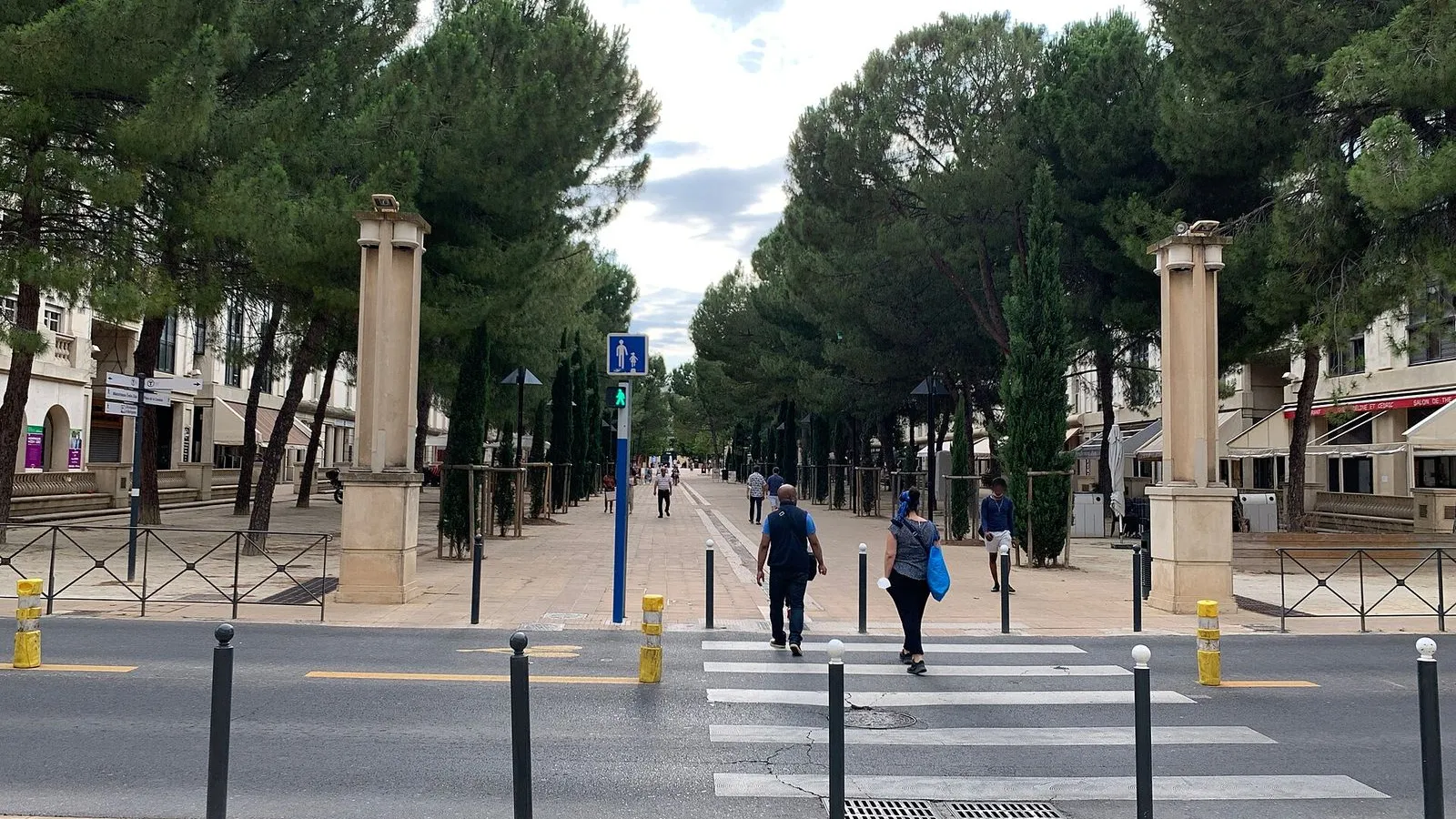
Place du Millénaire is the quiet pause between Antigone's two grandest statements. It is smaller than the square you just left, and that is deliberate. Bofill varied the scale of his squares so the walk would breathe, opening wide and closing in like a series of outdoor rooms. The colonnades continue all the way around, the same precast concrete, the same rhythm of pediments, but here the proportions are human again.

The square's name points to the turn of the millennium, the moment when this quarter stopped being a construction site and became a place people simply lived in. Café terraces spill onto the paving, office workers and residents cut across it, and on most days the loudest sound is a chair being pulled out. You are standing on what was, forty years ago, army land on the eastern edge of the city. Montpellier bought it, handed it to Bofill, and turned it into apartments, offices, shops, and these squares.

The old center is ten minutes behind you now; the river is five ahead.

≈2 min walk to the next stop
Free preview ends here · stops 4 to 7 continue in the app

Place de Thessalie

A round basin with three sculpted youths, added in 2003.

in app

Médiathèque centrale Émile Zola

A free five-level library inside a glass and stone block.

in app

Esplanade de l'Europe

The lawn on the Lez where the axis meets the river.

in app

Hôtel de Région

The regional government building that closes the axis.

in app
Good to know

Before you go

Is the Antigone walk mostly outdoors?

Yes, it is a largely pedestrian axis of squares and columns, though a few streets cross it with traffic.

Is the Médiathèque Émile Zola free?

Yes, entry to the library is free.

What is there to eat in Antigone?

Halles Jacques Cœur is the quarter's covered food market. The district's regular market runs on Wednesdays, and a farmers' market fills Avenue Samuel-Champlain on Sunday mornings.

SourceMontpellier Tourisme

Provenance · last verified August 28, 2026

Built from the Wayside route itself: the stops, their order, and the walk between them.

Photo by Gerd Eichmann on Wikimedia Commons · CC BY-SA 4.0

Photo by Fred Romero from Paris, France on Wikimedia Commons · CC BY 2.0

Photo by Fred Romero on Wikimedia Commons · CC BY 2.0

Photo by Chabe01 on Wikimedia Commons · CC BY-SA 4.0

Photo by Zairon on Wikimedia Commons · CC BY-SA 4.0

Photo by GFreihalter on Wikimedia Commons · CC BY-SA 4.0

Coming soon

Wayside isn't in the app stores yet, but it's in the works. Check back soon.