Rennes · Self-guided audio walk

Before and After the Fire

One night in December 1720 cut Rennes in two. This walk follows the line the flames drew, from the timber lanes that survived to the stone squares the king's architect built in their place.

  • 9Stops
  • 1.6 kmDistance
  • 30+ minTime
Before and After the Fire

Photo by Thanh Ly on Unsplash

The fire that changed Rennes started on the night of 22 to 23 December 1720, in a joiner's shop in a narrow old-town street, and burned for about a week. It destroyed 945 homes, 45 percent of the built-up town, and left some 8,000 people without a home.

The line the flames drew is still readable on the ground. Outside it, timber-framed houses lean over the lanes, some of them five centuries old. Inside it, the centre was rebuilt in stone to a single plan, with royal squares and uniform façades.

This hour-long walk runs that line: place Sainte-Anne and rue Saint-Michel, the Lices market, the Portes Mordelaises and the rampart promenade, the basilica that burned and the cathedral that did not, then the two rebuilt squares and rue Saint-Georges, where the timber returns.

Come on a Saturday morning and the Lices market turns the middle of the walk into lunch.

Hear it on the street

Get the turn-by-turn audio guide in the app. The narration plays itself as you reach each stop, hands-free and offline.

Stop by stop

The route

Interactive map of the route. The full stop list below works without it.

Place Sainte-AnneMust see

Photo by TouN on Wikimedia Commons

Place Sainte-Anne

0:00

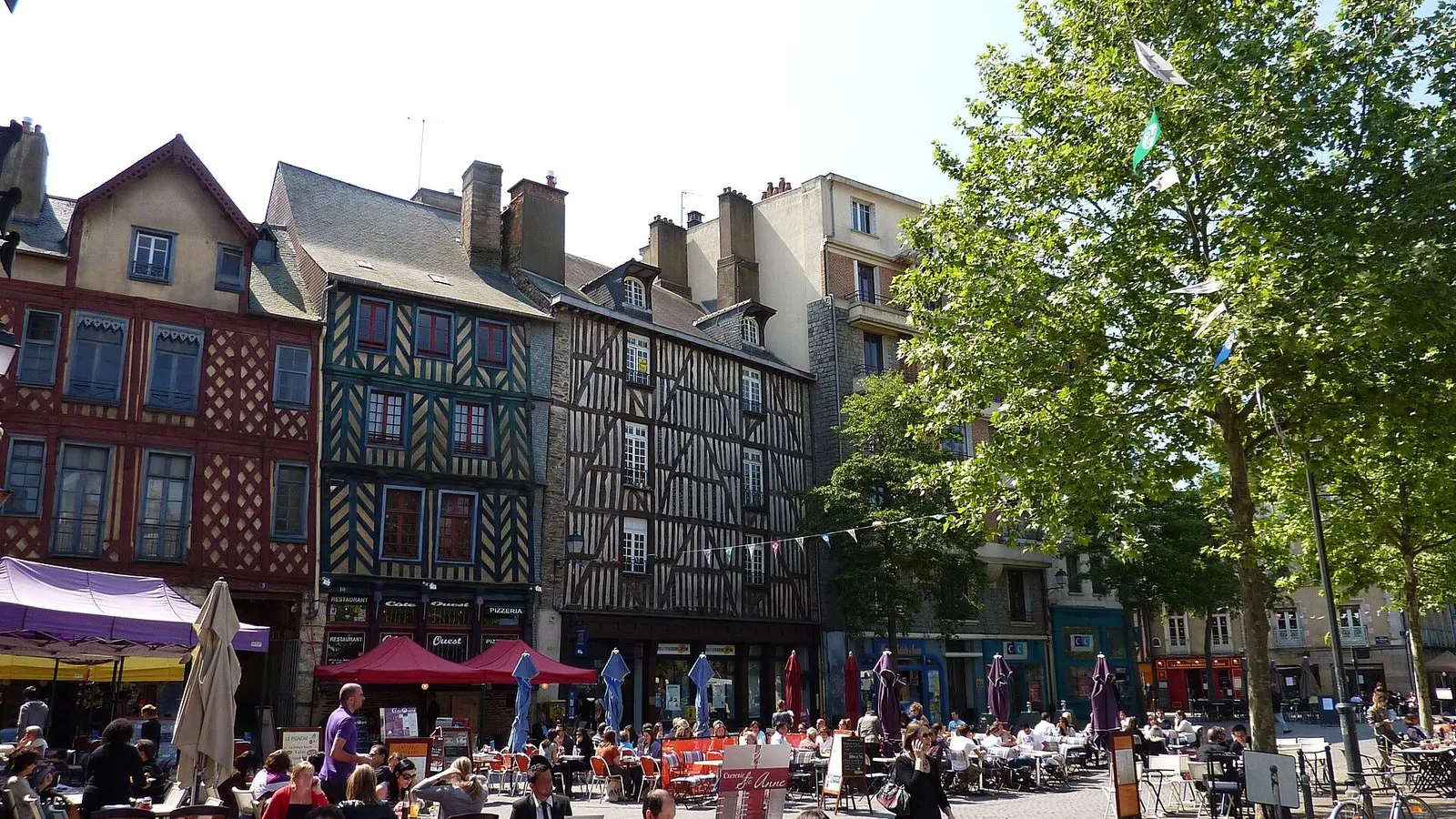
Thirty timber houses, the oldest dated 1580, on the fire's edge.

You're standing on the edge of the old town, where the road out to Saint-Malo used to leave Rennes. Turn and look down rue Saint-Michel. Thirty of its houses are timber-framed, and the oldest, at number 13, carries the date 1580. Look up as you walk: the carved beams over numbers 17 and 19 are original, and the upper floors jut out over the street to gain a little room.

Keep going and you'll see why the Rennais call this the rue de la Soif. There's a bar roughly every seven metres, which they like to call a French record.

Now the reason for this walk. In the night of 22 to 23 December 1720, a fire started in a joiner's shop in a narrow lane on the other side of this hill. It burned for about a week. When it was out, 945 homes were gone, 45 percent of the built-up town, and around 8,000 people had no home. Where you're standing, the flames never arrived. For the next hour, you'll keep crossing the line they left.
≈5 min walk to the next stop
Place des LicesMust see

Photo by Seb35 on Wikimedia Commons

Place des Lices

0:00

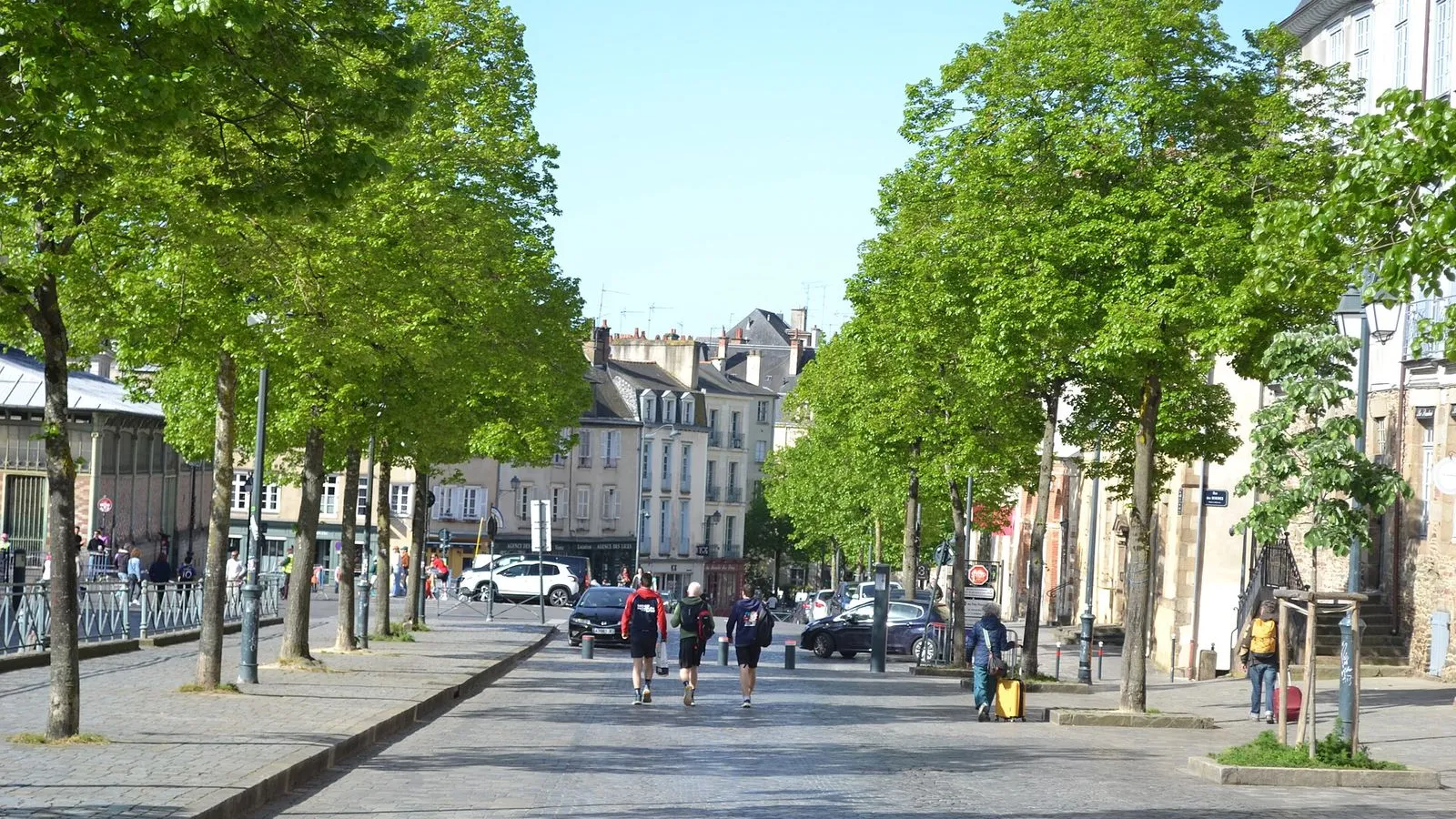
Saturday market square with twin timber mansions from the 1600s.

The Lices market has been held here since 1622, and it still runs on Saturday mornings only, from half past seven until half past one. The name comes from the lists, the ground outside the walls where knights held tournaments.

Two buildings on the square are the ones to study: tall timber-framed mansions raised in the second half of the 1600s for parliamentary families who wanted to live near the palace they sat in. They were built cheaply, in wood, then coated in plaster so they would pass for stone. In front of the twin façades a double flight of steps climbs to the door, a deliberate echo of the Parlement's own steps.

The halls in the middle are the Halles Martenot, built in 1871 on the model of the Baltard halls in Paris, 1,300 square metres under two brick and steel roofs. On market day one hall is the butchers', the other the local producers'. Everything else you need for a Breton picnic is out on the square.

≈2 min walk to the next stop
Portes MordelaisesMust see

Photo by chisloup on Wikimedia Commons

Portes Mordelaises

0:00

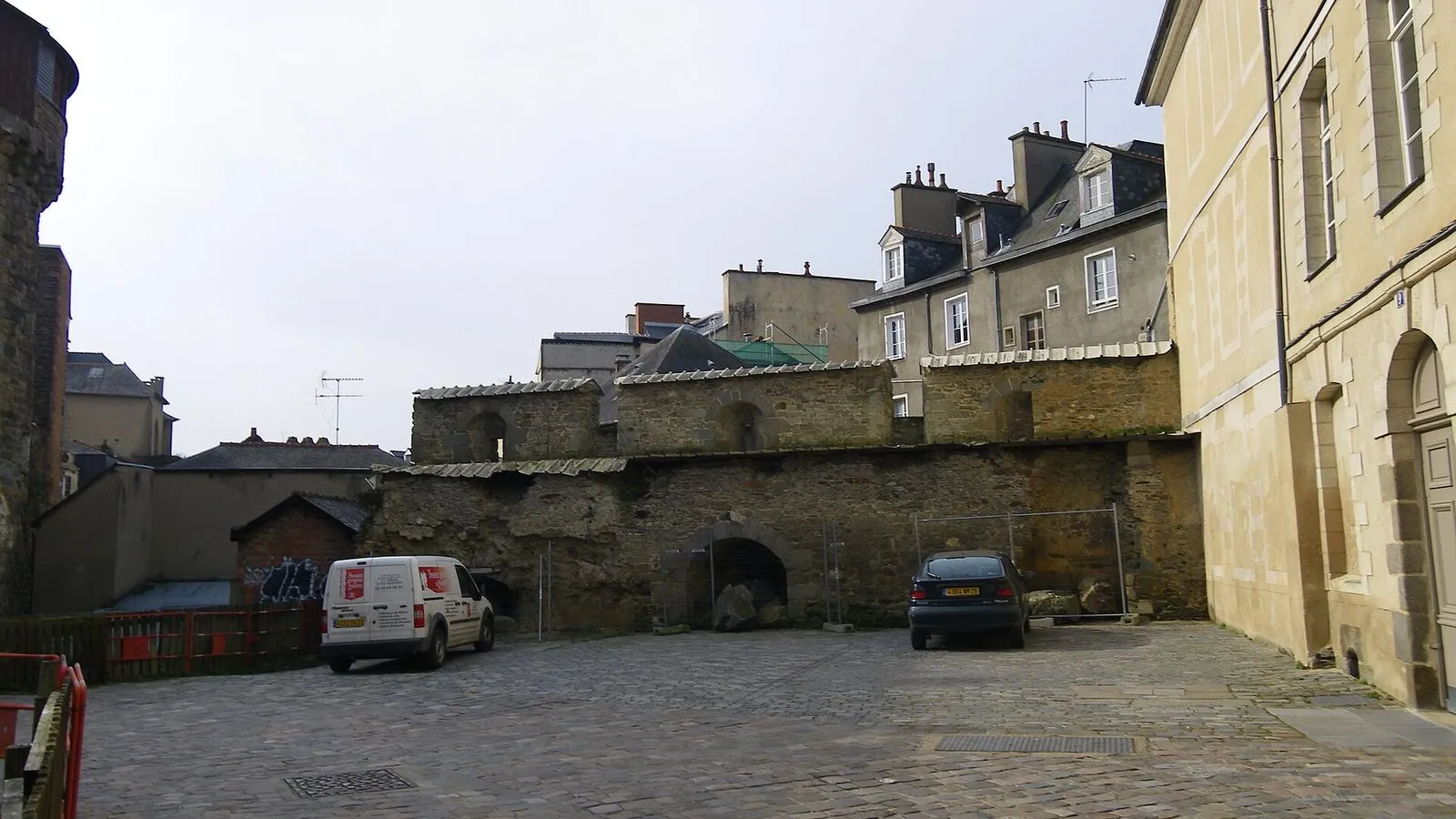
The only surviving city gate, and the rampart walk of 2026.

This is the only fortified gate left in Rennes, and for centuries it was the way in. The Dukes of Brittany rode through it before their coronation at Saint-Pierre, and the shield above the arch carries the arms of the Montfort line, who ruled Brittany from 1364 to 1514. Two towers flank a cart door and a smaller one for people, built for a drawbridge and a portcullis, on a wall that began as Gallo-Roman and was rebuilt in the 1400s.

A few steps on, you can climb onto the promenade that opened along the rampart in April 2026. It runs behind the old wall as far as the Tour Duchesne, open every day from a quarter to nine in the morning until ten at night, and the stone under your hand is local schist laid next to granite blocks taken from the Roman wall. From up there you can see how thick the defences were.

After 1723 the gate was no longer needed for defence. It became scenery, for a town that had turned its back on its walls.

≈2 min walk to the next stop
Free preview ends here · stops 4 to 9 continue in the app

Cathédrale Saint-Pierre

Granite towers over an interior remade as a Roman basilica.

in app

Basilique Saint-Sauveur

The basilica the fire gutted, and the chapter street beside it.

in app

Place du Champ-Jacquet

Where the south side burned and the north still stands.

in app

Place de la Mairie

Gabriel's town hall and the opera, on the first rebuilt square.

in app

Place du Parlement de Bretagne

The palace that survived 1720, framed by a royal square.

in app

Rue Saint-Georges

Crêperies and shops in houses older than the fire.

in app
Good to know

Before you go

How do you get inside the Parlement de Bretagne?

The Parlement de Bretagne is seen only on a guided visit booked through the tourist office: 90 minutes from €6.50, or combined with the historic heart walk from €7.50. Book before you travel, since the visit times shape the middle of the day.

SourceOffice de Tourisme, visites guidéesOffice de Tourisme, visite du Parlement en 60 minutes
When is the Lices market on?

The Lices market runs on Saturdays only, from 7:30 to 13:30, on place des Lices, which is the second stop of this walk. Come on a Saturday morning and the market is where lunch comes from; on other days the square is quiet and the twin timber mansions are the draw.

Is the Cathédrale Saint-Pierre open every day?

The Cathédrale Saint-Pierre opens 9:30 to 18:00 and is closed on Tuesdays and Wednesdays; the tourist office lists a 12:00 to 15:00 break, so plan to see it in the morning, during the first half of this walk.

SourceCathédrale de Rennes, informations pratiquesOffice de Tourisme, La Cathédrale Saint-Pierre
What survived the 1720 fire on this walk?

Everything outside the line the flames drew survived: place Sainte-Anne's timber houses, the oldest dated 1580; the north side of place du Champ-Jacquet; and the Parlement de Bretagne, which the fire never reached. Inside the line the city was rebuilt in stone to one plan, and that is the half of the walk that follows the cathedral.

Provenance · last verified September 26, 2026

Built from the Wayside route itself: the stops, their order, and the walk between them.

Photo by Thanh Ly on Unsplash

Photo by TouN on Wikimedia Commons · CC BY-SA 3.0

Photo by Seb35 on Wikimedia Commons · CC0

Photo by chisloup on Wikimedia Commons · CC BY 3.0

Photo by Pymouss on Wikimedia Commons · CC BY-SA 4.0

Photo by Lizixi Zhu on Unsplash

Coming soon

Wayside isn't in the app stores yet, but it's in the works. Check back soon.