Rouen · Self-guided audio walk

The Old Town Spine

Six stops on one straight pedestrian line: the market where Joan of Arc burned, the great clock, the courthouse, Monet's cathedral, and the palace where her trial was reopened.

  • 6Stops
  • 1 kmDistance
  • 20+ minTime
The Old Town Spine

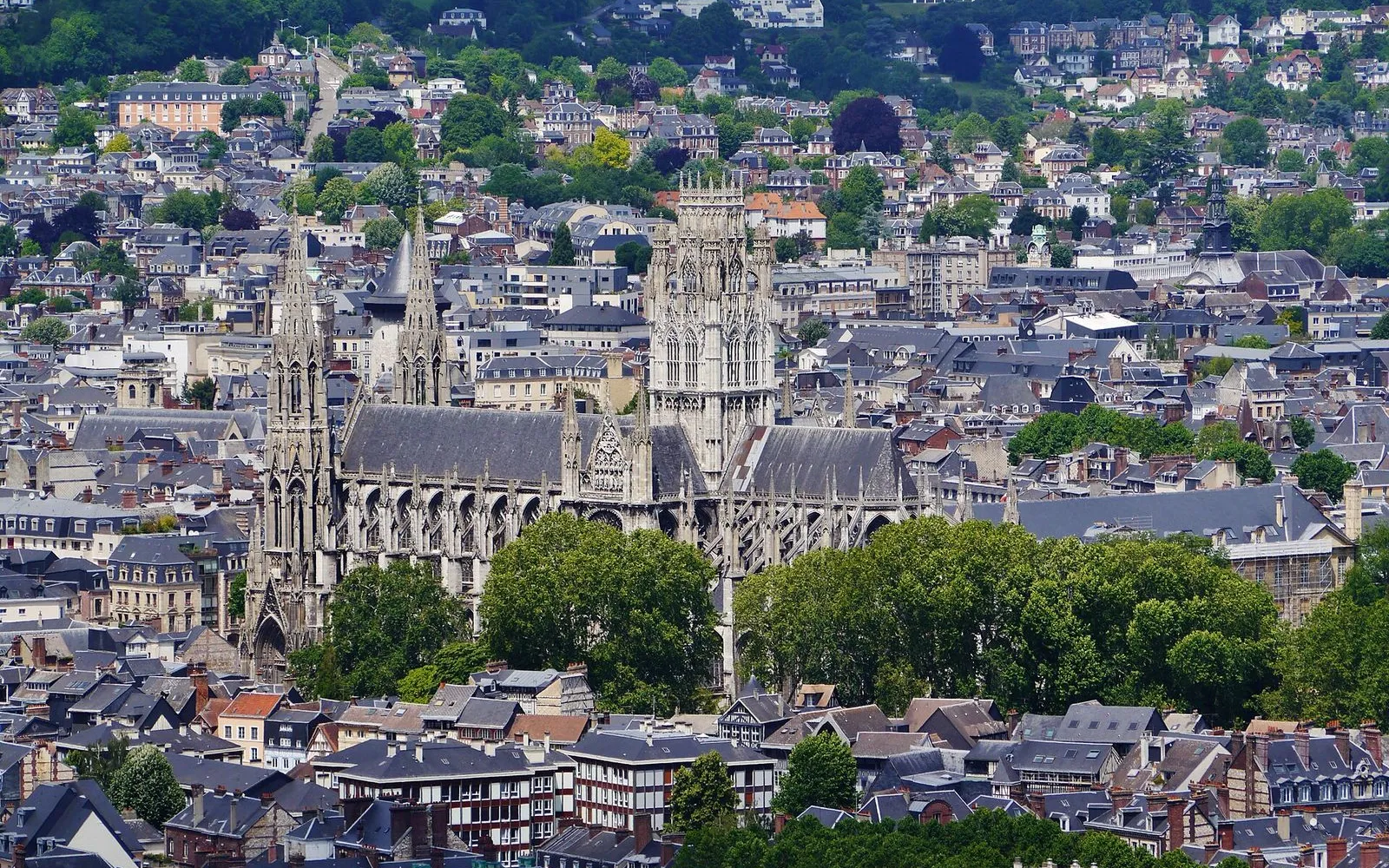
Photo by kirkandmimi on Wikimedia Commons

Rouen's medieval civic story runs along one straight pedestrian line, and this walk follows it end to end. You start at Place du Vieux-Marché, where Joan of Arc was burned on 30 May 1431 and a covered market still trades six days a week. Then you pass beneath the astronomical clock of the Gros-Horloge and, if the day allows, climb its belfry for the view over the roofs.

Next comes the Palais de Justice, begun in 1499 for the merchants' assembly and the Exchequer of Normandy, with the twelfth-century Maison Sublime hidden beneath its courtyard. The cathedral closes the axis. Monet painted its west front from rented windows over two campaigns, in 1892 and 1893.

You finish at the Historial Jeanne d'Arc, inside the archbishop's palace, in the very rooms of her 1431 condemnation and her 1456 rehabilitation. About a kilometre of walking, and five hundred years of a town arguing with itself.

Hear it on the street

Get the turn-by-turn audio guide in the app. The narration plays itself as you reach each stop, hands-free and offline.

Stop by stop

The route

Interactive map of the route. The full stop list below works without it.

Place du Vieux-MarchéMust see

Photo by KoS on Wikimedia Commons

Place du Vieux-Marché

0:00

The market square where Joan of Arc was burned.

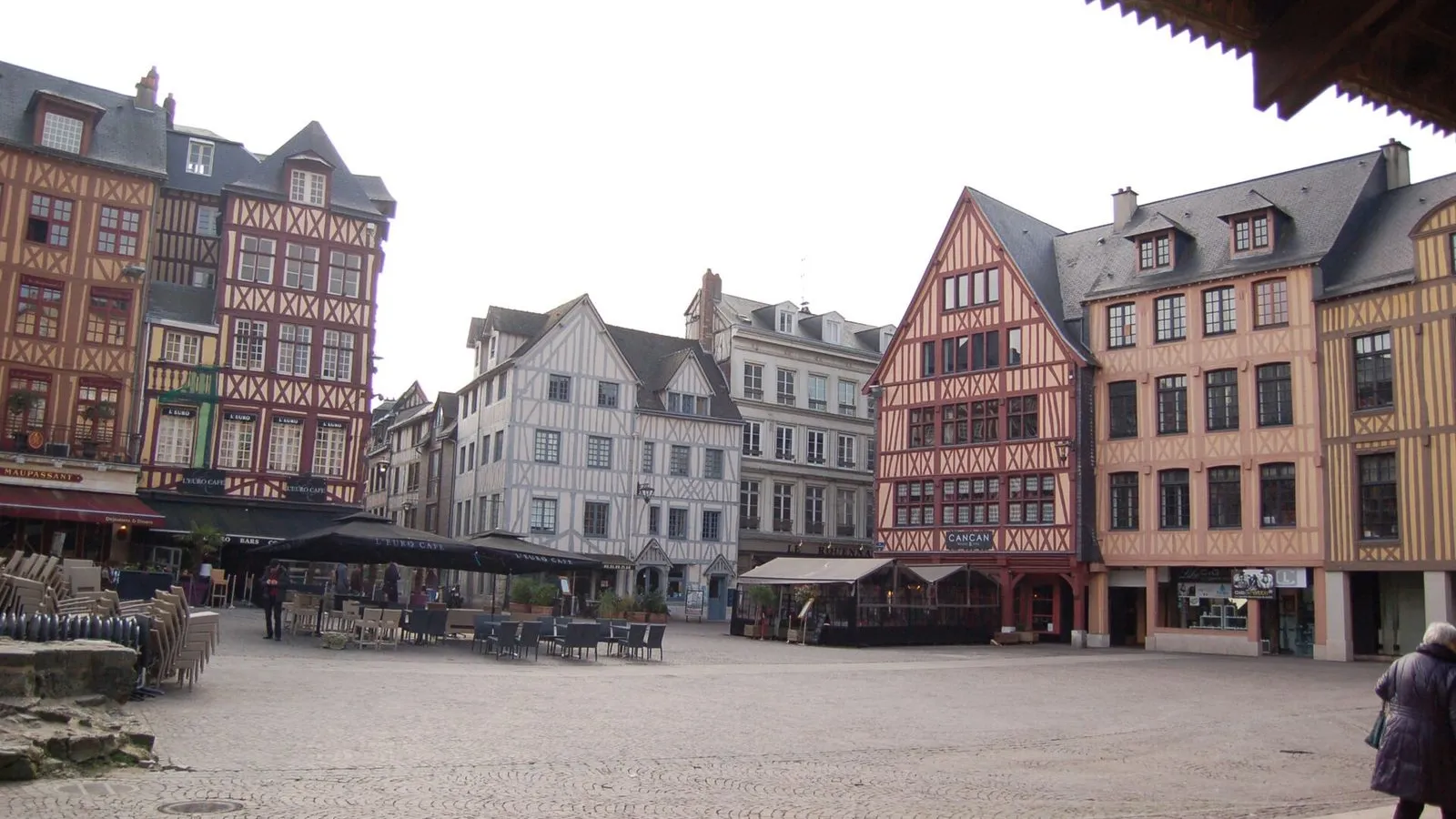
You're standing in a market square that has done two jobs at once for six centuries: selling food and remembering an execution. On 30 May 1431, Joan of Arc was burned at the stake in the open part of this marketplace. She was nineteen. Around you, the covered market still sets out cheese, fish, fruit, and flowers Tuesday to Saturday from seven in the morning until seven at night, and again on Sunday morning; it closes on Monday, when the square is left quiet.

The low modern church with the swept-up roof is the Église Sainte-Jeanne-d'Arc, inaugurated in 1979. Its designers kept the marketplace open beneath the eaves, so stallholders and worshippers share the same ground. Inside hang thirteen stained-glass windows from the sixteenth century, pulled from the bombed Église Saint-Vincent and reset here. That is the pattern of this whole walk: nothing in Rouen's old center stays only one thing.

The market and the memorial trade places with the day of the week, and both carry the city's story.
≈2 min walk to the next stop
Half-timbered housesLocal pick

Photo by Jorge Láscar from Melbourne, Australia on Wikimedia Commons

Half-timbered houses

0:00

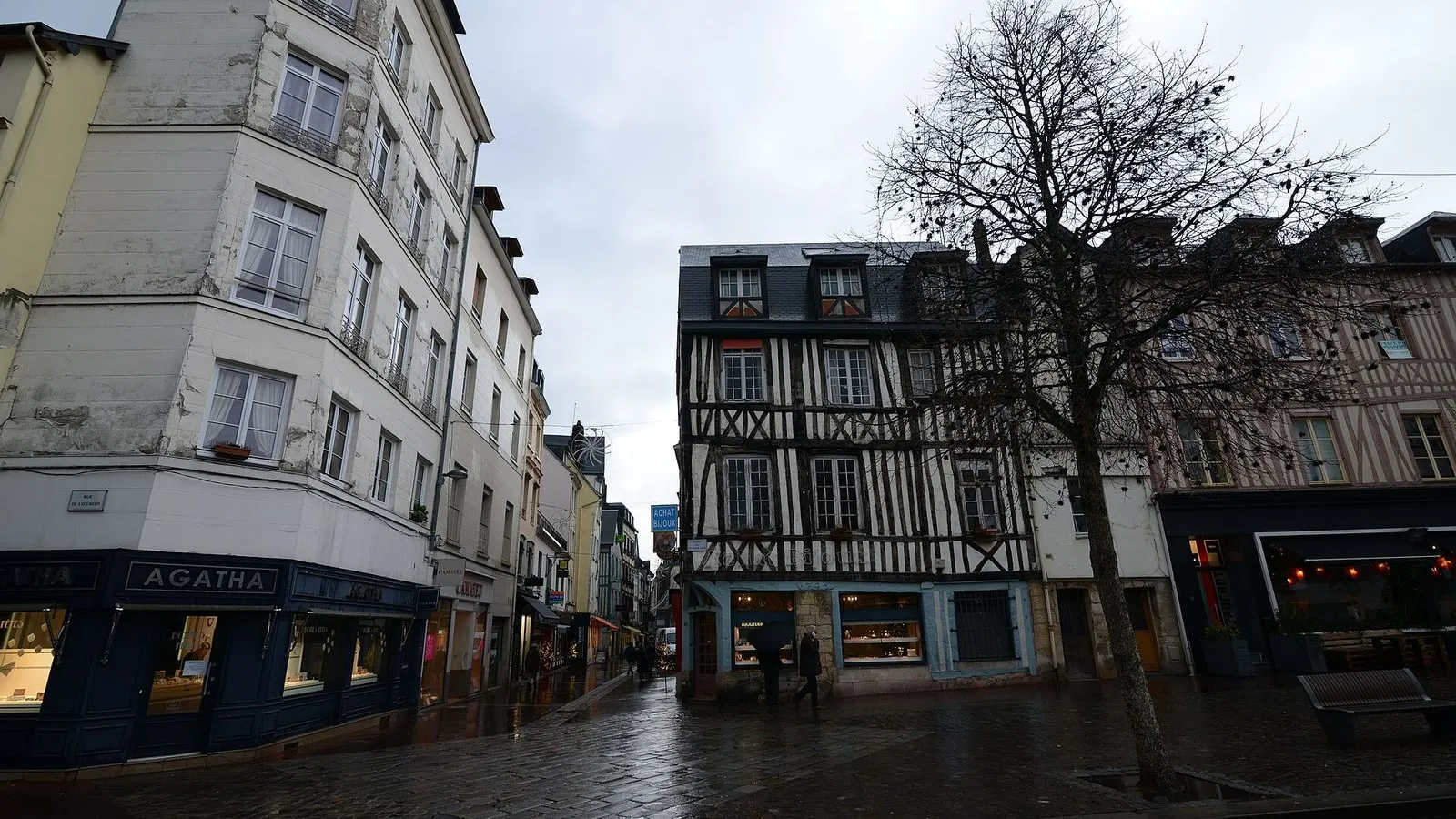
The timber-framed houses of the old town's main street.

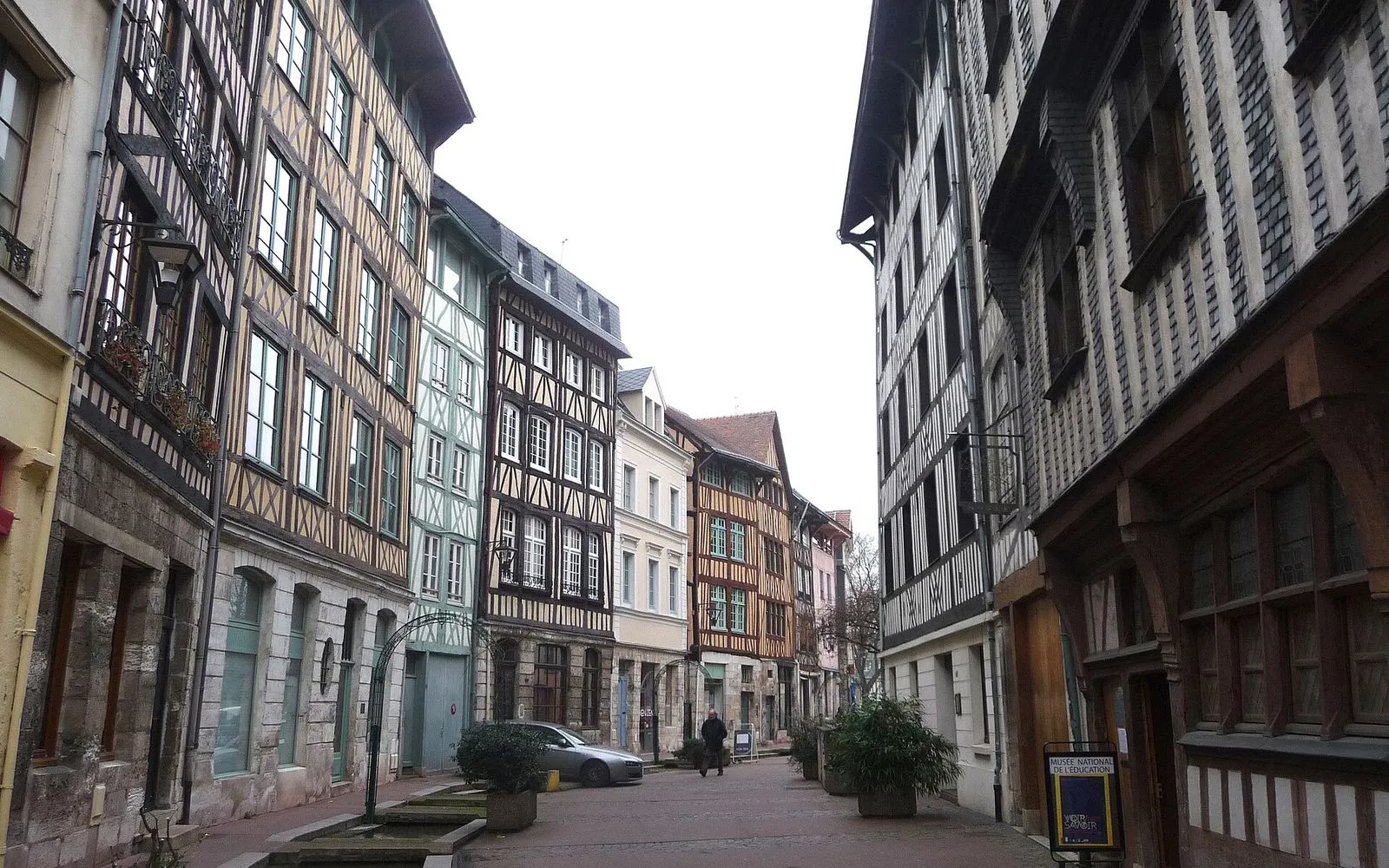
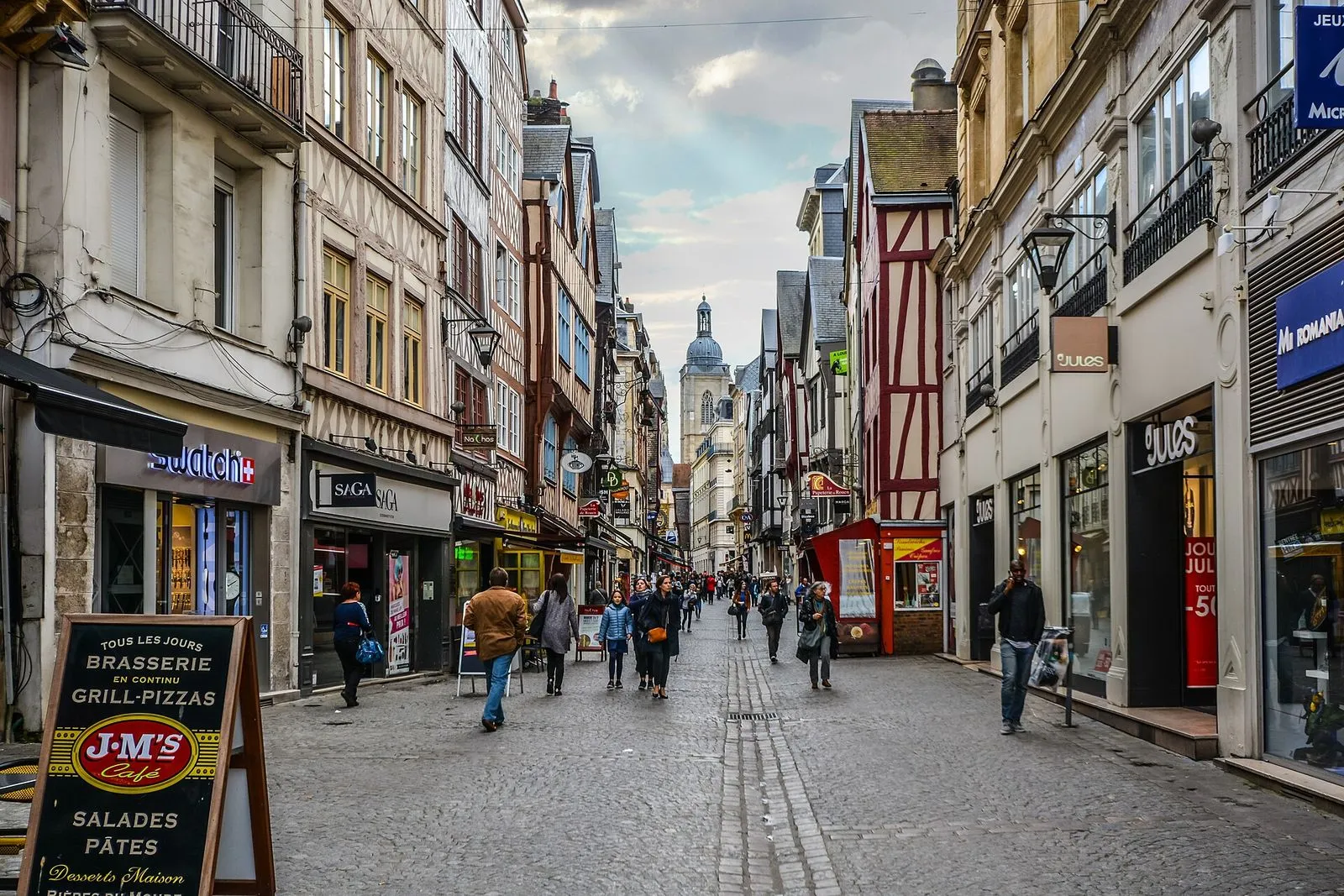
Rouen keeps more half-timbered houses than almost any other city in France, and some of the oldest of them stand on this street. The pattern repeats on both sides: an oak timber frame, the gaps packed with clay and straw, and each floor jutting a little further over the street than the one below, so the upper rooms gained space while the pavement stayed narrow. Three of the houses here may predate 1431, which means their beams were already standing when Joan of Arc was led through this street toward the market square. That is a rarer thing than it sounds.

Fire and the bombs of 1944 flattened much of Rouen, and what survives here survived because it was built to be repaired beam by beam. The bright reds, blues, and ochres are the restorers' work, repainting timber and plaster in shades the medieval street would have known. The street became pedestrian in 1971, the first pedestrian street in France. The only traffic now is footfall, the sound these paving stones have known for centuries.

≈2 min walk to the next stop
Gros-HorlogeMust see

Photo by Andy Hay on Openverse

Gros-Horloge

0:00

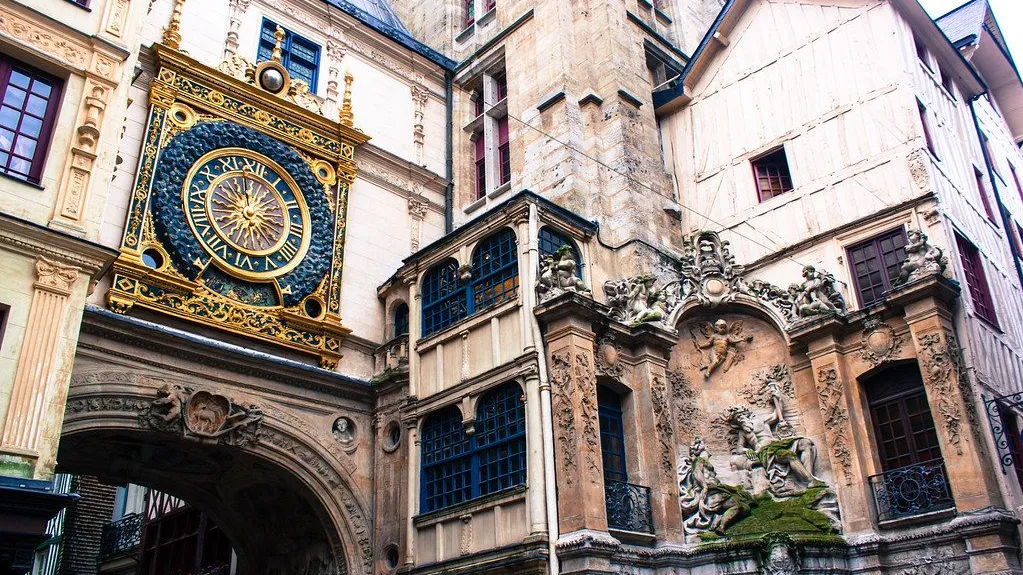
A one-handed astronomical clock above the old street.

Look up. The golden dial above the arch is Rouen's oldest civic machine, and it has only one hand. That single hand has marked the hours since the mechanism was made in 1389, which makes it one of the oldest working clock movements in Europe. The sheep carved all around it advertise the wool trade that paid for nearly everything here, including the bells in the gothic tower behind the clock.

Those bells were the town's voice, rung for markets, alarms, and the freedoms the city had won from its lords. A small globe above the dial turns with the phases of the moon. The museum opens every day except Monday, and the visit ends by climbing the belfry itself. Up there, the roofs of the old town spread out and you can trace the straight line you have just walked, from the market square back to this arch.

The clock told the town it was a town.

≈2 min walk to the next stop
Free preview ends here · stops 4 to 6 continue in the app

Palais de Justice

The largest civil Gothic courthouse in France.

in app

Cathédrale Notre-Dame de Rouen

The west front Monet painted from across the square.

in app

Historial Jeanne d'Arc

Joan's trial and rehabilitation, under one roof.

in app
Good to know

Before you go

Which stops on this walk charge entry?

Two stops on this walk charge entry. Climbing the Gros-Horloge belfry costs 7.85 euros, or 4 reduced and free under 6, and the Historial Jeanne d'Arc costs 12 euros, or 9 reduced, with a 36 euro rate covering two adults and two under-18s. Place du Vieux-Marché, the half-timbered street, the Palais de Justice and the cathedral are all free to walk up to and enter.

SourceVille de Rouen, Gros-HorlogeHistorial Jeanne d'Arc, infos pratiques
When is the best time to start this walk?

Start this walk in the morning. The Vieux-Marché covered market trades Tuesday to Saturday from 7:00 to 19:00 and Sunday from 7:00 to 13:00, so the square is at its fullest early, and the Gros-Horloge belfry opens at 10:00 between April and September. From 1 October the belfry opens only at 14:00, which turns the walk into an afternoon. On Mondays both the market hall and the belfry are closed.

SourceVille de Rouen, Marché Place du Vieux-MarchéVille de Rouen, Gros-Horloge
Is the cathedral still worth it during the spire work?

Yes. Cathédrale Notre-Dame stays open every day and the high spire work that began in summer 2026 leaves the west front Monet painted unaffected. The nave does not close at midday from Tuesday to Saturday. The 12:00 to 14:00 break you may see published belongs to the cathedral shop. Monday is the exception: the doors open only at 14:00.

SourceCathédrale Notre-Dame de Rouen

Provenance · last verified August 28, 2026

Built from the Wayside route itself: the stops, their order, and the walk between them.

Photo by kirkandmimi on Wikimedia Commons · CC0

Photo by KoS on Wikimedia Commons · CC BY-SA 4.0

Photo by Jorge Láscar from Melbourne, Australia on Wikimedia Commons · CC BY 2.0

Photo by Andy Hay on Openverse · CC BY 2.0

Photo by Zairon on Wikimedia Commons · CC BY-SA 4.0

Photo by Martpan on Wikimedia Commons · CC BY-SA 4.0

Coming soon

Wayside isn't in the app stores yet, but it's in the works. Check back soon.