Montevideo · Self-guided audio walk

From the Citadel Gate to the Port Market

Cross Montevideo's founding peninsula on foot, from the surviving citadel gate to the iron market hall, and finish over the grills.

  • 12Stops
  • 2.7 kmDistance
  • 50+ minTime
From the Citadel Gate to the Port Market

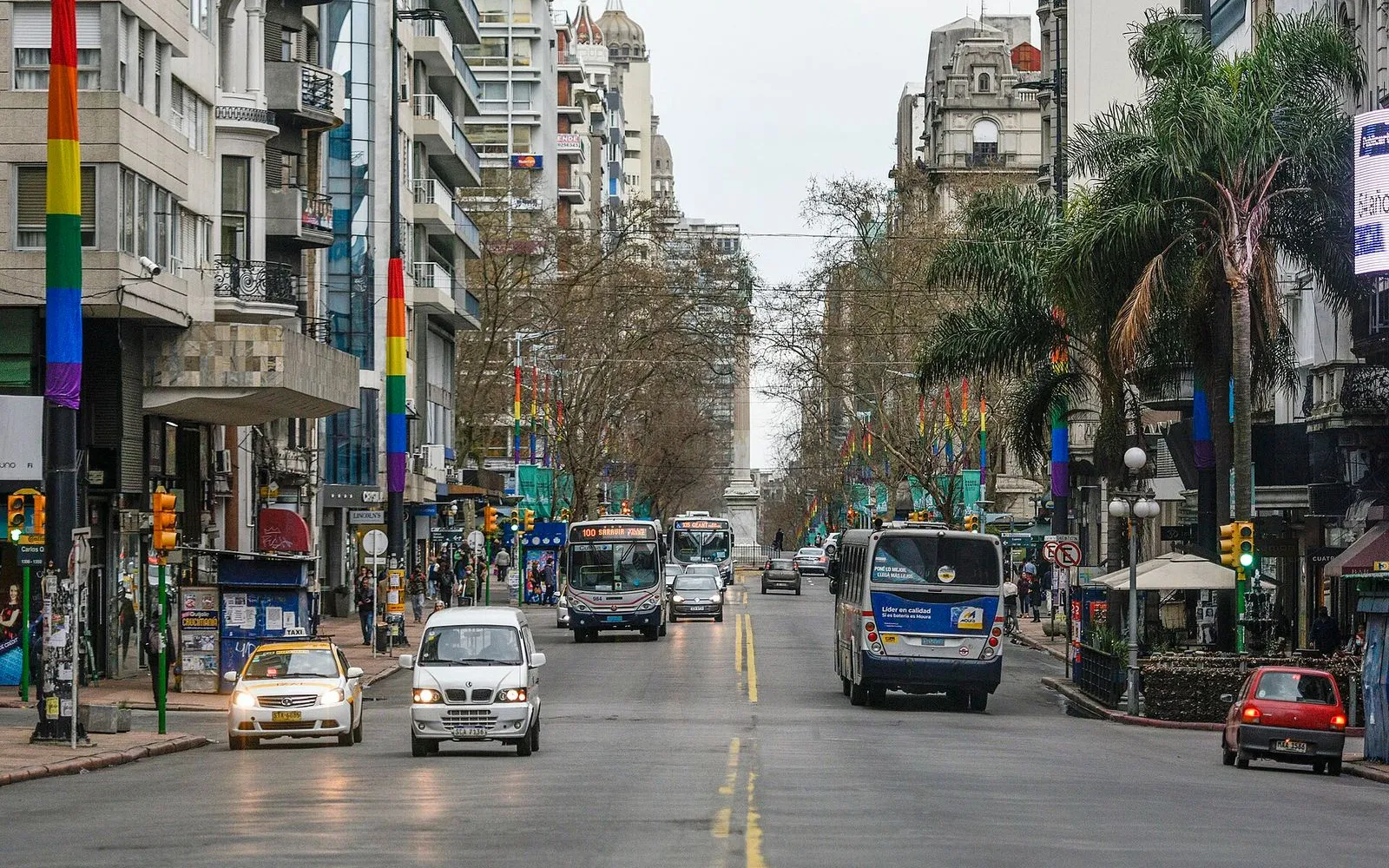
Photo by Helge Høifødt on Wikimedia Commons

Montevideo began behind a citadel wall, and this walk crosses the whole old peninsula from that surviving gate to the iron market hall by the port. You start in Plaza Independencia, where the fortress once stood and where José Gervasio Artigas now lies beneath the square, then thread down Peatonal Sarandí, the pedestrian spine that linked the gate to the old port.

Along the way you step inside the restored Teatro Solís, the museum of painter Joaquín Torres García, the cathedral and Cabildo on Plaza Matriz, and the palace turned decorative arts museum on leafy Plaza Zabala. The route ends at the Mercado del Puerto, where wood smoke and parrilla grills close the founding story over lunch.

Plan about two and a half hours, longer if you linger in the museums or over a steak.

Hear it on the street

Get the turn-by-turn audio guide in the app. The narration plays itself as you reach each stop, hands-free and offline.

Stop by stop

The route

Interactive map of the route. The full stop list below works without it.

Plaza IndependenciaMust see

Photo by Fulviusbsas on Wikimedia Commons

Plaza Independencia

0:00

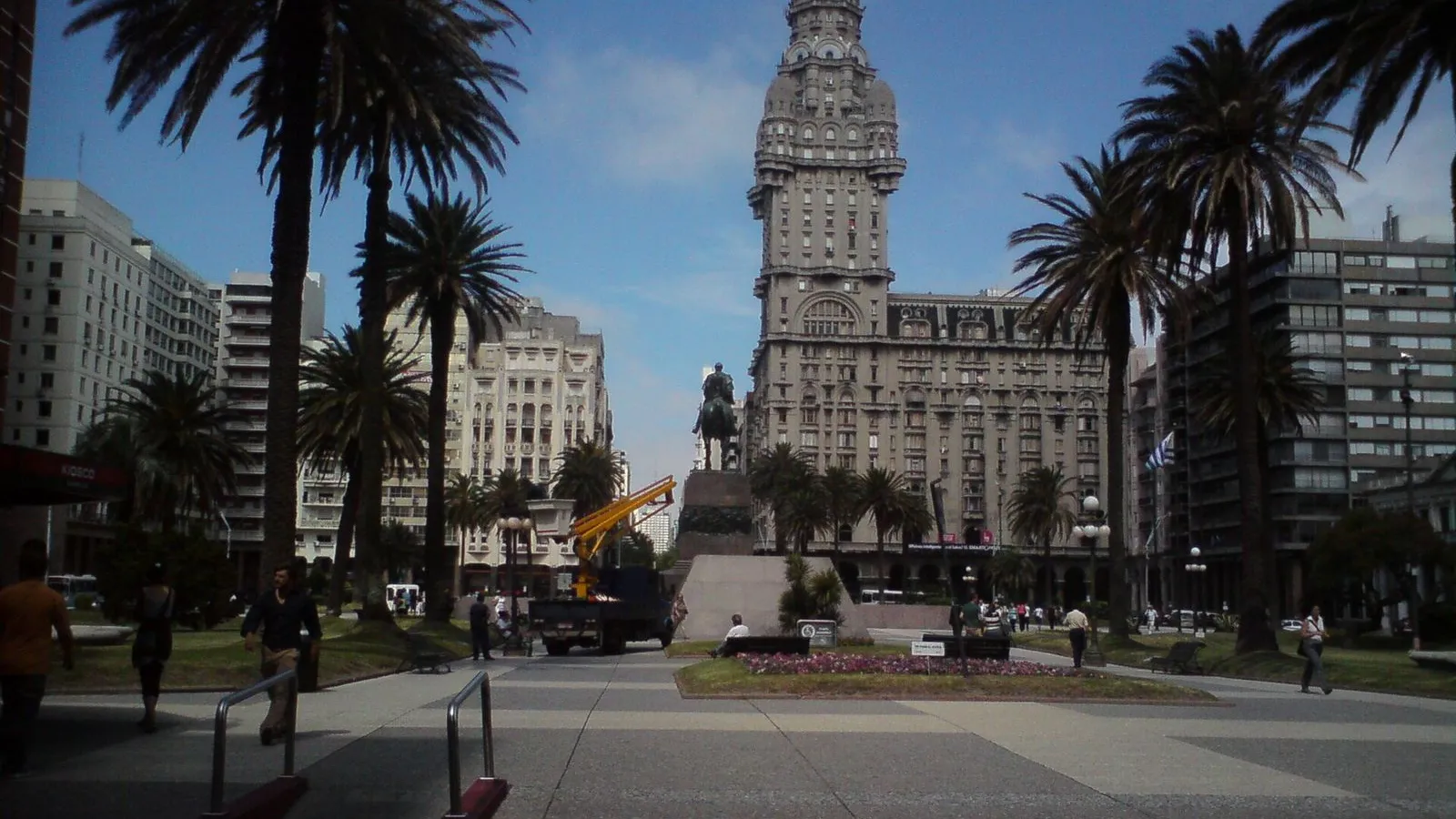
The city's main square, built where the colonial Citadel once stood, with the Artigas monument and underground mausoleum at its center.

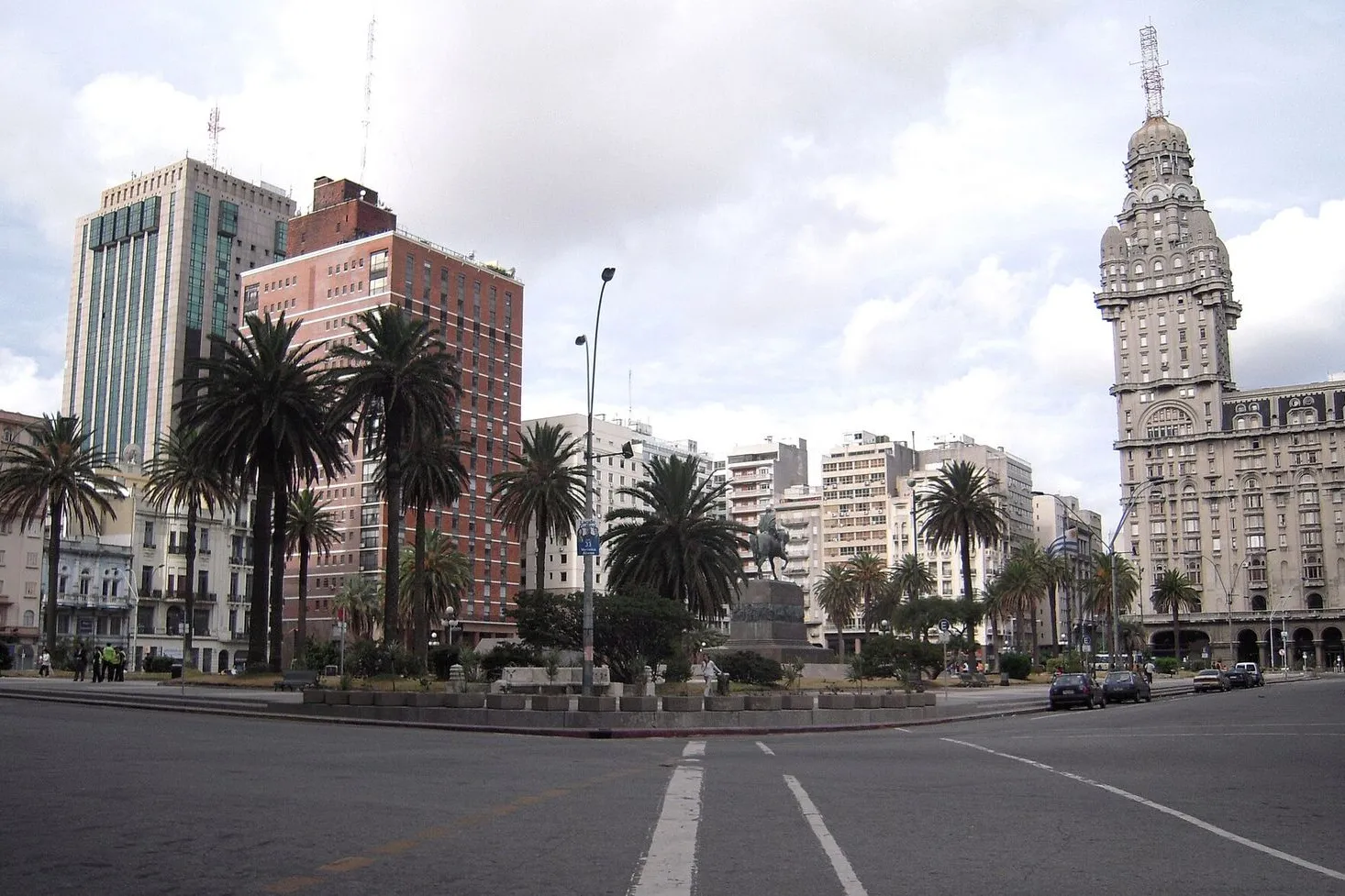
You're standing in Plaza Independencia, the hinge where Montevideo's walled colonial city met the new city that grew after independence. For more than a century this ground was the Citadel, a thick stone fortress that guarded the landward side of the Spanish town. Its walls filled the western half of the square you see now, and its gate stood roughly where the mausoleum steps descend today. At the center, José Gervasio Artigas rides a bronze horse toward the east.

The statue went up in 1923, but the general's remains didn't arrive here until 1977, when the military government built the underground mausoleum beneath the plaza. Walk down the granite steps and you enter a dim room watched over by two soldiers in the uniform of the Blandengues, the mounted corps Artigas joined as a teenager. The palace behind you with the pale neoclassical face is the old Estévez Palace, the president's house for most of the twentieth century. Across the square, on the corner of 18 de Julio, rises the tower that will be your next stop: the Salvo.
≈2 min walk to the next stop
Palacio SalvoMust see

Photo by Pablao19 on Wikimedia Commons

Palacio Salvo

0:00

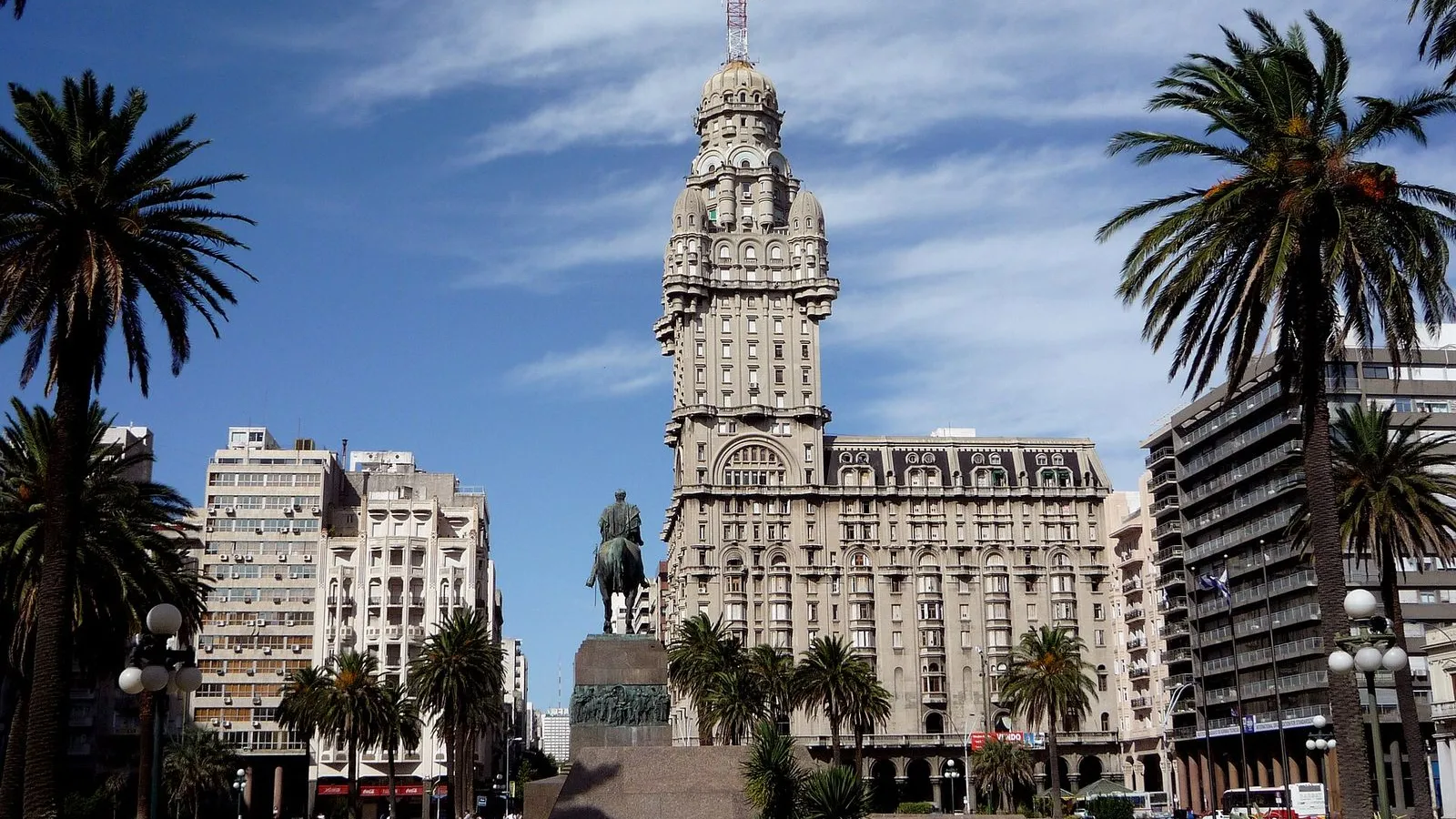
A 1928 eclectic skyscraper that was briefly the tallest building in Latin America, built where La Cumparsita was first played.

Look up at the Palacio Salvo, and you see the moment Montevideo decided it wanted to feel tall. The building was finished in 1928 as a hotel for the Salvo brothers, three businessmen who had made a fortune in wool and textiles. It never opened as a hotel. Instead the twenty seven floors were sold off as offices and apartments, a vertical city behind one eclectic facade.

At the time it was finished it was the tallest reinforced concrete building in the world, and briefly the tallest in Latin America. The architect was Mario Palanti, an Italian working in Buenos Aires, and he built an almost twin tower there, the Palacio Barolo. Palanti imagined the two domes as lighthouses linked by a beam of light across the river; the beams never met. Before the tower stood a pastry shop called La Giralda, and in 1917 a young Gerardo Matos Rodríguez first played his tango La Cumparsita on its piano.

Today a tango museum on the ground floor keeps that story, along with the sheet music and a piano from the original café.

≈4 min walk to the next stop
Puerta de la CiudadelaMust see

Photo by Fatima Cáneba on Wikimedia Commons

Puerta de la Ciudadela

0:00

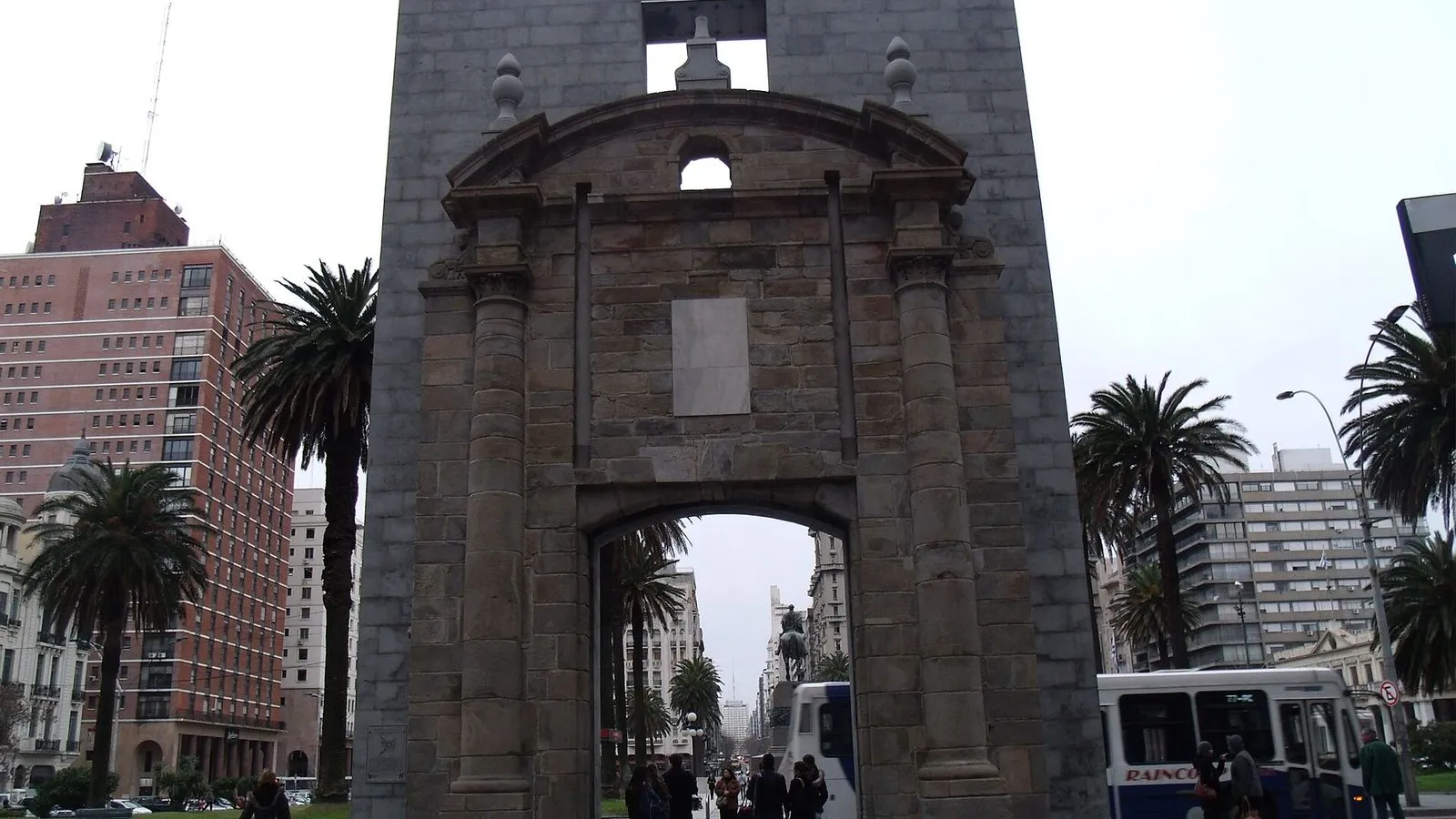
The surviving gateway of the colonial Citadel, moved here when the walls came down.

This stone gate is the oldest piece of Montevideo's defensive wall that still stands where a visitor can touch it. It was built between 1741 and 1780 as the main entrance to the Citadel, the fortress that defended the town from attack by land. Anyone entering the walled city from outside passed beneath this arch, under the watch of soldiers and customs men. When the walls were demolished in 1877 to let the town grow, the gate was taken apart stone by stone and stored, then rebuilt here, aligned with Peatonal Sarandí, the street that was the city's main spine.

Look at the two round towers and the shallow pediment above the arch; this is a military building, functional and stern, but it carries a carved crown and the names of the Spanish monarchs it served. In 1959 it was restored and braced with a concrete buttress behind, and it has been a national historic monument ever since. The opening behind you now is where the whole walk begins to thread into the old town.

≈3 min walk to the next stop
Free preview ends here · stops 4 to 12 continue in the app

Teatro Solís

The restored neoclassical theatre that opened in 1856 and remains the country's main stage.

in app

Museo Torres García

A museum devoted to the Uruguayan painter whose upside down map of South America became a symbol.

in app

Plaza Matriz

The founding square of Montevideo, home to the colonial cathedral and the old town's civic heart.

in app

Catedral Metropolitana de Montevideo

The neoclassical cathedral consecrated in 1804, seat of the archdiocese and the city's main colonial church.

in app

Cabildo de Montevideo

The colonial town hall where Uruguay's first constitution was sworn, now the city's historical museum.

in app

Plaza Zabala

A leafy 1890 garden square that breaks the old city's grid, with the equestrian statue of the city's founder at its center.

in app

Palacio Taranco

A 1910 French style palace turned decorative arts museum, facing leafy Plaza Zabala.

in app

Museo del Carnaval

A museum of Uruguay's carnival, its murga songs and candombe drums, on the old port Rambla.

in app

Mercado del Puerto

The 1868 iron market hall that became the city's great parrilla grill hall.

in app
Good to know

Before you go

Do I need to book the Teatro Solís guided tour in advance?

No. Guided tours run Tuesday to Friday at 11:00, 12:00 and 16:00, and Saturday and Sunday at 15:00 and 16:00. They cost 400 pesos for foreigners and 200 with a Uruguayan ID, and they are free on Wednesdays. Buy at the theater box office.

SourceTeatro Solís
Is the Mercado del Puerto open every day?

Yes. The market hall opens Monday to Friday 9:00 to 17:00, Saturday 9:00 to 17:00, and Sunday 10:00 to 17:00, while the outside terraces run until midnight. Sunday lunch is the busiest moment, with the grills and the musicians both in full swing.

SourceMercado del Puerto

Provenance · last verified August 20, 2026

Built from the Wayside route itself: the stops, their order, and the walk between them.

Photo by Helge Høifødt on Wikimedia Commons · CC BY-SA 3.0

Photo by Fulviusbsas on Wikimedia Commons · Public domain

Photo by Pablao19 on Wikimedia Commons · CC BY-SA 3.0

Photo by Fatima Cáneba on Wikimedia Commons · CC BY-SA 3.0

Photo by Intendencia de Montevideo on Wikimedia Commons · CC BY-SA 4.0

Photo by bullit on Wikimedia Commons · CC BY 3.0

Photo by Vince Alongi on Openverse · CC BY 2.0

Coming soon

Wayside isn't in the app stores yet, but it's in the works. Check back soon.