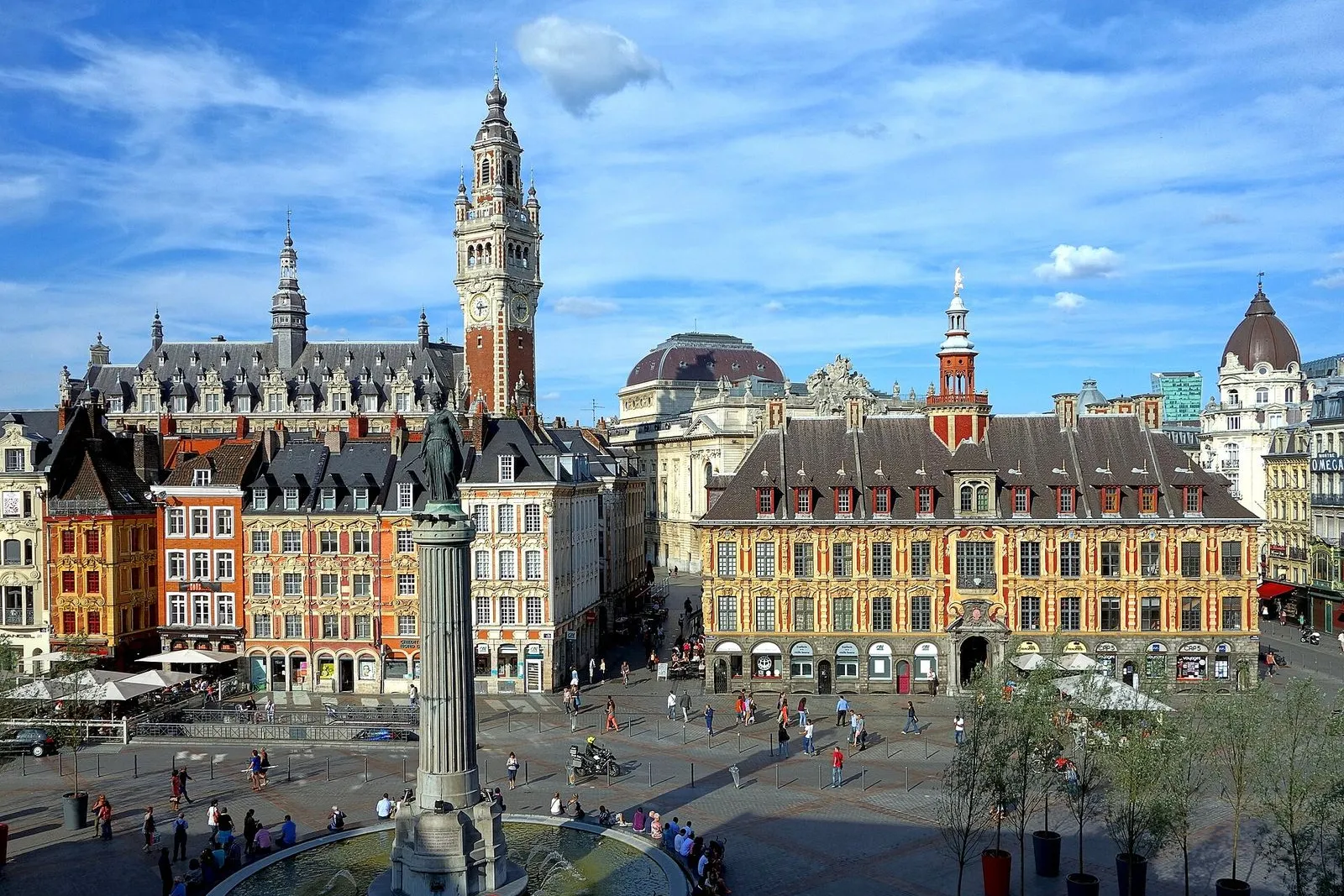
This is what to know before a first visit to Lille: how to get in from the airport, how the metro and tram work, when to come, and what to book ahead. For visa and entry rules, the currency, plugs, inter-city trains and national holidays, see the France country guide.
The direct Flibco airport shuttle between Lille-Lesquin and the station area costs €7.99 online and €9 from the driver, one way, and takes about 20 minutes.SourceAéroport de Lille
A single ilévia ticket costs €1.90 and is valid for one hour on the metro, tram, bus and TER within the Métropole Européenne de Lille.Sourceilévia
The Métropole charges a nightly tourist tax per adult on every paid stay, set by accommodation class; under-18s are exempt, and a 3-star hotel is about €1.76 per adult per night.SourceMétropole Européenne de Lille
The Palais des Beaux-Arts closes on Tuesdays and opens only 14:00 to 18:00 on Mondays, with Wednesday to Sunday 10:00 to 18:00.SourcePalais des Beaux-Arts de Lille
The Braderie de Lille, one of Europe's biggest street flea markets, takes over the city centre for the weekend of the first Sunday in September; in 2026 it runs 34 hours, from 08:00 on Saturday 5 September to 18:00 on Sunday 6 September.SourceVille de Lille
When to go
When is the best time to visit Lille?
Spring
Months
March to May
Weather
Average temperatures climb from 7.5°C in March to 13.8°C in May, with 45 to 62mm of rain a month.SourceMétéo France
Crowds
A shoulder season with mild walking weather and the Wazemmes markets in full swing; fewer tourists than summer.
Summer
Months
June to August
Weather
The warmest season averages 16.7 to 18.9°C, with daytime highs around 21 to 24°C; rain still falls regularly, about 64 to 71mm a month.SourceMétéo France
Crowds
Peak visitor season and the warmest days; the centre is busy, though August can thin out as locals leave on holiday.
Autumn
Months
September to November
Weather
Temperatures drop from 15.8°C in September to 7.6°C in November, and November is the wettest month at about 75mm of rain.SourceMétéo France
Crowds
September opens with the Braderie de Lille, which floods the city and fills hotels; the rest of autumn is calmer and damp.
Winter
Months
December to February
Weather
Winters are cold and damp, averaging about 4 to 5°C, with December the rainiest winter month at around 73mm.SourceMétéo France
Crowds
Quiet and grey apart from December, when the Christmas market lights the Grand'Place and short days push sightseeing into the early afternoon.
When to visit Lille, by season
Season
Months
Weather
Crowds
Spring
March to May
Average temperatures climb from 7.5°C in March to 13.8°C in May, with 45 to 62mm of rain a month.SourceMétéo France
A shoulder season with mild walking weather and the Wazemmes markets in full swing; fewer tourists than summer.
Summer
June to August
The warmest season averages 16.7 to 18.9°C, with daytime highs around 21 to 24°C; rain still falls regularly, about 64 to 71mm a month.SourceMétéo France
Peak visitor season and the warmest days; the centre is busy, though August can thin out as locals leave on holiday.
Autumn
September to November
Temperatures drop from 15.8°C in September to 7.6°C in November, and November is the wettest month at about 75mm of rain.SourceMétéo France
September opens with the Braderie de Lille, which floods the city and fills hotels; the rest of autumn is calmer and damp.
Winter
December to February
Winters are cold and damp, averaging about 4 to 5°C, with December the rainiest winter month at around 73mm.SourceMétéo France
Quiet and grey apart from December, when the Christmas market lights the Grand'Place and short days push sightseeing into the early afternoon.
The practical guide
Everything to sort before you go
Getting in from the airport
Lille-Lesquin airport sits a short drive southeast of the center. The fastest way in is the dedicated Flibco airport shuttle, which drops you by Place des Buisses near Lille-Flandres station in about 20 minutes and runs every day including public holidays. The city has two rail stations a short walk apart: Lille-Flandres, the old-city station for regional and many TGV services, and Lille-Europe, the modern hub for Eurostar and most long-distance high-speed trains. Both sit directly on the metro and tram network, so you can reach Vieux Lille in minutes. Lille is a border city, closer to Brussels than to Paris by rail, and the Belgian towns of Tournai, Mouscron and Kortrijk are local TER stops rather than a separate trip.
The Flibco airport shuttle costs €7.99 one way booked online, €9 from the driver, and €13.99 return online, with a roughly 20-minute trip to the city-center station area. SourceAéroport de Lille
ilévia bus 68 serves the airport from the 4 Cantons metro station, where you change to the metro for the center. SourceAéroport de Lille
The fastest train from Paris reaches Lille in 58 minutes; TGV INOUI services leave Paris Nord for Lille-Flandres or Lille-Europe in about an hour, and a direct TER covers the same route in about 2 hours 10 for less. SourceSNCF Connect, trajet Paris - Lille
Eurostar runs London St Pancras to Lille-Europe in 1 hour 22 minutes. SourceEurostar, London to Lille
Eurostar runs Lille-Europe to Brussels-Midi/Zuid in 35 minutes, which is shorter than the ride in from the airport on some days. SourceEurostar, Lille to Brussels
Tournai, in Belgium, is 28 km away and reachable by direct TER from 23 minutes, with the first train out at 06:01 and the last at 22:08. SourceSNCF Connect, trajet Lille - Tournai
Getting around
Lille's center is compact and mostly flat, so walking covers Vieux Lille, the Grand'Place and the Palais des Beaux-Arts without a ticket. For longer hops, ilévia runs the metro, trams and buses across the Métropole, and a single ticket covers the whole network for an hour. V'Lille, the docked bike share, is the other way to cross the city, on its own subscription rather than a transit ticket. The Halles de Wazemmes covered market opens Tuesday to Saturday and Sunday morning and closes all day Monday; the open-air market on Place de la Nouvelle-Aventure runs Tuesday, Thursday and Sunday mornings only. The city zoo closes on Tuesdays and opens only from 28 March to 27 September.
A single ilévia ticket costs €1.90 and is valid for one hour on the metro, tram, bus and TER across the Métropole. Sourceilévia
The ZAP ticket costs €1.20 for short metro or tram hops of up to 3 stations. Sourceilévia
The Pass 1 jour costs €5.70 for unlimited travel for 24 hours on ilévia and TER within the Métropole. Sourceilévia
A carnet of 10 single tickets costs €16.60. Sourceilévia
V'Lille had 2,600 bikes across 260 docking stations as of 1 January 2024, on a network of roughly 1,000 km of cycle paths across the Métropole. SourceV'Lille
Money and payments
The one local extra you will notice on a hotel or rental bill is the tourist tax, charged per adult per night and collected by the host, with under-18s exempt. It varies with the accommodation's star rating or classification, so it comes to a euro or two on a mid-range hotel, not a flat fee. There is no separate city entry fee and no local surcharge to budget for elsewhere. Cards are taken almost everywhere, contactless included, but the Wazemmes stalls and the smaller food stands still run on cash, so carry a note or two on a market morning. Restaurant prices are quoted with service included, so a tip is a rounding-up rather than a percentage.
The tourist tax applies to every paid overnight stay, with rates set by accommodation class; a 3-star hotel is about €1.76 per adult per night, and unclassified rentals are capped at €5.06 per person per night. SourceMétropole Européenne de Lille
Safety and common scams
Lille is generally safe for visitors, and the center feels busy and watchable into the evening. The two places to be most alert are the same as in any large French city: the crowded Wazemmes market and the area around Gare Lille-Flandres, where pickpockets work packed spaces. Keep a hand on your phone and wallet in the Sunday market crush, and do not leave bags hanging off chairs at café terraces. The old town and Rue Masséna stay lively late, which is mostly a good thing for anyone walking back to a hotel.
For the police, dial 17 or 112. The 114 line is the emergency route for anyone who cannot make a voice call. SourceMa Sécurité, ministère de l'Intérieur
Health and emergencies
French pharmacies show a green cross, and a pharmacist will deal with a minor problem across the counter without an appointment or a referral. When they are shut, the closed door carries the address of the pharmacie de garde on rota that night. The CHU de Lille runs the city's emergency departments and the ambulance service together, so a serious problem goes through the medical emergency number rather than to a hospital door. Tap water is drinkable across the Métropole. No vaccination is required to enter France, and nothing about a walking visit to Lille calls for one.
The CHU de Lille's Pôle de l'Urgence holds the SAMU, the SMUR and the Centre 15 alongside the adult and paediatric emergency departments and the poison-control centre, so one call reaches whichever one you need. SourceCHU de Lille, pôle de l'Urgence
A European Health Insurance Card is free from your own insurer and covers state healthcare in France, but it does not cover private care and it does not cover treatment you travelled here for. SourceYour Europe, health cover for temporary stays
Staying connected
Sockets are the French type E: two round pins, with the earth pin standing up out of the socket itself. The supply is 230 volts at 50 hertz, so British and Irish plugs need an adapter and North American appliances need to be dual voltage as well. Mobile coverage is good across the Métropole and holds underground on both metro lines. Free wifi is normal in cafés and in both stations. A visitor from outside the EU staying more than a few days will usually pay less on a French eSIM than on a home carrier's roaming rate.
A visitor on an EU mobile plan pays no roaming surcharge in France: calls, texts and data come out of the home allowance under the EU's roam-like-at-home rules. SourceYour Europe, mobile roaming costs
Operators may apply a fair-use limit to roaming, and yours should text you as you cross the border to say what it is. SourceYour Europe, mobile roaming costs
Etiquette and tipping
People in Lille are famously warmer and more direct than the Parisian stereotype, and a little politeness goes a long way. Say bonjour when you walk into a shop or café and au revoir when you leave, and add s'il vous plaît before requests. Skipping the greeting is the one thing that reliably lands badly. Restaurant service is unhurried, so catch a server's eye rather than waving across the room, and expect to keep a café table as long as you like once you have ordered. Market prices are fixed and haggling is not done, though a stallholder will often round down on the last of something. The northern Ch'ti identity is a point of local pride, and asking about it usually opens a conversation rather than causing offence.
The language
French is the working language everywhere. In the surrounding Nord region some older residents still speak Ch'ti, a Picard dialect, but in central Lille you will hear standard French, with Ch'ti surfacing mostly in place names, food names and jokes. English is spoken in hotels, museums and by many younger people, though less universally than in Paris, so a few French phrases for shops and cafés make the old town easier. The museums label in French and English, and the tourist office works in both. Flemish spellings survive on the map around the city, in street and village names, which is a reminder of how close the border is rather than a second language in daily use.
Accessibility
The airport shuttle is wheelchair accessible, and ilévia runs Handipole, a door to door accessible transport service that can be booked in advance. In the old town, expect uneven cobblestones and narrow kerbs on Rue de la Monnaie and around Vieux Lille, which are harder with a chair or a stroller. The Grand'Place and the wide boulevards are flat and easier to navigate, and so is Boulevard de la Liberté, which runs level from the museum square to the citadel park. The paths inside the Jardin Vauban and the citadel park are surfaced and gently graded. The Palais des Beaux-Arts has lifts to every floor, though the first floor is closed for refitting for part of 2026.
Handipole, ilévia's on-demand accessible transport service, costs €3.20 per trip. SourceMobiLille
The Flibco airport shuttle is wheelchair accessible via a platform at the rear doors. SourceAéroport de Lille
Public holidays and hours
The city's two big calendar moments are the Braderie de Lille, the vast street flea market held the weekend of the first Sunday in September, and the Christmas market that fills the Grand'Place in December. Hotels fill well in advance for the Braderie, and shops around the market square can keep irregular hours during it; large parts of the centre close to traffic for the weekend, so arrive by train rather than by car. National public holidays affect opening hours across France, so check the country guide for those dates. The 1st of May is the strictest of them, when almost everything except cafés and the parks stays shut, and museums close on their usual weekday whatever else is happening.
The Braderie de Lille runs the weekend of the first Sunday in September; in 2026 it runs 34 hours, from 08:00 on Saturday 5 September to 18:00 on Sunday 6 September. SourceVille de Lille
What to book ahead
Book the airport shuttle online before you land to pay €7.99 instead of €9 from the driver, and book hotels months ahead for the Braderie weekend in September or the December Christmas market. The Palais des Beaux-Arts is worth planning around because it closes on Tuesdays and keeps only an afternoon opening on Mondays; much of its upper floor is shut for refitting into 2027, so check what is on view before you commit a full afternoon. If you mean to see three or more paying sites in a couple of days, price the Lille City Pass against the individual tickets first: it pays back on a museum-heavy plan and not on a walking one.
The Palais des Beaux-Arts is closed Tuesdays, opens Monday 14:00 to 18:00 and Wednesday to Sunday 10:00 to 18:00, with admission at €7 full price and €4 reduced. SourcePalais des Beaux-Arts de Lille
The Lille City Pass runs for 24, 48 or 72 consecutive hours, each version sold either as a digital pass or with 24 hours of metropolitan transport for €4 more; the tourist office prices the 48-hour pass at €39. It is sold at the tourist office and online. SourceOffice de Tourisme de Lille, City Pass