Brugge · Self-guided audio walk

Markt, Burg and the merchant canals

Bruges made its money on water. Start under the Belfort, cross the Burg and the old fish market, and follow the canals to the quay where every cargo was weighed and taxed. Seven stops in the old centre.

  • 7Stops
  • 1.6 kmDistance
  • 30+ minTime

This is the first walk Bruges asks you to take, and almost all of it is open on foot. You start on the Markt under the Belfort, whose 366 steps lead to the best view in the city, then drop to the Rozenhoedkaai, the canal bend the postcards are made of.

From there the route runs through the fish market, the Blinde-Ezelstraat and the Burg, where the Basilica of the Holy Blood and the town hall share one square, then along the Groenerei and the Spiegelrei to Jan van Eyckplein, the old harbour quay where cargo was weighed and taxed.

The thread is water: the Reie carried the trade, and the canals still carry the looking. Book a timed Belfort ticket online; weekends and summer cost €16, winter weekdays €15. The basilica is free, its treasury €5. The fish stalls trade Wednesday to Saturday mornings.

Hear it on the street

Get the turn-by-turn audio guide in the app. The narration plays itself as you reach each stop, hands-free and offline.

Stop by stop

The route

Interactive map of the route. The full stop list below works without it.

MarktMust see

Photo by Michael Maga-ao on Unsplash

Markt

0:00

Bruges' market square, the 83-metre Belfort and its 366 steps.

You're standing on the Markt with the Belfort in front of you. The tower is 83 metres of brick and stone, raised in stages between the 13th and 15th centuries, and it is listed as UNESCO World Heritage with the other belfries of Flanders. Climbing it takes 366 steps, up a single spiral staircase that people use in both directions. Partway up you pass the treasury, where Bruges kept its charters, its city seal and its cash in the Middle Ages.

One floor higher is the drum that turns the carillon, and above that the small room where the carillonneur's keyboard waits. Tickets cost 16 euros at weekends, on public holidays and right through the summer, and 15 euros on winter weekdays between 3 November and 31 March. The tower fills up, so book a timed slot online before you come; last entry is an hour before closing. If the queue is long, the square itself deserves ten minutes.

This is where the city has always gathered.
≈4 min walk to the next stop
RozenhoedkaaiMust see

Photo by Ank Kumar on Wikimedia Commons

Rozenhoedkaai

0:00

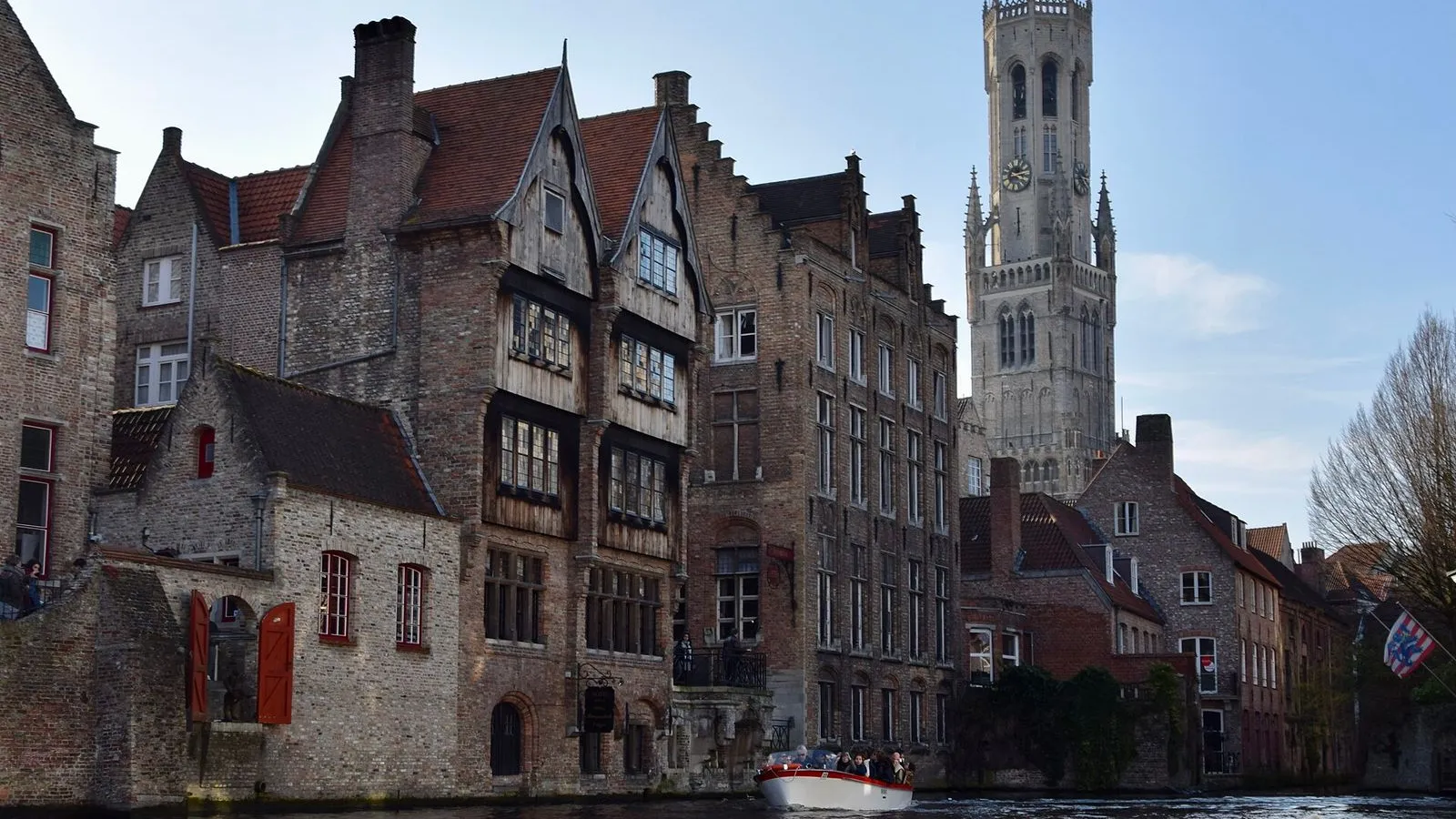
The canal bend on the postcards, once the city's salt quay.

You came down the Wollestraat for this, and here it is. The view runs along the Reie, the river that turned Bruges into a port, and since the late Middle Ages the Reie splits just here into two arms, both of them canalized. One of them, the Kraanrei, was later covered over and now runs beneath the streets behind you. For centuries this quay was called the Zoutdijk, the salt quay, and a document from 1390 calls it the salt stairs by the Eechoutte, where boats were loaded.

Salt mattered more than it sounds: it preserved the herring and the butter the city sold abroad. The pretty name came later, in the 18th century, when stalls on the quay sold rozenkransen, rosaries, to travellers passing through. The quay's position did the work. Between the fish market, the tanners' square and the Pandreitje, a good part of what changed hands in this corner of the city passed in front of you.

Since 2018 the quay, the fish market and the tanners' square have been protected as a single city view.

≈2 min walk to the next stop
VismarktMust see

Photo by Olaf Meister on Wikimedia Commons

Vismarkt

0:00

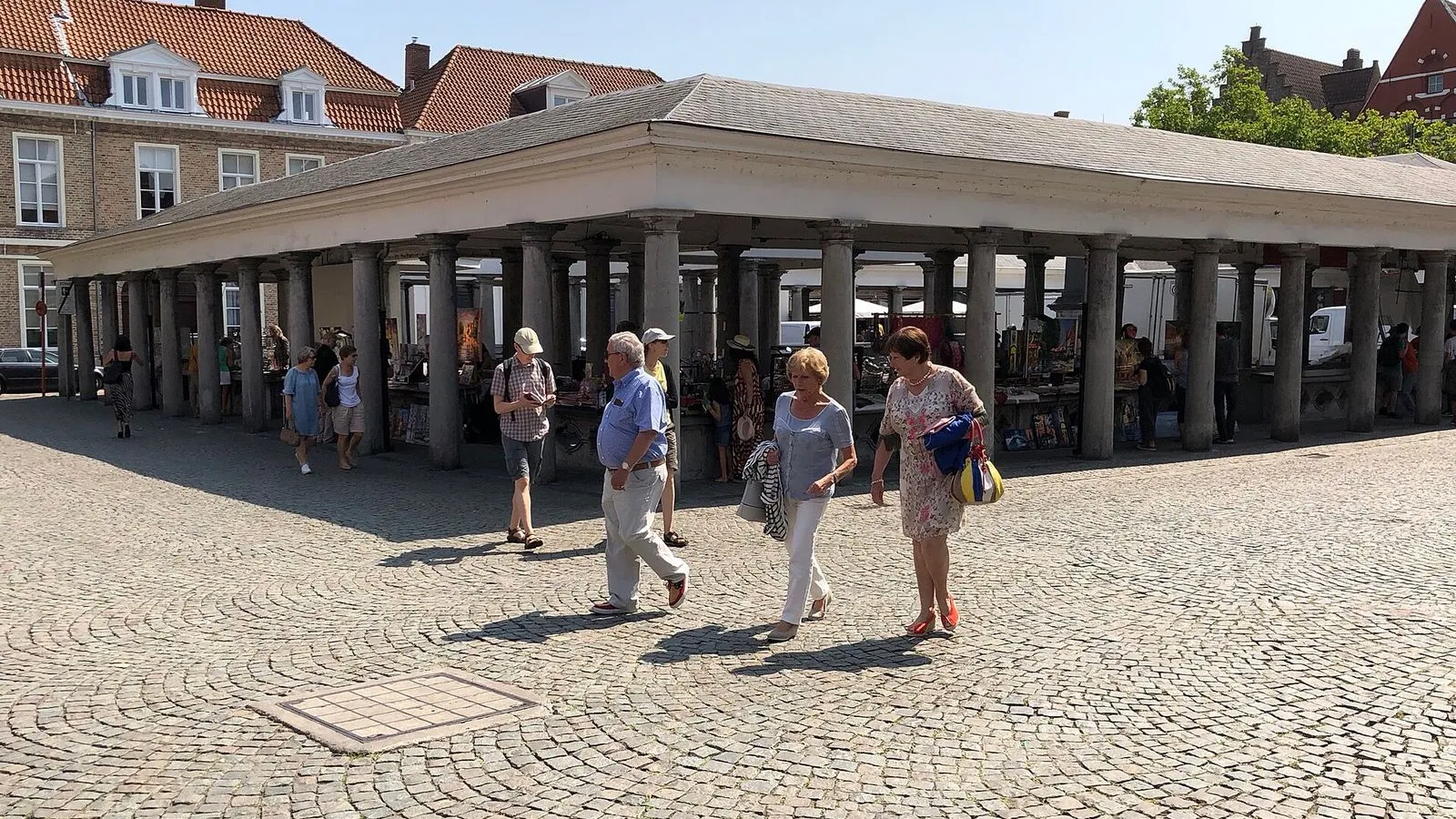
Calloigne's colonnade of 1820, the oldest fish hall in Belgium.

Fish was a luxury here. North Sea fish was sold up on the Markt, and it was the rich who bought it. In the 18th century the fishmongers were banished from the Markt. The smell was the complaint. In 1745 they were moved to this square, then called the Braamberg, a patch of ground between the Groene Rei and the Braambergstraat, and for another 75 years they sold in the open air, rain or not.

In 1820 the city architect Jean-Robert Calloigne gave them the colonnade you see, finished the following year: 126 Tuscan columns with no bases, set in a double row around a rectangular courtyard, with one raised gateway breaking the run of columns. It's the oldest surviving fish hall in Belgium, and the only public building Bruges put up during the Dutch period. Wooden sales tables were replaced by bluestone benches in 1852. In the courtyard a pump sits under a bluestone obelisk. Stalls still sell day-fresh fish, but only from Wednesday to Saturday morning.

≈2 min walk to the next stop
Free preview ends here · stops 4 to 7 continue in the app

Burg

The count's chapel, the Holy Blood relic and the Gothic town hall.

in app

Peerdenbrug

The horses' bridge, over the canal that carried Bruges' trade.

in app

Sint-Walburgakerk

Jesuit church on Sint-Maartensplein, with Bruges' finest pulpit.

in app

Jan van Eyckplein

The old harbour square, the Poortersloge and the toll house.

in app
Good to know

Before you go

Do I need to book the Belfort in advance?

The Belfort is a busy location and works on timed slots, so book online before you come and turn up on time, because a missed slot voids the ticket. Entry costs €16 at weekends and through the summer season, and €15 on winter weekdays. In summer it is open 09:00 to 20:00 daily; in winter, weekdays and Sundays run 10:00 to 18:00 while Saturdays keep 09:00 to 20:00, and the last entry is an hour before closing.

SourceMusea Brugge: Belfort
Is the Basilica of the Holy Blood free to visit?

The Basilica of the Holy Blood is free to enter and opens daily from 10:00 to 17:15. The museum and treasury, where the relic's history is displayed, cost €5 and are free for children under 12. During services the upper or lower church is reserved for those attending, so check the door before you walk in.

SourceBasilica of the Holy Blood
When do the Vismarkt fish stalls trade?

The Vismarkt fish stalls trade on Wednesday to Saturday mornings under the colonnade that Jean-Robert Calloigne built in 1820. Come before noon for grey shrimp and the day's catch, and walk the square at other hours for the colonnade itself, which is the oldest fish hall in Belgium.

SourceVisit Bruges: Vismarkt (Fish Market)

Provenance · last verified September 27, 2026

Built from the Wayside route itself: the stops, their order, and the walk between them.

Photo by Michael Maga-ao on Unsplash

Photo by Michael Maga-ao on Unsplash

Photo by Ank Kumar on Wikimedia Commons · CC BY-SA 4.0

Photo by Olaf Meister on Wikimedia Commons · CC BY-SA 4.0

Photo by Falk2 on Wikimedia Commons · CC BY-SA 4.0

Photo by Ermell on Wikimedia Commons · CC BY-SA 4.0

Coming soon

Wayside isn't in the app stores yet, but it's in the works. Check back soon.