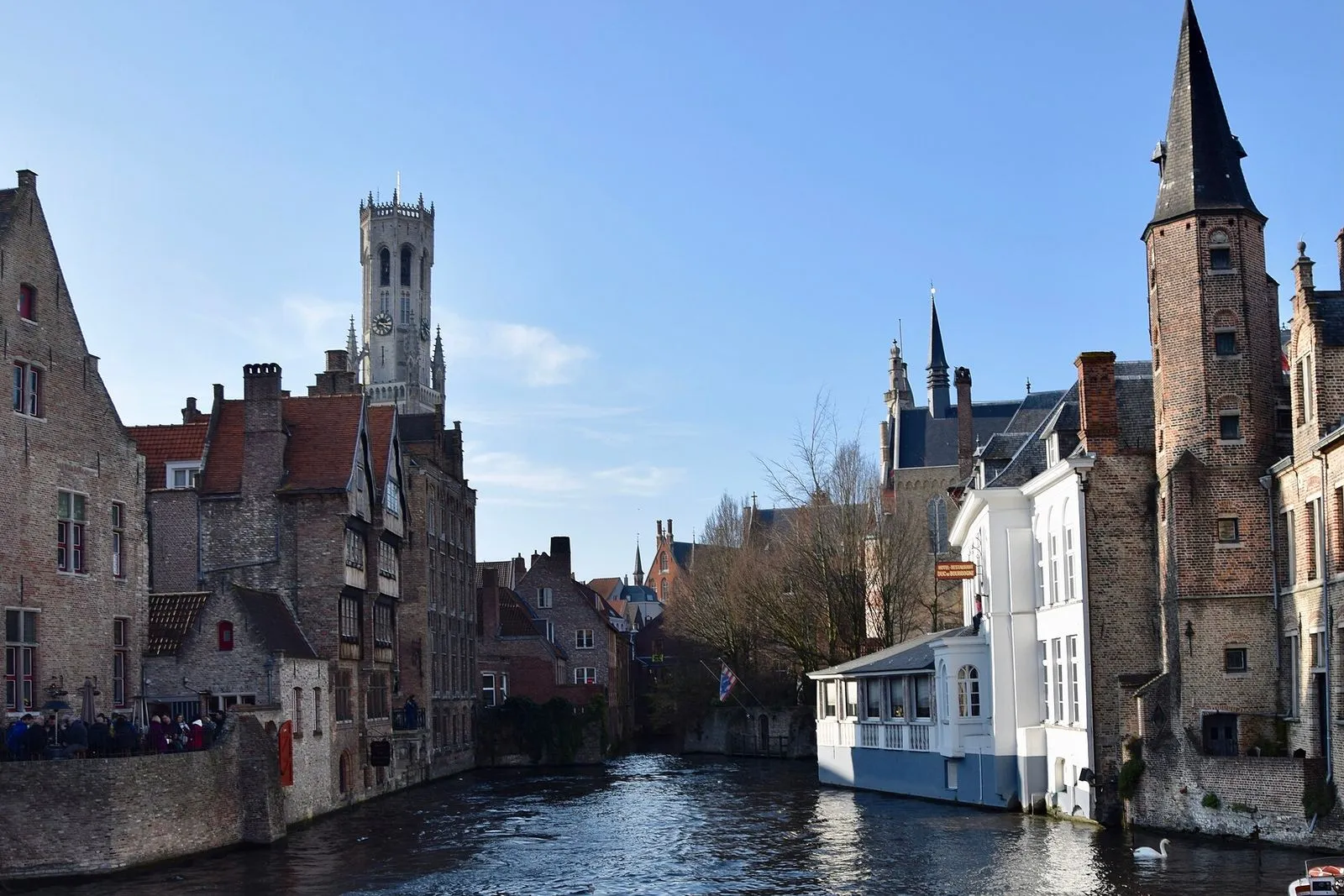
What to know before a first visit to Bruges: trains from Brussels and the airport, buses and bikes, the tourist tax, safety, closing days, and what to book before you go.
Bruges is small enough to walk end to end, and old enough that the streets themselves are the sight, so the pre-trip facts come down to a short list: how to arrive, how to cross the centre, what the city adds to your bill, and what has to be booked before you get there. This guide covers arrival by train from Brussels and from Brussels Airport, the buses and bikes that link Brugge station to the Markt, the nightly tourist tax, local safety and health notes, accessibility, weekly closing days, and the reservations worth making in advance. Visa rules, currency, plug types, and the rest of Belgium's national travel planning sit in the Belgium country guide.
The emergency number in Bruges is 112, free and staffed around the clock for fire, police and medical help; the local police also answer 101.SourceVisit Bruges, practical info
The Musea Brugge Card gives 72 hours of entry to the city's municipal museums for €49, with reduced rates at €37 and €25, and it activates at your first visit.SourceMusea Brugge, tickets
When to go
When is the best time to visit Brugge?
Spring
Months
March to May
Weather
Spring temperatures climb from about 4°C to 16°C, with monthly rainfall of 20 to 37 mm and daylight stretching from roughly 12 to 15.5 hours.SourceWeather Atlas, Bruges climate
Crowds
Easter weekend and the May school holidays fill the centre, and from April the Belfort and the brewery tours sell out on weekends; weekdays in March are still quiet.
Summer
Months
June to August
Weather
Summer averages about 19°C to 21°C, rain runs at 37 to 56 mm a month, and daylight lasts around 16 hours at the height of the season.SourceWeather Atlas, Bruges climate
Crowds
This is peak season on the Markt and along the canals. Reserve museum slots and the brewery ahead, and walk the postcard bends early in the morning if you want them to yourself.
Autumn
Months
September to November
Weather
Temperatures fall from the high teens to around 10°C, November brings up to 48 mm of rain, and the days shorten fast.SourceWeather Atlas, Bruges climate
Crowds
Weekends stay full through September and into October, then the city quiets after the autumn school holidays and several sights move to winter hours.
Winter
Months
December to February
Weather
Winter lows sit near 3°C, December highs reach about 7°C, December is the wettest month at around 56 mm, daylight runs about 8 hours, and snow falls now and then in January.SourceWeather Atlas, Bruges climate
Crowds
Winter is the quietest season outside the Christmas market weeks, when the Markt gets busy again; museums are easy to walk into, but a few sights open on selected days only, such as the Sint-Janshuismolen mill, which runs on the second Sunday of the month in winter.
When to visit Brugge, by season
Season
Months
Weather
Crowds
Spring
March to May
Spring temperatures climb from about 4°C to 16°C, with monthly rainfall of 20 to 37 mm and daylight stretching from roughly 12 to 15.5 hours.SourceWeather Atlas, Bruges climate
Easter weekend and the May school holidays fill the centre, and from April the Belfort and the brewery tours sell out on weekends; weekdays in March are still quiet.
Summer
June to August
Summer averages about 19°C to 21°C, rain runs at 37 to 56 mm a month, and daylight lasts around 16 hours at the height of the season.SourceWeather Atlas, Bruges climate
This is peak season on the Markt and along the canals. Reserve museum slots and the brewery ahead, and walk the postcard bends early in the morning if you want them to yourself.
Autumn
September to November
Temperatures fall from the high teens to around 10°C, November brings up to 48 mm of rain, and the days shorten fast.SourceWeather Atlas, Bruges climate
Weekends stay full through September and into October, then the city quiets after the autumn school holidays and several sights move to winter hours.
Winter
December to February
Winter lows sit near 3°C, December highs reach about 7°C, December is the wettest month at around 56 mm, daylight runs about 8 hours, and snow falls now and then in January.SourceWeather Atlas, Bruges climate
Winter is the quietest season outside the Christmas market weeks, when the Markt gets busy again; museums are easy to walk into, but a few sights open on selected days only, such as the Sint-Janshuismolen mill, which runs on the second Sunday of the month in winter.
The practical guide
Everything to sort before you go
Getting in from the airport
Bruges is reached by train, and the ride is simple. Direct trains from Brussels run several times an hour and take about an hour, landing at Brugge station, which sits a 20-minute walk from the Markt. From Brussels Airport (Zaventem), direct trains to Bruges run roughly hourly and take about an hour and a half; some airport departures involve a change in Brussels, and most tickets to or from the airport include the Diabolo supplement that opens the station gates. Check that your train stops at 'Brugge'; some services call only at Brugge Sint-Pieters, northwest of the centre. Coaches set down at Bargeplein, also about 20 minutes on foot from the Markt. If you want to drop your bags first, left luggage at the station sits opposite the tourist office, with a one-day minimum hire and card payment, and booking ahead is wise.
Brugge station is about a 20-minute walk from the Markt, and bus lines 1 and 2 serve central stops including 't Zand, Sint-Salvatorskathedraal and Dijver. SourceVisit Bruges, travelling to and in Bruges
Left luggage at Brugge station is opposite the tourist office on Stationsplein; the minimum hire is one day, payment is by bank card, and the operator advises booking in advance. SourceVisit Bruges, practical info
Getting around
Bruges' historic centre is compact and mostly pedestrian, so walking covers nearly everything inside the canals, and the one routine ride is between Brugge station and the centre. De Lijn buses 1 and 2 run that link every few minutes, and a single ticket costs €3, a day ticket €9 and a three-day ticket €18; you can tap a contactless bank card or phone on board, so you do not need to hunt for change. Drivers get help too: park at P+R Centrum Station and the city hands out free bus tickets into town with your parking ticket. Cycling is how locals move, and most streets in the old centre sit in a 30 km/h bicycle zone, so expect bikes in shared space; Blue-bike runs a 24/7 rental point at the station with regular and electric bikes through its app, alongside Hoppy's shared e-bikes. Buses keep running in the evening until about 11 p.m., and until about 2 a.m. on Friday and Saturday nights.
De Lijn single tickets cost €3, a day ticket €9 and a three-day ticket €18, and you can pay contactless on board. SourceDe Lijn, tickets and fares
Blue-bike has 24/7 rental at the station area through its app, with conventional and electric bikes, and most streets in the historic centre are a 30 km/h bicycle zone shared with pedestrians. SourceVisit Bruges, travelling to and in Bruges
Money and payments
Bruges levies its own tourist tax on top of your room rate. For 2026 and 2027 the rate is €3.75 per person aged 18 and over per night in hotels and other room-based lodgings, and €1.50 at campsites and camper pitches; from 2028 those rates rise to €5 and €2, and guests under 18 pay nothing. Budgets stretch further with the Musea Brugge Card, which covers 72 hours of entry to the municipal museums for €49, with reduced rates at €37 and €25, and with the combined Onze-Lieve-Vrouwekerk and Gruuthusemuseum ticket, which takes €5 off the pair; a Stadhuis ticket also includes the Brugse Vrije next door. Paying is easy: museum tickets sell online, and on De Lijn buses you can tap a contactless bank card or phone on the reader.
The Musea Brugge Card gives 72 hours of entry to all open Musea Brugge sites and activates at the start of your first visit. SourceMusea Brugge, tickets
A combined ticket for the Onze-Lieve-Vrouwekerk museum and the Gruuthusemuseum cuts €5 off the pair, and a Stadhuis ticket includes free access to the Brugse Vrije. SourceMusea Brugge, tickets
Safety and common scams
Bruges' centre is compact and busy late into the evening, and the hazards that actually catch visitors are traffic and uneven ground. Much of the old centre is a shared 30 km/h bicycle zone where bikes, delivery vans and pedestrians mix, so keep out of cycle lanes and watch your step on the cobbles. In an emergency, call 112, the free European number that reaches fire, police and medical services around the clock; the police also take calls on 101. For anything that is not urgent, the tourist offices at Markt 1 and Stationsplein 5 are open daily and can point you to the right service.
Call 112 for free, 24/7 help from fire, police or medical services anywhere in the EU; Bruges police also answer 101. SourceVisit Bruges, practical info
Most streets in the historic centre are a 30 km/h bicycle zone where cyclists and pedestrians share the space, so watch for bikes near the Markt and the Burg. SourceVisit Bruges, travelling to and in Bruges
The tourist offices at Markt 1 (Historium) and Stationsplein 5 are open daily and sell Musea Brugge passes, walking guides and tickets for guided tours. SourceVisit Bruges, tourist offices
Health and emergencies
Tap water is safe to drink everywhere in Bruges, and the city's free public fountains make refilling easy; they are turned off in winter so the pipes do not freeze. Pharmacies carry a green cross and the word 'Apotheek', and the out-of-hours duty rota is published at apotheek.be. When you need a doctor outside normal hours, an on-call GP service runs at the AZ Sint-Jan campus on Ruddershove 10A in the evenings, at weekends and on public holidays, and Bruges' two hospitals are at Ruddershove 10 and Sint-Lucaslaan 29. Poison emergencies go to the Poison Control Centre on +32 70 245 245, staffed around the clock, and anything immediately serious is a 112 call.
An out-of-hours GP clinic operates at the AZ Sint-Jan campus, Ruddershove 10A, covering evenings, weekends and public holidays; pharmacies are marked with a green cross and 'Apotheek' sign, with the duty rota at apotheek.be. SourceVisit Bruges, practical info
Bruges has two hospitals, at Ruddershove 10 and Sint-Lucaslaan 29, and the Poison Control Centre answers +32 70 245 245 around the clock. SourceVisit Bruges, practical info
Etiquette and tipping
Bruges runs on shared space and quiet corners, and a little awareness covers both. The Begijnhof is still a convent, with nuns living behind the white houses around the courtyard, so keep voices low there and treat the grass and doorways as private. Timed tickets are strict: turn up at the start of your Belfort slot, because the ticket expires if you are late. In the streets, the old centre is a bicycle zone where locals commute and make deliveries, so walk to the side of the lane and step clear when a bike rings. Inside churches and chapels on the museum circuit, take phone calls outside and keep photography low-key.
Belfort tickets are time-bound, so arrive at the start of your slot; museum staff also recommend reserving a time slot in advance for busy locations. SourceMusea Brugge, tickets
The historic centre is largely a 30 km/h bicycle zone, shared between cyclists and pedestrians rather than separated from them. SourceVisit Bruges, travelling to and in Bruges
The language
Bruges speaks Dutch, in the West Flemish accent of the polders and the coast, and English is a working second language across the tourism trade: museum desks, restaurants, hotel receptions and bus drivers all use it daily, and French works in many places too. Two words carry you a long way, 'dank u wel' for thank you and 'alstublieft' for please, even when the answer comes straight back in English. On the phone, Bruges' area code is 050; from abroad you dial +32 50 and drop the leading zero, so the tourist office number, 050 44 46 46, becomes +32 50 44 46 46 from outside Belgium.
Dutch is the main language of Bruges, with English and French widely understood in the tourism trade. SourceVisit Bruges, practical info
The area code for Bruges is 050; from abroad, dial +32 50 and drop the leading zero of the local number. SourceVisit Bruges, practical info
Accessibility
Bruges' centre is flat but medieval, and the things to plan around are cobbles and stepped canal bridges. The city publishes an accessibility brochure with a step-reduced walking route and lists of accessible museums, eating places, toilets, parking and transport, available from the tourist offices and online. Several public toilets in the centre are accessible, and they charge a small fee. Two sites reward a decision before you commit: the Belfort climb is 366 steps and Musea Brugge advises it only for visitors in good physical condition, and the Groeningemuseum closes on 11 January 2027 for a renovation expected to run about four years, with the heart of its collection moving to BRUSK next door.
Visit Bruges publishes an accessibility brochure with an accessible walking tour and vetted accessible museums, eating places, toilets, transport and parking. SourceVisit Bruges, accessibility
The Belfort visit involves climbing 366 steps, and Musea Brugge warns it is physically demanding and should be attempted only in good condition. SourceMusea Brugge, tickets
Bruges' central public toilets charge a fee, and some are accessible to disabled visitors and offer baby-changing facilities. SourceVisit Bruges, practical info
Public holidays and hours
Bruges' sights keep their own weekly closing days, and one long closure will shape itineraries for years. Museum Sint-Janshospitaal closes on Mondays and the Gruuthusemuseum on Wednesdays. The Adornesdomein and the Kantcentrum close on Sundays, and in winter the Sint-Janshuismolen mill opens only on the second Sunday of the month; the rest of the year it closes on Mondays, like the city's other mills. The Vismarkt fish stalls trade on Wednesday to Saturday mornings only. And from 11 January 2027 the Groeningemuseum shuts for a renovation of about four years, with the heart of its collection shown at BRUSK next door, the new exhibition building that opened on 8 May 2026 with two exhibitions. Check each venue's own page before you set out, since exceptional closures happen.
BRUSK, Musea Brugge's new exhibition building, opened on 8 May 2026 with two exhibitions. SourceMusea Brugge, news
Musea Brugge locations can close at short notice for works or exhibition changes, so the museum group advises checking the location page before you travel. SourceMusea Brugge, tickets
What to book ahead
A handful of things in Bruges reward booking before you leave home. The Belfort runs on timed slots, Musea Brugge recommends reserving one in advance, and your entry expires if you arrive late, so pick a slot you can keep. At Brouwerij De Halve Maan on Walplein, book online: the 45-minute guided tour costs €16, includes one beer at the end and climbs 220 steps, while the 90-minute XL version, weekends only, costs €26 and includes three beers. Other museum tickets can be bought on the day, though booking a slot ahead saves queuing in summer. If you want to store bags at Brugge station on arrival or departure, book the left luggage ahead; the minimum hire is one day. Around Easter and the December Christmas market weeks, central hotels sell out, so secure a room first and build the rest of the bookings around it.
Belfort tickets are time-bound and can be reserved in advance; Musea Brugge recommends a reserved slot for busy locations like the Belfry. SourceMusea Brugge, tickets
Reserve a time slot for each museum you plan to visit, since Musea Brugge uses slots to manage busy periods. SourceMusea Brugge, tickets
Left luggage at Brugge station is best booked in advance, with a minimum hire of one day and payment by bank card. SourceVisit Bruges, practical info