Ghent · Self-guided audio walk

Three Towers and the Leie Quays

Ghent got rich on cloth and on grain. Walk the proof in half an hour: the altarpiece, the belfry, a town hall with two faces, an alley of wet paint, and the quays where the grain money landed.

  • 7Stops
  • 1.2 kmDistance
  • 20+ minTime
Three Towers and the Leie Quays

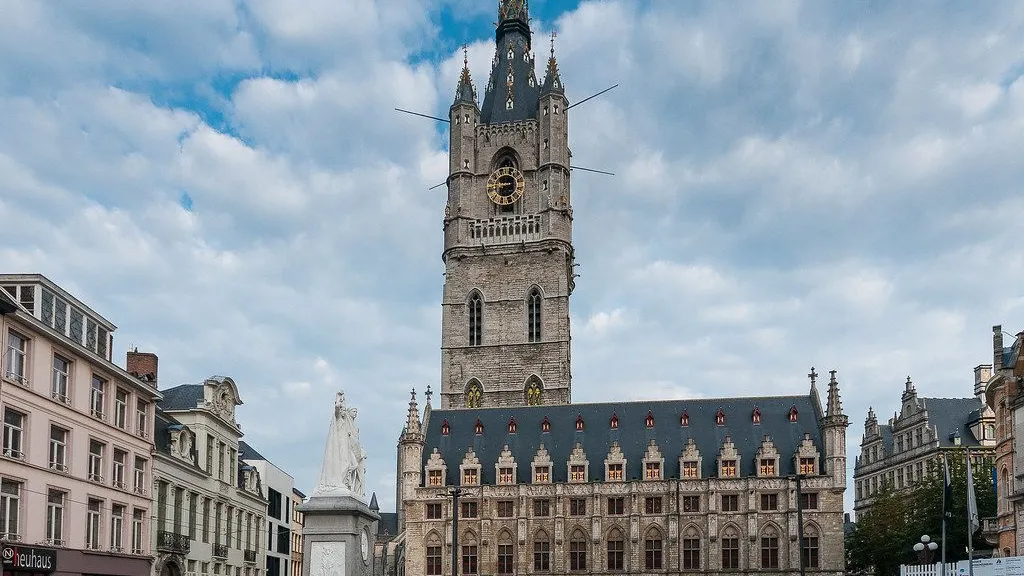
Photo by Fred Romero from Paris, France on Wikimedia Commons

This is the walk almost every visitor to Ghent takes first, and it holds up. It runs a short loop from Sint-Baafsplein, where the cathedral and the belfry stand side by side, west through the old trading streets to the Leie.

The idea underneath is simple: Ghent grew rich on wool cloth and on grain, and the buildings you pass are what that money bought. The town hall wears a late Gothic face on Hoogpoort and a Renaissance one on Botermarkt. Werregarenstraat is the alley the city gives to graffiti writers, and Sint-Niklaaskerk was paid for by the grain staple.

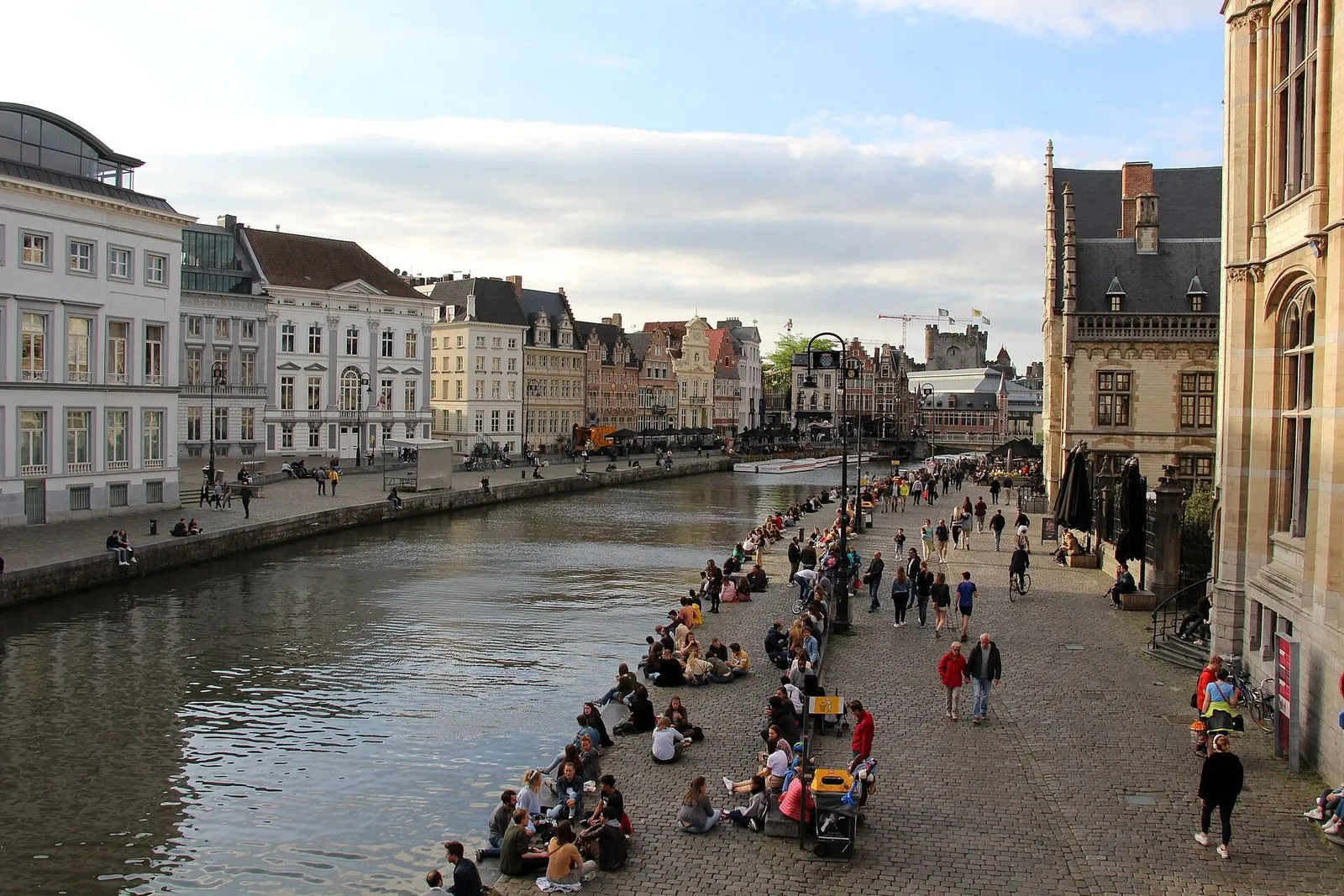
The last third is the payoff. From Sint-Michielsbrug the three towers line up in a single row, and the walk ends on Graslei and Korenlei, where guild houses face each other across the water.

Flat ground, about a kilometre, an hour at an unhurried pace.

Hear it on the street

Get the turn-by-turn audio guide in the app. The narration plays itself as you reach each stop, hands-free and offline.

Stop by stop

The route

Interactive map of the route. The full stop list below works without it.

Sint-BaafskathedraalMust see

Photo by Jonatan Moerman on Unsplash

Sint-Baafskathedraal

0:00

Van Eyck's altarpiece in its own chapel, visitor centre included.

You're standing on Sint-Baafsplein with two of Ghent's three towers overhead: the cathedral behind you and the belfry a few steps off. Different kinds of power raised them, and this walk is really about the money that paid for both.

Inside, in the Sacraments chapel, hangs the painting that made the city's name. Hubert van Eyck began it, Jan finished it, and it went up here on 6 May 1432 in the chapel of Joos Vijd and Elisabeth Borluut, the two leading citizens who commissioned it. The quatrain on the frame names them, and which brother painted what is still argued over. There are twenty panels. The lower register, with the Adoration of the Mystic Lamb at its centre, is in front of you, and restoration uncovered the original Lamb's face with its huge frontal eyes. Seven panels from the upper register are being treated across town at the Museum of Fine Arts, and high-resolution photographs hang in their place. The visitor centre has augmented-reality glasses that put the whole altarpiece back together.

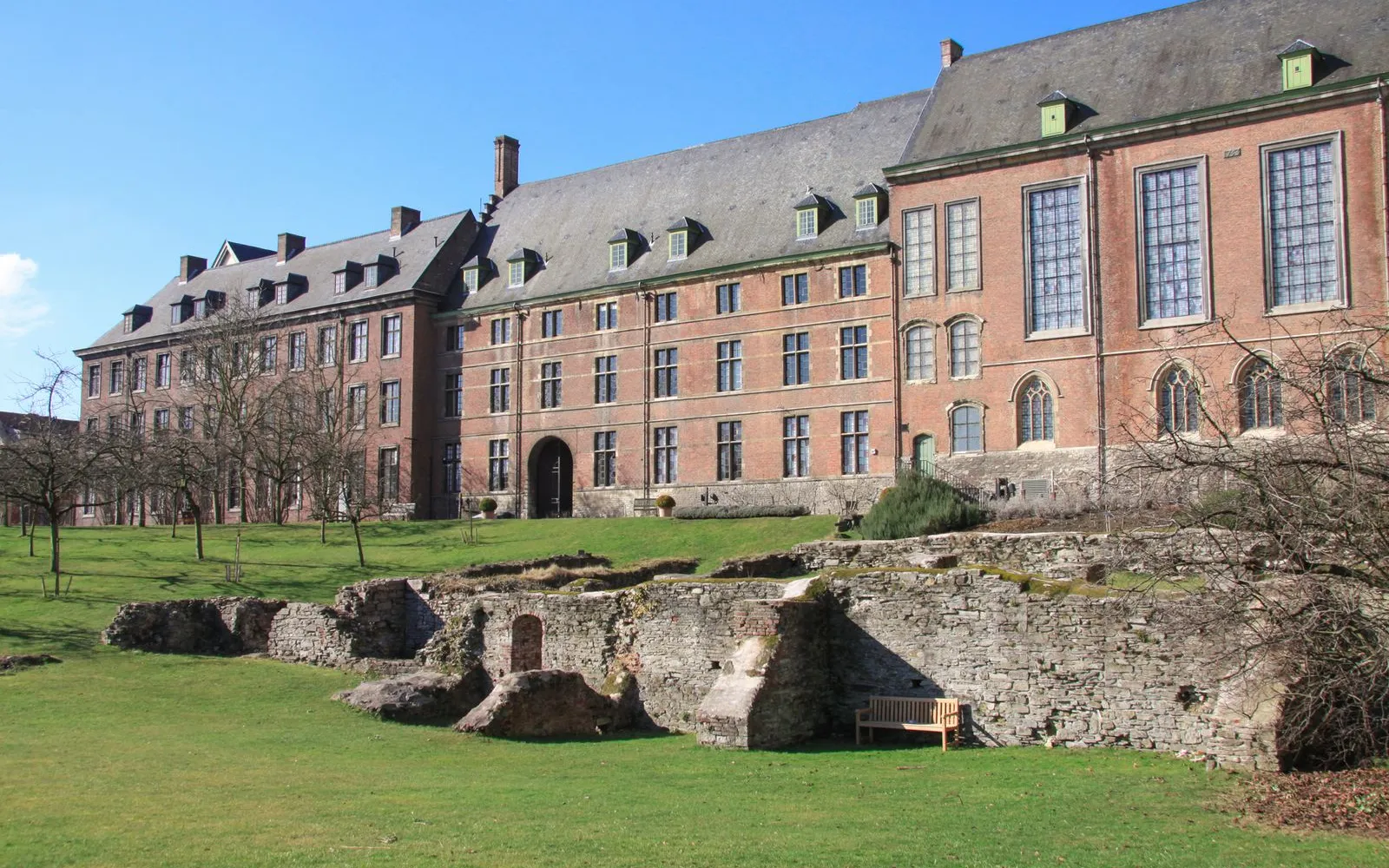
Before it was a cathedral, this was Sint-Janskerk, the parish church of Ghent's first harbour.
≈3 min walk to the next stop
Belfort and LakenhalleMust see

Photo by bvi4092 on Openverse

Belfort and Lakenhalle

0:00

A civic tower under a gilded dragon, with the cloth hall against it.

Look up. The belfry is 95 metres of it, with the cloth hall leaning against its east side. The city began the tower around 1313, the year of its first building accounts. Four of the six planned levels were up by 1323, then the money thinned out. The spire you see is from 1911 to 1913, the work of Valentin Vaerwyck.

Find the gilded copper dragon on top: 3.55 metres long, 455 kilograms. Legend says Ghent's men took it off Bruges cathedral after their victory in 1382 and carried it home as war booty. The account books say the city ordered it in 1377. It sat above the room where the charters and the city's privileges were kept, and the story was better than the paperwork.

The cloth hall is where wool cloth, Ghent's other fortune, was inspected, valued and sold. Work began in 1425 and stopped in 1445 with seven of the eleven bays done. The rest came in 1903. The little door facing the Botermarkt shows a daughter nursing her starving father in prison, and the city kept its own jail in the crypt until 1902.

≈2 min walk to the next stop
StadhuisMust see

Photo by Pymouss on Wikimedia Commons

Stadhuis

0:00

Late Gothic on Hoogpoort, Renaissance on Botermarkt, one building.

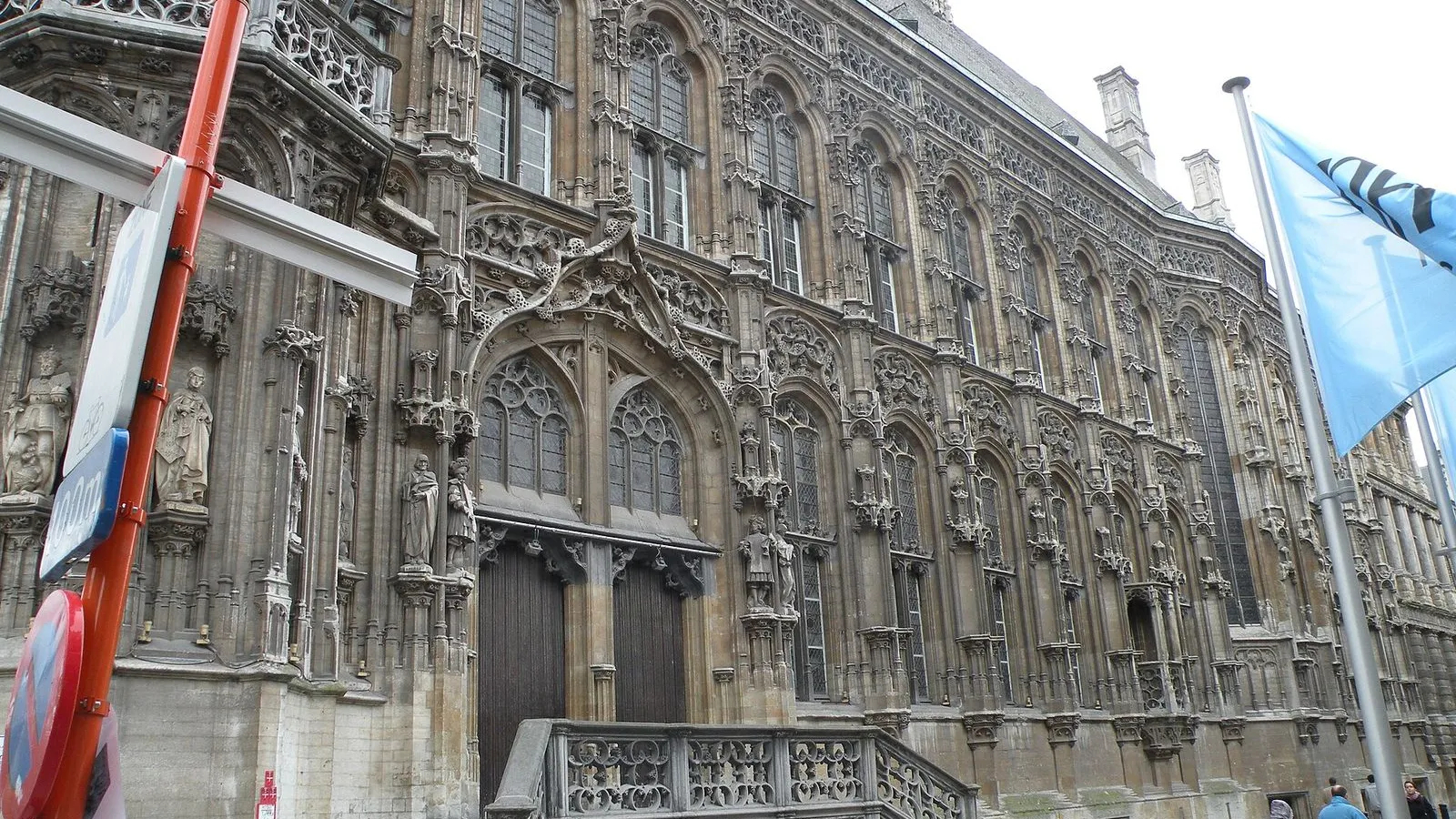
Ghent's town hall shows you two faces, and both are worth the walk around the block. The Hoogpoort side is the Schepenhuis van de Keure, the aldermen's house, built between 1519 and 1539 by Rombout the second Keldermans and Dominicus de Waghemaekere in flamboyant late Gothic. The niches along the front hold the counts of Flanders, and nineteen of those statues date from the late 19th and early 20th century. The oldest above-ground part of the whole complex is from 1482, and a cellar on the corner may be older than 1100.

Walk round to the Botermarkt and the style flips. The Schepenhuis van Gedele went up between 1595 and 1618 in Renaissance dress, with Tuscan, Ionic and Corinthian columns stacked in the Italian manner.

Inside survives the Pacificatiezaal, the hall named for the Pacification of Ghent of 1576. And the wool trade that paid for much of this had its own address: the old cloth hall stood opposite, on the Hoogpoort, until the city built a new one against the belfry in 1425.

≈2 min walk to the next stop
Free preview ends here · stops 4 to 7 continue in the app

Werregarenstraat

A narrow alley where the city lets the paint do the talking.

in app

Sint-Niklaaskerk

Grain money built this church; its tower once held the city watch.

in app

Sint-Michielsbrug

The one spot where all three towers line up in a row.

in app

Graslei en Korenlei

Guild houses facing each other across Ghent's medieval grain harbour.

in app
Good to know

Before you go

Do I need tickets for the cathedral and the belfry?

The Ghent Altarpiece visitor centre is ticketed: €16 for the one-hour augmented-reality visit, €8 for children under 12, and the last slot for that hour-long visit is at 16:00. The Belfort climb takes a ticket as well, sold online, and the route ends at its belvedere.

SourceSint-Baafs Kathedraal Gent: ticketsVisit Gent: Belfort
Where do the three towers line up together?

Sint-Michielsbrug is the spot: the cathedral, the belfry and Sint-Niklaaskerk stand in one row from there. The walk reaches the bridge near its end, before the Graslei quays.

When is the best time to walk this route?

In the morning, when the cathedral doors open at 8:30 and the altarpiece's first slot runs at 10:00. Sunday shifts things: the cathedral opens at 10:00 and the Lam Gods visitor centre only from 13:00.

SourceSint-Baafs Kathedraal Gent: openingsuren

Provenance · last verified September 27, 2026

Built from the Wayside route itself: the stops, their order, and the walk between them.

Photo by Fred Romero from Paris, France on Wikimedia Commons · CC BY 2.0

Photo by Jonatan Moerman on Unsplash

Photo by bvi4092 on Openverse · CC BY 2.0

Photo by Pymouss on Wikimedia Commons · CC BY-SA 3.0

Photo by Wernervc on Wikimedia Commons · CC BY-SA 3.0

Photo by Michielverbeek on Wikimedia Commons · CC BY-SA 4.0

Coming soon

Wayside isn't in the app stores yet, but it's in the works. Check back soon.