Las Vegas · Self-guided audio walk

Glitter Gulch: The Downtown Walk

Fremont Street from the railroad to the Mob, in eight stops.

  • 8Stops
  • 1.6 kmDistance
  • 30+ minTime

Before the Strip there was a railroad stop, a land auction, and a dusty street called Fremont. This walk traces downtown Las Vegas from its 1905 founding to the neon-soaked Glitter Gulch era and the mobsters who ran it. You start at the Plaza, where the first train pulled in, and follow Fremont east past the oldest casino in Nevada, the waving cowboy, the LED canopy, Binion's poker room, the federal courthouse that grilled the mob, a row of rescued vintage neon, and the El Cortez, where Bugsy Siegel learned the casino business. The stories are denser here than anywhere else in the city.

Hear it on the street

Get the turn-by-turn audio guide in the app. The narration plays itself as you reach each stop, hands-free and offline.

Stop by stop

The route

Interactive map of the route. The full stop list below works without it.

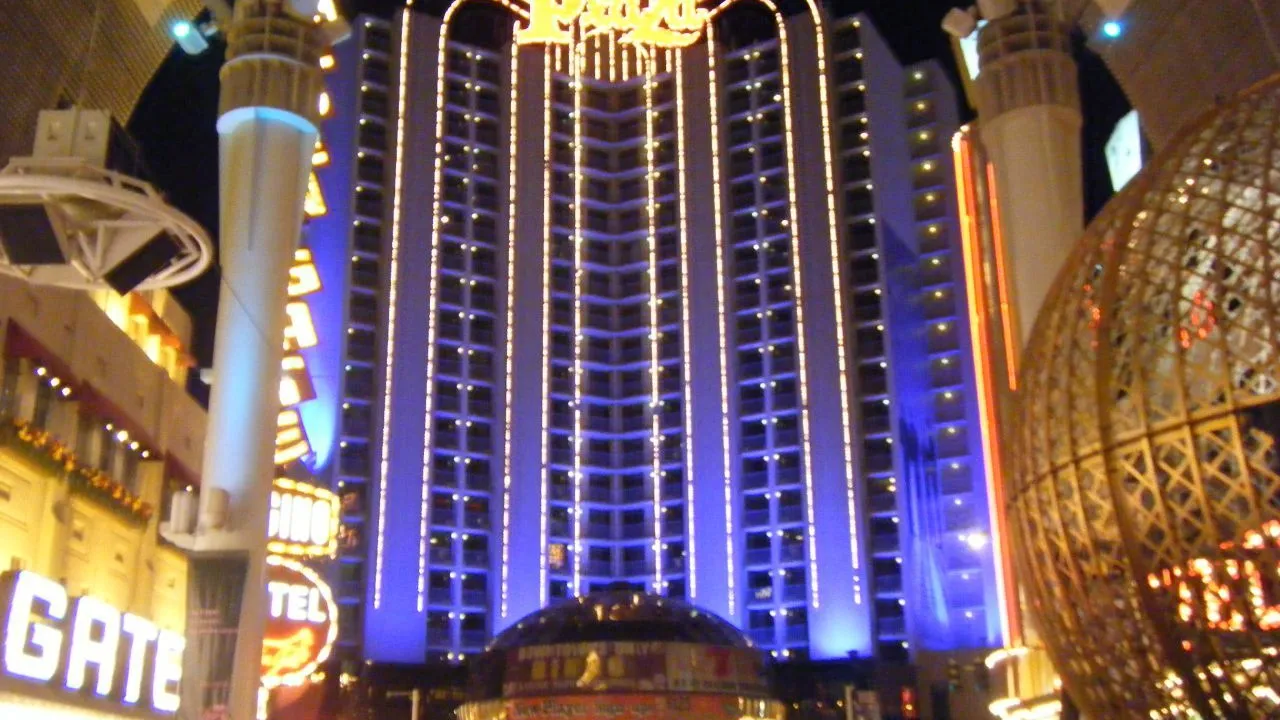
Plaza Hotel & CasinoMust see

Photo by joe pyrek on Wikimedia Commons

Plaza Hotel & Casino

0:00

The corner of Main and Fremont, where Las Vegas began as a railroad stop in 1905.

You are standing where Las Vegas was born. In 1905 the San Pedro, Los Angeles and Salt Lake Railroad held a land auction right here, selling off 40 blocks of a new townsite carved from the desert. The train depot sat exactly where the Plaza tower rises now. Fremont Street was the first paved road in the city, the first to get a traffic light, and the first to glow with neon when the Overland Hotel hung a sign in 1928.

Before the Strip existed, before the mob arrived, before anyone called it Sin City, this intersection was the whole town. Look up Fremont Street. That canyon of neon signs and casino marquees you see running east is the Glitter Gulch. The walk starts here and ends at the El Cortez, about a mile that way.

When you are ready, head east along Fremont. Stay on the south sidewalk. The Golden Gate is the low brick building just ahead on your right.
≈2 min walk to the next stop
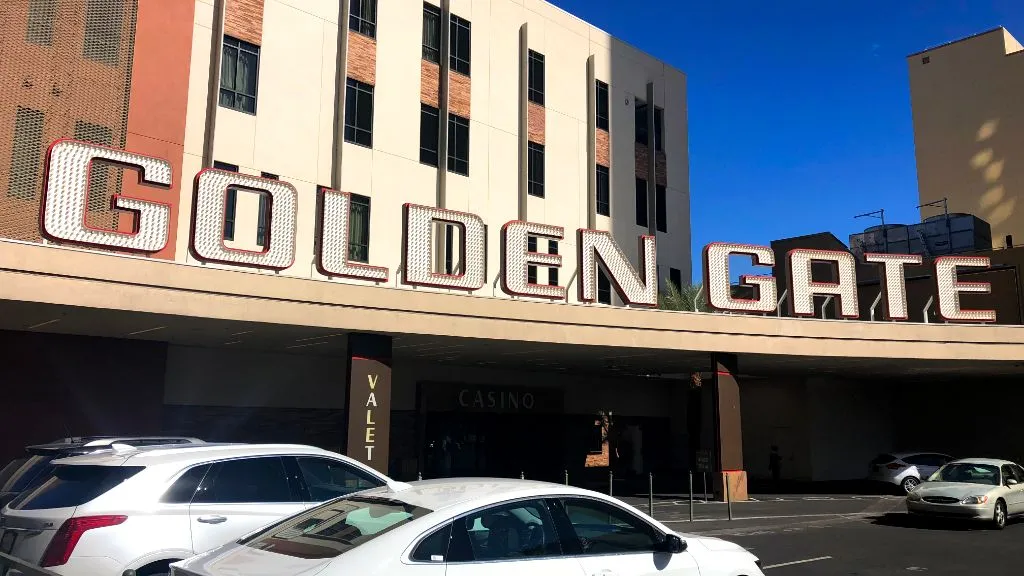
Golden Gate Hotel & CasinoMust see

Photo by Raul Jusinto on Wikimedia Commons

Golden Gate Hotel & Casino

0:00

Nevada's oldest operating casino, open since 1906 and still dealing cards.

This low brick building is the oldest casino in Nevada. It opened in 1906 as the Hotel Nevada, a rooming house for railroad men and prospectors. The first telephone in Las Vegas was installed here in 1907. When gambling was outlawed statewide in 1909, the Hotel Nevada kept dealing cards behind closed doors.

Prohibition only doubled the business. Step inside for a moment and look at the floor. The original water fountain, one of the oldest artifacts on Fremont Street, is set into the wall near the arches. In a city that rarely saves its own history, that chipped marble basin matters.

The place got its current name in 1955 when investors from San Francisco, looking across the Golden Gate toward Nevada, bought in and expanded. When you come back out, look up across the street. The waving cowboy is our next stop.

≈3 min walk to the next stop
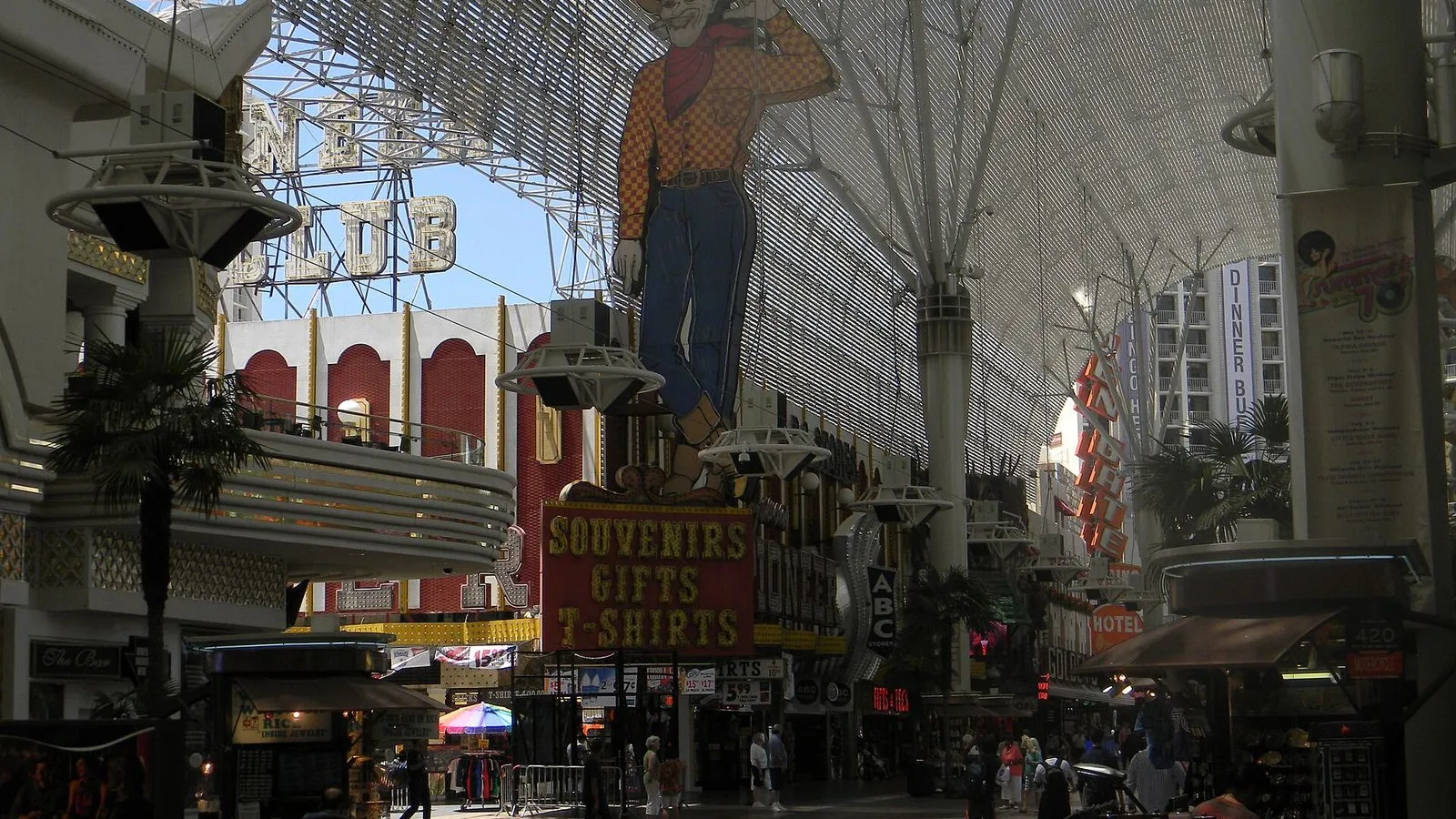
Vegas VicMust see

Photo by Laslovarga on Wikimedia Commons

Vegas Vic

0:00

The 40-foot neon cowboy who has greeted Fremont Street since 1951.

Vegas Vic has been waving from this spot since April 1951. He is 40 feet tall, weighs more than four tons, and his arm alone holds a thousand pounds of steel driven by a three-horsepower motor. YESCO, the sign company that defined the Las Vegas skyline, built him in Salt Lake City for twenty-five thousand dollars. For decades his arm moved and a loudspeaker boomed 'Howdy Podner' every fifteen minutes.

The voice belonged to Maxwell Kelch, the Chamber of Commerce president who first dreamed up the Vegas Vic character in 1945 as a marketing mascot. Look at his hat. When the Fremont Street Experience canopy went up in 1994, workers had to slice several inches off the brim so he would fit underneath. The Pioneer Club casino that commissioned him closed in 1995, but Vic stayed.

The building is a souvenir shop now. The cowboy outlasted the gambling hall.

≈1 min walk to the next stop
Free preview ends here · stops 4 to 8 continue in the app

Fremont Street Experience

The Viva Vision LED canopy, four blocks of light, and the atomic-age stories buried under the neon.

in app

Binion's Gambling Hall

Benny Binion's casino, where the World Series of Poker dealt its first hand.

in app

Mob Museum

The 1933 federal courthouse where the Kefauver hearings exposed organized crime to the nation.

in app

Fremont East Entertainment District

A time capsule of old Las Vegas, lined with rescued neon signs from casinos that no longer exist.

in app

El Cortez

The oldest continuously operating hotel-casino in Las Vegas, and the school where Bugsy Siegel learned the trade.

in app
Good to know

Before you go

How is Fremont Street different from the Strip?

Fremont Street is the older, denser, and more historically layered version of Las Vegas. The Strip is spectacle built for cars and postcards. Downtown is where Las Vegas began as a railroad stop in 1905, grew into a neon-lit gambling corridor in the 1940s and 50s, and now mixes vintage casinos with a four-block LED canopy, live music stages, and a zip line. The stories here are older. The drinks are cheaper. The walk is shorter and every building has a past.

Do I need to book Mob Museum tickets in advance?

General admission to the Mob Museum is $37.95 and can be purchased on the day, but online reservations are strongly encouraged, especially on weekends. Arriving before 11:00 a.m. or after 5:00 p.m. saves $7 on admission for non-Nevada residents. The museum is open daily from 9:00 a.m. to 9:00 p.m.

SourceThe Mob Museum: Admission
Is Fremont Street safe?

The Fremont Street Experience under the canopy is busy, well-lit, and patrolled through the late evening. The blocks east of the El Cortez grow quieter after dark, but the walk itself stays on main thoroughfares. Standard city awareness applies: keep valuables close in crowds, and do not wander down dark empty side streets alone at night.

Provenance · last verified August 9, 2026

Built from the Wayside route itself: the stops, their order, and the walk between them.

Photo by Jordi Vich Navarro on Unsplash

Photo by joe pyrek on Wikimedia Commons · CC BY-SA 2.0

Photo by Raul Jusinto on Wikimedia Commons · CC BY-SA 2.0

Photo by Laslovarga on Wikimedia Commons · CC BY-SA 3.0

Photo by Ron Mader on Wikimedia Commons · CC BY-SA 2.0

Photo by Lyle Hastie on Unsplash

Coming soon

Wayside isn't in the app stores yet, but it's in the works. Check back soon.